- Same-day reply, and a same-day home visit on request
- 500+ designs in our catalogues to choose from at home, or stitch your own fabric
- Every window measured on site, at three points, because floors and ceilings are rarely level
- Your own fabric stitched too, checked for width, shrinkage and pattern repeat before cutting
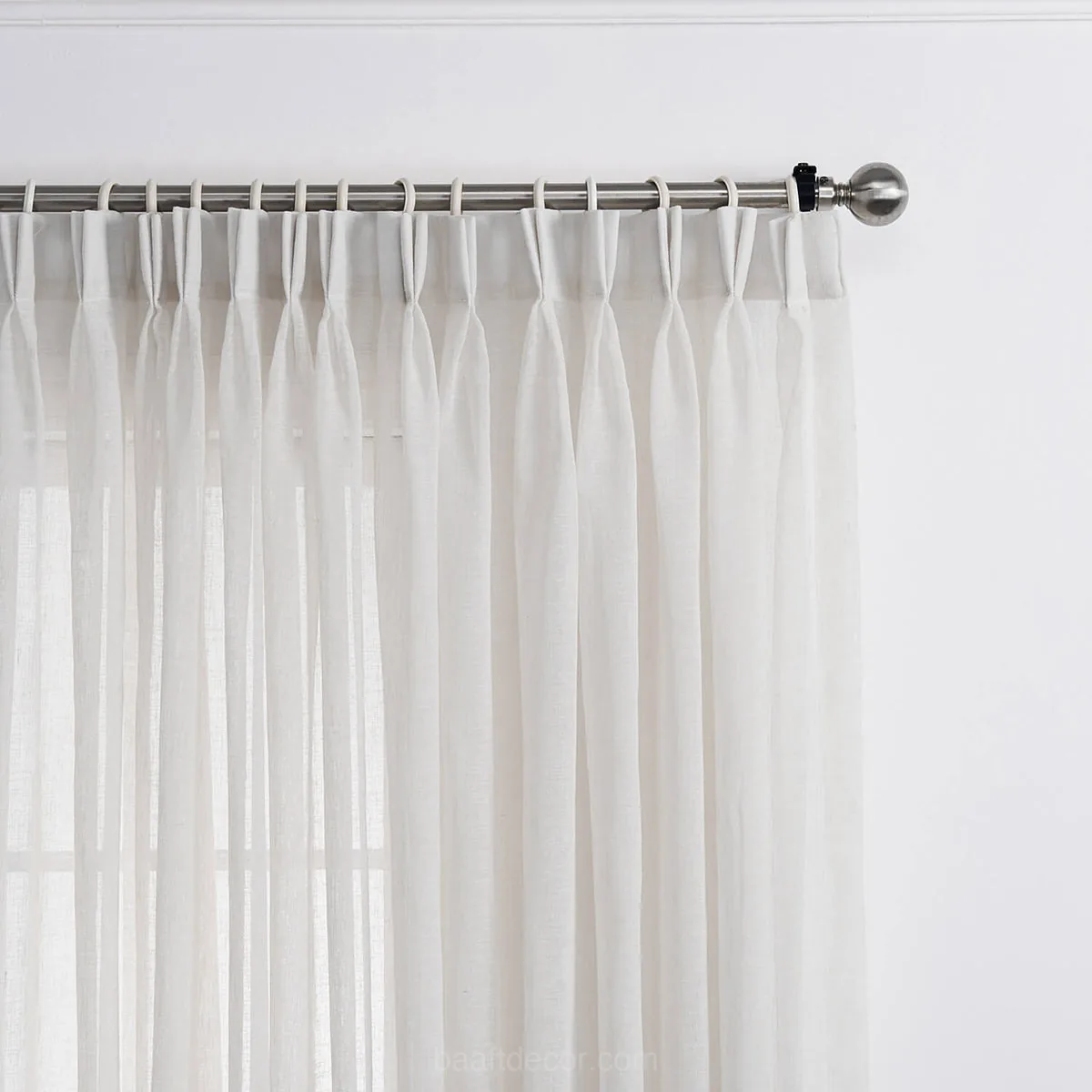
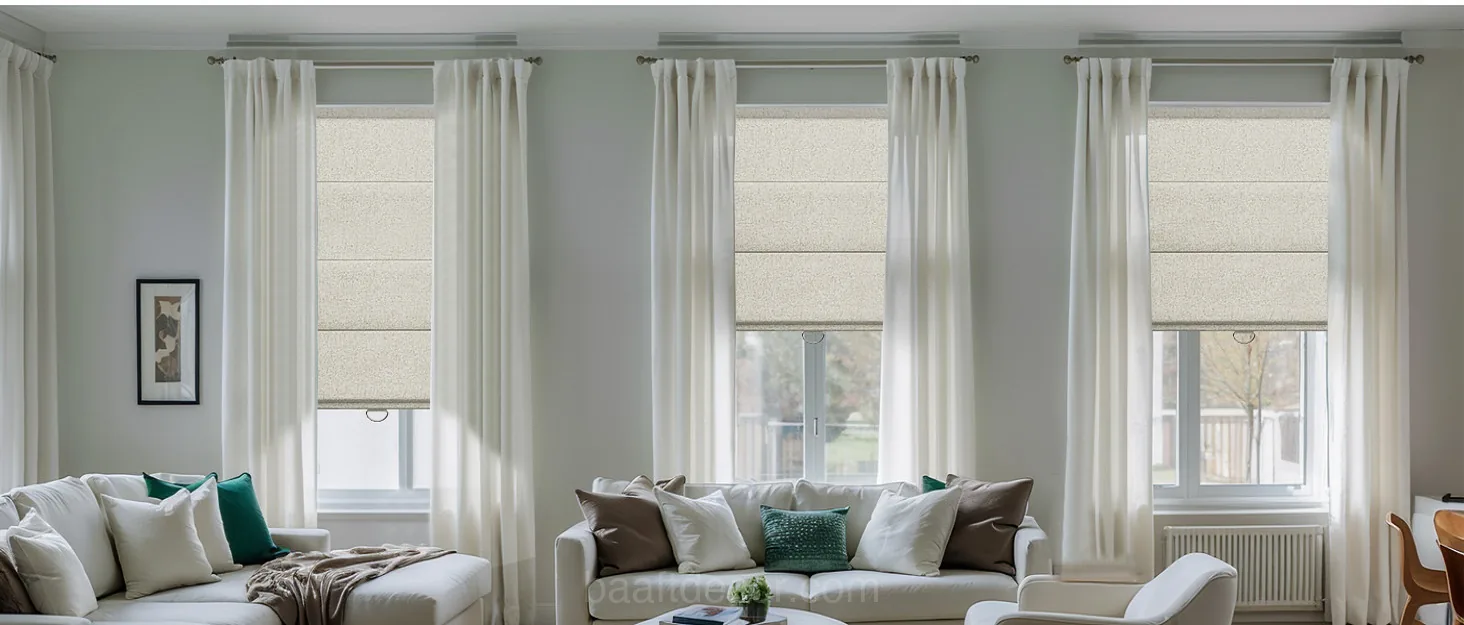
- Eyelet, pinch pleat, pencil pleat and ripple fold headings, matched to your rod or track
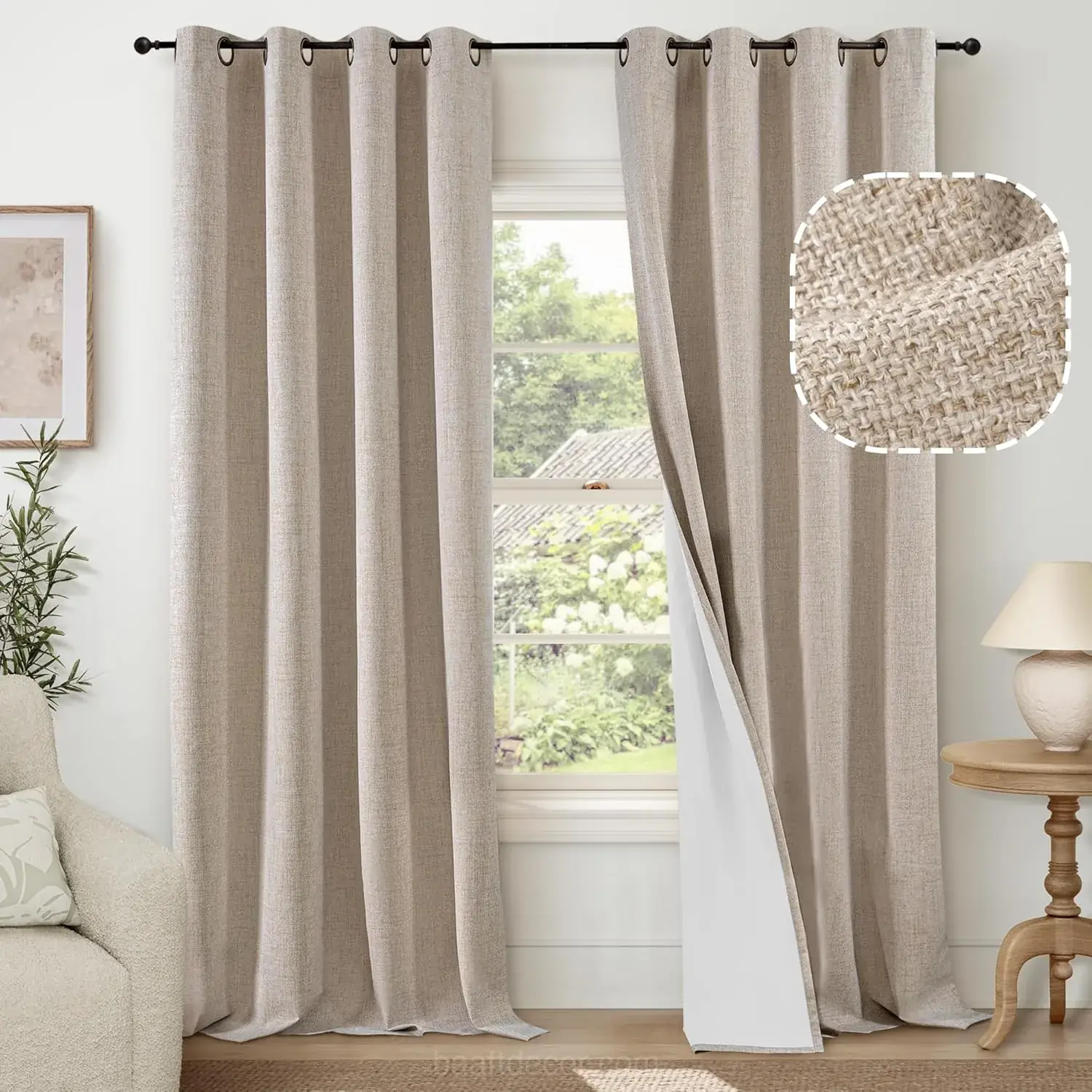
- Sewn-in or detachable lining, including blackout and thermal
- Corner weights and deep double hems so panels hang straight in AC drafts and balcony wind
Most curtains that look cheap aren’t cheap fabric; they’re badly stitched. Shallow hems, the wrong fullness, a heading that doesn’t suit the rod, a length cut to the wrong mark. Curtain stitching is the core of our work on made-to-measure curtains in Hyderabad, and this page explains how we do it. For fabrics, hardware and costs in one place, see our complete curtains buying guide.
What our curtain stitching covers
Most people who call us want the whole job done: we bring fabric samples, measure, stitch and fit. That’s what we do most, and it’s the easiest way to get curtains that hang right, because one team owns every measurement.
We also take smaller jobs, and say so plainly:
- Your fabric, our stitching. Fabric from a wholesale shop, an online order, or a length you’ve had at home for years. We check it before cutting.
- Stitching for existing hardware. If your rods or tracks are already up and you’re happy with them, we stitch to suit them.
- Matching an existing set. A new curtain for a room where the others are staying, matched for heading and length.
If you’re bringing your own fabric, check three things before you buy: the width (most furnishing fabric is about 54 inches, wide-width sheers much more), the pattern repeat, and the care label. Cotton and linen can shrink in the first wash, so we either allow for it or tell you to dry clean.
Want this measured for your windows? We visit with samples, free across Hyderabad. WhatsApp +91 98499 17494.
Which curtain heading should you choose?
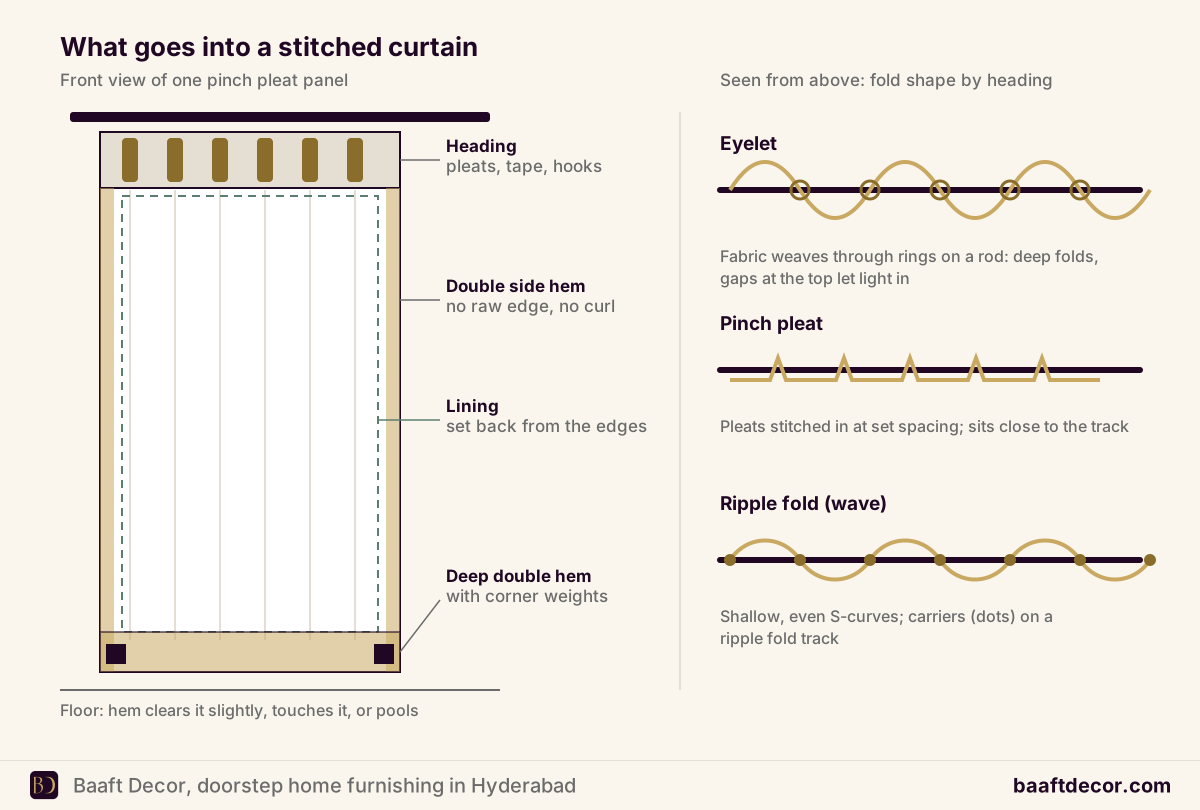
The heading is the top of the curtain, where it meets the rod or track. It decides how the folds look, how much fabric you need and how much light leaks at the top.
| Heading | Hardware | Typical fullness | Look | Light at the top | Suits |
|---|---|---|---|---|---|
| Eyelet | Rod, through metal rings punched into the fabric | Around 1.5 to 2 times | Clean, deep folds | Some, between the rings | Living rooms, kids’ rooms, everyday use |
| Pinch pleat (double or triple) | Track or rod with rings and hooks | Around 2 to 2.5 times | Tailored, formal | Little | Bedrooms, living rooms, lined curtains |
| Pencil pleat | Track or rod with hooks, gathered by tape | Around 2 to 2.5 times | Soft, gathered | Little | Bedrooms, older homes, budget-friendly lining |
| Ripple fold (wave) | Ripple fold track with fixed carrier spacing | Set by the carrier spacing | Even S-shaped folds | Very little | Modern flats, floor-to-ceiling glass, motorised tracks |
Our guide to types of curtains has photos of each heading. One honest note on eyelets: they’re the easiest to live with, but on a west-facing bedroom they leak light and heat at the top. For those rooms we suggest pinch pleat or ripple fold on a ceiling track.
Lining, fullness, hems and weights
These are the details that separate tailored curtains from ready-made ones.
Lining
A lining sits behind the face fabric. In Hyderabad, where afternoon sun hits west windows hard from March to June, it does real work: it shields the face fabric from sun, gives the curtain body, and stops a light fabric looking patchy against the glass. The US Department of Energy’s Building America guidance on window attachments notes that reducing UV exposure slows the fading of fabrics and furnishings. We stitch plain cotton or polyester linings, blackout linings and thermal linings, either sewn in or detachable. Our curtain lining guide compares them.
Fullness
Fullness is how much fabric goes into the curtain compared with the width of the track. Too little and the curtain looks flat and stretched when closed; too much and it bunches when open. Our guide on how much fabric you need for curtains works through the maths for different headings.
Hems
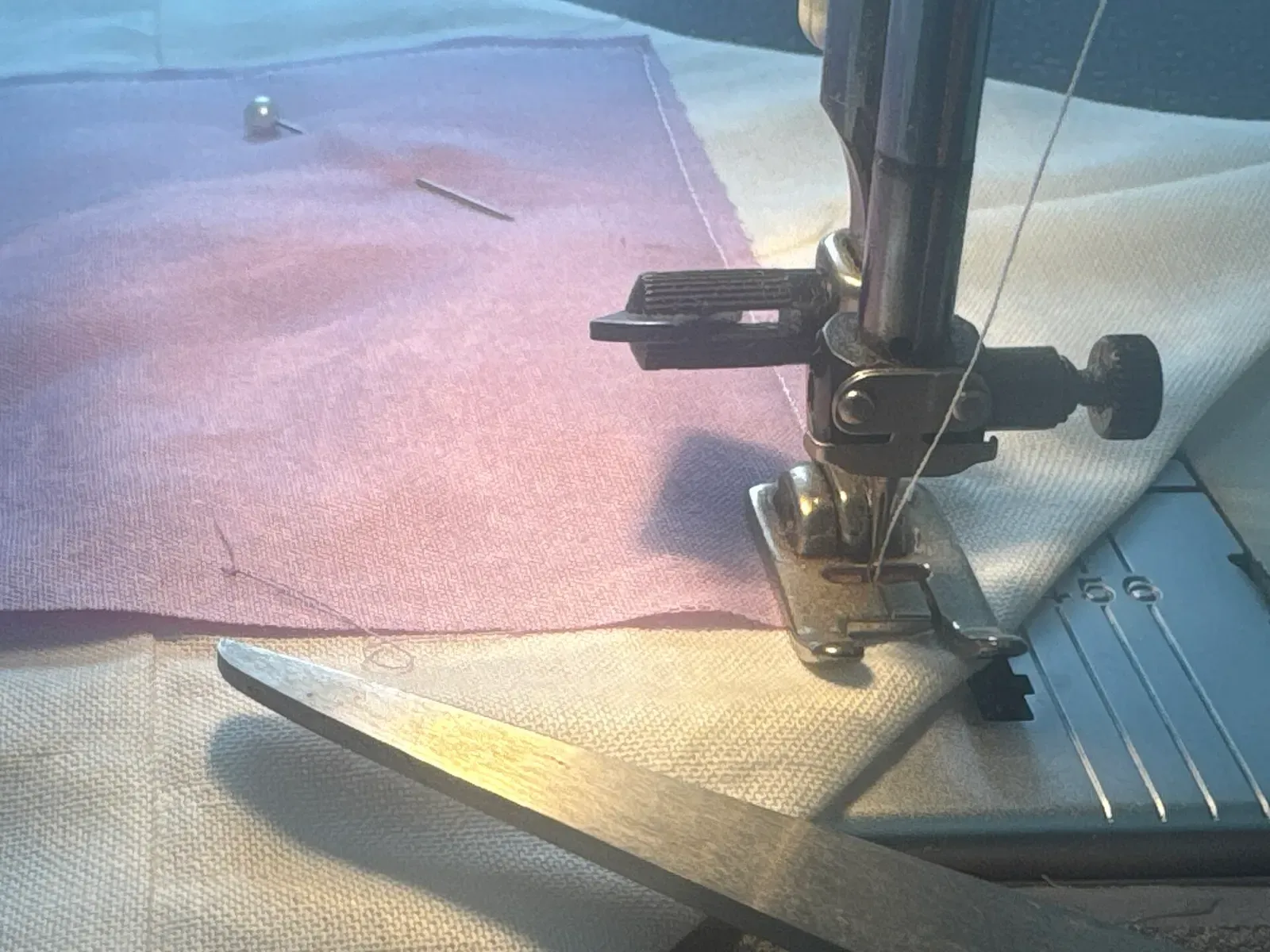
Side hems are double-turned so no raw edge shows and the edge doesn’t curl. The bottom hem is deep and double-turned too, which gives the curtain weight at the bottom and leaves room to let it down later if needed.
Weights
We add weights at the bottom corners, and weight tape along the hem on sheers. In high-rise flats with balcony doors, and in rooms where the AC blows straight at the window, unweighted curtains swing and twist. Weights keep them hanging straight.
How we measure for curtain stitching
We don’t take one width and one height. For each window we measure:
- Width of the rod or track, plus overlap at the centre and returns to the wall at the ends
- Drop from the top of the rod or track to the floor, at the left, centre and right, because floors in new flats are often a few millimetres out and older homes more
- Clearances for AC units, switches, wardrobe doors and window handles
- Finish point, which you choose: just clearing the floor (easiest to clean in dusty Hyderabad homes), touching it, or pooling
If the rods or tracks aren’t up yet, we plan the hardware first, since the curtain length depends on exactly where it will hang.
Hanging and dressing the curtains
When the curtains come back, we hang them, check every hem against the floor and adjust where needed. Then we dress them: set the pleats or folds by hand and tie them loosely for a day or two so the fabric learns its shape. If the rods or tracks need fitting or replacing, our curtain installation service is done on the same visit.
How long does curtain stitching take?
Measuring takes under an hour for most homes. Stitching and fitting take usually 2 days, and at most a week for big orders, lined ripple fold panels or fabric we have to order in.
What decides the cost of curtain stitching?
- Number of windows, their width and drop
- Heading style (ripple fold and pinch pleat take more labour than eyelet)
- Fullness, which sets the fabric quantity
- Lining type, and sewn-in or detachable
- Fabric, if you’re using ours
- Pattern matching across joined widths
- Hardware, if new rods or tracks are needed
You get a fixed, itemised quote after the free home visit.
Curtain stitching across Hyderabad
We measure and fit across the city, including Gachibowli, Kondapur and Kukatpally.
WhatsApp +91 98499 17494 with a photo of your windows and, if you have it, your fabric, or book a free home visit and we’ll measure every window and bring samples to compare.
How it works
- Free home visit with samples We bring fabric and lining samples, look at your windows in daylight and check the existing rod or track. If you've bought fabric already, keep it ready so we can check it.
- Measure and plan the heading We measure width, drop and clearances at three points per window, then agree the heading style, fullness, lining and where the curtain should finish: just above the floor, touching it or pooling.
- Fabric check and quote For your fabric we check the width, the pattern repeat and whether you have enough metres. You get an itemised quote that lists the fabric quantity for each window.
- Cutting and stitching Widths are joined with matched patterns, side hems are double-turned, lining is attached, the heading is set and the bottom hem is weighted. This usually takes 2 days, and at most a week for larger jobs.
- Hanging and dressing We hang the curtains, check that every hem sits level, and set the folds so they fall evenly. If a panel needs adjusting, we do it there or take it back.
Frequently asked questions
Can you stitch curtains from fabric I bought myself?
Yes, Baaft Decor stitches curtains from fabric customers buy elsewhere, including fabric from wholesale shops, online orders and lengths you already have at home. We check it on the home visit before cutting: its width, whether it is likely to shrink, the pattern repeat, and whether there are enough metres for the fullness you want. If it falls short we tell you before any cutting, so you can buy more from the same lot. Full projects with our own fabric are still what we do most.
How much fabric do I need for curtain stitching?
The fabric you need for curtains depends on the track width, the heading's fullness and the drop. For pinch pleat and pencil pleat headings we usually plan about two to two and a half times the track width, and a little less for eyelets. Each panel's length is the drop plus allowances for the heading and a deep bottom hem. Patterned fabric needs extra to match the repeat across joined widths. We calculate the exact metres per window after measuring, so you don't buy too much or too little.
Which curtain heading is best: eyelet, pinch pleat or ripple fold?
The best curtain heading depends on your hardware and the look you want. Eyelet headings slide on a rod, look clean and are easy to open, but let some light through at the top. Pinch pleat headings sit on a track or rod with rings, look tailored and hold even folds. Ripple fold, also called wave, needs a special track with fixed carrier spacing and gives soft, uniform S-shaped folds. For bedrooms that need darkness, pinch pleat or ripple fold on a ceiling track works better than eyelets.
Should my curtains be lined?
Lining is worth it for most Hyderabad windows that get direct sun. A lining protects the face fabric from fading, makes the curtain hang with more body, stops the fabric looking patchy against the light and adds some heat resistance. Blackout lining also darkens bedrooms. Sheers and some light cottons look better unlined. Lining can be sewn in, which drapes best, or detachable on the same hooks, which lets you wash the lining and face fabric separately.
How long does curtain stitching take?
Curtain stitching and fitting usually take 2 days from the measuring visit, and at most a week for larger jobs. The home visit and measuring take under an hour for most homes. What decides where you fall in that range is the amount of work: the number of windows, ripple fold headings, lots of lined panels or fabric we have to order in. Once the curtains are ready we come back to hang and dress them, fitting new tracks or rods on the same visit if needed.
Why do some stitched curtains hang unevenly?
Stitched curtains hang unevenly for three usual reasons. First, the floor or ceiling isn't level, so a curtain cut to one measurement ends up touching the floor at one end and floating at the other; we measure at three points to avoid this. Second, the fabric wasn't relaxed or pre-shrunk and moved after the first wash. Third, hems were too shallow or unweighted, so the panel twists in a draught. Deep double hems and corner weights fix most of this.
Do you only stitch, or also install the curtains?
We do both. Most of our curtain work is a full project: we measure, supply the fabric, stitch, and fit the rods or tracks and hang the curtains. We also take stitching-only work with your fabric and install-only jobs where you already have curtains or hardware. If your windows don't have rods or tracks yet, we plan the hardware on the same visit so the curtain length and heading match what will be fitted.