Every guide in this series
 Blackout vs Sheer vs Dim-Out Curtains: Which Do You Need?Blackout curtains block almost all light and suit bedrooms and media rooms.
 Curtain Cost in Hyderabad: What Really Drives the PriceCurtain cost in Hyderabad depends mainly on how much fabric your windows need (width × fullness × drop), the fabric grade, whether you add blackout or thermal lining, the stitching style, and the rod or track you choose.
 Types of Curtains: Headings, Fabrics and Which One Suits Each RoomCurtains are grouped in two ways: by how much light they block (sheer, dim-out, blackout) and by how the top is stitched (eyelet, pencil pleat, pinch pleat, ripple fold and others).
 Door Curtain Ideas: Main Doors, Balcony Doors, Kitchens and Wardrobe OpeningsThe right door curtain depends on the door.
Most curtain regrets in Hyderabad homes come from the same few decisions made in the wrong order. People pick a fabric from a catalogue first, then find the curtain is too short for the floor-to-ceiling glass, too thin for the west sun, or too heavy for the rod someone has already drilled into the beam. When we plan custom curtains in Hyderabad, we work through the choices in a fixed sequence, and that’s how this guide is organised.
Each chapter below gives you enough to make the decision yourself. Where a topic needs more room, it links to a dedicated guide.
How do you choose curtains for a Hyderabad home?
Choose curtains room by room, in this order:
- Light control. Sheer, dim-out or blackout, or a layered pair.
- Heading style. Eyelet, pleated or ripple fold, which also decides rod or track.
- Fabric and lining. Something that survives strong sun, dust and monsoon damp.
- Size. Measured from the hardware position, not the glass.
- Hardware and fixing. Strong enough for the weight, fixed into the right material.
Cost and care follow from those five. Get them right and a good curtain lasts many summers. Get the order wrong and you’ll be redoing something.
Chapter 1: How much light should each curtain block?
This is the first question for every room, and it has three answers.
| Type | What it does | Best rooms |
|---|---|---|
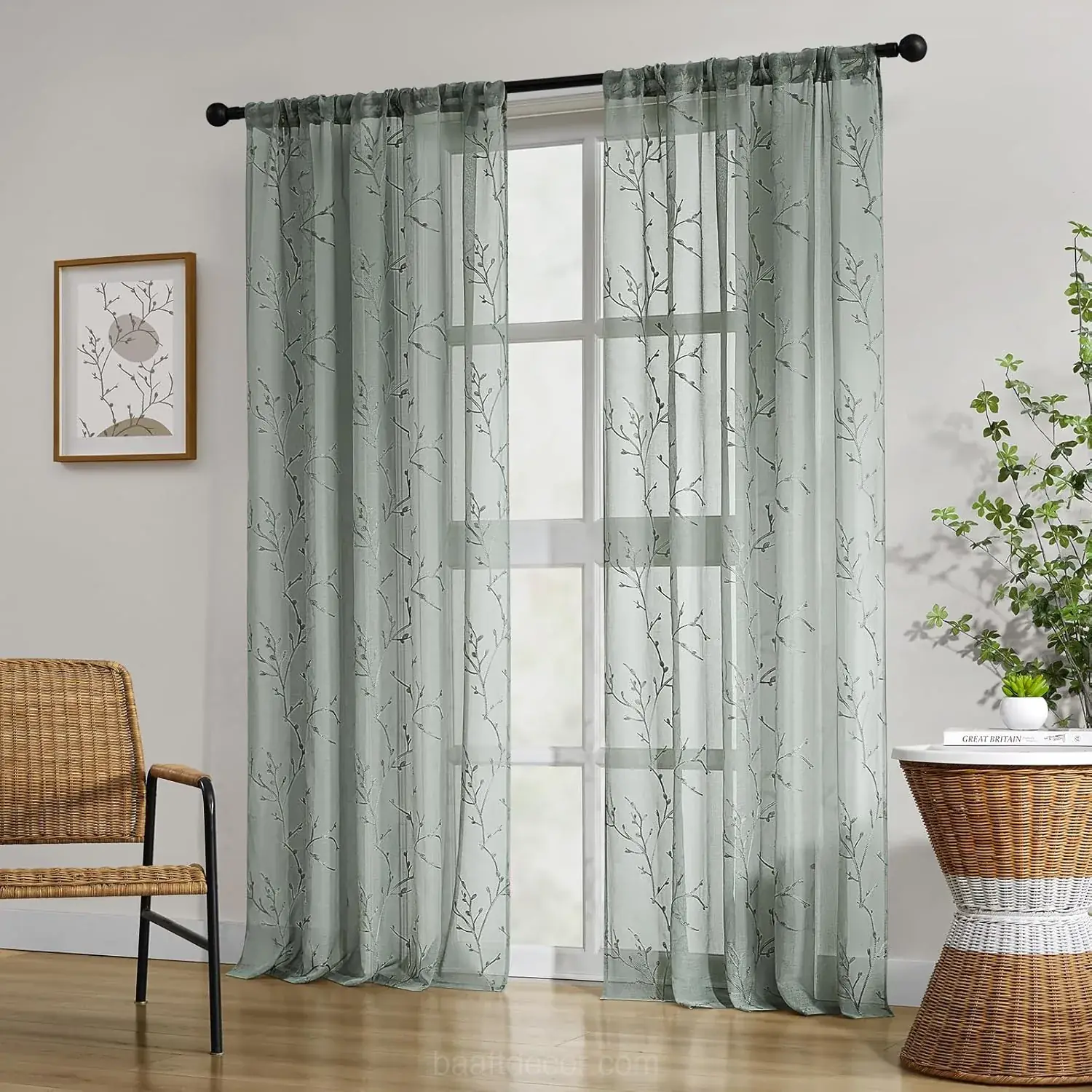
| Sheer | Filters daylight, cuts glare, daytime privacy only | Day layer everywhere |
| Dim-out (lined) | Blocks most light, a soft glow gets through | Living room, study, dining |
| Blackout | Blocks almost all light | Bedrooms, nursery, media room |
Sheers have a limit people forget: at night, with lights on inside, anyone in the facing tower can see silhouettes through them. So in most rooms the answer is a pair. A sheer hangs on the room side for daytime, and a dim-out or blackout curtain hangs behind it for evenings, heat and sleep. It’s what we fit most often.
Blackout is made three ways. A blackout lining, sewn in or detachable, behind your chosen fabric lets even a pale linen-look darken a bedroom. 3-pass coated fabric has three foam coats on its back and blocks close to all light by itself, with firmer folds and fewer colours. Triple-weave, with a dark yarn woven into the middle, is softer and usually machine washable, but pale shades let a faint glow through at midday, so it behaves more like heavy room-darkening. Light also leaks over the top, at the sides, through the centre and under the hem, so our blackout curtains service fits a ceiling track, side returns, centre overlap arms and floor-length panels.
Our full comparison of blackout, dim-out and sheer curtains covers how each fabric is built, why the lining facing the glass should be light, and when a blackout roller blind behind the curtain helps.
Chapter 2: Which curtain type and heading suits each room?
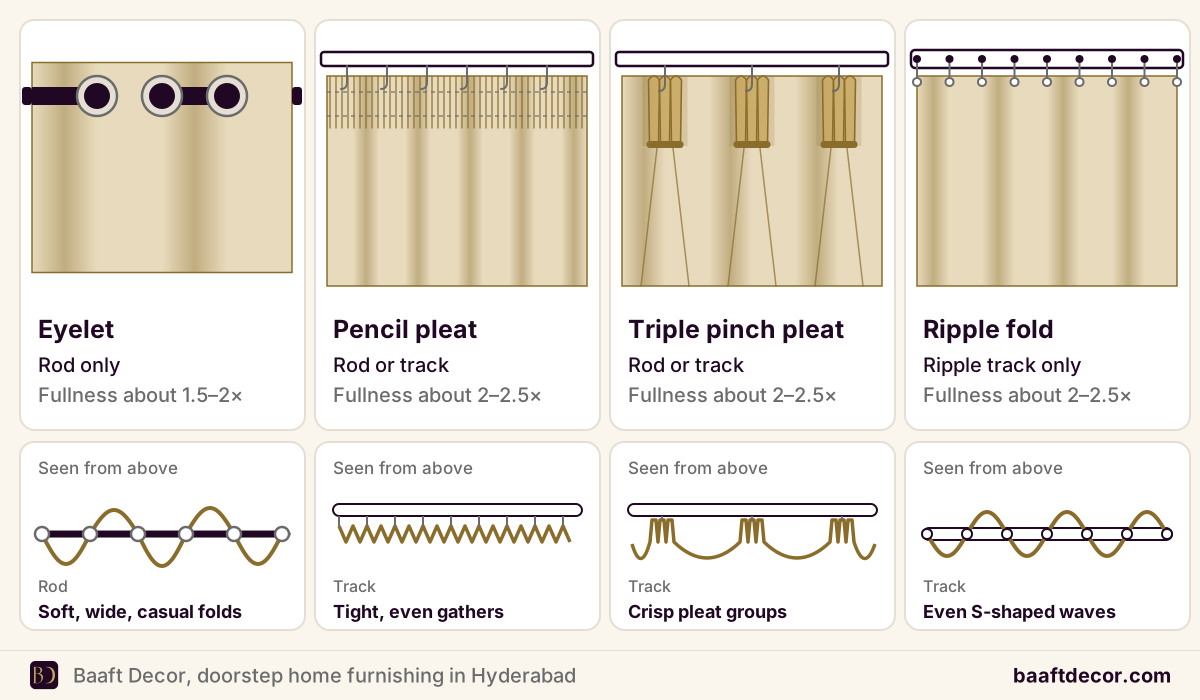
The heading is how the top of the curtain is stitched. It changes the look more than almost anything else, and it decides how much fabric you buy and what it hangs from.
| Heading | Look | Fullness | Hangs from |
|---|---|---|---|
| Eyelet | Soft, wide, casual folds | About 1.5 to 2x | Rod only |
| Pencil pleat | Tight gathers | About 2 to 2.5x | Rod or track |
| Pinch pleat | Crisp, tailored | About 2 to 2.5x | Rod or track |
| Ripple fold | Even S-shaped waves | About 2 to 2.5x | Ripple track only |
Pinch pleat is the one most Indian living rooms know, and it works on rods and tracks. Ripple fold stacks neatly when open, which helps on wide sliding doors where you want as much glass clear as possible, and it’s the usual pairing with motors. Eyelets use the least fabric and suit kids’ rooms and rentals, but they can’t run on a slim ceiling track, which rules them out in many flats with false ceilings.
Our types of curtains guide walks through every heading, length and fabric family with a room-by-room table. And if a catalogue or designer says “drapes”, our explainer on drapes vs curtains clears up what the word actually means: heavier, lined, floor-length and tailored. In India most people call both curtains, and that’s fine.
Chapter 3: Which curtain fabric survives Hyderabad’s sun, dust and monsoon?
Fabric decides how long the curtain lasts. Three local conditions do most of the damage.
Sun. West and south-west windows take hard afternoon sun from March to June. Cotton and linen fade unevenly on these windows, and real silk weakens. Polyester and poly-blends hold colour far better, which is why they’re our default on sunny sides. A lining sewn behind any fabric slows fading a great deal.
Dust. New gated communities stay dusty for months while the next towers go up. Smooth polyester and washable sheers shed it. Velvet and heavy textures hold it.
Monsoon damp. From June to September, lined curtains pressed against damp walls or condensation on the glass can get mildew spots. Leave a small gap from the glass and air the room on dry days.
| Fabric | Strengths | Watch out for |
|---|---|---|
| Polyester, poly-blends | Holds colour, washes easily, few creases | Can look flat in cheap grades |
| Cotton | Soft, breathable | Fades and can shrink; line it |
| Linen-look polyester | Textured look, low upkeep | Real linen creases and costs more |
| Velvet, jacquard | Rich, formal, some light blocking | Heavy, holds dust, needs strong hardware |
| Sheers (voile, linen sheer) | Light, washable, glare control | No night privacy on their own |
Heat is a separate question from light. A curtain sits inside the glass, so the sun’s heat has already come through the window before the fabric stops it, which is why the US Department of Energy’s Building America Solution Center finds outdoor shading more effective. Inside, a thermal or blackout lining with a white backing facing the glass reflects some heat back out. Our guide to keeping your home cool in Hyderabad summers ranks the options: outside shading first, then a sunscreen or blackout roller close to the glass, then a thermal-lined curtain, closed by late morning on west windows.
Chapter 4: Curtain designs, colours and finishing details
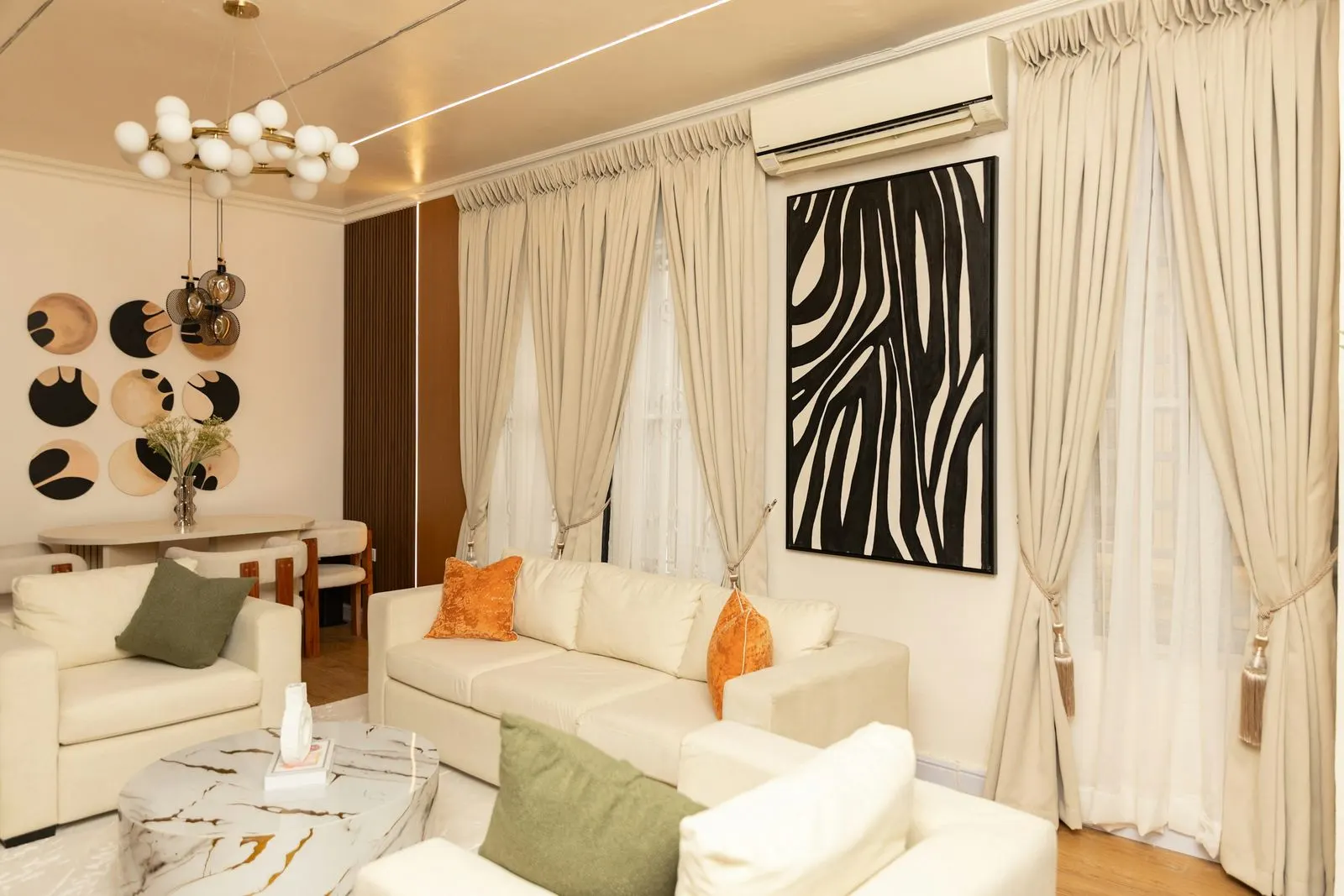
Good curtain design is mostly proportion. Where the curtain starts, where it stops and how full it is decide whether it looks tailored or temporary. Fabric pattern comes after.
The rules we follow on almost every window:
- Mount high, at or near the ceiling, or at least 10 to 15 cm above the frame.
- Mount wide, 15 to 20 cm past the frame on each side.
- Floor-length curtains stop 1 to 2 cm above the floor. Not 10 cm. Not puddled in construction dust.
- Use enough fullness. About 2x for pleated curtains.
On colour, Hyderabad light is the deciding factor. North and east windows get gentle light, so blues and greys look fine there. On west windows, light and mid tones show fading less, and deep colours need a light-backed lining. Textured linen-look weaves in warm neutrals have largely replaced shiny satins in new apartments, and they hide minor creasing well. For living rooms and bedrooms, our curtain designs guide has layering ideas, colour-block borders, pooja room curtains, and treating a long living-dining hall as one wall.
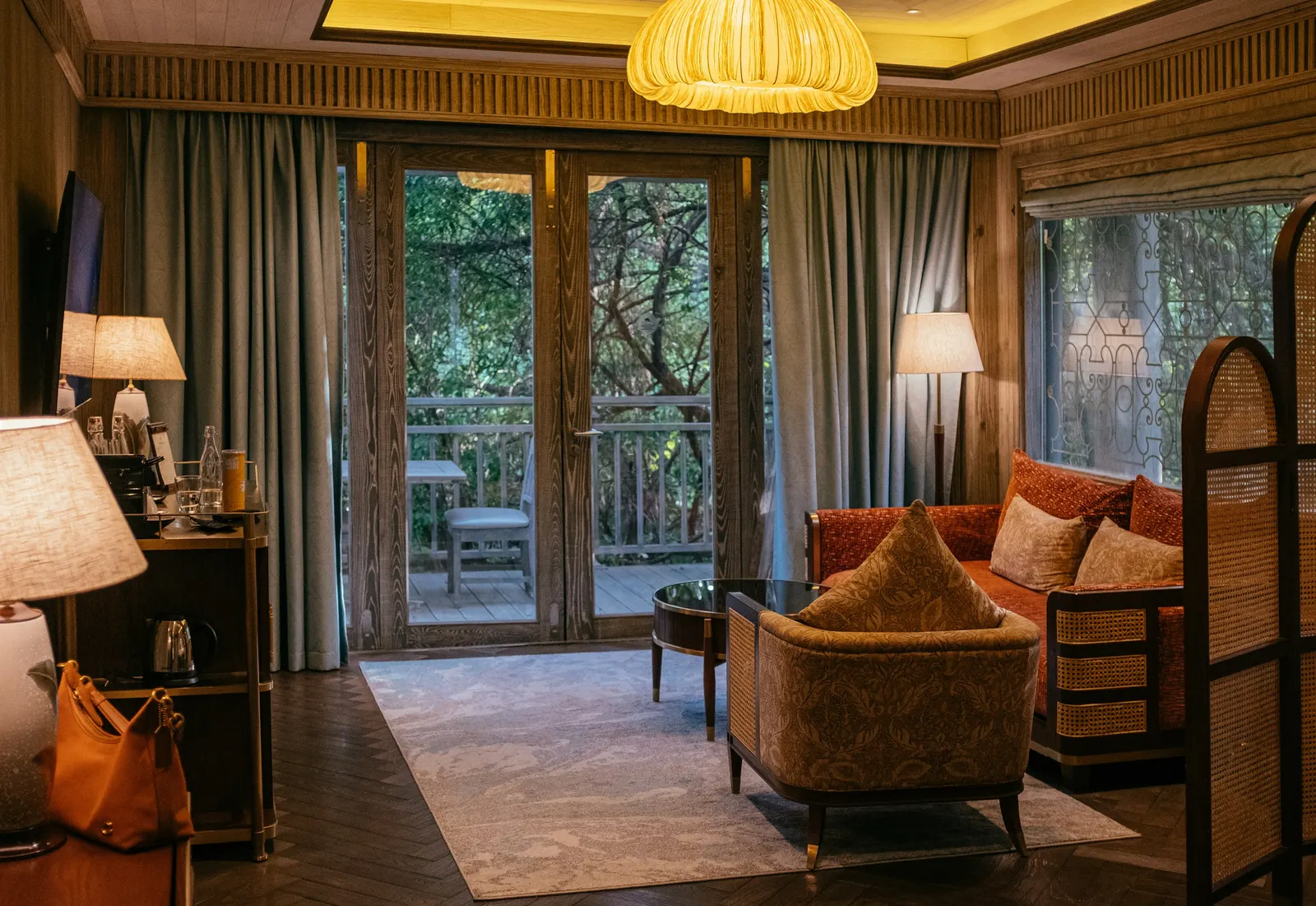
Two more topics get their own guides. A pelmet is a rigid box, usually plywood or MDF, painted, veneered or fabric-wrapped, that hides the track; a valance does the same job in soft fabric. Our guide to curtain pelmets and valances covers when one helps (an ugly track, light over blackout curtains, an uneven beam line), when swags and frills date a room, and when a false-ceiling pocket is better. Our door curtain ideas go door by door: main doors left open behind a locked grille, sliding balcony doors, kitchen doorways kept clear of the hob, and wardrobe or store openings.
Chapter 5: How to measure windows for curtains
Most curtains that look wrong weren’t badly stitched. They were badly measured.
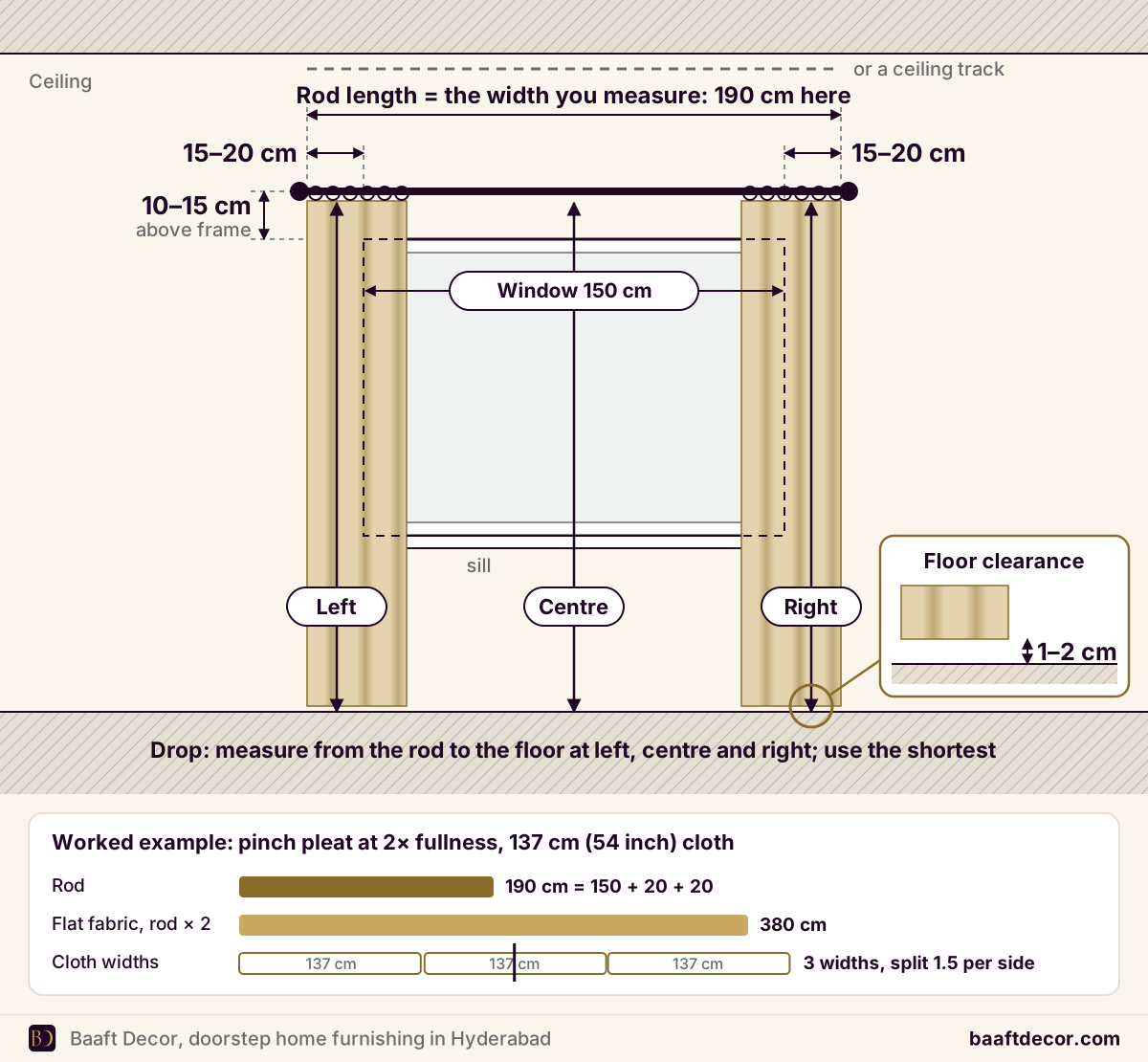
Measure from the hardware position, never just the glass. Decide where the rod or track will go first. Then:
- Measure the full rod or track length. That’s your width.
- Multiply by the fullness for your heading.
- Measure the drop from the hanging point to the floor or sill at the left, centre and right. Use the shortest reading, because floors in new flats are rarely level. For eyelets, measure from the top of the rod and add 3 to 4 cm, since the fabric rises above it.
- Divide the flat width by the fabric width (often around 54 inches, about 137 cm) and round up to get the number of widths.
A worked example: a 150 cm bedroom window, rod extended 20 cm each side, is a 190 cm rod. At 2x fullness for pinch pleat, you need 380 cm of flat fabric, which is three widths of 137 cm cloth, split one and a half per side. For a quick check in feet, one 54-inch width covers about 2 ft of rod at 2x fullness.
Use a steel tape. Cloth tapes stretch over long spans. And look up before you decide on height: many Hyderabad apartments have a concrete beam right above the window, sometimes with only a small gap below the ceiling.
Ready-made curtains in India come in roughly 5 ft, 7 ft and 9 ft lengths, with panels about 4 ft wide. New apartments with floor-to-ceiling glass usually fall between those sizes. Our step-by-step guide on how to measure windows for curtains covers sliding doors, bay windows, double layers, a blind and curtain together, and the most common measuring mistakes.
Chapter 6: Rods, tracks, fixing and motorisation
The hardware is the part people choose last and regret first. A thin rod across a 3 m balcony door will bow in the middle however good the brackets are, and a track screwed only into gypsum board will pull out.
Rod or track? In most new apartments, a ceiling-mounted aluminium track wins. It’s slim, runs smoothly, takes two layers in a double channel and can be motorised later. A rod makes sense where the hardware is meant to be seen, like a black metal rod in an industrial-style room or a wooden pole in a traditional house. Slim rods around 16 to 19 mm suit sheers. Lined and blackout curtains need about 25 mm or thicker.
Fixing into Hyderabad walls. RCC beams above windows need proper bits and anchors. AAC and fly-ash block walls in newer gated communities need anchors made for those blocks. Gypsum false ceilings can’t hold a track on their own: fix through to the slab, or into a backing strip installed before the ceiling is closed. If a false ceiling is still being planned, coordinate a recessed track pocket with your contractor or our false ceiling team.
Supports. Centre supports roughly every metre, closer (about 60 to 90 cm) for heavy lined curtains.
Sliding doors. Run the track 20 to 25 cm past the opening on the stacking side so the fabric clears the glass. On a door that slides one way, stack the curtain on the fixed side.
Balconies and humid rooms. Aluminium or stainless steel. Powder-coated mild steel rusts once the coating chips. If gliders get stiff, a dry silicone spray works; oil collects dust and stains fabric.
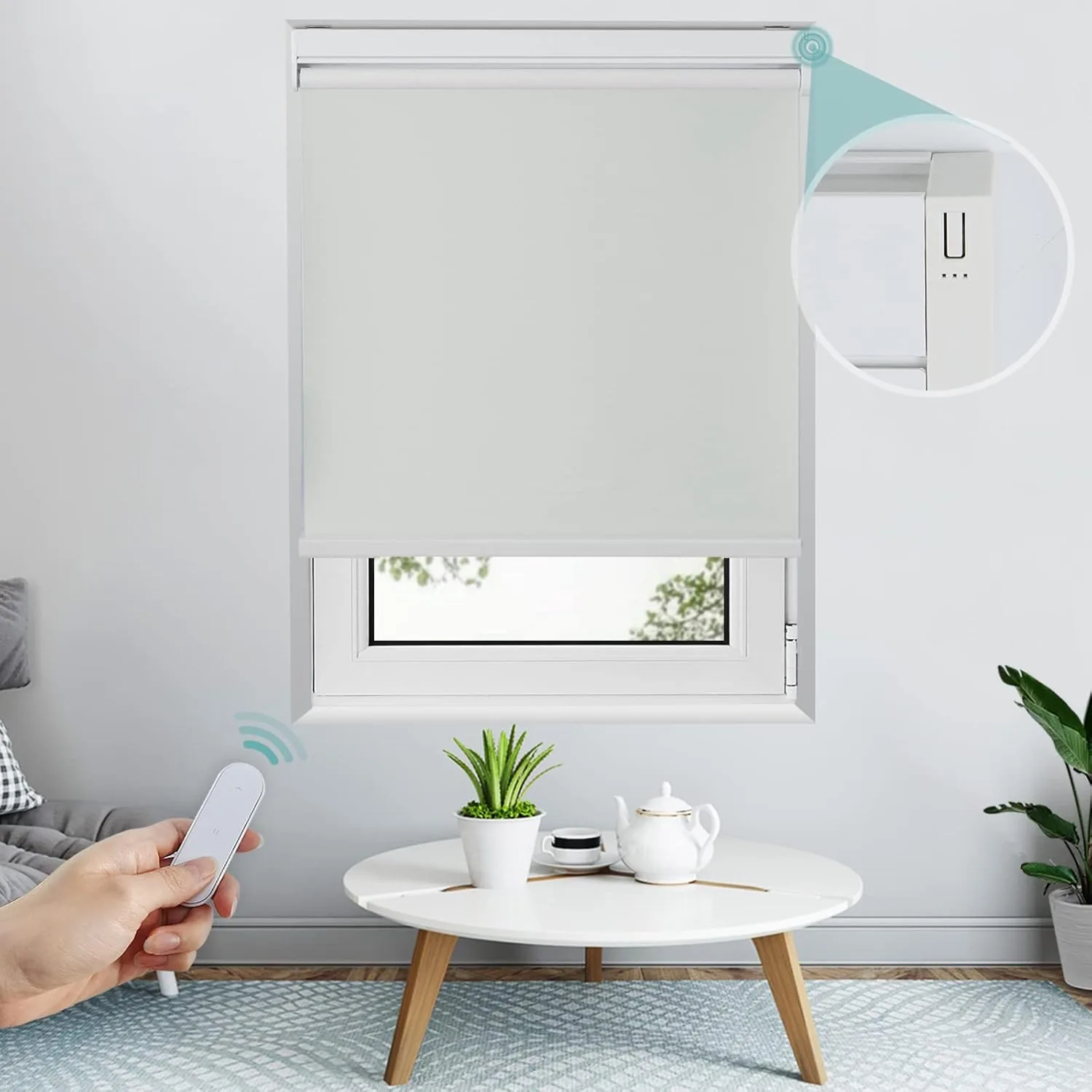
Motors. Curtains run on a track motor that drives a belt inside a motor-rated track; roller, zebra and roman blinds use a tubular motor inside the roller. A schedule can close the west side at noon and open it at sunset. Wired motors need a socket at the track head, planned before the false ceiling goes in; rechargeable battery motors need no wiring. Motors earn their keep on very wide or tall windows, double-height rooms and heavy lined curtains. Our motorised curtains and blinds service covers motor choice, controls and re-heading existing curtains for a track.
Every rod material, track type, bracket and wall fixing is in our curtain rods and tracks guide. Our guide to high-rise apartment window solutions handles heat, glare, night privacy and wind on upper floors, a common brief in towers around Kokapet and the Financial District.
Chapter 7: What drives curtain cost?
There’s no honest per-window figure before measuring, because curtain cost is a calculation, not a rate card. These are the lines that move it:
- Fabric quantity. Rod length × fullness ÷ fabric width gives the number of widths; widths × drop gives the metres. Floor-to-ceiling curtains use roughly twice the fabric of sill-length ones on the same window.
- Fabric grade. Two curtains with identical measurements can differ several times over in cost purely because of the cloth. Patterned fabric also loses some cloth at every cut to match the repeat.
- Lining. Blackout, dim-out or thermal lining roughly doubles the fabric quantity and adds stitching.
- Heading. Eyelet is the least labour; pinch pleat and ripple fold take more.
- Hardware. Tracks are usually priced per running foot. Ceiling, double and ripple tracks cost more than a basic channel.
- Installation. Concrete beams, gypsum ceilings that need backing, and double-height windows add work.
- Motorisation. The biggest single jump on any window.
A fair quote lists each of these separately, with GST shown clearly. If a quote says “living room curtains, 1 lot”, ask for the breakdown. Our curtain cost guide explains each driver in detail and where you can save without regretting it, such as putting blackout lining only where people sleep. When you’re ready for actual figures, we give a fixed written quote for curtains across Hyderabad after measuring your home.
Chapter 8: How custom curtains are made and installed
Here’s how a curtain job runs with us, from first call to the last fold.
- Free home visit. We bring sheer, dim-out and blackout samples, hold them against your windows in your light, and check walls, ceilings and beams.
- Measurement. Every window separately, even ones that look identical. In apartments, two “same size” windows often differ by a few centimetres.
- Written quote. Fabric, metres, lining, heading, hardware and installation, line by line.
- Stitching. Fabric is cut to your exact drop with the agreed fullness and lining.
- Installation. Brackets and tracks fixed into the right material, curtains hung, folds dressed, and the draw tested on every window.
Doing every room in one visit saves repeat trips, and in new flats it’s best done once the painting and dusty work are finished.
Chapter 9: Caring for curtains through the year
Curtains in Hyderabad have a hard life: summer sun, months of fine cement dust, then monsoon damp. A simple routine goes a long way.
- Every few weeks: vacuum with a soft brush attachment, top to bottom. More often during nearby construction.
- Washing: sheers and most polyester curtains wash on a gentle cycle as the label allows. Sewn-in blackout linings are best dry cleaned; 3-pass coated fabric can take a gentle cold wash without wringing. Never tumble dry either, because the coating can crack. Ask for a detachable lining if you want easier cleaning.
- Summer: close west-facing curtains before the sun reaches them, not after the room has heated up.
- Monsoon: keep fabric off damp glass and sliding-door tracks, open windows on dry days, don’t wash heavy curtains unless they can dry within a day, and watch for spots on linings near the floor.
- Hardware: wipe tracks during dust season and check that brackets haven’t loosened.
Our Hyderabad home furnishing calendar covers timing month by month: order summer curtains in February so they’re up by March, and deep-clean or dry-clean them in October after the monsoon.
When should you call a professional?
Some curtain jobs are fine as DIY. Swapping a ready-made eyelet curtain on an existing rod in a rented flat needs no one. Call a professional when:
- the window is floor-to-ceiling, a sliding door, or a corner or bay window;
- the track goes into a false ceiling, an RCC beam or AAC blocks;
- you want blackout that is properly dark, with no side or top leaks;
- the curtain is heavy, double-layered or motorised;
- you’re furnishing a whole new flat and want consistent headings and hem lines throughout.
Which curtain setup suits each room?
| Room | Light control | Heading | Notes |
|---|---|---|---|
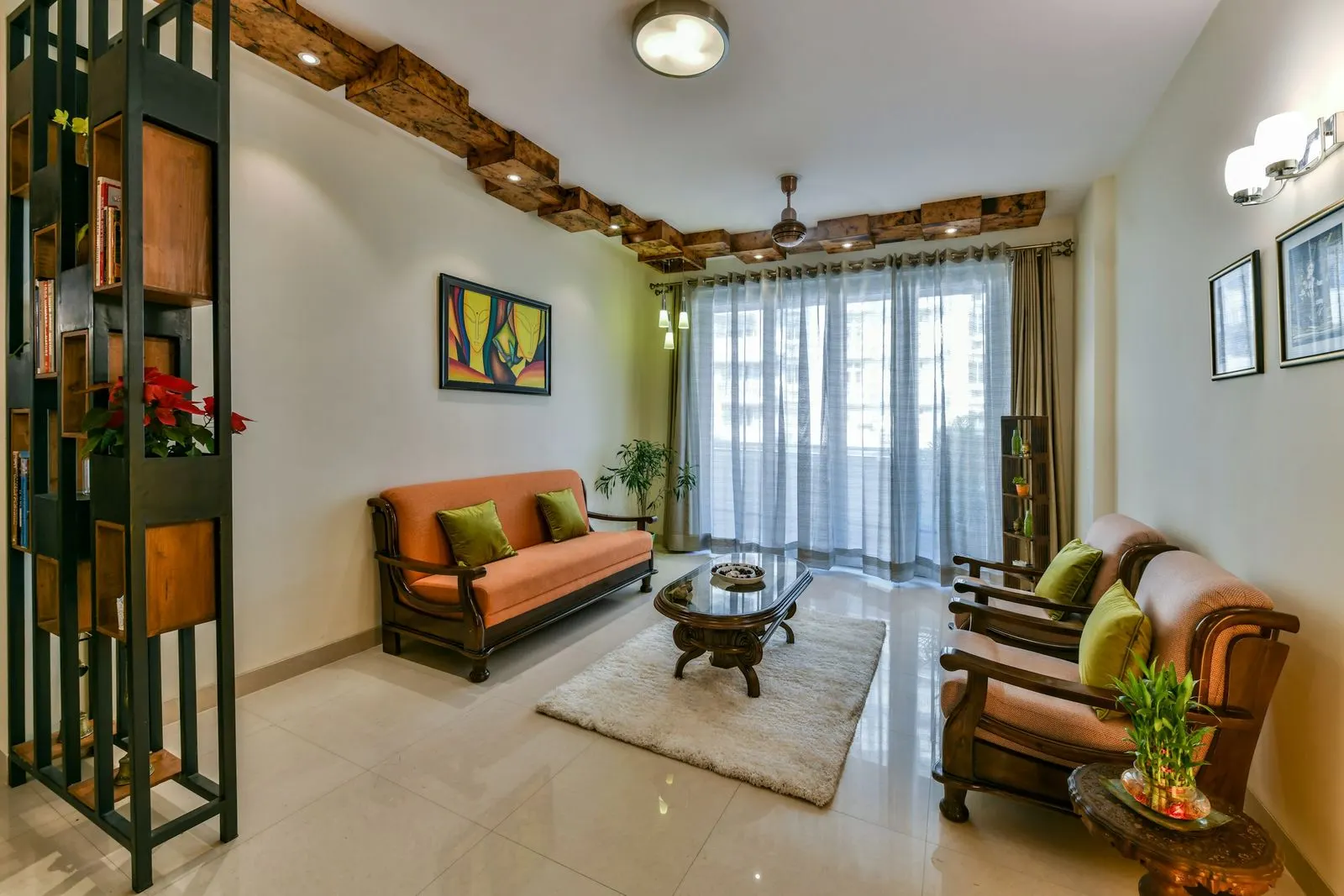
| Living room | Sheer + dim-out | Pinch pleat or ripple fold | Double track, floor length |
| Master bedroom | Sheer + blackout | Pinch pleat or ripple fold | Ceiling-mounted, wide, to stop leaks |
| Kids’ room | Blackout or dim-out | Eyelet or pencil pleat | Washable fabric, no low cords |
| Study | Dim-out | Pencil pleat or eyelet | Cuts screen glare |
| Pooja room door | Sheer or light lined | Pinch pleat or tab-top | Keep clear of diyas |
| Kitchen, bathroom | Usually a blind | Not applicable | Curtains absorb oil and steam |
Curtains or blinds?
Some windows are better without a curtain at all. Windows above a counter, bed or desk suit a blind close to the glass; kitchens do better with an aluminium venetian or wipeable roller, bathrooms with faux-wood or aluminium venetians. Many sunny bedrooms get both: a sunscreen roller for daytime glare and a blackout curtain for night. Our blinds vs curtains comparison explains why a basic roller usually costs less than lined curtains (it uses fabric equal to the window area), compares heat, cleaning and space, and lists the pairings we fit most. The window blinds buying guide covers every blind type the same way this guide covers curtains.
Get curtains planned for your home
Fabric looks different in a shop than at your own window. Book a free home visit and we’ll bring samples for every room, measure each window, and give you a written quote for made-to-measure curtains before any cutting starts, including blackout curtains for bedrooms and motorised tracks for tall glass. We work across Hyderabad from 8 AM to 10 PM, all seven days. WhatsApp or call +91 98499 17494.
Frequently asked questions
How do I choose curtains for my home in Hyderabad?
To choose curtains for a Hyderabad home, go room by room and decide five things in order. First, how much light the room should block: blackout for bedrooms, dim-out for living rooms, a sheer as the daytime layer. Second, the heading, such as pinch pleat, ripple fold or eyelet. Third, a fabric that handles strong sun and dust, usually a lined polyester or poly-blend on west-facing windows. Fourth, the size, measured from where the rod or track will go. Fifth, hardware strong enough for the weight.
Which curtain fabric is best for Hyderabad's climate?
For Hyderabad's climate, polyester and polyester-blend curtain fabrics are usually the best all-round choice. They hold colour better than cotton or linen in the strong March to June sun, wash easily during the dusty construction months, and resist creasing. Linen-look polyester gives a textured, natural look with less upkeep than real linen. Whatever the face fabric, add a lining on west and south-west windows, because lining protects the fabric from sun fading and helps the folds hang well.
Should I buy ready-made or custom-stitched curtains?
Ready-made curtains suit standard windows in rented flats, kids' rooms and study rooms, because they are cheaper and come in common lengths of about 5 ft, 7 ft and 9 ft. Custom-stitched curtains suit most new Hyderabad apartments, where floor-to-ceiling glass, sliding balcony doors and false ceilings rarely match those sizes. Custom curtains are cut to the exact drop, use proper fullness and can be lined with blackout or thermal lining, so they cover the window fully and last longer on sunny windows.
Do I need blackout curtains in every room?
You do not need blackout curtains in every room. Blackout lining matters most in bedrooms, nurseries, home theatres and any room where someone sleeps in the day, because Hyderabad gets early sunrise light for much of the year. Living rooms, studies and dining areas usually do better with a dim-out or regular lining behind a sheer, which keeps the room usable in daylight. Full blackout in a living room tends to feel gloomy, so people leave it open and lose the benefit.
Is a curtain rod or a curtain track better for an apartment?
In most new Hyderabad apartments a curtain track is the better choice, especially with a false ceiling, a beam above the window or a sheer and blackout pair. A ceiling-mounted aluminium track runs smoothly, stops light spilling over the top, takes two layers in a slim double channel and can later be motorised. A decorative rod suits rooms where the hardware is meant to be seen, eyelet curtains and rented homes. Heavy lined curtains need a rod of about 25 mm diameter or more.
How much fabric does a curtain need?
A curtain needs much more fabric than the window width. Start with the rod or track length, which usually runs 15 to 20 cm past the frame on each side, then multiply by the fullness: about 1.5 to 2 times for eyelet curtains and 2 to 2.5 times for pinch pleat and ripple fold. Divide that by the fabric width, commonly around 54 inches, and round up to get the number of widths. As a rough rule at 2x fullness, one 54-inch width covers about 2 ft of rod, so a 7 ft rod needs four widths. Each width is then cut to the drop plus allowances for the heading and hem.
How should curtains be cleaned in Hyderabad's dust and monsoon?
Curtains in Hyderabad need regular vacuuming with a soft brush every few weeks, more often when buildings nearby are under construction. Sheers and most polyester curtains can be washed on a gentle cycle as the care label allows. Curtains with a sewn-in blackout lining are safest dry cleaned, 3-pass coated fabric can take a gentle cold wash without wringing, and neither should be tumble dried, because the coating can crack. During the June to September monsoon, keep curtains from pressing against damp glass or walls and air the room on dry days to prevent mildew spots.
Are motorised curtains worth it?
Motorised curtains are worth it for very wide or tall windows, heavy lined curtains, double-height living rooms, and windows that are hard to reach behind furniture. They run on a motor-rated track and work by remote, wall switch, phone app or voice assistant, and a schedule can close west-facing windows before the afternoon sun when nobody is home. Rechargeable battery motors need no new wiring and are charged every few months. Wired motors need a socket at the track head, best fitted before the false ceiling is closed. For ordinary bedroom windows a manual track usually does the job well.
What happens during a free home visit for curtains?
During a free home visit for curtains, Baaft Decor brings fabric samples in sheer, dim-out and blackout options to your home so you can see them against your own windows and light. We check the walls, ceiling and any beam above each window, suggest the rod or track and heading for each room, and measure every window separately. You then receive a written, itemised quote listing fabric, lining, stitching, hardware and installation. Visits run 8 AM to 10 PM, all seven days.