Every guide in this series
 Best Blinds for Balcony: PVC, Bamboo, Outdoor Roller or Monsoon?The best blinds for a balcony depend on what you need to block.
 Types of Window Blinds: Which One Suits Each RoomThe main types of window blinds are roller, zebra (dual), roman, aluminium venetian, wooden or faux-wood venetian, vertical, honeycomb, bamboo or woven, and PVC outdoor blinds.
 Window Blinds Cost in Hyderabad: What Drives the PriceWindow blind cost in Hyderabad is worked out per square foot of blind, so the size of each window sets the base.
A blind is a small thing to get wrong and an annoying thing to live with: the bedroom that glows at 6 AM, the zebra blind that never quite lines up, the balcony roller slapping the railing all night. Most of those problems come from choosing the type before thinking about the room. When we fit window blinds in Hyderabad, we start with what each window needs at 2 PM and at 10 PM, and the type follows from that.
This guide covers every decision in that order. Each chapter gives you enough to choose, and links to a deeper guide where there’s more to say.
How do you choose window blinds for a Hyderabad home?
Choose blinds window by window, in this order:
- What the room needs. Darkness for sleep, glare control for screens, daylight with privacy, or moisture resistance.
- Blind type. Roller, zebra, roman, venetian, vertical, honeycomb or an outdoor blind.
- Fabric. Its opacity (dim-out or blackout) or, for sunscreen fabric, its openness factor.
- Mounting and mechanism. Inside or outside the recess; chain, cordless spring or motor.
- Fixing. Into RCC, AAC block or a false-ceiling backing, never gypsum alone.
Most Hyderabad flats end up with two or three blind types, and that’s normal.
Chapter 1: What types of window blinds are there?
There are nine common types.
| Type | Light control | Best rooms | Watch out for |
|---|---|---|---|
| Roller | Sheer to full blackout, set by fabric | Bedrooms, study, kitchen | Up or down only, no tilt |
| Zebra (dual) | Adjustable, never full blackout | Living, dining | Bulkier roll, must be dead level |
| Roman | Dim-out to blackout with lining | Bedrooms, dining, study | Folds hold dust; inside the recess, the stack covers the top of the glass |
| Aluminium venetian | Fine tilt | Kitchen, bathroom | Every slat collects dust |
| Wooden / faux-wood | Fine tilt | Living, study (wood); wet areas (faux) | Real wood can warp in damp |
| Vertical | Tilt and draw sideways | Wide windows, sliding doors | Vanes sway under a ceiling fan |
| Honeycomb | Dim-out to blackout | West-facing bedrooms | Costs more, gentle cleaning |
| Bamboo / woven | Filters light | Covered sit-outs | See-through at night |
| PVC / outdoor | Shade and rain cover | Balconies, utility | Wind on high floors |
Our types of window blinds guide goes through all nine in detail, including printed rollers, the blinds-versus-shades question and a room-by-room shortlist.
Roller and zebra blinds
The two you’ll be offered most. A roller is one sheet of fabric on a tube, and the fabric decides everything. It’s the simplest to clean, the easiest to motorise, and with blackout fabric it’s the bedroom default.
A zebra blind loops one long fabric with alternating sheer and solid bands down the front of the tube, round the bottom rail and back up behind. Turn it a little and the bands line up to let light through, or overlap to block the view, which makes it ideal for a living room facing the next tower. The catches: no true blackout, a fatter roll, a higher rate per square foot, and sheer bands that show dust and let people see in after dark if left open. Our zebra vs roller blinds comparison lists all seven drawbacks, gives a room-by-room verdict (zebra for living and dining rooms, rollers for bedrooms, kitchens and kids’ rooms), and explains the double roller (sunscreen and blackout on one bracket) that many people actually wanted when they asked for zebra.
Roman blinds
Curtain-style fabric that folds into horizontal pleats as you raise it. Romans look warmer than rollers and suit bedrooms, dining rooms and studies with average-sized windows. Three choices decide how one turns out:
- Fold style. Flat folds keep a print unbroken. Hobbled and cascade styles look fuller but use noticeably more fabric and hold more dust.
- Lining. Unlined fabric filters light but fades faster. Standard lining suits most rooms; bedrooms need blackout lining.
- Mount. Inside the recess, the raised stack covers the top of the glass. Fix the headrail above the frame and the stack sits on the wall instead.
Keep romans out of bathrooms and away from sinks and hobs. Our roman blinds guide compares flat, hobbled, relaxed and cascade folds, explains each lining, suggests fabrics that hold up in Hyderabad sun and sets out the cord-safety rules.
Venetian, vertical and honeycomb blinds
Aluminium venetians (commonly 25 mm slats) are moisture-proof and wipeable, so they’re our usual pick for kitchens and bathrooms. Wooden slats look rich in a study but can warp in humid rooms; faux-wood in PVC or composite handles bathroom steam and monsoon damp far better. Vertical blinds draw to one side, which suits sliding balcony doors you walk through every day. Honeycomb blinds trap air in their cells, which helps on hot west-facing bedroom windows.
Chapter 2: Fabric, opacity and openness factor
Within one blind type, the fabric decides how the room feels.
- Dim-out fabric softens light and gives daytime privacy.
- Blackout fabric uses a coating or dense weave to stop nearly all light. Bedrooms and kids’ rooms.
- Sunscreen fabric is a technical weave sold by openness factor: the percentage of the fabric that’s open weave.
| Openness | Glare and heat blocked | View out | Good for |
|---|---|---|---|
| 1% | Most | Limited | West-facing living rooms, harsh afternoon sun |
| 3% | High | Good | Most sunny rooms and home offices |
| 5% | Moderate | Clear | Moderate sun where the view matters |
| 10% | Least | Very clear | North-facing or shaded windows |
Colour changes the result as much as openness. Darker sunscreen fabrics give a clearer view out and cut glare better, because your eye isn’t fighting a bright fabric surface. Lighter ones reflect more heat. For a west-facing living room we usually suggest 1% to 3% in a mid tone.
One thing to remember about sunscreen fabric: at night, with lights on inside, the view reverses and people can see in. A bedroom needs a blackout layer somewhere.
Chapter 3: Which blinds help most in Hyderabad’s heat?
By April, the rooms that feel like an oven at 4 PM are almost always the ones with west or south-west glass, sliding balcony doors or high-floor windows with nothing shading them.
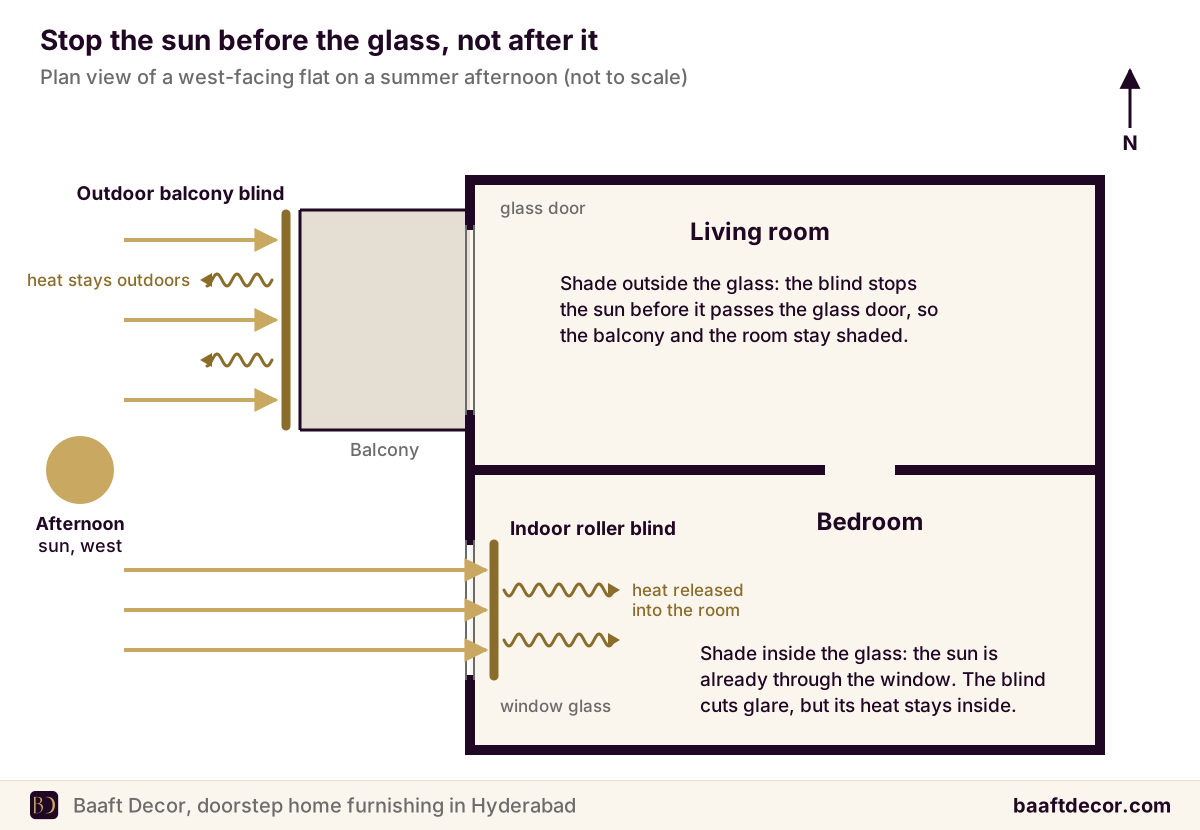
The single most useful idea is to stop the sun before it gets through the glass. The US Department of Energy’s Building America Solution Center notes that exterior attachments block sunlight before it passes through the window, while interior ones only stop it after it’s inside. In a Hyderabad flat, “outside” usually means a blind across the balcony, which shades both the balcony and the sliding door behind it.
Inside the glass, a blackout or 1% to 3% sunscreen roller close to the window does the most. A light backing facing outward helps reflect heat. Zebra blinds help less on the hottest windows, because when open, their sheer bands let direct sun through.
Timing matters too. Close west and south-west blinds by late morning, before the sun reaches them, and open everything after sunset. If nobody’s home in the afternoon, a motorised blind on a schedule does it for you, and on the hottest windows a thermal-lined curtain in front of the roller covers the edges. Our guide to keeping your home cool in Hyderabad summers shows how to layer outdoor blinds, sunscreen rollers and lined curtains, and when to close each window by direction.
Chapter 4: Balcony and outdoor blinds
A balcony blind is an outdoor product, and most failures we see come from treating it like an indoor one. In a single year it faces 40 °C sun, June to September rain, pre-monsoon squalls and constant dust.
The options, briefly:
- Outdoor roller in sunscreen fabric: best for sun and glare on open balconies you sit on.
- PVC chick: low cost, doesn’t rot, can be hosed down. Good for utility balconies.
- Bamboo chick: warm look, but only for covered sit-outs that stay mostly dry.
- Clear PVC monsoon blind: keeps rain out, gives zero privacy, and traps heat in summer.
- Zip-track: the fabric edges lock into side channels, so it handles wind best. Costs the most.
On high floors, wind becomes the deciding factor. In towers around Kokapet and the Financial District, a loose blind can tear within a season. Tie-downs, heavier bottom bars, stainless steel guide cables or zip-track channels fix that, roughly from cheapest to best.
Fixing matters as much as fabric. A balcony blind should hang from the RCC slab or beam above, never from cladding, a balcony false ceiling or a glass railing, and it needs stainless steel or powder-coated aluminium hardware so it doesn’t leave rust streaks after one monsoon. Check your residents’ association rules first, because many gated communities restrict colours or ask that blinds sit inside the balcony opening.
Our balcony blinds service covers outdoor fabrics, wind fixing and RWA-friendly colours. The guide to the best blinds for balconies rates all five options on sun, rain, wind, night privacy and upkeep, with picks by balcony type. For upper floors, our guide to high-rise apartment window solutions covers two-layer setups for floor-to-ceiling glass, stopping blinds flapping by open sliding doors, and planning power points for motors early.
Chapter 5: Measuring and mounting
Most disappointment with blinds comes from fitting, not from the type.
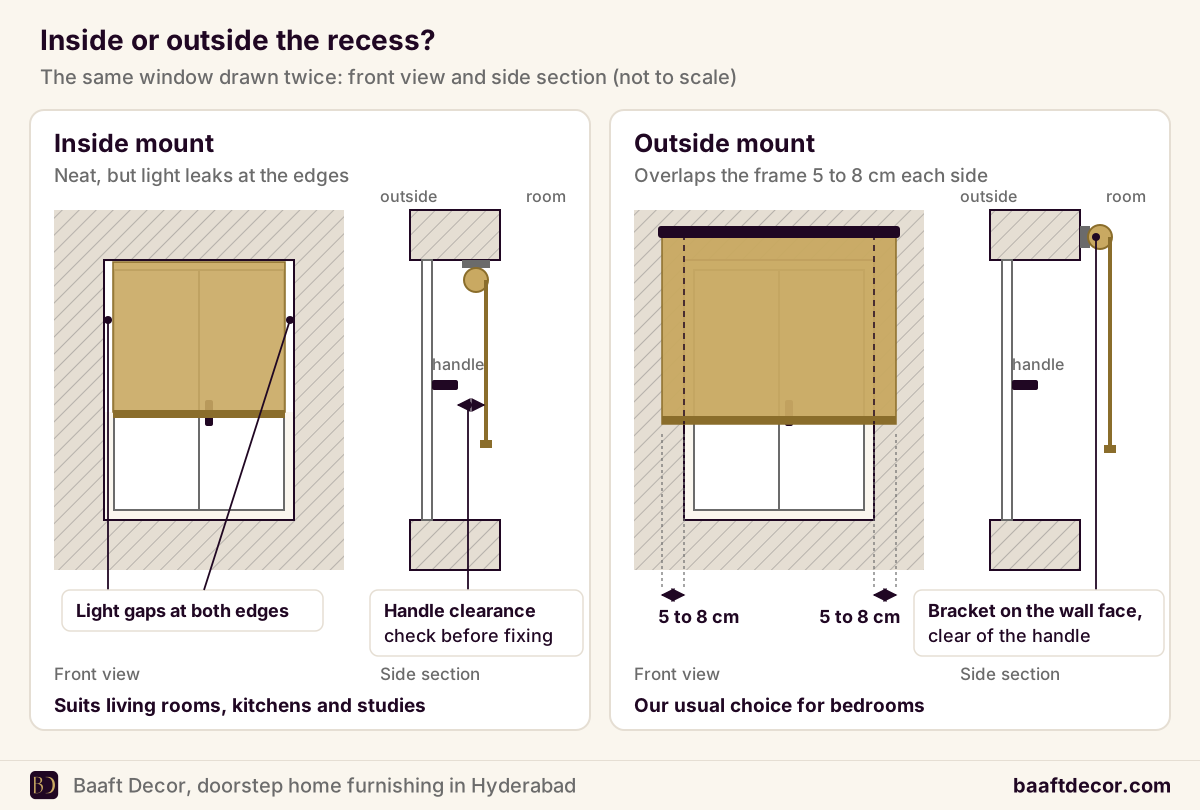
Inside or outside the recess. Inside looks tidy but always leaves thin strips of light at the sides. Outside, overlapping the frame by about 5 to 8 cm (2 to 3 inches) each side, blocks more light and makes the window look bigger. For bedrooms we usually mount outside; for blackout without any edge glow, add side channels.
Measuring. An inside-mount blind must fit the narrowest point of the recess, so check the width at the top, middle and bottom. For an outside mount, measure the blind, not the glass: it runs past the frame on each side and above it, so a 5 ft by 4 ft window takes a blind of roughly 5.5 ft by 4.5 ft. Windows that look identical often aren’t, so measure every one.
Clearance. Many Hyderabad flats have uPVC or aluminium sliding windows with handles that stick out, and older houses often have MS grilles inside the frame. A blind that rubs a handle every day wears its edge. A zebra roll is fatter than a roller, and an inside-mounted roman needs depth for its folded stack, so measure the projection before deciding where the brackets go.
Wide windows. A 12 ft living room window is often split into two or three blinds, because fabric comes in fixed roll widths, long tubes sag in the middle and a heavy blind is hard work on a chain.
Fixing surface. RCC lintels need proper bits, AAC blocks need anchors made for them, and a gypsum false ceiling can’t hold a blind on its own. We avoid drilling uPVC frames where we can; a cracked profile is expensive to fix.
Chapter 6: Mechanisms, child safety and motors
Most blinds in Indian homes run on a bead chain. It’s reliable and the cheapest option. Spring-loaded cordless blinds cost a little more and have no loop to reach.
That loop matters. The US Consumer Product Safety Commission urges families with children to replace corded blinds with cordless ones, and until then to permanently anchor bead chains and cord loops to the wall or floor. The rules we follow:
- Kids’ rooms: cordless or motorised only.
- Chains elsewhere: a tensioner fixing the loop to the wall.
- Corded romans: cleat at least 1.5 metres above the floor. Cutting a cord shorter doesn’t remove the risk.
- Venetians: a tilt wand, not a tilt cord.
- Furniture: no beds, cots or sofas under windows.
Motors fit roller, zebra, roman, honeycomb and vertical blinds. They earn their cost on tall or wide windows, blinds behind beds or sofas, and living rooms with several large blinds that open together every morning. A motor also stops a zebra blind exactly at the aligned or closed position. Our motorised curtains and blinds service explains wired and rechargeable battery options.
Chapter 7: What drives the cost of window blinds?
Blinds are quoted per square foot of finished blind, but the rate on that square foot can vary several times over depending on what you pick.
- Size. Width × drop of the finished blind. Many suppliers set a minimum billable area per blind.
- Type. Plain rollers and PVC or bamboo chicks cost least, then verticals and aluminium venetians, zebra, and roman (tailoring and lining); honeycomb and real wooden venetians cost most. Outdoor rollers cost more than indoor ones because of weather-rated fabric and wind hardware.
- Fabric collection. Blackout, sunscreen and textured collections cost more than plain dim-out. Colour rarely changes the rate.
- Mechanism. Chain is the base; cordless spring adds a little; a motor is the biggest single jump.
- Extras. Cassette, side channels, double-roller brackets, weighted bottom rails.
- Installation. Concrete, AAC, false ceilings and splitting wide windows all add work.
A fair quote lists each blind separately with its size, type, fabric code, mount, mechanism, extras, installation and GST. Our window blinds cost guide works through a sample window, explains every line of a quote and shows where to save, such as motorising only the big living room window. For a fixed figure, we quote for custom blinds across Hyderabad after measuring every window.
Chapter 8: Blinds, curtains or both?
Most homes don’t need to pick a side. Blinds win on kitchens, bathrooms, studies, windows above counters and windows behind beds or desks. Curtains win on large sliding doors and floor-to-ceiling glass, and they absorb sound in echoey new flats with vitrified floors. Against lined, pleated curtains, a basic roller usually costs less, because pleated curtains need about 2 to 2.5 times the rod length in fabric, plus lining. At the premium end it flips: a motorised zebra or wooden venetian can cost more than simple eyelet curtains.
The best setup on west-facing bedrooms is often both: a sunscreen or blackout roller close to the glass, and a lined curtain in front that covers the edges. Plan both projections together, or the blind’s bracket clashes with the curtain track later. Our blinds vs curtains guide compares them on cost, light, heat, dust, privacy and look, and lists the blind-and-curtain pairings we fit most. The curtains buying guide covers the curtain side.
Chapter 9: Blinds for offices and home offices
Office blinds have a different job: stopping screen glare all day and keeping a glass facade uniform from outside. A 3% to 5% sunscreen roller is the usual default at workstations, 1% to 3% or darker fabric on harsh west glass, blackout or double rollers in conference rooms, zebra or venetian on glass cabins, and verticals on wide sliding doors. Many buildings also expect flame-retardant fabric, so ask for the test certificate. The office blinds guide goes zone by zone, lists the specs to put in writing, and explains why west facades in HITEC City and the Financial District need lower openness.
At home, the same logic works in a spare-room office: a 3% to 5% sunscreen roller cuts laptop glare and keeps the room bright for video calls. If the room doubles as a bedroom, a double roller or a zebra blind gives privacy at night. And place the desk so the window is beside you, not behind the screen.
Chapter 10: How we measure and fit blinds
- Free home visit. We bring dim-out, blackout, sunscreen and outdoor samples and hold them at your actual glass.
- Measurement. Every window, with recess depth, handle projection and the fixing surface checked.
- Written quote. Each blind listed with size, type, fabric, mount, mechanism and extras.
- Fitting. Brackets levelled (we level the brackets, not the wall), blinds hung, tensioners and cord cleats fixed, and every blind run up and down before we leave.
Caring for blinds through the year
- Roller and zebra: vacuum in place with a soft brush every couple of weeks during dusty months. A cassette keeps the roll itself clean.
- Venetian: wipe slat by slat; it takes longer than people expect.
- Roman: vacuum along each fold every week or two. Most can’t be machine-washed; for dry-cleanable fabric, ask for hook-and-loop fixing and removable rods.
- Honeycomb: gentle vacuuming of the cells.
- Kitchen: keep fabric blinds away from the hob. Heat and grease ruin them fast; aluminium or wipeable coated fabric only.
- Monsoon: let outdoor blinds dry fully before rolling them up, because water trapped in the roll starts mildew. Rinse PVC and outdoor fabrics with plain water; harsh detergents strip coatings.
- Storms: roll balcony blinds up when strong wind is forecast, even with tie-downs.
When should you call a professional?
A single small roller in a rented flat is a reasonable DIY job, with the landlord’s okay. Bring in a professional for outside-mount bedroom blinds that must be properly dark, zebra blinds (alignment is unforgiving), anything fixed into a false ceiling or AAC block, wide windows that need splitting, motorised blinds, and every balcony blind, because outdoor blinds carry wind load that indoor ones never see.
Which blind suits each room?
| Room | Our usual suggestion |
|---|---|
| Master bedroom | Blackout roller, outside mount, side channels if needed |
| Living room facing a tower | Zebra, or sunscreen roller with curtains |
| West-facing living room | Outdoor balcony blind, 1% to 3% sunscreen roller and a lined curtain |
| Dining room | Zebra, or a flat or cascade roman |
| Kids’ room | Cordless or motorised blackout roller |
| Study / home office | 3% to 5% sunscreen roller |
| Kitchen | Aluminium venetian or wipeable roller |
| Bathroom | Faux-wood or aluminium venetian |
| Sliding balcony door | Vertical blinds or a pair of rollers |
| Open balcony | PVC chick, outdoor roller or zip-track |
Get blinds measured for your home
Light behaves differently on every window. Book a free home visit and we’ll bring indoor and outdoor samples, check each window’s recess, handles and fixing surface, and give a written quote for window blinds and balcony blinds before anything is ordered. We work across Hyderabad from 8 AM to 10 PM, all seven days. WhatsApp or call +91 98499 17494.
Frequently asked questions
Which type of window blind is best for Hyderabad homes?
No single blind type is best for a whole Hyderabad home; most flats need two or three types. Blackout roller blinds suit bedrooms and kids' rooms. Zebra blinds or sunscreen rollers suit living rooms that face other towers. Aluminium venetian or faux-wood blinds suit kitchens and bathrooms because they handle moisture and wipe clean. Vertical blinds suit wide sliding doors. For open balconies, PVC chick, outdoor roller or zip-track blinds are built to handle sun, rain and wind.
What openness factor should I choose for sunscreen roller blinds?
The openness factor of a sunscreen roller blind is the percentage of open weave in the fabric. For west-facing living rooms in Hyderabad that take harsh afternoon sun, 1% to 3% openness blocks the most glare and heat while keeping some view. For most sunny rooms and home offices, 3% is a good balance. 5% suits rooms with moderate sun where the view matters, and 10% suits shaded or north-facing windows. Darker colours give a clearer view out; lighter colours reflect more heat.
Are zebra blinds better than roller blinds?
Zebra blinds are better than roller blinds only in rooms that need daylight and privacy together from one blind, such as living and dining rooms facing another building. Roller blinds are better in bedrooms, kids' rooms, kitchens and studies, because they can give full blackout with the right fabric, clean more easily, have a slimmer roll and cost less per square foot. Zebra blinds never give true blackout, since light passes through the sheer bands and around the edges.
Do window blinds help keep a room cool in Hyderabad summers?
Window blinds help keep a room cooler, but blinds inside the glass work less well than shading outside it, because the sun's heat has already passed through the window. Inside, a blackout roller or a 1% to 3% sunscreen roller close to the glass gives the best result, especially with a light backing facing outward. For the hottest west-facing rooms, combine an outdoor balcony blind with an indoor roller and a lined curtain in front, and close blinds on sun-facing windows before the afternoon sun reaches them.
Should blinds be mounted inside or outside the window recess?
Blinds mounted inside the window recess look neat but always leave thin strips of light at the edges, which suits living rooms, kitchens and studies. Blinds mounted outside the recess, overlapping the frame by about 5 to 8 cm on each side, block much more light and make the window look larger, so they suit bedrooms. An outside mount also lets a roman blind's raised stack sit on the wall instead of over the glass. Many Hyderabad flats have shallow recesses with sliding window handles that stick out, so recess depth and handle clearance should be checked before choosing an inside mount.
Which blinds are best for a balcony in Hyderabad?
The best balcony blind depends on what you need to block. Outdoor roller blinds in sunscreen fabric are best for sun and glare on open balconies. PVC chick blinds are the low-cost, all-weather option that can be hosed down. Clear PVC monsoon blinds keep rain out but give no privacy. Bamboo suits covered, mostly dry sit-outs. On high floors where wind is strong, zip-track blinds locked into side channels, or rollers on guide cables, last far longer than loose blinds.
How are window blinds priced in Hyderabad?
Window blinds in Hyderabad are usually priced per square foot of finished blind, so each blind's measured width and drop set the base area. The blind type, such as roller, zebra, roman, wooden or honeycomb, and the fabric collection then set the rate. Extras add to it: a cassette, side channels, a motor, special brackets for false ceilings, installation and GST. Many suppliers also apply a minimum billable area per blind. A fixed quote is only possible after measuring each window.
Are corded window blinds safe in homes with small children?
Corded window blinds with loose cords or bead-chain loops are a strangulation risk for young children. The US Consumer Product Safety Commission urges families with children to choose cordless blinds, and until then to keep cords out of reach and permanently anchor bead chains and cord loops to the wall or floor. In kids' rooms, choose spring-operated cordless or motorised blinds. In other rooms, fit a chain tensioner, fix any roman blind cord cleat at least 1.5 metres above the floor, and keep cots, beds and furniture away from the window.
Which window blinds are easiest to clean in a dusty area?
In dusty areas, flat roller and zebra blinds fitted with a cassette are the easiest to keep clean, because the cassette protects the rolled fabric and the flat fabric can be vacuumed in place with a soft brush every couple of weeks. Aluminium and faux-wood venetian blinds wipe clean but every slat collects dust separately, so they take longer. Roman blinds and honeycomb blinds need gentle vacuuming of the folds and cells. Outdoor PVC blinds can be rinsed with plain water.