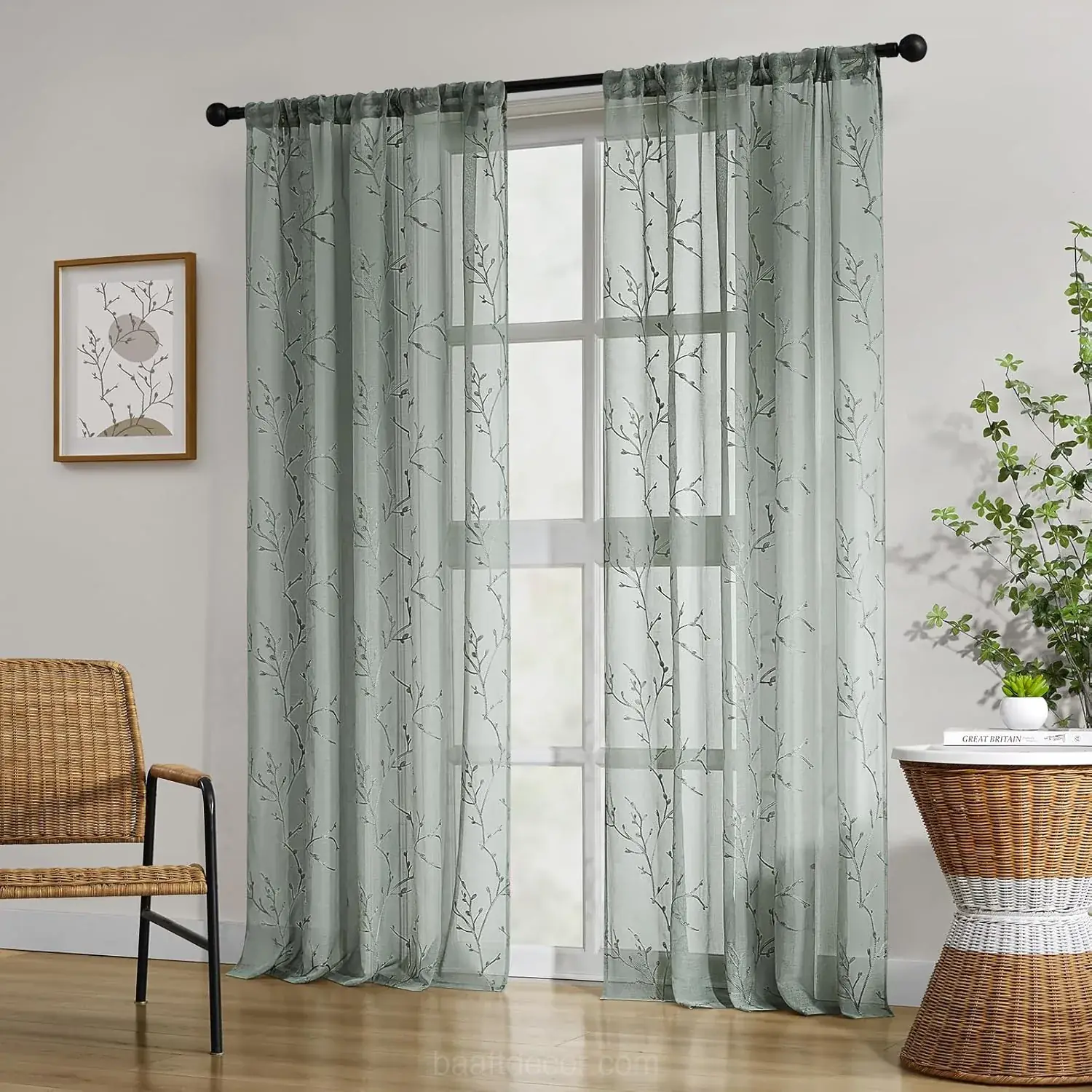
All three are curtains. They just let through very different amounts of light. If you choose the wrong one, you either wake up at 5:45 AM in May or live in a dim living room all afternoon. When we plan curtains for Hyderabad homes, this is the first decision we make for each room, and it’s the first chapter of our curtains buying guide for Hyderabad homes too.
The short verdict:
- Choose blackout for bedrooms, nurseries, home theatres, and anyone who sleeps in the day.
- Choose dim-out for living rooms, studies and dining rooms that need privacy and less sun but not darkness.
- Choose sheer as a daytime layer anywhere you want light without glare or prying eyes.
- Layer sheer with dim-out or blackout in most rooms. It’s what we recommend most often.
What are blackout curtains?
Blackout curtains are curtains built to stop almost all light passing through the fabric. There are two ways to get there.
Coated blackout lining. A separate lining is sewn behind your chosen fabric. The lining has layers of acrylic foam and an opaque coating that seal every gap in the weave. This gives the darkest result and lets you use almost any face fabric, even a light linen-look.
Triple-weave fabric. Three layers of yarn are woven into one cloth, with a dark yarn in the middle. It’s softer, drapes more naturally and is usually machine washable. Darker colours block close to all light; pale colours can let a faint glow through at midday.
If a bedroom needs to be properly dark, our blackout curtains service uses coated linings by default and sizes the curtain to stop edge leaks.
What are dim-out curtains?
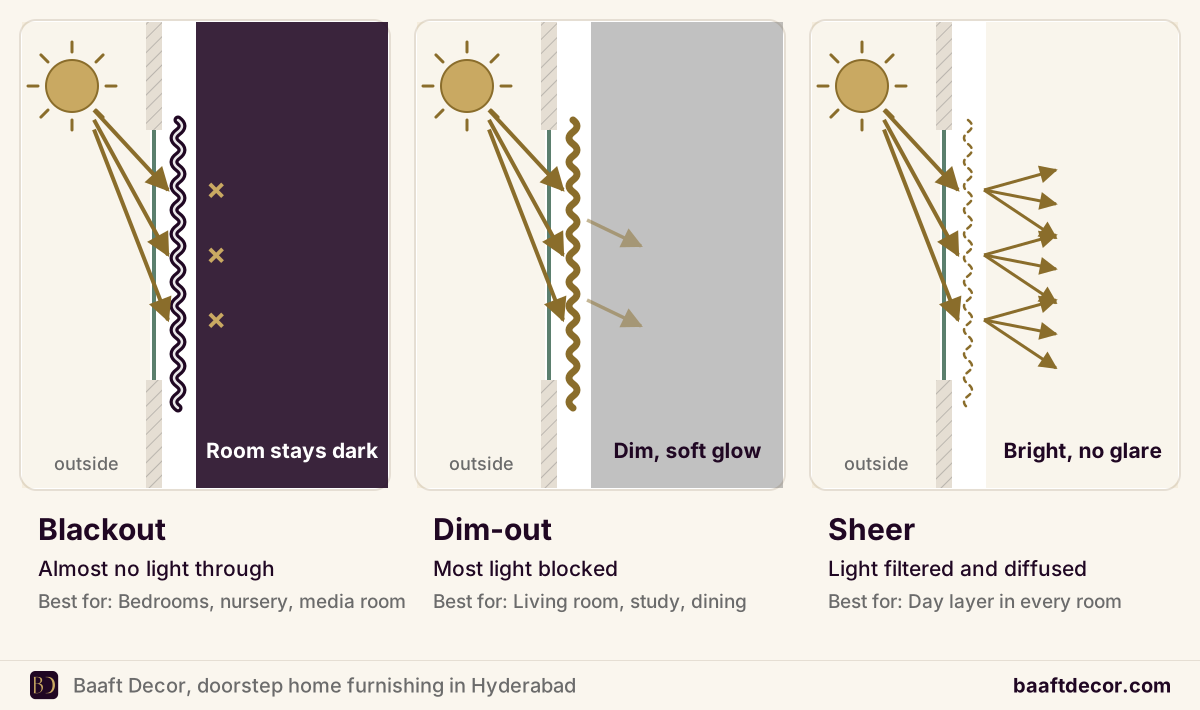
Dim-out (or room-darkening) curtains block most light but not all. The room gets dark enough for an afternoon nap or a laptop without glare, but you can still tell it’s daytime.
You’ll see percentages quoted for dim-out, but they don’t mean much. Fabric density, colour and lining all change the result, and suppliers don’t measure it the same way. Hold the actual sample up to your window at midday and judge it there.
Dim-out is the right choice for most living rooms. Full blackout in a living room tends to feel gloomy, and you’ll end up leaving it open.
What are sheer curtains, and what are the benefits?
Sheers are light, translucent fabrics such as voile, linen sheer, organza or embroidered net. Their benefits:
- Daytime privacy. You see out; neighbours in facing towers see much less in.
- Glare control. Harsh light becomes soft and even, which helps TV screens and work-from-home desks.
- Less fading. Diffused light is gentler on sofas, rugs and wooden floors.
- Easy upkeep. Most sheers wash easily, useful during Hyderabad’s dusty construction months.
The limitation: at night, with lights on inside, a sheer shows silhouettes. It always needs a partner in bedrooms.
Blackout vs dim-out vs sheer: side by side
| Factor | Blackout | Dim-out | Sheer |
|---|---|---|---|
| Light through fabric | Almost none | Most blocked, soft glow | Filtered, room stays bright |
| Daytime privacy | Full | Full | Good |
| Night-time privacy | Full | Full | Poor with lights on |
| Heat on sunny windows | Helps most, especially with light backing | Helps | Cuts glare, limited heat effect |
| Weight and drape | Heaviest, stiffer if coated | Medium | Light, flowing |
| Washing | Coated lining: gentle or dry clean | Usually machine washable | Easy |
| Best rooms | Bedrooms, nursery, media room | Living room, study, dining | Day layer everywhere |
Do blackout curtains keep the room cool?
Partly. A curtain sits inside the glass, so the sun’s heat has already come through the window before the curtain meets it. The US Department of Energy’s Building America Solution Center notes that interior attachments are less effective at reducing heat gain than exterior shading for exactly this reason.
Still, a blackout or thermal lining with a white or light backing facing the window reflects some heat back out. In a west-facing bedroom that takes the full afternoon sun from March to June, closing a lined curtain at noon changes how hot the room feels by evening. The full summer plan is in our guide to keeping your home cool in Hyderabad summers.
Why your blackout room still isn’t dark
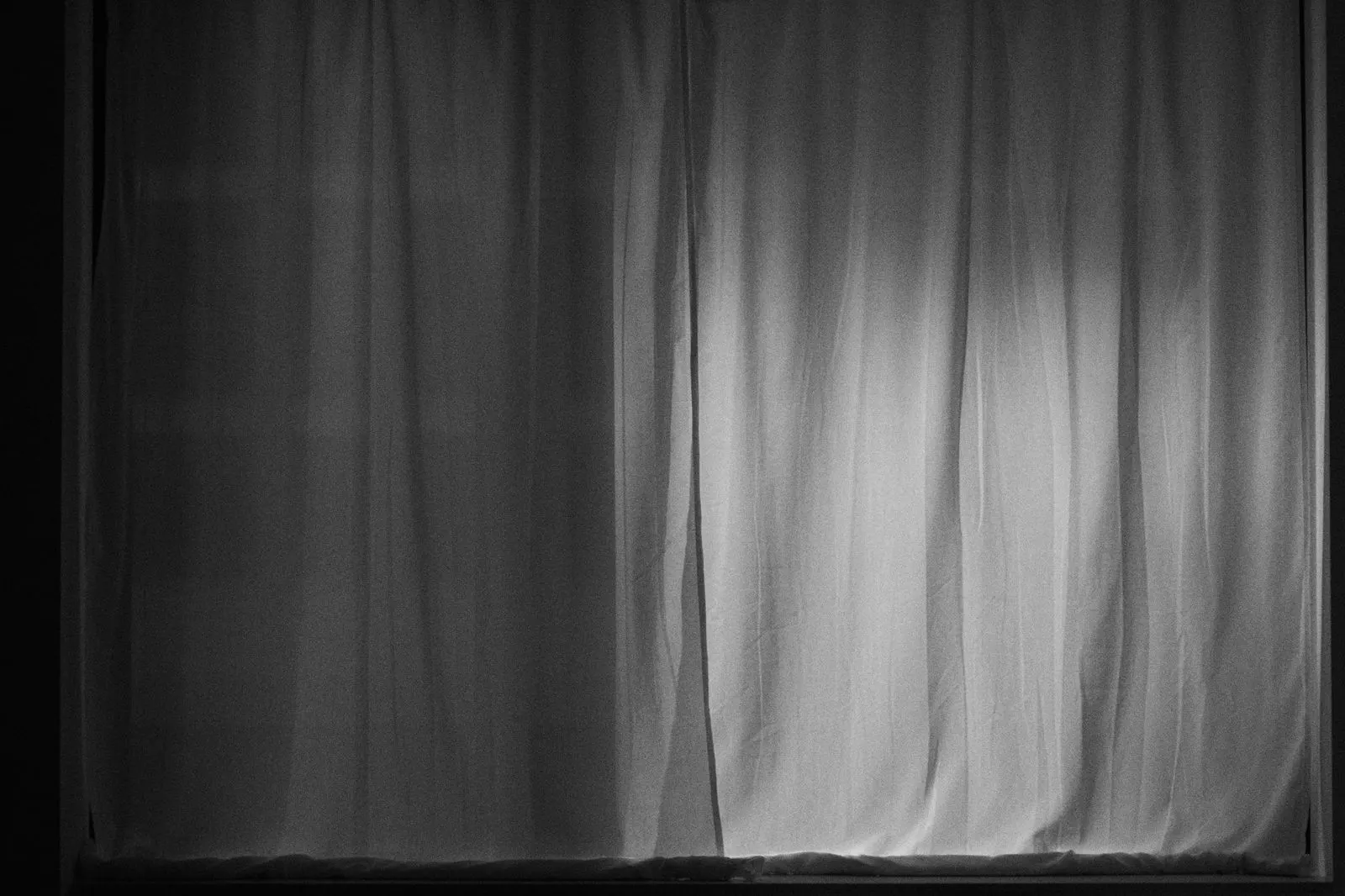
Most “my blackout curtains don’t work” complaints have nothing to do with the fabric. Light gets in around it:
- Top gap. Light spills over a rod mounted just above the frame. Mount higher, use a ceiling track, or add a pelmet.
- Side gaps. The curtain should extend 15 to 20 cm past the frame on each side. Return brackets that bend the track back to the wall close the side gap fully.
- Centre gap. Overlapping arms on the track let the two halves cross instead of just meeting.
- Bottom gap. Floor length, or at least 10 to 15 cm below the sill.
Our curtain rods and tracks guide covers ceiling tracks, double tracks and overlap arms in more detail.
Does colour matter?
Yes, in two places.
Face fabric colour. With a coated lining, the colour of the front fabric hardly changes how dark the room gets, so you can pick a pale linen-look for a bedroom and still sleep in the dark. With triple-weave fabric, colour matters a lot: charcoal and navy block far more than ivory or beige.
Lining colour. The side facing the glass should usually be white or off-white. It reflects more heat back out on sun-facing windows than a dark backing does, and the building looks uniform from outside. Some residents’ associations in gated communities prefer that, so it’s worth checking before you order.
A note on dark curtains: deep colours on a west window look rich, but the fabric itself heats up in the afternoon and can fade along the fold lines. If you love a dark shade, a light-backed lining protects it.
Blackout curtain or blackout blind?
A blackout roller blind fits inside or just outside the window recess and blocks light at the glass. It’s cleaner in small rooms, kids’ rooms where long curtains get pulled, and windows above a bed or desk. On its own, though, it leaks a thin line of light at both sides.
For the darkest possible bedroom, use both: a blackout roller blind close to the glass and a curtain in front that covers the edges. If you’re weighing the options, our window blinds service explains the blind side.
The layered setup most homes end up with
A double track or double rod carries a sheer in front and a dim-out or blackout curtain behind. During the day you open the heavy layer and keep the sheer drawn. At night you close both.
It earns its place in high-rise flats in areas like the Financial District, where many living rooms look straight across at the next tower and the afternoon sun lands on full-height glass.
Which one should you choose by room?
| Room | Recommended |
|---|---|
| Master bedroom | Sheer + blackout |
| Kids’ room / nursery | Blackout (sheer optional) |
| Living room | Sheer + dim-out |
| Home office | Sheer + dim-out |
| Home theatre | Blackout, ideally ceiling to floor |
| Dining room | Sheer, or sheer + dim-out on sunny sides |
See the difference before you decide
Fabric swatches look different in a shop than at your own window. Book a free home visit and we’ll hold blackout, dim-out and sheer samples against your glass, at your light, then measure and quote. We’re available 8 AM to 10 PM, all seven days. WhatsApp or call +91 98499 17494.
Frequently asked questions
What are blackout curtains?
Blackout curtains are curtains made to block almost all incoming light. They get this ability either from a coated blackout lining sewn behind the decorative fabric, where layers of acrylic foam and an opaque coating seal the weave, or from a dense triple-weave fabric with a dark yarn woven into the middle. Coated linings give the darkest result. Blackout curtains are used in bedrooms, nurseries, home theatres and by anyone who sleeps during the day. Light can still leak around the edges unless they are sized and mounted correctly.
What are the benefits of sheer curtains?
The main benefits of sheer curtains are daytime privacy, softer light and less glare without making a room dark. A sheer lets you see out while making it harder for neighbours or facing towers to see in during the day. It diffuses harsh sunlight, which reduces glare on TVs and laptop screens and slows fading of sofas and floors. Sheers are light, easy to wash and make rooms feel larger. They do not give privacy at night when lights are on inside.
What is the difference between dim-out and blackout curtains?
The difference between dim-out and blackout curtains is how much light gets through. Blackout curtains block almost all light, so a well-fitted blackout curtain can make a bedroom dark at noon. Dim-out curtains, also called room-darkening curtains, block most light but let a soft glow through, especially in lighter colours. Dim-out curtains are lighter, drape more softly and are usually easier to wash. Choose blackout for sleeping rooms and media rooms, and dim-out for living rooms, studies and dining areas.
Do blackout curtains keep a room cooler?
Blackout curtains can keep a room cooler, but only partly. Because they sit inside the glass, the sun's heat has already entered the window before the curtain stops it, so outdoor shading such as awnings or outdoor blinds is more effective. A blackout or thermal lining with a light or white backing facing the window reflects some of that heat back out and reduces the warm-glass feel in the room. Keep them closed on sun-facing windows during the hottest part of the day for the best result.
Are blackout drapes the same as blackout curtains?
Blackout drapes and blackout curtains do the same job: they block almost all light. The word drapes usually describes heavier, lined, floor-length curtains with a pleated top, often custom-made, while curtains can mean lighter or shorter panels. In India most people say curtains for both. What matters for darkness is not the name but the lining or fabric construction, the curtain's width and length relative to the window, and how it is mounted to stop light leaking at the edges.
Can I use only sheer curtains in a bedroom?
Using only sheer curtains in a bedroom works only if you are comfortable with early light and limited night-time privacy. Sheers filter light but do not block it, so a bedroom with only sheers gets bright at sunrise. At night, with lights on inside, people outside can see movement and silhouettes through a sheer. For most bedrooms in Hyderabad apartments, especially those facing other towers, a sheer layered with a dim-out or blackout curtain on a double track or rod is the safer choice.
How should blackout curtains be washed?
How you wash blackout curtains depends on how they are made. Curtains with a coated blackout lining should not be machine washed hard or tumble dried, because the coating can crack or peel; dry cleaning or a gentle hand wash with drip drying is safer, and some linings are made detachable for this reason. Triple-weave blackout fabrics are usually machine washable on a gentle cycle. Always check the fabric care label, and vacuum curtains regularly so dust does not build up between washes.
Do blackout curtains reduce outside noise?
Blackout curtains reduce outside noise slightly but do not soundproof a room. Their heavy, lined fabric absorbs some sound and cuts echo inside the room, which makes traffic or construction noise feel a little softer. Most outside noise in Hyderabad apartments comes through gaps around windows and sliding doors, so sealing those gaps makes a bigger difference. If noise is your main concern, combine heavy lined curtains with well-sealed windows rather than relying on curtains alone.