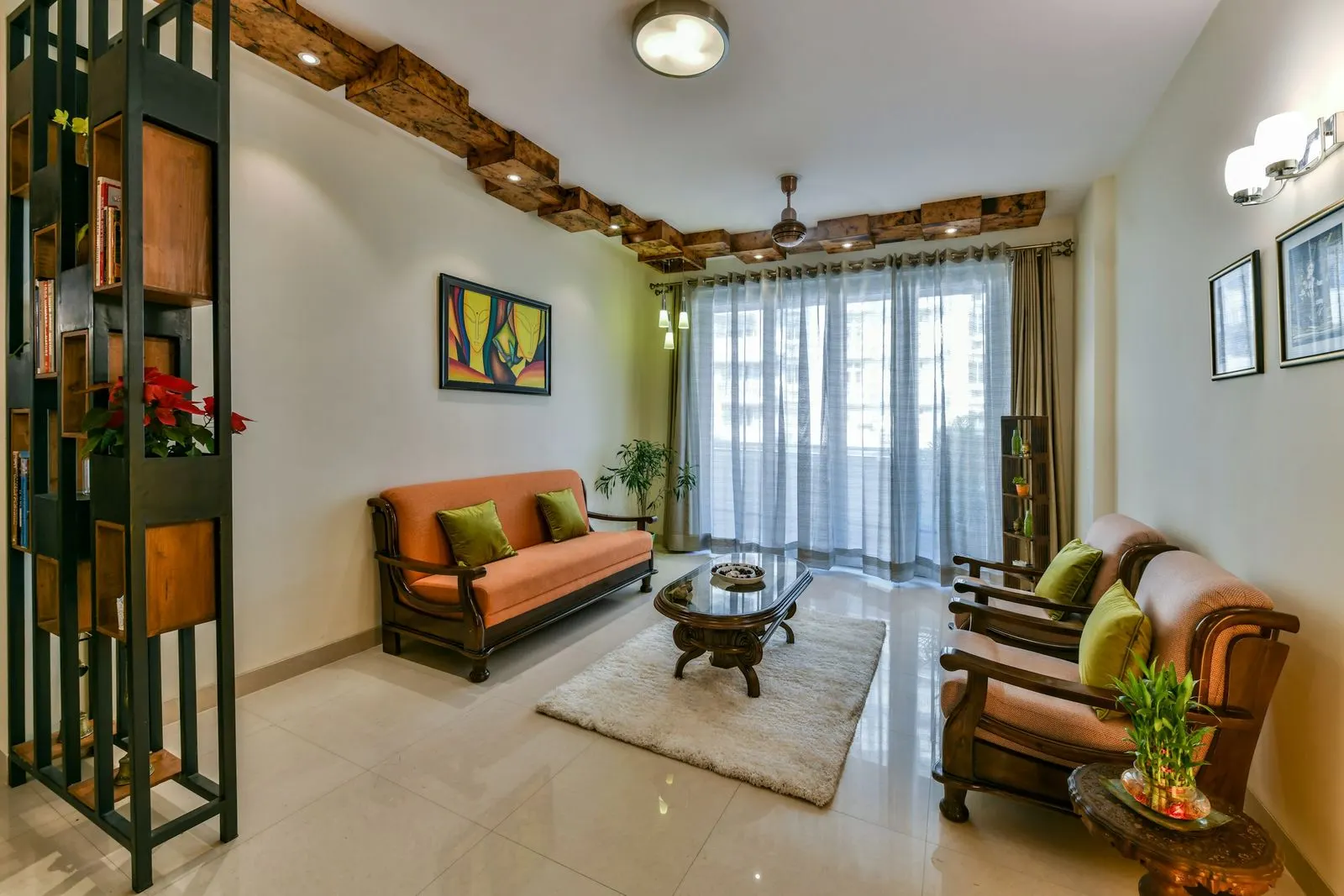
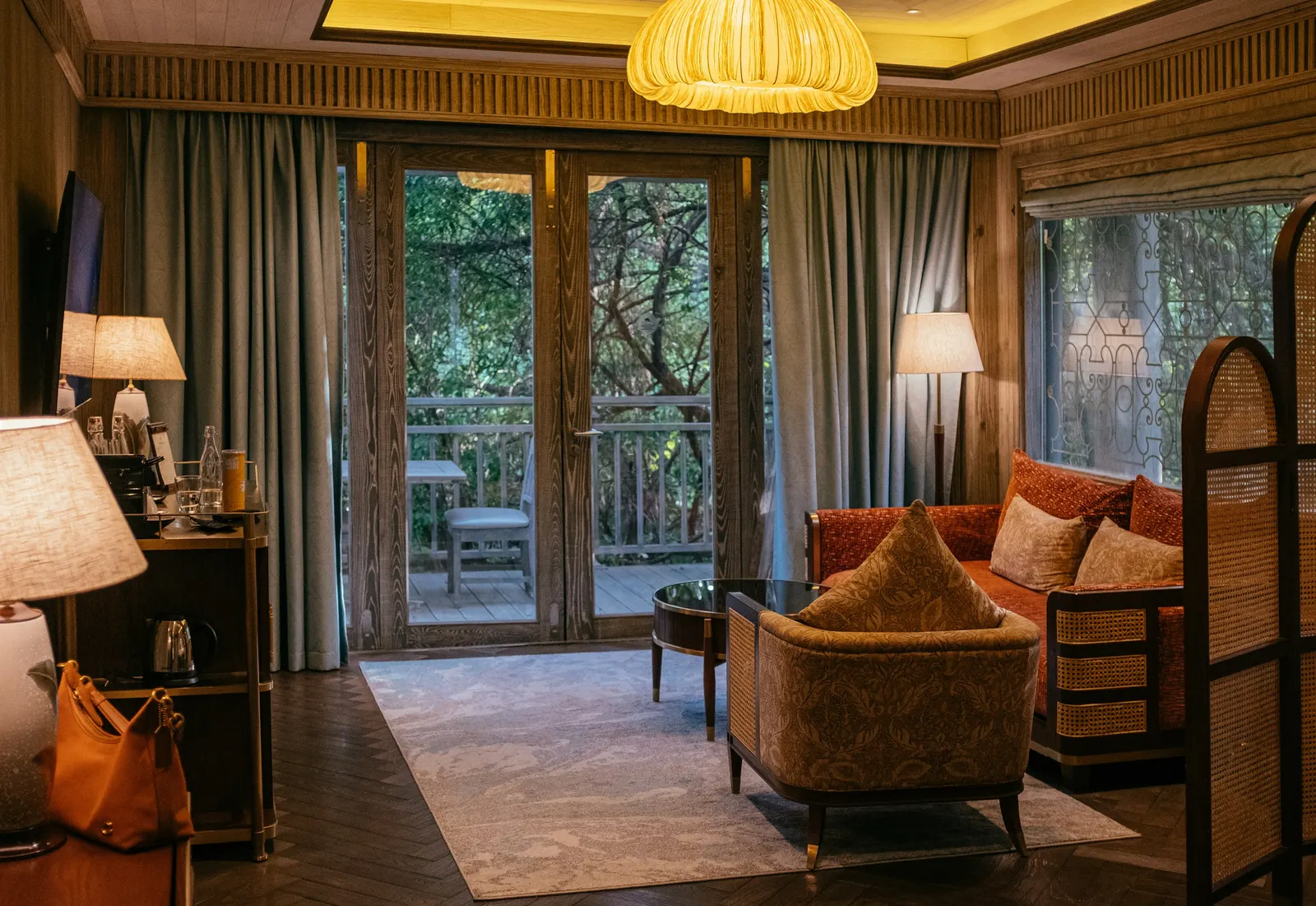
Ask for “curtains” at any furnishing shop and the next question is “which type?” That’s really two questions. How much light should the curtain block, and how should the top be stitched? Answer both properly and the curtain suits the room for years. When we design custom curtains in Hyderabad, we settle those two first and pick the fabric after.
Below is each type, how it works and where we’d use it. Type is one step in a longer sequence, and our curtains buying guide for Hyderabad homes covers the rest: measuring, hardware, cost and care.
The two ways curtains are classified
| Question | Options | What it decides |
|---|---|---|
| How much light should it block? | Sheer, dim-out (lined), blackout | Privacy, glare, darkness, heat |
| How is the top stitched? | Eyelet, pencil pleat, pinch pleat, box pleat, ripple fold, goblet, tab-top | Look of the folds, fabric quantity, rod or track |
Fabric and special features (motorisation, thermal lining) come after these two.
Types of curtains by light control
Sheer curtains
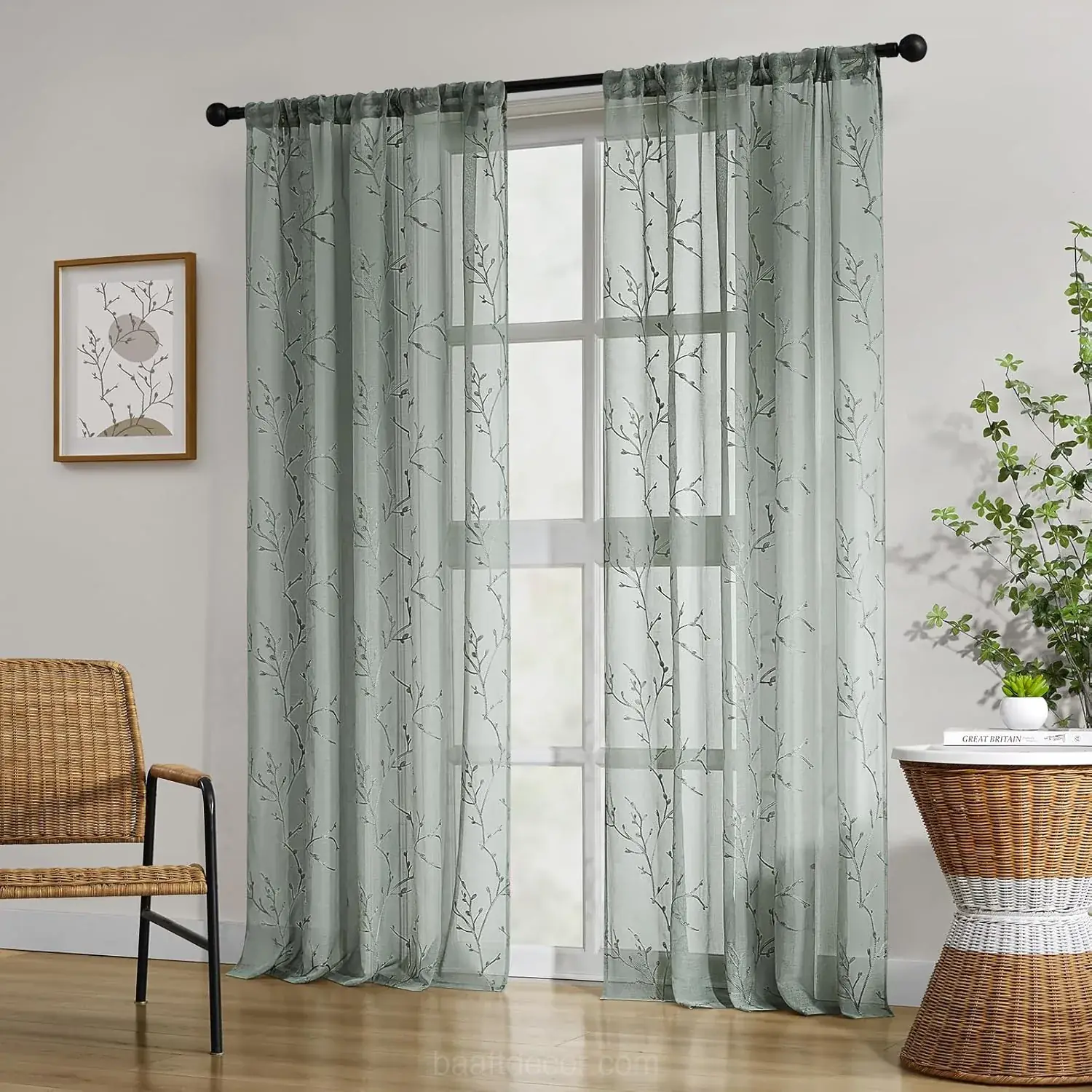
Thin, see-through fabric like voile or linen sheer. They filter daylight, cut glare and give daytime privacy from the street or a facing tower. At night, with lights on inside, people can see through them. So sheers almost always need a second layer.
Dim-out or lined curtains
A regular curtain fabric with a lining sewn behind it. The room gets noticeably darker and the face fabric is protected from sun fading. This is the sensible default for living rooms.
Blackout curtains
These block almost all light, either through a coated blackout lining or a dense triple-weave fabric. We fit them in bedrooms, media rooms and for anyone who sleeps through the day after a night shift. Our blackout curtains service covers fabric and lining options in detail.
For a closer comparison of the three, read blackout vs sheer vs dim-out curtains.
Types of curtains by heading style
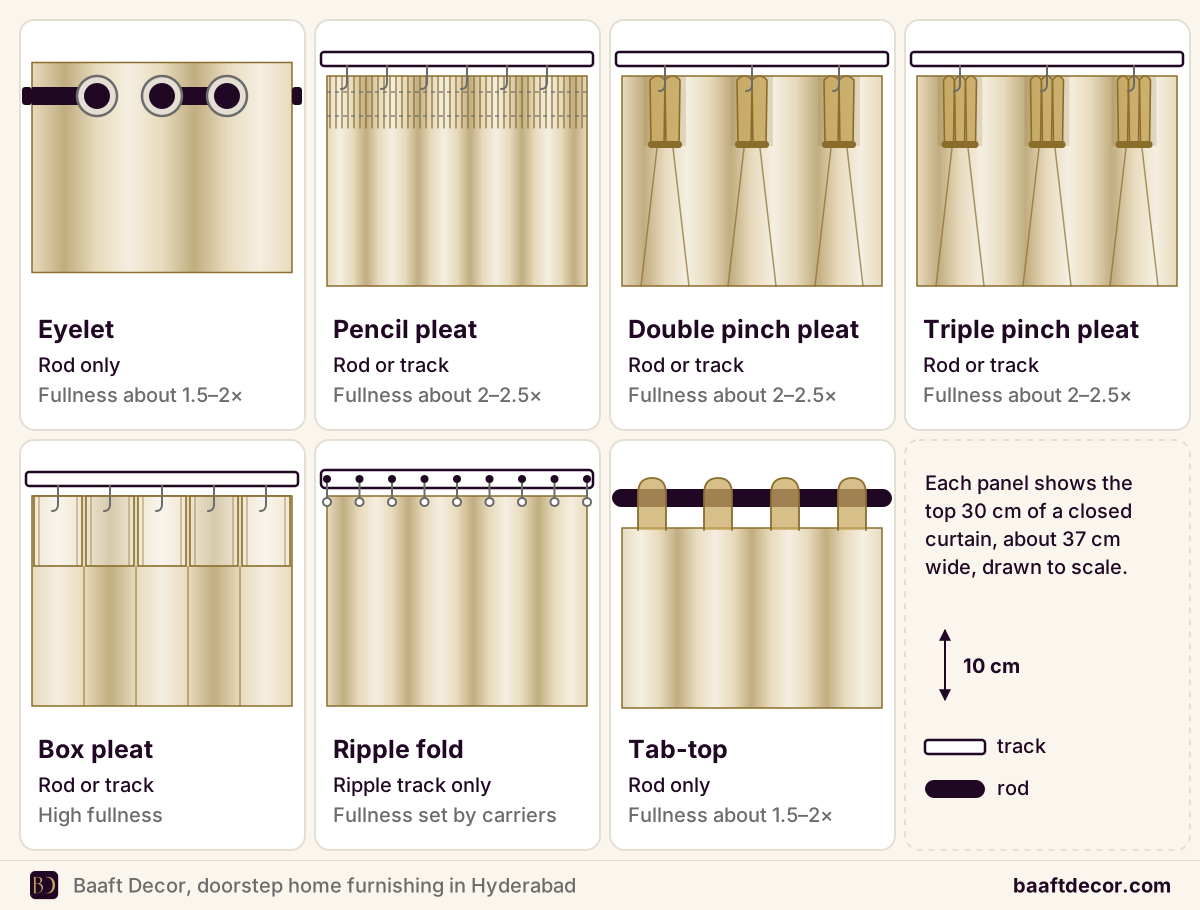
The heading changes how the curtain looks more than almost anything else. It also decides how much fabric you need.
| Heading | Look | Fabric fullness | Hardware | Best for |
|---|---|---|---|---|
| Eyelet (grommet) | Soft, wide, casual folds | About 1.5 to 2x | Rod only | Kids’ rooms, study, rentals |
| Pencil pleat | Tight, gathered folds | About 2 to 2.5x | Rod or track | Budget-friendly all-rounder |
| Pinch pleat (double or triple) | Crisp, tailored, even | About 2 to 2.5x | Rod or track | Living rooms, master bedrooms |
| Box pleat | Flat, structured, formal | High | Rod or track | Formal living and dining rooms |
| Ripple / wave fold | Even S-shaped waves | About 2 to 2.5x | Ripple track only | Modern apartments, motorised |
| Goblet pleat | Rounded, cup-shaped tops | High | Rod or track | Tall, formal rooms |
| Tab-top / rod pocket | Relaxed, gathered | About 1.5 to 2x | Rod only | Curtains that stay mostly closed |
Eyelet
Metal rings punched into the top. They slide easily and use the least fabric. The catch: the ring size must match the rod, and eyelets can’t run on a slim ceiling track. Many Hyderabad apartments now have false ceilings with track pockets, so eyelets don’t fit that plan.
Pinch pleat
Fabric is pinched into groups of two or three folds and stitched at fixed spacing. The three-fold version is the one most Indian homes know. It works on rods and tracks and looks tidy whether open or closed, which is why it’s the most common choice we see for living rooms.
Ripple fold
The curtain clips onto carriers inside a special track, so every wave is identical. It stacks compactly when open, which helps on wide sliding doors where you want as much glass clear as possible. It’s also the usual pairing with motors. More on hardware in our curtain rods and tracks guide.
Pencil pleat, box pleat, goblet and tab-top
Pencil pleat is the economical all-rounder. Box and goblet pleats are formal and suit high ceilings. Tab-top and rod-pocket curtains drag on the rod, so we only suggest them for decorative panels that rarely move.
Types of curtains by fabric
The fabric decides how long the curtain survives a Hyderabad summer.
- Polyester and poly-blends: Hold colour in strong sun, wash easily and resist creasing. Our usual pick for west-facing rooms.
- Cotton: Soft and breathable, but fades and can shrink. Best lined.
- Linen and linen-look: The textured look many new apartments want. True linen creases; linen-look polyester gives a similar feel with less upkeep.
- Velvet: Rich and heavy, good for formal rooms and some light blocking. Collects dust, so plan for regular vacuuming during construction season.
- Silk and faux silk: Real silk weakens in direct sun and needs lining. Faux silk (polyester) gives the sheen without that problem.
- Jacquard and embroidered weaves: Patterned in the weave itself. Common in traditional living rooms and pooja room curtains.
Types of curtains by length
Length is where most ready-made curtains go wrong, so it’s worth getting exact.
- Sill length ends about 1 cm above the windowsill. Practical for windows above a bed, desk or kitchen counter.
- Below-sill (apron) length drops 10 to 15 cm past the sill to cover the gap where light leaks in.
- Floor length stops about 1 to 2 cm above the floor. This is what most living rooms and bedrooms get, and it makes ceilings look taller.
- Puddled curtains are deliberately 5 to 15 cm longer so they pool on the floor. They look dramatic in photos, but in Hyderabad they collect construction dust and get trodden on, so we rarely recommend them.
Ready-made curtains in India usually come in 5 ft, 7 ft and 9 ft lengths. Real windows rarely match, which is why so many curtains hover a few inches above the floor.
What Hyderabad conditions mean for your choice
Three things wear curtains out here.
Sun. West- and south-west-facing windows take heavy afternoon sun from March to June. Unlined natural fabrics fade on these windows, so lining matters more than the heading.
Dust. New gated communities stay dusty for months while neighbouring towers are built. Washable sheers and smooth polyester shed dust better than velvet or heavy textures.
Monsoon humidity. Between June and September, lined curtains pressed against damp walls or condensation-prone glass can develop mildew spots. Leave a small gap from the glass and air the room on dry days.
You’ll also hear the word “drapes” in shops and online. Our guide on drapes vs curtains explains where the line actually sits.
Special-purpose curtains
- Motorised curtains run on a motor-rated track, controlled by remote, app or schedule. Useful for tall windows and heavy lined curtains.
- Thermal curtains have a coated lining that helps reduce heat entering from sunny windows.
- Door and partition curtains divide spaces, hide store areas or screen a kitchen entrance.
- Balcony curtains use outdoor-grade fabric that tolerates sun and monsoon moisture.

Which type of curtain is best for each room?
| Room | Light control | Heading | Notes |
|---|---|---|---|
| Living room | Sheer + dim-out | Pinch pleat or ripple fold | Double track or rod for two layers |
| Master bedroom | Sheer + blackout | Pinch pleat or ripple fold | Ceiling-mounted, floor length to stop light leaks |
| Kids’ room | Blackout or dim-out | Eyelet or pencil pleat | Washable fabric, no cords hanging low |
| Study / home office | Dim-out | Pencil pleat or eyelet | Stops screen glare without darkening the room |
| Pooja room | Sheer or light lined | Pinch pleat or tab-top | Often a decorative jacquard or embroidered fabric |
| Kitchen | Blinds usually better | Not applicable | Curtains near the hob absorb oil and smoke |
In kitchens, bathrooms and some balcony windows, a blind often works better than any curtain. Our blinds vs curtains comparison explains when to switch.
Choosing your type at home
It’s hard to judge a heading from a catalogue photo. Book a free home visit and we’ll bring fabric samples, hold them up against your windows in your light, measure every room, and give a written quote. We work across Hyderabad from 8 AM to 10 PM, all seven days. WhatsApp or call +91 98499 17494.
Frequently asked questions
What are the different types of curtains?
The different types of curtains are usually described in two ways. By light control, there are sheer curtains that filter daylight, dim-out or lined curtains that soften it, and blackout curtains that block almost all of it. By heading, which is how the top is stitched and hung, the common types are eyelet, pencil pleat, pinch pleat (double or triple), box pleat, ripple or wave fold, goblet pleat and tab-top. Fabric (polyester, cotton, linen-look, velvet) and function (motorised, thermal, door curtains) are further ways to describe them.
Which type of curtain is best for an Indian home?
For most Indian homes, the best type of curtain is a two-layer setup: a light sheer in front for daytime privacy and glare control, and a lined dim-out or blackout curtain behind it for night-time privacy and heat. Pinch pleat and ripple fold headings look neat and suit most living rooms and bedrooms. A sun-fast polyester or poly-blend fabric handles strong summer sun, dust and frequent washing better than pure cotton or silk, which fade and weaken faster on sunny windows.
Which type of curtain is best for a living room?
The best type of curtain for a living room is usually a sheer layer combined with a lined pinch-pleat or ripple-fold curtain on a double track or rod. The sheer keeps the room bright while cutting glare on the TV and blocking the view from facing towers. The lined curtain handles evening privacy and the afternoon sun on west-facing windows. Dim-out lining is normally enough in a living room; full blackout is only needed if you use the room for movies during the day.
Which type of curtain is best for a bedroom?
The best type of curtain for a bedroom is a blackout curtain, ideally with a sheer layer in front for daytime use. Blackout lining keeps early morning light out, which matters in Hyderabad where the sun rises early through most of the year. For the darkest result, hang the curtain from a ceiling track or a rod mounted well above the window, extend it past the frame on both sides, and let it reach the floor so light cannot leak around the edges.
Are eyelet curtains better than pleated curtains?
Eyelet and pleated curtains suit different rooms, so neither wins everywhere. Eyelet curtains use less fabric, slide easily on a rod and cost less, so they work well in kids' rooms, study rooms and rented homes. Pleated curtains such as pinch pleat or pencil pleat hold neater, more even folds, work on tracks as well as rods, and look more tailored in living rooms and master bedrooms. Eyelets cannot run on a slim ceiling track, which limits them in homes with false ceilings.
What is a ripple fold curtain?
A ripple fold curtain, also called a wave curtain, is a curtain that hangs in even, continuous S-shaped folds from a special track. Small carriers in the track are spaced at fixed intervals and the curtain snaps onto them, so every fold is the same depth whether the curtain is open or closed. Ripple fold curtains look clean and modern, stack neatly when open, and are the usual choice for motorised curtains. They need a ripple-fold track and cannot be hung on a decorative rod.
Which curtain fabric lasts longest in strong sun?
Polyester and polyester-blend curtain fabrics generally last longest in strong sun because they hold colour better and are less damaged by sunlight than natural fibres. Cotton and linen fade faster on sunny windows, and silk weakens with prolonged sun exposure. Whatever the fabric, a lining sewn behind it protects the face fabric from direct sunlight and greatly slows fading. On west-facing windows in Hyderabad, a lined poly-blend in a mid or light shade is usually the most durable choice.
Should every room in the house have the same type of curtain?
Every room does not need the same type of curtain, but keeping the heading style and hardware consistent where rooms are visible from each other looks better. A common approach is to use the same heading, for example pinch pleat or ripple fold, across the living and dining area, then vary the fabric and lining by room: blackout in bedrooms, sheers plus dim-out in living spaces, and simpler eyelet curtains in kids' rooms or the study. This keeps the home looking planned without overspending.