You’ve measured the window. Now the shop asks, “How many metres?” This guide answers exactly that: how to turn a track length and a drop into metres of curtain fabric, so you can check a quote or buy your own cloth with confidence. When we do curtain stitching in Hyderabad, whether with our fabric or cloth you bought elsewhere, this is the arithmetic we run before cutting anything.
If you haven’t measured yet, start with how to measure windows for curtains, which covers rod height, overhang and drop. Fabric quantity is one step in a longer sequence; our curtains buying guide for Hyderabad homes covers the rest.
The curtain fabric formula in one line
Curtain fabric in metres = number of fabric widths × cut drop. Everything else in this guide is about getting those two numbers right.
- Finished width: track or rod length, plus about 10 cm for returns (the sides that turn back to the wall) and the centre overlap.
- Flat width: finished width × fullness, plus side hems.
- Number of widths: flat width ÷ usable fabric width, rounded up.
- Cut drop: finished drop + heading allowance + hem allowance, rounded up to whole pattern repeats if the fabric has one.
- Total: widths × cut drop.
Want us to do the sums for your windows? We visit with samples and measure, free across Hyderabad. WhatsApp +91 98499 17494.
Fullness by heading: how much wider than the track?
Fullness is the ratio of flat fabric to finished curtain width. It’s the biggest single factor in how many metres you buy. A curtain at 1x looks like a bedsheet stretched across the glass. The typical ranges below are common trade practice; your maker may work slightly differently.
| Heading | Typical fullness | What it means for fabric |
|---|---|---|
| Eyelet (grommet) | 1.5 to 2x | Least fabric; eyelet count must be even per panel |
| Pencil pleat | 2 to 2.5x | Gathered tape, flexible |
| Pinch pleat (double or triple) | 2 to 2.5x | Triple pleats sit toward the top of the range |
| Ripple fold | about 2 to 2.5x | Set by the carrier spacing on the track |
| Sheers (any heading) | 2.5 to 3x | Thin fabric needs more to look full |
Eyelets have one quirk. The number of rings on each panel should be even, so both edges turn back toward the wall. That sometimes pushes a panel up to the next half width. Our types of curtains guide compares how each heading is stitched.
Fabric width: 54 inch versus 110 inch and wider
Fabric width decides how many drops you cut. Most curtain fabric sold in India comes around 54 inches (137 cm) wide, sometimes 48 or 58 to 60 inches. That’s “up the roll” fabric: the pattern runs along the length, so you cut drops and join widths side by side.
Many sheers and some plain fabrics come in wide widths, typically around 110 to 118 inches (about 2.8 to 3 m). These are often used railroaded, turned sideways so the roll width becomes the drop. Railroaded fabric is woven so the pattern or grain runs across the width instead of along it. For curtains, that means one long continuous panel with no vertical seams, and you simply buy a length equal to the flat width.
| Standard width (about 54 in) | Wide width, railroaded (about 110 to 118 in) | |
|---|---|---|
| How it’s cut | Vertical drops, joined side by side | One length, used sideways |
| You buy | Widths × cut drop | Flat width (plus side hems) |
| Visible joins | Yes, on wide windows | None |
| Height limit | None | Cut drop must fit inside the roll width |
| Typical use | Main curtains, prints, velvet | Sheers, some plain fabrics |
The height limit catches people out in Hyderabad. Under a typical false ceiling, a floor-length drop is often over 2.6 m, and once you add heading and hem allowances, a 110 inch roll (about 279 cm) can be too short. Check the roll width against your cut drop before you buy a wide sheer.
Cut drop: finished drop plus allowances
Cut drop is what each width is actually cut to. Take the finished drop from your measurements (track to floor, minus 1 to 2 cm of clearance for floor-length curtains) and add:
- Heading allowance: typically about 5 to 15 cm, depending on the heading tape or buckram.
- Hem allowance: typically about 10 to 20 cm for a double-turned bottom hem. A deeper hem makes heavy curtains hang straighter.
Together that’s usually 20 to 30 cm per drop. Different makers use different allowances, so if you’re supplying fabric, ask your tailor for their figure. UK fabric suppliers describe the same method: finished drop plus allowances equals cut drop.
Worked example: a living-room window in Hyderabad
Here’s a typical apartment window with a false ceiling: track 240 cm, pinch pleat pair at 2.5x, floor-length, plain 54 inch fabric.
- Finished width: 240 + 10 = 250 cm
- Flat width: 250 × 2.5 = 625 cm, plus 4 side hems of about 5 cm = 645 cm
- Widths: 645 ÷ 137 = 4.7, so 5 widths (2.5 per curtain)
- Finished drop: 263 cm. Cut drop: 263 + 10 + 15 = 288 cm
- Total: 5 × 2.88 m = 14.4 m of plain fabric
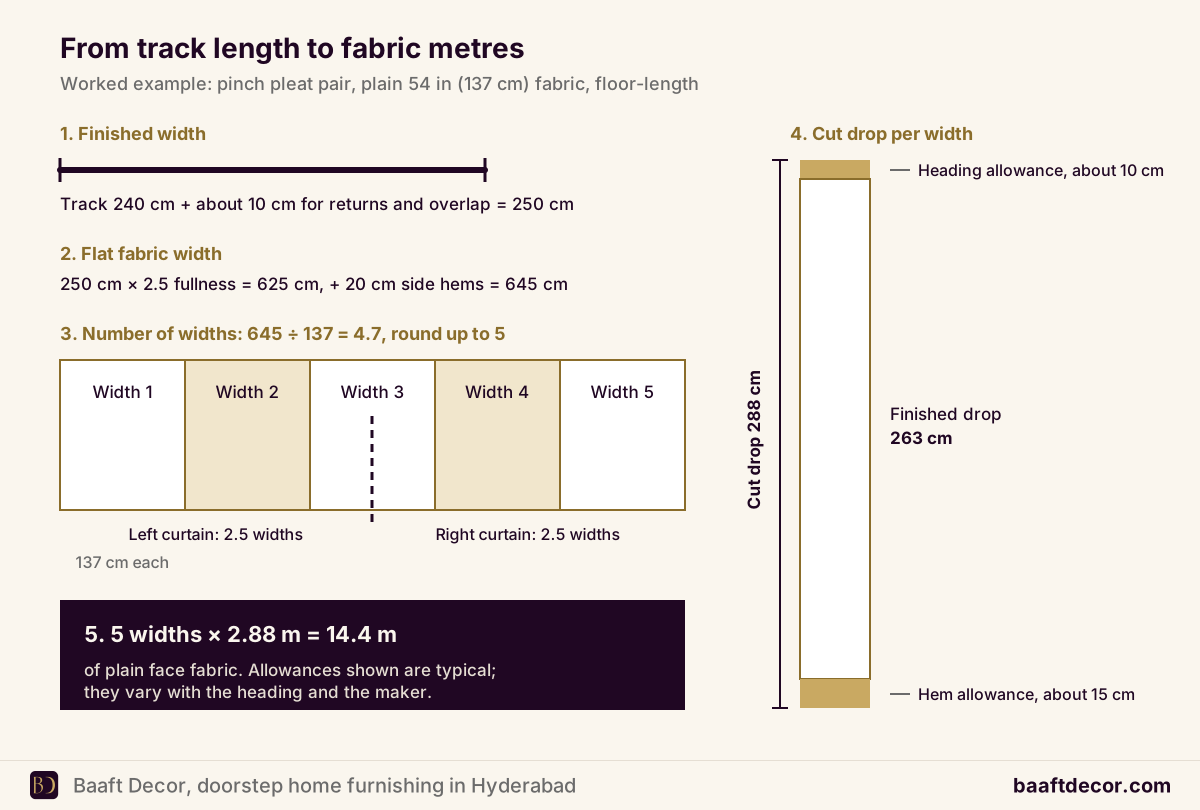
Each width must go fully to one curtain or be split exactly in half, so a pair can take 2, 3, 4 or 5 widths but never 2.3. Always round up.
Quick reference for floor-length curtains
Worked out with the same method: 263 cm finished drop (288 cm cut), plain 54 inch fabric, typical allowances. Your windows will differ, so treat this as a sense check, not a quote.
| Track length | Eyelet at 2x | Pinch pleat at 2.5x |
|---|---|---|
| 120 cm | 3 widths, about 8.6 m | 3 widths, about 8.6 m |
| 180 cm | 3 widths, about 8.6 m | 4 widths, about 11.5 m |
| 240 cm | 4 widths, about 11.5 m | 5 widths, about 14.4 m |
| 300 cm | 5 widths, about 14.4 m | 6 widths, about 17.3 m |
Pattern repeat: why printed fabric needs more
A pattern repeat is the distance before the design starts again. If your fabric has one, every cut drop must be rounded up to a whole number of repeats so the pattern lines up across joins and between the two curtains.
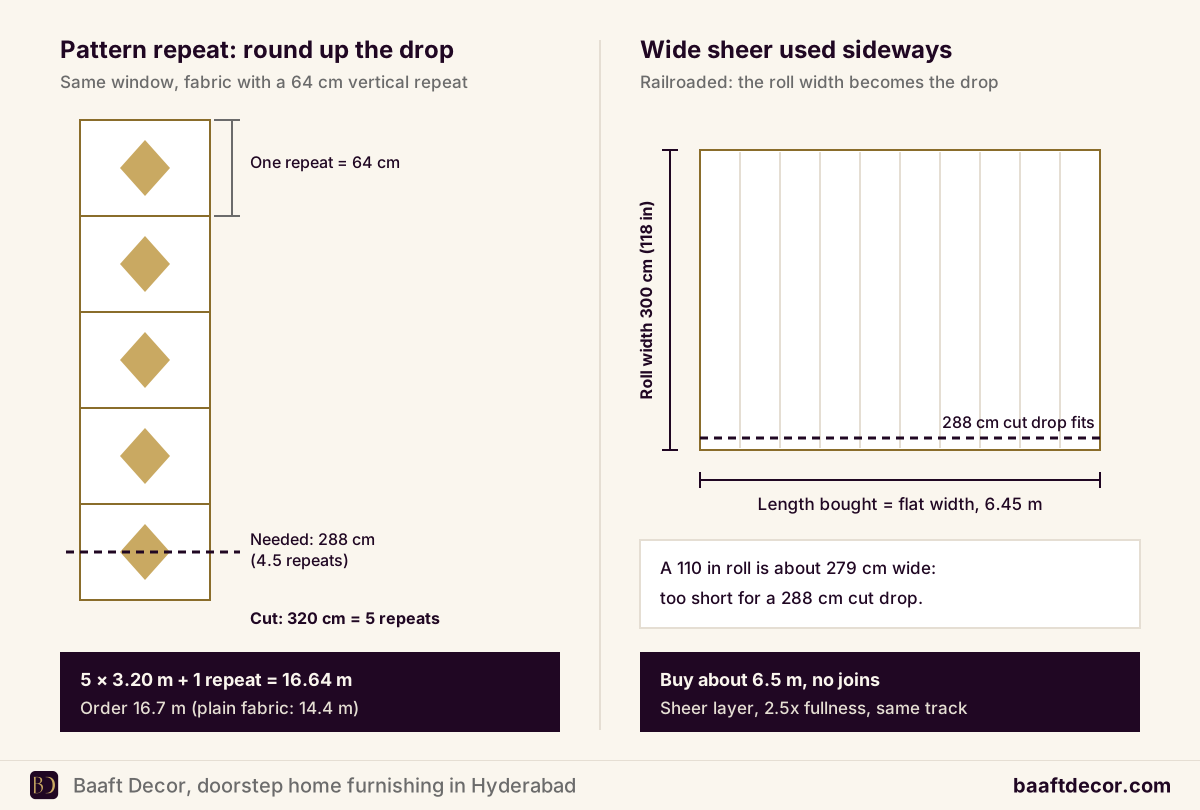
In the example above, with a 64 cm repeat, the 288 cm cut drop is 4.5 repeats, so each width is cut to 5 repeats: 320 cm. Five widths × 3.20 m = 16.0 m, plus one extra repeat to place the pattern nicely on the window, gives 16.64 m. Order 16.7 m, compared with 14.4 m for plain fabric.
Half-drop patterns, where alternate widths shift by half a repeat, can need a little more again. Ask the shop for the repeat before you calculate.
The sheer layer and the lining
Sheer layer. Using the same 250 cm finished width at 2.5x fullness, the flat width is again about 645 cm. In a 118 inch (300 cm) wide sheer used sideways, the 288 cm cut drop fits, so you buy about 6.5 m with no joins. In 54 inch sheer you’d need five drops instead, about 14.4 m with seams. Read our sheer curtains guide for fabric choices.
Lining. Lining usually takes the same number of widths, a slightly shorter cut drop (it’s finished just above the curtain hem) and never a repeat. Our curtain lining guide explains dim-out, blackout and thermal options.
Common fabric-buying mistakes we see
- Buying for the window, not the track. The track extends past the frame, so the curtain must too.
- Forgetting allowances. Buying exactly “the drop” leaves nothing for heading and hem.
- Ignoring the pattern repeat. It’s the most common reason people run out on the last width.
- Mixing dye lots. Buy all fabric for one room from the same roll or batch, especially in strong colours.
- Skipping pre-wash on cotton and linen. Natural fibres can shrink, so ask whether the fabric is pre-shrunk.
- Wide sheer, tall drop. Check the roll width covers your cut drop under a high false ceiling.
Construction dust and monsoon humidity don’t change the arithmetic, but they do affect what you buy. Washable fabrics and a lining make curtains easier to live with in a new Hyderabad flat.
Get the quantity checked before you buy
Fabric shops are happy to sell you a round number; it doesn’t always match your window. We’re happy to check your sums, or measure and quote the full job, fabric to fitting. We take on curtains in Hyderabad of every kind, and Baaft Decor measures, stitches and fits curtains at homes across the city. We regularly work on new flats needing curtains in Manikonda, curtains in Nallagandla and curtains in Tellapur.
Book a free home visit and we’ll bring fabric samples, measure every window and give you a written quote with the exact metres. We work 8 AM to 10 PM, all seven days. WhatsApp or call +91 98499 17494.
Frequently asked questions
How do I calculate how much fabric I need for curtains?
To calculate curtain fabric, take the finished width (track or rod length plus about 10 cm for returns and overlap) and multiply it by the fullness for your heading, typically 2 to 2.5 for pleats and ripple fold or 1.5 to 2 for eyelets. Add about 5 cm of side hem per curtain edge. Divide by the usable fabric width, usually 137 cm for 54 inch fabric, and round up to get the number of widths. Multiply the widths by the cut drop, which is the finished drop plus about 20 to 30 cm for heading and hem.
How many metres of fabric do I need for a window curtain?
The metres of fabric you need for a window curtain depend on the track length, heading and drop. As a worked example, a 240 cm track with a pinch pleat pair at 2.5 times fullness and a 263 cm floor-length drop needs five widths of 54 inch fabric, each cut to about 2.88 m, which is roughly 14.4 m of plain fabric. A short window with a 120 cm track and the same drop needs about 8.6 m. Patterned fabric needs more because each drop is rounded up to whole pattern repeats.
How much fabric do I need for a 7 ft door curtain?
A 7 ft (about 213 cm) door curtain needs a cut drop of roughly 2.4 m per fabric width once heading and hem allowances of about 20 to 30 cm are added. How many widths you need depends on the door width and heading. A standard 3 ft door with a rod extending past each side, in eyelet heading at 2 times fullness, usually needs two or three widths of 54 inch fabric, so about 4.8 to 7.2 m in total. A wider balcony door or a pleated heading needs more widths.
What is cut drop in curtain making?
Cut drop is the length each piece of curtain fabric is cut to before stitching. It equals the finished drop, measured from the track or rod to where the curtain ends, plus allowances for the heading at the top and the hem at the bottom. Typical allowances add about 20 to 30 cm, depending on the heading tape, buckram and hem depth the maker uses. For patterned fabric, the cut drop is rounded up to a whole number of pattern repeats so the design matches across joined widths.
Does patterned fabric need more fabric for curtains?
Patterned curtain fabric needs more metres than plain fabric because every cut drop must be rounded up to a whole number of pattern repeats, so the design lines up across joined widths and between the left and right curtains. Most makers also add one extra repeat to position the pattern on the window. In a worked example, a window needing 14.4 m of plain fabric needs about 16.7 m of fabric with a 64 cm repeat. Large repeats on tall drops can add more than that, so check the repeat before ordering.
What is railroaded curtain fabric?
Railroaded curtain fabric is fabric whose design or grain runs across the roll rather than along it, so the roll width becomes the curtain's height. Wide-width sheers, often around 110 to 118 inches (about 2.8 to 3 m), are commonly used this way. You buy a length equal to the flat curtain width and get one continuous curtain with no vertical joins. The limit is height: the cut drop must fit inside the roll width, so very tall drops under high false ceilings may need a wider roll.
How much lining fabric do I need for curtains?
Lining for curtains usually needs about the same number of widths as the face fabric, because lining rolls are commonly a similar width to 54 inch curtain fabric. The cut drop is often a little shorter, since lining is typically finished slightly above the curtain's bottom hem so it does not show. Lining has no pattern repeat, so you never round up for it. For the worked example in this guide, that means roughly 14 m of lining behind 14.4 m of plain face fabric. Blackout lining follows the same calculation.
Should I buy extra curtain fabric?
Buying a little extra curtain fabric is sensible if you are supplying your own material, because rolls can have flaws, dye lots vary between batches, and a later repair or extra window is easier with matching fabric. Rounding up to the next half metre is common for plain fabric. For patterned fabric, the extra repeat for positioning already gives some margin. Ask your curtain maker to confirm the final quantity before you buy, since their heading and hem allowances decide the exact cut drop.