Most homes we visit in Hyderabad want two things from a window at once: daylight, and not being on display to the tower opposite. Sheer curtains are how you get both during the day. When we plan custom sheer curtains in Hyderabad, the first question isn’t the fabric. It’s whether the sheer has to work alone, or whether it’ll have a lined curtain behind it for the evening.
This guide covers the sheer layer in detail: types, privacy, layering, fullness, colour and care. For where sheers fit among all your curtain decisions, start with our curtains buying guide for Hyderabad homes.
What are sheer curtains?
Sheer curtains are thin, see-through curtains made from finely woven or open-mesh fabric. They filter daylight, soften glare and blur the view in from outside, but they don’t block light or give privacy at night.
You’ll hear several names in shops: sheers, sheer drapes, voile, net curtains, “curtains and sheers”. They overlap, but they aren’t quite the same thing.
Sheer vs voile vs net vs linen-look
| Type | What it is | Look | Daytime privacy | Where we’d use it |
|---|---|---|---|---|
| Voile | Fine, soft, plain-weave fabric, today mostly polyester | Smooth, light folds | Good | Living rooms, bedrooms behind blackout |
| Net / tulle | Open mesh construction, often embroidered | Very airy, most see-through | Lower | Decorative layers, pooja rooms, doors |
| Linen-look sheer | Polyester with slubbed, textured yarn | Matte, natural texture | Better | Modern apartments, living rooms |
| Semi-sheer | Denser weave, still lets light through | Soft, slightly opaque | Best of the sheers | Ground-floor flats, street-facing rooms |
| Embroidered or printed sheer | Any of the above with a pattern | Decorative | Varies | Traditional living rooms |
Voile is a soft, light fabric that you can see through slightly, traditionally cotton, now mostly polyester for curtains. “Net curtain” in Indian shops often just means any sheer, so ask to see the actual weave before you decide.
A note on names: a “mosquito net curtain” is a different product, a fine insect mesh hung at doors or windows to keep insects out. It isn’t a decorative sheer, though the two are often sold side by side, and a sheer won’t stop mosquitoes. If insects are the problem, fit mosquito mesh on the window itself and keep the sheer for light and privacy.
Our take: linen-look sheers have become the default in new Hyderabad apartments because they give a little more daytime privacy than plain voile, hide dust better and look less “shiny” in strong sun.
Want sheers measured for your windows? We visit with samples, free across Hyderabad. WhatsApp +91 98499 17494.
How much privacy do sheer curtains really give?
A sheer hides whichever side of the glass is darker. That’s the whole rule.
During the day, the outside is brighter than your room, so the sheer looks pale from a facing flat and the room behind it is hard to make out. After dark with lights on, the room is brighter, and silhouettes and movement show clearly through the fabric.
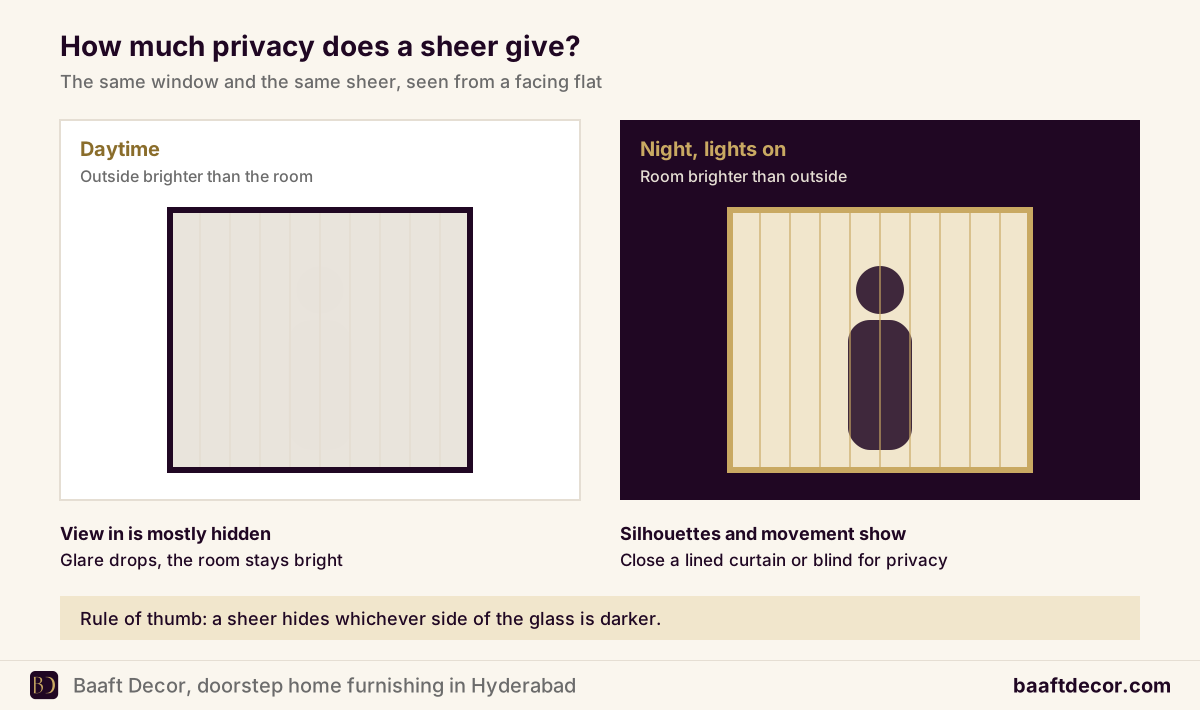
What this means in practice:
- Ground and lower floors facing a road or a neighbour: choose a semi-sheer or linen-look sheer for more daytime cover.
- High floors with no facing tower: an airy voile is often enough for the day.
- Every bedroom and most living rooms: add a lined curtain or blind for the night.
For how sheers compare with lined and blackout curtains on light and heat, read blackout vs sheer vs dim-out curtains.
Layering sheers with drapes
Layering means a sheer and a heavier curtain on the same window, each on its own track or rod. The usual order is the sheer closest to the glass and the lined curtain on the room side.
- Double track or double rod. Two runs, side by side. In homes with false ceilings, we often fit a double ceiling track recessed into a pocket so the hardware disappears.
- Sheer stays closed all day. The main curtain stacks open in daytime and closes at night.
- Match the headings. Ripple fold over ripple fold, or pinch pleat with pinch pleat, looks planned. Mixing an eyelet sheer with a pleated main curtain rarely does.
- Reverse layering (sheer on the room side) looks soft and hotel-like, but you’ll be moving the sheer every evening. We suggest it only where the main curtain rarely moves.
Headings and hardware for sheers
The heading is how the top of the sheer is stitched, and it changes how the folds fall. For sheers, three work best:
- Ripple fold (wave): even, continuous S-shaped folds on a ripple track. The cleanest modern look, and the usual choice for wide sliding doors and motorised tracks.
- Pinch pleat: tailored folds that match a pinch-pleat main curtain on a double track.
- Pencil pleat: gathered tape, light and economical, good for bedrooms and kids’ rooms.
Eyelets do work on sheers, but metal rings on thin fabric can pull and pucker, and eyelets can’t run on a slim ceiling track. Light sheers move easily on most tracks, so a heavy-duty rod is rarely needed for the sheer layer itself; the lined curtain beside it decides the track strength.
Which sheer for which room?
| Room | Sheer type | Paired with |
|---|---|---|
| Living room | Linen-look or voile, ivory or white | Dim-out lined curtain |
| Master bedroom | Voile or linen-look | Blackout curtain |
| Ground-floor or street-facing room | Semi-sheer | Lined curtain or blind |
| Balcony sliding door | Wide-width voile, weighted hem | Lined curtain on a double track |
| Pooja room or prayer corner | Embroidered sheer or net | Often used alone |
| Kids’ room | Washable polyester voile | Blackout curtain |
Fullness and length
Sheers need more fabric than lined curtains to look full. Typical fullness for sheers is 2.5 to 3 times the track length, against 2 to 2.5 for most lined curtains. Low fullness in a thin fabric shows every gap in daylight.
Many sheers come in wide widths, typically 110 to 118 inches, and can be used sideways so one length covers a wide sliding door with no vertical joins. Check that your drop fits the roll width under a high false ceiling. Our guide on how much fabric you need for curtains has the full calculation.
Length: floor-length, stopping 1 to 2 cm above the floor. Puddled sheers look romantic in photos, but they collect construction dust within a week.

What colour sheer curtains work best?
- White: maximum light and the cleanest look from outside. In harsh sun it can look slightly cold.
- Ivory or off-white: warmer, kinder to beige and cream walls, and the most common choice we see.
- Grey or taupe: more glare control, hides dust between washes, makes the room a little darker.
- Coloured or patterned sheers: a decorative accent. Keep the main curtain plain if the sheer is busy.
Pick the sheer to suit the main curtain’s lining colour, so the window reads as one set from both sides.
Hyderabad conditions: sun, wind and dust
West sun. A sheer cuts glare but not much heat. On west and south-west windows, pair it with a lined or thermal curtain. Sunlight is also the main thing that wears sheers out: the Canadian Conservation Institute notes that UV in daylight yellows and weakens fibres, and the damage is cumulative. The main curtain closed in the afternoon protects the sheer too.
High-rise wind. On upper floors, sheers billow through open sliding doors. A weighted hem (a weight tape or chain sewn into the bottom hem) keeps them hanging straight.
Construction dust. Gated communities stay dusty for months while neighbouring towers go up. Light-coloured sheers show it first. A gentle wash every couple of months keeps them bright.
Caring for sheer curtains
- Check the care label. Polyester sheers usually take a gentle cold machine wash in a mesh bag; cotton voile and embroidered sheers may need hand washing or dry cleaning.
- Use a mild detergent, no bleach, and don’t wring.
- Rehang slightly damp so the creases drop out on the track.
- Hard water can leave sheers grey and stiff. Rinse well and use a little less detergent.
- In the June to September monsoon, dry them fully before rehanging against cool glass, or they can pick up mildew spots.
More detail is in our guide on how to wash and care for curtains.
Planning sheers for your home
Sheers are one part of a window, so we plan them with the main curtain, track and lining together. Baaft Decor supplies, stitches and fits sheer and layered curtains in Hyderabad, and we also stitch or fit sheers you’ve bought yourself. High-floor flats with big sliding doors are where sheers earn their keep, for example in homes needing curtains in Gachibowli, curtains in Kokapet and curtains in Financial District.
Book a free home visit and we’ll bring sheer samples to hold against your glass in your own light, measure every window and give a written quote. We work 8 AM to 10 PM, all seven days. WhatsApp or call +91 98499 17494.
Frequently asked questions
What are sheer curtains?
Sheer curtains are lightweight, see-through curtains made from finely woven or open-mesh fabric such as voile, net or linen-look polyester. They filter and soften daylight, cut glare on screens and floors, and stop people outside from seeing clearly into a room during the day. Sheers do not block light or give privacy at night, so they are usually hung with a second, heavier lined or blackout curtain on a double track or double rod. In Indian shops they are often called net curtains.
Are sheer curtains see-through at night?
Yes, sheer curtains are see-through at night when the lights are on inside. A sheer hides whichever side of the glass is darker. During the day the outside is brighter, so the sheer looks pale from the street and the room behind it is hard to see. After dark the room is brighter, so silhouettes and movement show clearly through it. For night-time privacy, close a lined, dim-out or blackout curtain, or a blind, behind or in front of the sheer.
What is the difference between sheer, voile and net curtains?
Sheer is the general name for any see-through curtain. Voile is a type of sheer: a soft, fine, plain-weave fabric that is slightly see-through and drapes in smooth folds. Net curtains use an open mesh or tulle-like construction, so they are usually the most transparent and are often embroidered or patterned. In everyday Indian usage, net curtain is often used loosely for any sheer. Linen-look sheers use textured yarns for a slubbed, more opaque look that gives a little more daytime privacy.
Should sheer curtains go in front of or behind the main curtains?
Sheer curtains usually hang behind the main curtains, on the track or rod closest to the glass, with the lined curtain on the room side. This lets the sheer stay closed all day while the main curtain opens and closes, and the heavier curtain protects the sheer from being pulled. Some designers reverse the order, putting the sheer in front so its soft look faces the room. That works visually but means the sheer must be drawn aside every time you close the curtain behind it.
How much fullness do sheer curtains need?
Sheer curtains typically need 2.5 to 3 times the track length in flat fabric, which is more than the 2 to 2.5 times used for most lined curtains. Because sheer fabric is thin, low fullness makes it look flat and skimpy, especially in daylight when light shows every gap. Wide-width sheers, often around 110 to 118 inches, can be used sideways so one length covers a wide window without vertical joins, as long as the curtain's cut drop fits within the roll width.
What colour sheer curtains are best?
White and ivory are the most common sheer curtain colours because they let in the most light and look clean from inside and outside. Pure white can look slightly cold or bluish in strong sun, so ivory or off-white often suits warm-toned walls better. Grey and taupe sheers cut more glare and keep their look longer in dusty areas, but they make the room a little darker and look darker from outside. Pick the sheer colour to match the lining or main curtain so they read as one set.
Do sheer curtains reduce heat?
Sheer curtains reduce glare and take the edge off direct sunlight, but they reduce heat only a little because thin, open fabric lets most light and warmth through. On west and south-west facing windows that take strong afternoon sun, a sheer alone will not keep a room cool. Pairing the sheer with a lined or thermal curtain, or a blind, does much more. Close the heavier layer during the hottest hours and keep the sheer drawn the rest of the day for light and privacy.
How do you wash sheer curtains?
Most polyester sheer curtains can be washed on a gentle, cold or cool machine cycle inside a mesh laundry bag, or by hand, with a mild detergent and no bleach. Do not wring them. Rehang them on the track while still slightly damp so the creases drop out under their own weight. Always check the care label first, because cotton voiles and embroidered sheers may need hand washing or dry cleaning. In hard water areas, rinse well so detergent and minerals do not leave sheers looking grey or stiff.