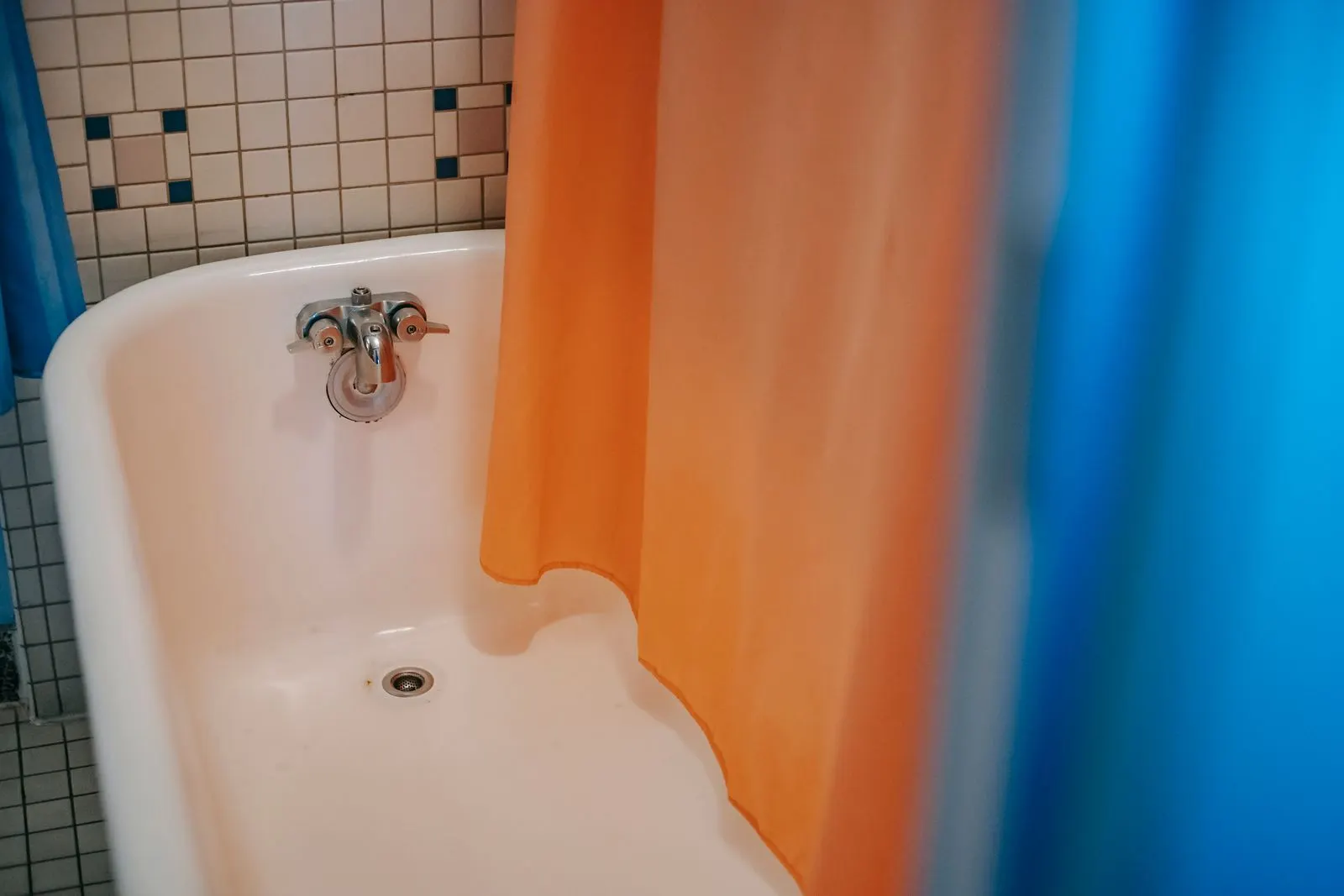
Many bathrooms in Hyderabad apartments have a shower area on the same floor level as the rest of the room, with no tub and no partition. Water gets everywhere. A shower curtain is the cheapest way to keep it in one corner, and getting the rod shape, material and liner right decides whether it lasts two years or turns black by August. When people ask us about curtains in Hyderabad for a new flat, bathroom questions come up more often than you’d expect.
This page is a practical guide to shower curtains and bathroom window curtains. Baaft Decor doesn’t stitch or install shower curtains, so treat it as buying advice for ready-made ones. For curtains in every other room, our curtains buying guide for Hyderabad homes covers fabric, measuring and hardware.
What is a shower curtain, and what does it need to do?
A shower curtain is a water-resistant panel hung from a rod along the open side of a shower or bathtub, so that spray stays inside the wet area and the rest of the floor stays dry. It needs to repel water, dry quickly, resist mould and survive regular washing.
A complete setup has four parts:
- Rod: straight, L-shaped or curved, either a tension rod or one fixed with brackets.
- Hooks or rings: usually 12 for a standard-width curtain, in plastic or stainless steel. Plain steel rusts quickly in a wet bathroom.
- Liner: a waterproof inner layer that hangs inside the tub or tray.
- Curtain: the decorative outer layer, often polyester, that hangs outside the liner.
You can skip the liner if the curtain itself is fully waterproof, such as PEVA or vinyl. You give up the softer look, though.
PEVA vs polyester vs vinyl shower curtains
These three materials cover almost every shower curtain sold in India. Here’s how they compare in a humid bathroom.
| Material | What it is | Waterproof? | Washing | Feel and look | Typical role |
|---|---|---|---|---|---|
| Polyester fabric | Woven synthetic, often with a water-repellent finish | Repels water, not fully waterproof | Machine wash, gentle cycle | Soft folds, prints and textures | Outer curtain, with a liner |
| PEVA | Polyethylene vinyl acetate, a chlorine-free plastic film | Yes | Gentle machine wash or wipe | Light, slightly frosted, flexible | Liner, or a budget curtain |
| PVC vinyl | Polyvinyl chloride film | Yes | Wipe by hand | Stiff, glossy, can smell when new | Cheapest option |
| Fabric with weighted hem | Polyester with small weights or magnets in the hem | Repels water | Machine wash | Hangs straighter, flaps less | Showers with strong exhaust fans |
Our take: a polyester curtain with a PEVA liner is the easiest to live with. The liner takes the water and the mould, and it’s cheap to wash or replace. PVC vinyl works on a tight budget but tends to crack and yellow, especially near a window that gets afternoon sun.
Need curtains or blinds for the rest of the house? We visit with samples, free across Hyderabad. WhatsApp +91 98499 17494.
Shower rods: straight, L-shaped and curved
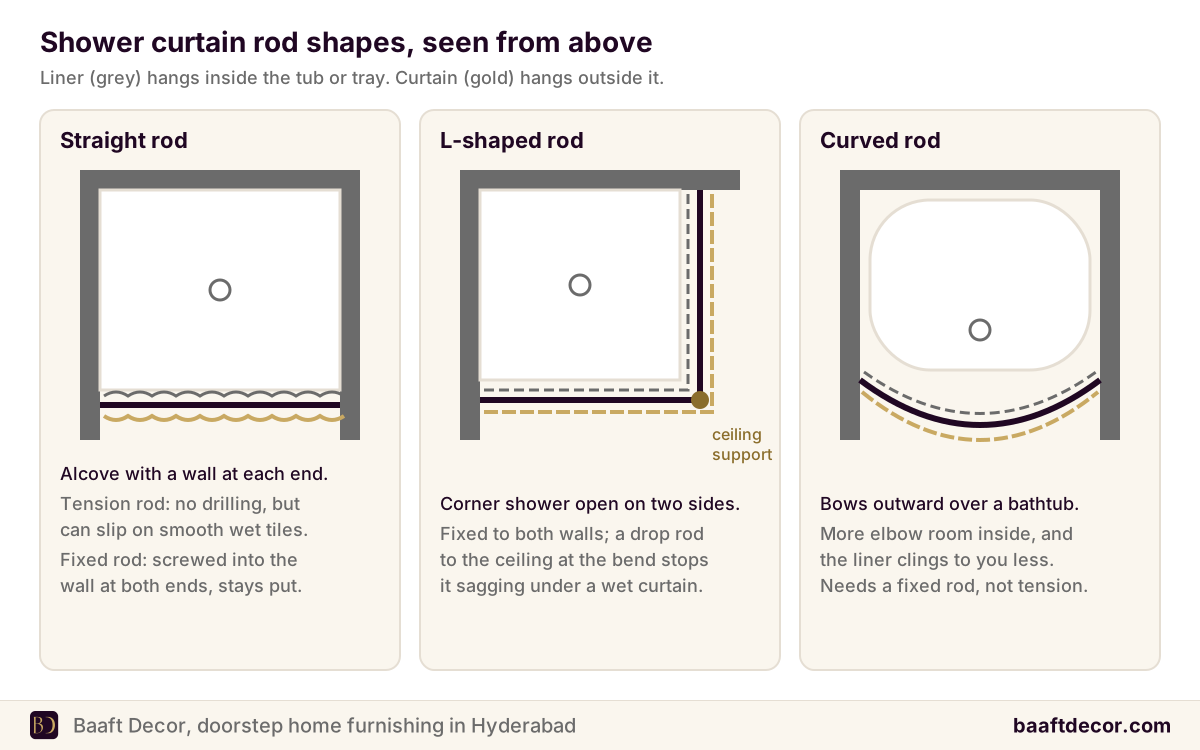
The right rod depends on how many sides of your shower are open. Pick the rod first, then buy a curtain that suits its length.
Straight rods and tension rods
A straight rod spans an alcove with a wall at each end. A spring tension rod needs no drilling, which suits rented flats, but it can slip on smooth wet tiles when a heavy wet curtain hangs from it. A fixed rod screwed into the wall at both ends stays put. Use stainless steel or aluminium; chrome-plated mild steel rusts at the joints within a monsoon or two.
L-shaped corner rods
An L-shaped rod wraps a corner shower that’s open on two sides, which is common in Indian bathrooms where the shower sits in one corner of the room. It’s fixed to both walls, and a ceiling support at the bend stops it sagging. Where there’s a false ceiling, the support has to reach the slab above or a reinforced point, not the gypsum sheet alone.
Curved rods
A curved rod bows outward over a bathtub, adding elbow room inside and stopping the liner from clinging to you. It needs fixed brackets, never tension.
Rod height and curtain length
For a walk-in shower area, the curtain hem should clear the floor by roughly 2 to 5 cm so it doesn’t sit in water. For a bathtub, the liner should hang inside the tub edge. Measure from where the hooks will sit, not from the rod itself, because hooks add a few centimetres.
How to measure for a shower curtain
Measure for a shower curtain by taking the rod length and the drop from the hook line to where the hem should end, then buying a curtain about 15 to 30 percent wider than the rod so it can close without stretching tight. A standard ready-made curtain is typically about 180 cm wide and 180 cm long, sold as 72 by 72 inches, with 12 holes along the top.
- Rod length. Wall to wall for a straight rod. For an L-shaped rod, measure both legs and add them.
- Drop. From the underside of the rod, plus the hook, to about 2 to 5 cm above the floor in a walk-in shower, or to a few centimetres inside the tub edge.
- Width. One standard curtain covers a straight rod of up to about 150 cm comfortably. Wider or L-shaped runs need two curtains or an extra-wide one.
- Liner. Same width as the curtain, the same length or a touch shorter so it sits inside the tray.
If your bathroom has a high ceiling or a rod mounted close to it, look for extra-long curtains of about 200 cm rather than letting a short one hang halfway down.
Wet and dry zones in Indian bathrooms
Most Indian bathrooms are one tiled room with a floor drain, so the shower curtain’s real job is to split it into a wet zone and a dry zone. The dry side holds the toilet, basin and often a geyser switch and an electrical point, which you want kept well away from spray.
That changes a few choices. Hang the curtain so it runs from wall to wall with no gap at the ends; a short rod leaves a strip where water escapes. A weighted or magnetic hem stops the curtain blowing inward when the exhaust fan pulls air. And if the floor has a slight slope towards the drain, set the hem height from the highest point of the floor, so it never drags.
Why shower curtains grow mould in the monsoon, and how to stop it
Shower curtains grow mould because they stay wet for hours in a warm, poorly ventilated room. In Hyderabad that peaks between June and September, when the air outside is already humid and nothing dries properly.
The US EPA’s guide to mould recommends keeping indoor humidity below 60 percent, ideally 30 to 50 percent, and running the bathroom fan or opening the window while showering. In practice:
- Spread the curtain out across the full rod after every shower. Bunched folds stay damp.
- Run the exhaust fan for a good while after the last shower of the day. Check that it actually vents outside.
- Wash the liner every two to four weeks in the monsoon, monthly the rest of the year.
- Replace the liner once black spots stop coming out. It’s the cheap part, by design.
- Keep the hem off the floor. A hem that sits in a puddle wicks water up and goes mouldy first.
Hard water adds white soap scum, which mould feeds on. A wipe with diluted vinegar along the bottom of the liner between washes helps. Our monsoon home care guide covers damp across the rest of the house too.
Bathroom window curtains and privacy
Bathroom windows in Hyderabad flats are usually small ventilators high on the wall, often louvred or frosted, plus a larger window in some villas and master bathrooms. Each needs a different answer.
| Window | Good option | Why |
|---|---|---|
| Small high ventilator | Frosted glass or privacy film, no curtain | Nothing to get damp; air keeps moving |
| Window beside the shower | PVC or aluminium venetian blind | Wipes clean, tilt for light and privacy |
| Larger window away from water | Roller blind in moisture-resistant fabric | Clean look, rolls up fully |
| Window in a dry zone | Short polyester café curtain on a tension rod | Soft look, machine washable |
Avoid cotton, linen and anything lined in a bathroom. They hold moisture, and the lining is where mould starts. If you want a fabric curtain, keep it short, unlined and on a rod you can lift it off in seconds. For more on blind types, see our guide to types of window blinds.
Caring for bathroom curtains
Wash polyester curtains and PEVA liners on a gentle, cool cycle with mild detergent and a couple of towels, which scrub off soap scum. Take off all hooks first. Don’t tumble-dry plastic on high heat; hang it back on the rod damp and let it drip-dry. For fabric bathroom window curtains, the same rules apply as any lightweight curtain. Our curtain washing and care guide goes through it fabric by fabric.
Baaft Decor measures and fits window curtains and blinds, including for bathroom windows, at homes across Hyderabad, such as curtains in Madhapur, curtains in Tellapur and curtains in Kollur.
Sorting the bathroom window
For the shower itself, a ready-made polyester curtain with a PEVA liner on a fixed stainless rod will serve most homes well. For the bathroom window, and every other window in the flat, we can help: book a free home visit and we’ll bring blind and curtain samples, check which ones suit a humid room, measure, and give you a written quote. We work across Hyderabad from 8 AM to 10 PM, all seven days. WhatsApp or call +91 98499 17494.
Frequently asked questions
Which material is best for a shower curtain?
Polyester is the best all-round shower curtain material for most homes because it is water-repellent, machine washable and hangs in soft folds. On its own it lets some water through, so it is usually paired with a liner. PEVA is a lightweight, chlorine-free plastic that is fully waterproof and works well as a liner or a budget curtain. PVC vinyl is the cheapest and most waterproof, but it is stiff, can smell strongly when new and tends to crack and yellow over time.
Do I need a liner with a fabric shower curtain?
You need a liner with most fabric shower curtains, because polyester and cotton curtains are water-repellent rather than fully waterproof, and spray will soak through them during a long shower. The liner, usually PEVA or a tightly woven polyester, hangs inside the tub or shower tray and takes the water, while the decorative curtain hangs outside and stays dry. The liner is also the part that grows mould, and it is cheaper and quicker to wash or replace than the outer curtain.
What size is a standard shower curtain?
A standard shower curtain is typically about 180 cm wide by 180 cm long, often sold as 72 by 72 inches, with 12 holes along the top for hooks. Longer versions of about 180 by 200 cm suit higher rods and ceiling-height installations, and narrow stall sizes of about 90 to 120 cm wide suit small shower enclosures. Measure the rod length and the height from the rod to the floor or tub edge before buying, and choose a liner of the same width as the curtain.
What is the difference between a straight, L-shaped and curved shower rod?
A straight shower rod spans an alcove between two walls and can be a spring tension rod or a fixed rod screwed in at both ends. An L-shaped rod wraps a corner shower that is open on two sides, fixed to both walls with a support to the ceiling at the bend so it does not sag. A curved rod bows outward over a bathtub, giving more elbow room inside and keeping the liner from clinging. Curved and L-shaped rods need fixed brackets; tension rods only suit straight runs.
How do I stop mould on a shower curtain?
To stop mould on a shower curtain, keep the bathroom drier and let the curtain dry fully after every shower. Run the exhaust fan or open the window while showering and for a while after, and spread the curtain out across the rod instead of leaving it bunched. The US EPA recommends keeping indoor humidity below 60 percent, which is hard in a Hyderabad monsoon, so wash the liner every two to four weeks from June to September and replace it once black spots stop coming out.
Can a shower curtain be washed in a washing machine?
Most polyester shower curtains and many PEVA liners can be washed in a washing machine on a gentle, cold or lukewarm cycle with mild detergent. Adding a couple of towels helps scrub off soap scum and mildew. Remove all hooks and rings first, check the care label, and never tumble-dry plastic liners on high heat, because they can warp or melt. Hang the curtain back on the rod while still damp so creases drop out. Stiff PVC vinyl curtains are better wiped down by hand.
What curtains are best for a bathroom window?
The best covering for a bathroom window is one that tolerates steam and dries quickly: a PVC or aluminium venetian blind, a roller blind in a moisture-resistant fabric, or a short polyester café curtain on a tension rod. These give privacy while letting light in through the top or between the slats. Avoid cotton, linen and lined curtains, which stay damp and grow mould. On small ventilator windows high up in the wall, frosted glass or a privacy film with no curtain at all is often the most practical choice.
Is a shower curtain better than a glass shower partition?
A shower curtain is cheaper, quicker to fit and easier to change than a glass shower partition, and it suits rented flats and small bathrooms where a hinged glass door would hit the toilet or basin. It does need regular washing and lets a little water escape at the edges. A glass partition keeps water in better, is easier to wipe and lasts much longer, but costs more and needs drilling into tiles. Many Indian bathrooms use a curtain first and move to glass during a renovation.