Many sagging curtains we’re called to fix aren’t a rod problem. They’re a bracket problem: too few supports, brackets too shallow for the window handle, or screws in plaster with nothing solid behind them. When we handle curtain installation in Hyderabad, choosing and placing the brackets takes longer than hanging the curtain, and it’s the part that decides whether the rod is still straight years later.
This guide is about brackets only: types, projection, spacing and fixing. For choosing between a rod and a track in the first place, see our curtain rods and tracks guide, and for the full planning sequence, the curtains buying guide for Hyderabad homes.
What are curtain rod brackets?
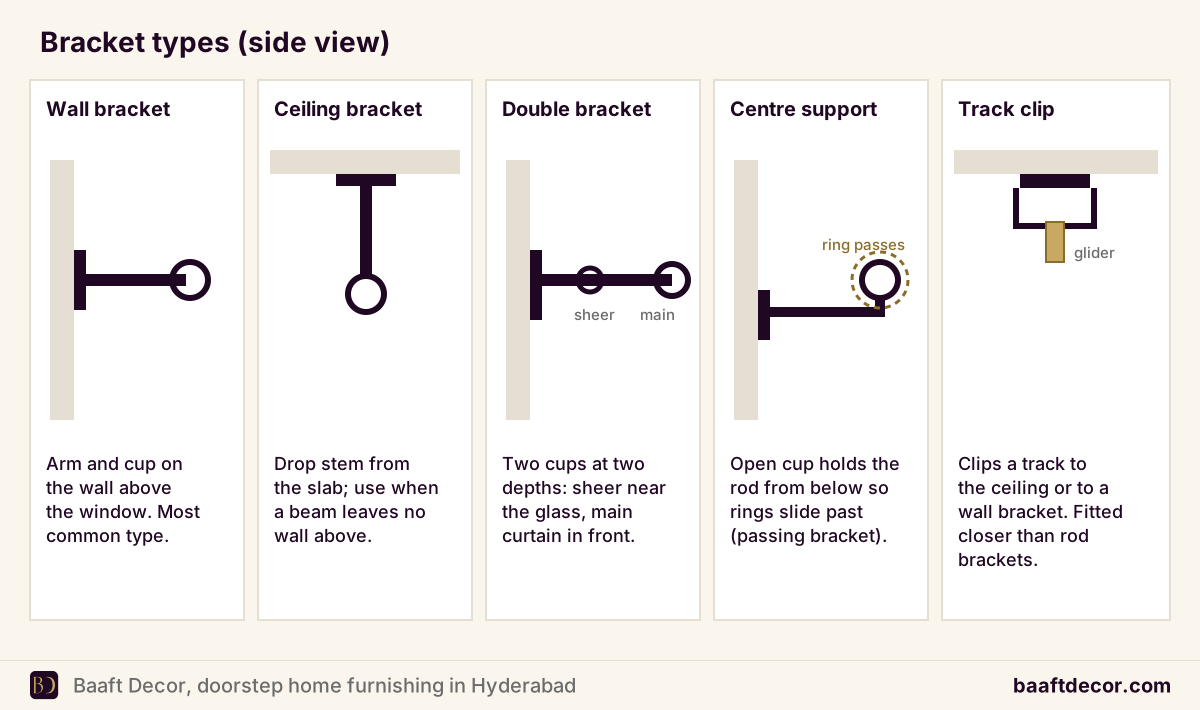
Curtain rod brackets are the supports that hold a rod on the wall or ceiling, and they set its height, its distance from the wall and how much weight it can carry. Shops also call them curtain rail brackets, rod holders, parda holders or curtain sockets.
| Bracket type | Where it fixes | Use it for |
|---|---|---|
| Wall end bracket | Wall above the window | Most single-rod windows |
| Ceiling bracket | Slab or ceiling, on a drop stem | Beam above the window, ceiling-height curtains |
| Double bracket | Wall or ceiling | Sheer plus main curtain on two rods |
| Centre support | Between the end brackets | Wide windows, heavy curtains |
| Passing bracket | Between the end brackets | Rings that need to slide past the support |
| Socket (inside recess) | Both side walls of a recess | Pipe rod fixed end to end inside a niche |
| Track clip | Ceiling or wall bracket | Curtain tracks (fitted closer together) |
Sockets are worth a note. A curtain socket is a cup fixed to each side wall of a recess, with the pipe sitting between them. It’s common in older Hyderabad houses and works well for short pipe rods, but it can’t take a centre support, so keep socket spans short and the curtain light.
Want this measured for your windows? We visit with samples, free across Hyderabad. WhatsApp +91 98499 17494.
Wall brackets or ceiling brackets?
Use wall brackets when there’s at least 10 cm of solid wall above the window frame; use ceiling brackets when a beam or the ceiling sits right on top of the window. In many Hyderabad apartments the lintel beam meets the window frame, which leaves no room for a wall bracket.
| Wall bracket | Ceiling bracket | |
|---|---|---|
| Needs | Solid wall above the frame | Solid slab or backing above |
| Look | Classic rod with finials | Curtain falls from ceiling height |
| Light leak at the top | Some, above the rod | Very little |
| With false ceiling | Fix below the ceiling line | Fix to slab or plywood backing |
| Typical problem | Beam leaves no space | Gypsum board alone can’t hold it |
Ceiling brackets also suit people who want the room to look taller, because the curtain runs from the ceiling to the floor. If you’re going down that route, a track usually works better than a rod; our curtain channel and ceiling track guide covers those.
Single or double curtain rod brackets?
Choose double brackets when you want a sheer and a heavier curtain that open independently, which is the setup most living rooms and bedrooms in Hyderabad end up with. A double curtain rod lets you keep the sheer drawn for daytime privacy and glare, and close the lined curtain at night or against the afternoon sun.
The conventional layout on rods is sheer on the inner rod, nearest the glass, and the main curtain on the outer rod facing the room. On ceiling tracks we often reverse it, blackout near the glass for a darker room, as our rods and tracks guide explains. Either works; decide before the brackets go up, because the inner and outer rods often differ in diameter.
How much projection does a bracket need?
Bracket projection should clear the deepest obstruction on the wall, plus the fold depth of the curtain in front of it, plus 2 to 3 cm of running space. That’s how we work it out on site, rather than taking whatever bracket comes in the box.
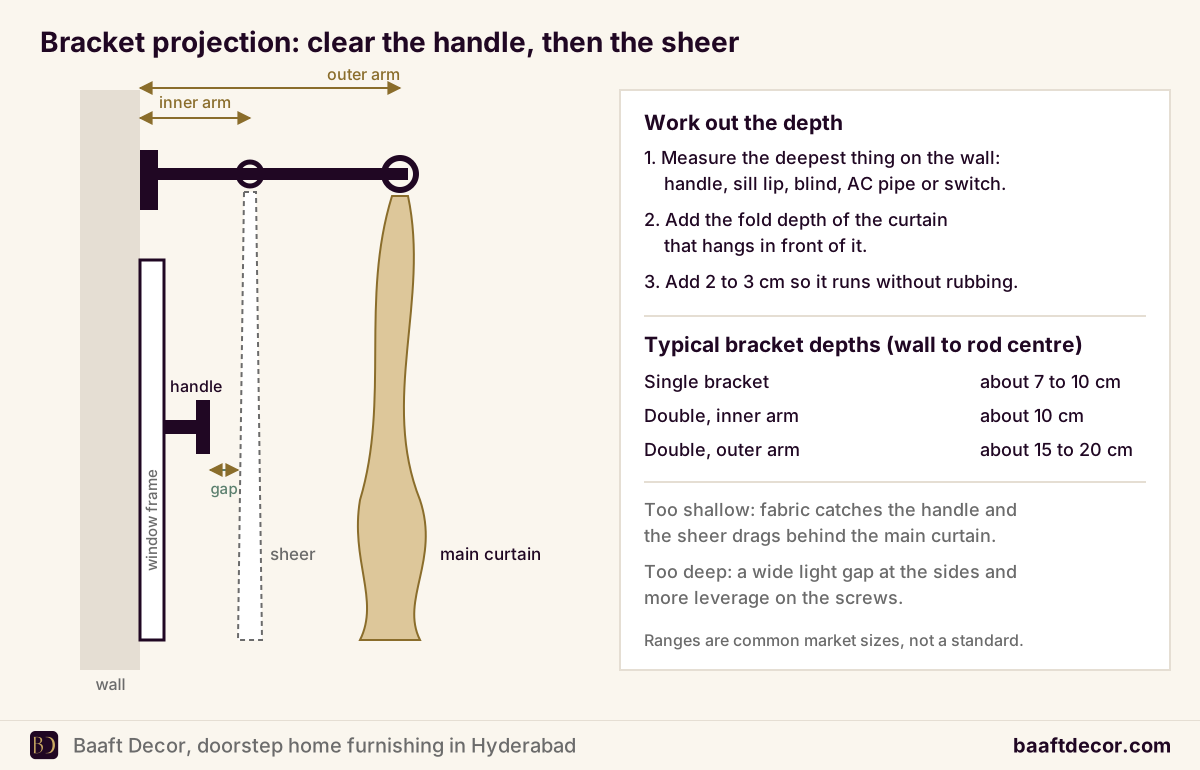
Typical depths you’ll find in the market (wall to rod centre):
- Single brackets: about 7 to 10 cm.
- Double brackets: about 10 cm for the inner arm and 15 to 20 cm for the outer.
- Adjustable brackets: slide out to suit; useful when the window has a deep handle.
Things that push the projection out in Hyderabad homes:
- Window handles. Aluminium and uPVC sliding windows have handles that stand proud of the frame; casement handles stand further.
- A blind behind the curtain. A roller or zebra blind inside the recess plus a curtain in front needs a deeper bracket.
- AC units and pipes. If a split AC sits above the window, don’t run the curtain across its vents. Mount the rod below the unit with a clear gap, or bring the curtain forward on ceiling brackets so the airflow isn’t blocked. Measure the unit’s depth with a tape first.
Don’t overdo it either. A bracket deeper than it needs to be leaves a wide light gap at the sides and puts more leverage on the screws.
How far apart should curtain brackets be?
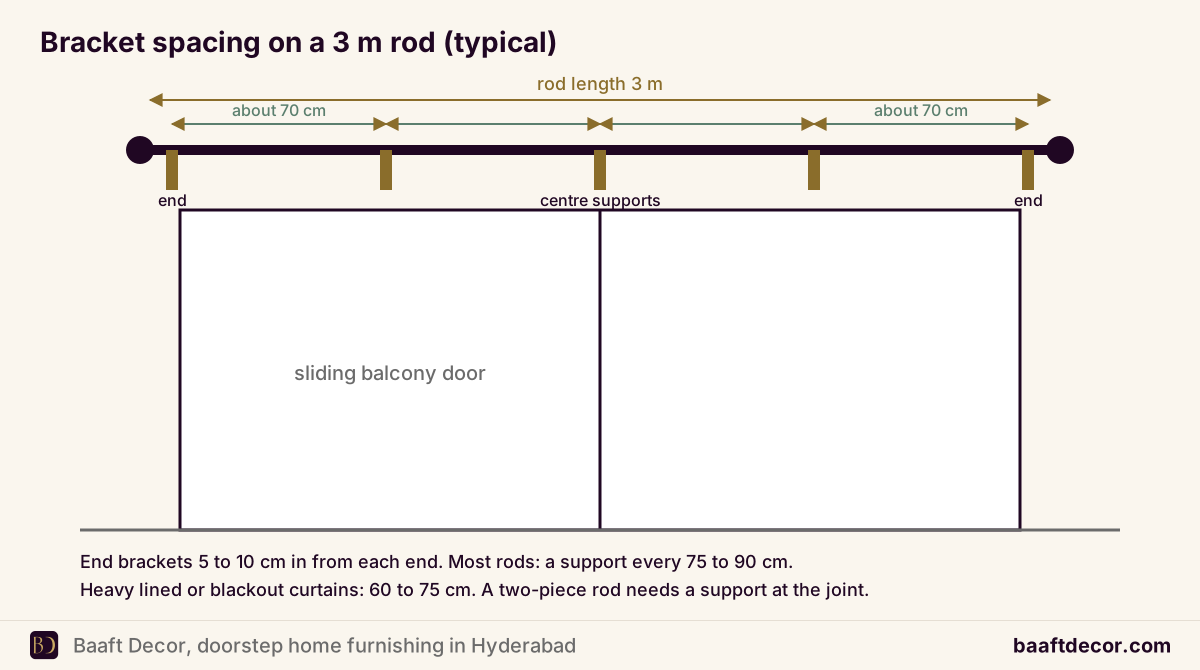
Space supports about every 75 to 90 cm along the rod, with an end bracket 5 to 10 cm in from each end; heavy curtains need 60 to 75 cm. The end brackets sit inside the finials, so the decorative ends stay free. That range matches manufacturer guidance such as Kwik-Hang’s bracket advice, which suggests a support every 30 to 36 inches.
| Rod and curtain (typical) | Rod diameter | Support spacing |
|---|---|---|
| Sheer or light unlined | 16 to 19 mm | up to about 90 cm |
| Lined or dim-out | 25 mm or more | 75 to 90 cm |
| Blackout, velvet, interlined | 25 to 28 mm or more | 60 to 75 cm |
| Two-piece rod at the joint | any | always one support |
These are working ranges from common trade practice; if the rod’s maker gives a spacing or load rating, follow it. On a double rod each bracket carries two curtains with more leverage, so stay at the tighter end.
Fixing curtain brackets into RCC, brick, AAC and gypsum
The wall decides the fixing: RCC and brick take normal plugs, AAC needs rotary drilling and special anchors, and gypsum board can’t carry a bracket on its own. Most Hyderabad flats have more than one of these around a single window.
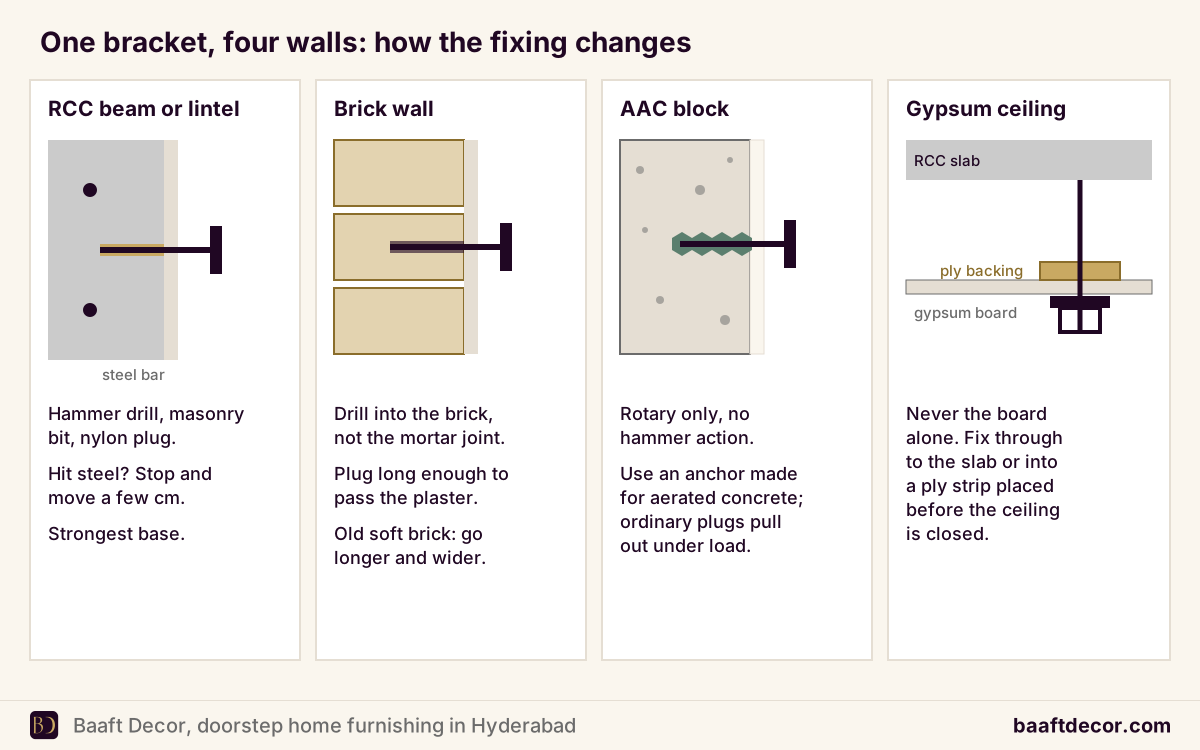
RCC beams and lintels. The strongest base. Hammer drill with a masonry bit and a nylon plug. If the bit hits a steel bar, stop and move the hole a few centimetres rather than forcing it.
Brick. Drill into the brick, not the mortar joint, and use a plug long enough to pass the plaster. Old soft brick in older houses may need longer, wider plugs.
AAC and fly-ash blocks. Common in newer gated communities. Drill on rotary only, because hammer action crushes the cell walls and the hole ends up oversized. Use an anchor made for aerated concrete, such as the fischer GB aircrete anchor, and add an extra bracket for heavy curtains.
Gypsum false ceilings. Never fix only into the board. Fix through to the slab with longer fixings, or into a plywood backing strip fitted before the ceiling is closed. If your ceiling is still being built, ask for that strip now.
Also check for hidden conduits above windows and along ceiling lines before drilling, and keep holes clear of window frames, where water can track in during the monsoon.
Bracket problems we’re called to fix
- Rod sagging in the middle: no centre support, or one that has pulled loose.
- Bracket pulled out of the wall: plugs in AAC or plaster with nothing solid behind.
- Curtain catching on the handle: projection too shallow.
- Rod jumping out of the bracket: open cups with no locking screw, on a window that sees wind.
- Rings stuck at every support: a closed bracket where a passing bracket was needed.
All of these are routine for our curtain repair service: we re-fix in sound material, add supports or swap brackets without replacing the curtain. If you’re also fitting tiebacks, match their depth to the brackets, as our curtain holders and tiebacks guide explains, and for the full order of work see how to hang curtains.
Baaft Decor measures, stitches and fits curtains at homes across Hyderabad, including bracket-only and re-fixing jobs. We visit for curtains in Kukatpally, curtains in Begumpet, curtains in Gachibowli and curtains in Financial District, among other areas.
Get brackets fixed once, properly
Whether it’s a new set of curtains in Hyderabad or brackets for curtains you already own, we’ll check the wall, pick brackets with the right projection and spacing, and fix them into sound material. Book a free home visit, 8 AM to 10 PM, all seven days: WhatsApp or call +91 98499 17494.
Frequently asked questions
What are curtain rod brackets?
Curtain rod brackets are the supports that hold a curtain rod on the wall or ceiling. A standard set has an end bracket near each end of the rod, inside the finials, and one or more centre supports on wider windows. The bracket decides three things: how high the rod sits, how far it stands out from the wall, and how much weight it can carry before it sags. In India they are also called curtain holders, rod holders, parda holders or sockets, depending on the shop and the style.
How far apart should curtain rod brackets be?
Curtain rod brackets are typically spaced about 75 to 90 cm apart along the rod, with an end bracket 5 to 10 cm in from each end. Manufacturer guidance such as Kwik-Hang's suggests a support every 30 to 36 inches, which is the same range. Light sheers on a stiff aluminium rod can stretch slightly further, while heavy lined, blackout or velvet curtains are better with supports every 60 to 75 cm. A rod supplied in two joined pieces always needs a support at the joint.
Should curtain brackets go on the wall or the ceiling?
Curtain brackets should go on the wall when there is solid wall of 10 cm or more above the window frame, which is the most common case. Ceiling brackets are the better choice when a concrete beam or the ceiling sits close to the top of the window, which is very common in Hyderabad apartments, or when you want the curtain to fall from ceiling height to make the room look taller. With a gypsum false ceiling, ceiling brackets must be fixed through to the slab or into a plywood backing strip.
What is a double curtain rod bracket?
A double curtain rod bracket is a single bracket with two cups at different depths, so it carries two rods: one for a sheer and one for the main curtain. Typical off-the-shelf double brackets hold the inner rod about 10 cm from the wall and the outer rod about 15 to 20 cm out, although sizes vary by brand. The usual layout puts the sheer on the inner rod near the glass and the lined or blackout curtain on the outer rod, so you can close either layer on its own.
How much projection do curtain brackets need?
Curtain brackets need enough projection to clear the deepest thing on the wall, plus the fold depth of the curtain, plus 2 to 3 cm so the fabric runs without rubbing. The deepest thing might be a window handle, a sill lip, a blind fitted behind the curtain, an AC pipe or a switchboard. Typical single brackets hold the rod about 7 to 10 cm off the wall. Too little projection snags the curtain on handles; too much leaves light gaps at the sides and puts more leverage on the screws.
Can curtain brackets be fixed into AAC block walls?
Curtain brackets can be fixed into AAC block walls, but they need the right drilling method and anchor. AAC is aerated concrete: light and full of air pockets, so ordinary nylon plugs drilled with hammer action can spin or pull out under load. Drill on rotary only, without hammer, and use an anchor made for aerated concrete, such as fischer's GB aircrete anchor. For heavy curtains, add an extra bracket so each fixing carries less weight, or fix into the RCC beam above the window where one exists.
Why is my curtain rod sagging in the middle?
A curtain rod sags in the middle when the span between brackets is too long for the rod diameter and curtain weight, or when a centre support is missing or has pulled loose. Thin rods of around 16 to 19 mm bow quickly under lined curtains, and a 3 m balcony door with only two end brackets will sag with almost any heavy fabric. The fix is to add a centre support, re-fix any loose bracket into sound wall, or replace the rod with a thicker one or a track.
Do curtain rod brackets for a double rod need more supports?
Curtain rod brackets for a double rod usually need the same or slightly closer spacing than a single rod, because each bracket carries two curtains and the outer arm stands further from the wall, which increases leverage on the screws. On a standard window, three double brackets (two ends and one centre) is common. On a wide sliding door with a blackout and a sheer, plan for supports every 60 to 75 cm and use longer plugs, especially in AAC or old plastered brick walls.