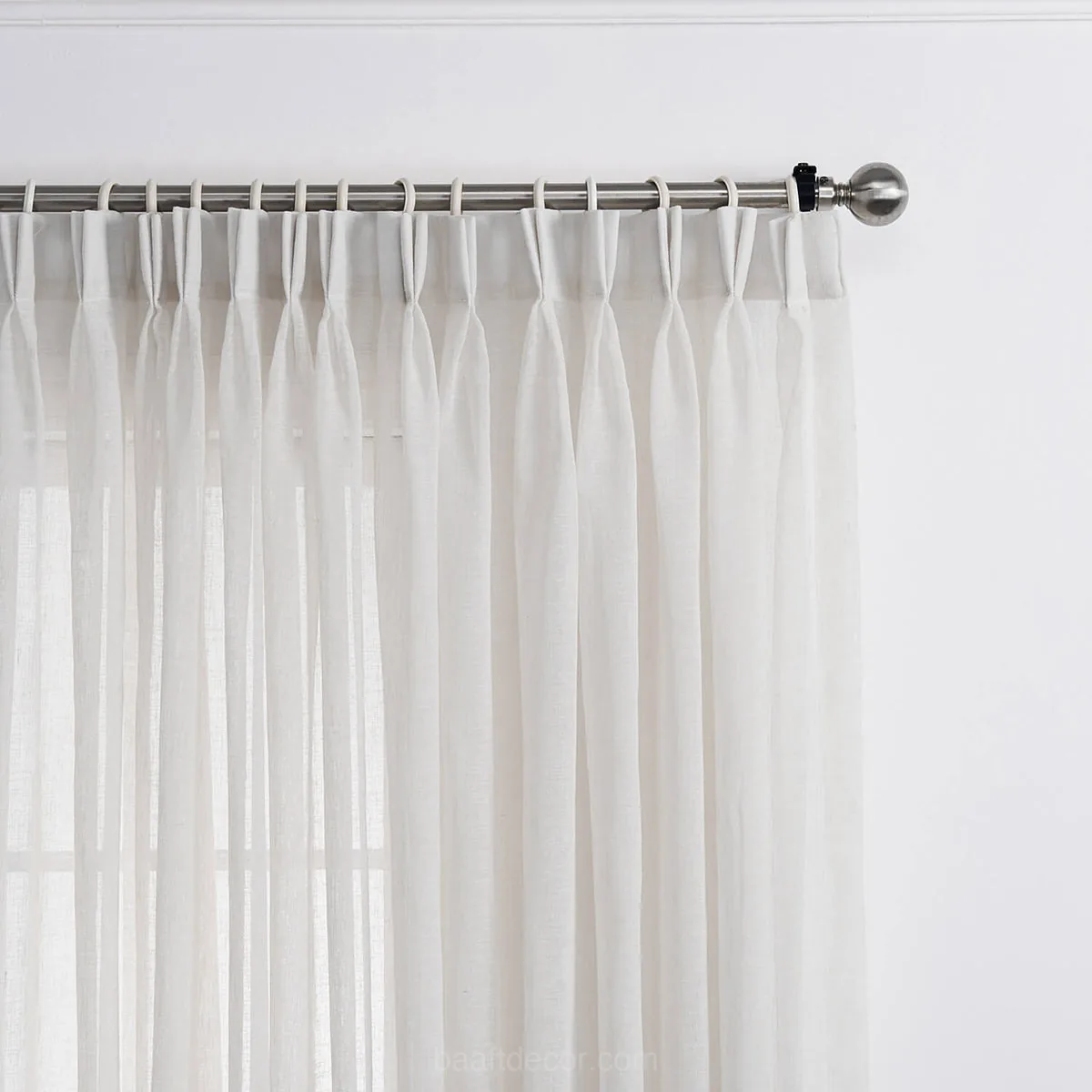
Ask a hardware shop in Hyderabad for a “curtain track” and you may get a blank look. Ask for a “curtain channel” and they’ll pull out three profiles and ask single or double. It’s the same thing: an aluminium profile with gliders inside. When we plan curtain installation in Hyderabad, especially in flats with false ceilings, the channel and where it’s fixed matter as much as the fabric.
This guide goes deep on channels and ceiling tracks: profiles, pockets, double channels, bay windows and the false ceiling batten. For the wider rod-versus-track decision, read our curtain rods and tracks guide first, and for everything from fabric to cost, the curtains buying guide for Hyderabad homes.
What is a curtain channel?
A curtain channel is the Indian trade name for a curtain track: a long aluminium or PVC profile, open along the underside, in which gliders or runners slide. The curtain’s hooks hang from the gliders. Channels are sold by the running foot, in single and double versions, and fix to a wall bracket or straight to the ceiling.
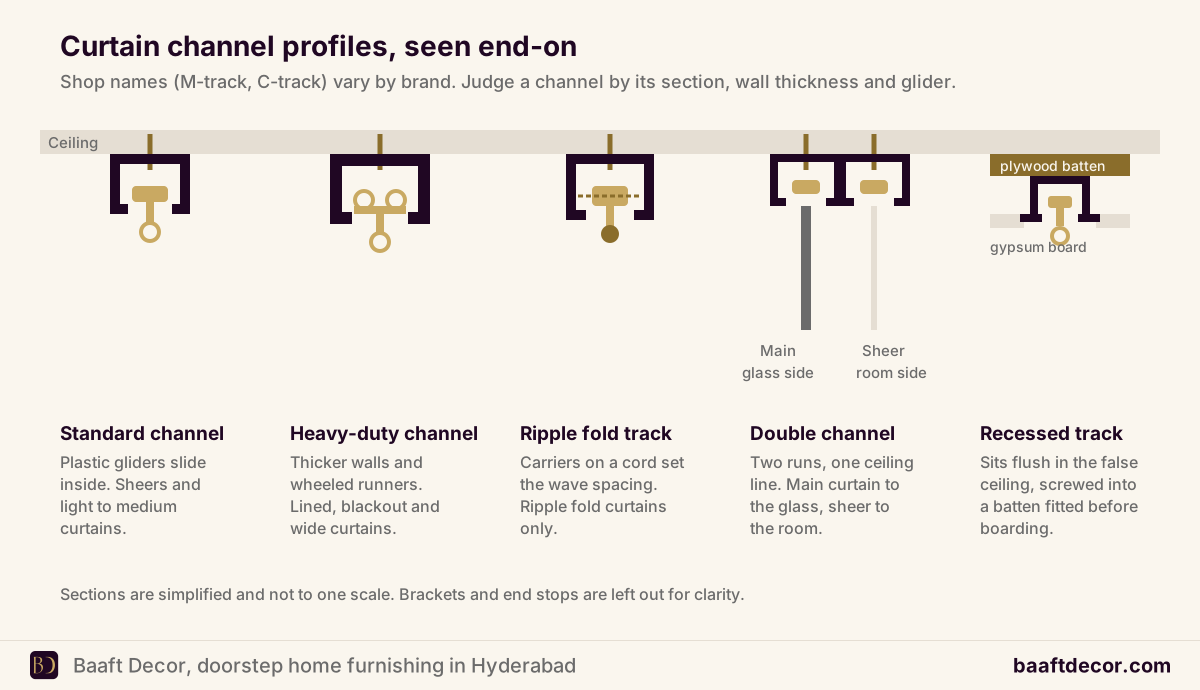
Shops name profiles by shape: you’ll hear M-track, C-track and “heavy channel”. The names don’t fix a size, so an M-track from one brand may not take gliders from another. Judge a channel by three things: the section (how the lips are shaped), the wall thickness of the aluminium, and the glider or runner sold with it.
Planning a false ceiling and want the curtain pocket right? We visit with samples and track options, free across Hyderabad. WhatsApp +91 98499 17494.
Types of curtain channel
| Channel | Carries | Suits | Watch out for |
|---|---|---|---|
| Standard channel (M or C profile) | Plastic gliders | Sheers, light and medium curtains | Thin walls bow on long spans |
| Heavy-duty channel | Wheeled or ball-bearing runners | Lined, blackout, wide sliding doors | Needs closer fixings |
| Double channel | Two sets of gliders | Sheer plus main curtain | Needs a wider pocket |
| Ripple fold track | Carriers on a cord | Ripple fold curtains only | Heading must match the track |
| Recessed track | Gliders, flush in the ceiling | Clean false-ceiling look | Batten before boarding |
| Bendable track | Gliders or runners | Bay and corner windows | Minimum bend radius |
| Motorised track | Belt-driven carriers | Tall, heavy or hard-to-reach curtains | Power point planned in advance |
Which carriers go in which channel, and which hooks go with each heading, is covered in our guide to types of curtain hooks and gliders.
Ceiling curtain track or wall track?
A ceiling curtain track (also called a curtain rail in the ceiling) is a channel screwed to the ceiling instead of a wall bracket. The curtain falls from ceiling to floor, there’s no gap over the top for light to leak through, and the room reads taller.
We fit ceiling tracks by default when:
- the window sits close to the ceiling, which is common in Hyderabad flats with a beam above the window;
- you want floor-to-ceiling curtains across a sliding balcony door;
- the bedroom needs real darkness, since light over the top of a wall track is the usual leak.
A wall track still makes sense with a good height of wall above the window, a cornice, a pelmet, or a ceiling you can’t drill. How high to mount it and how far past the window to run it is covered in how high to hang curtains.
Recessed tracks and false ceiling pockets
A recessed track sits in a pocket or slot in the false ceiling, so the hardware disappears and the curtain seems to fall straight out of the ceiling. It’s the cleanest look, and the one most often done wrong, because it depends on work that happens weeks before the curtain fitter arrives.
The batten goes in before the board
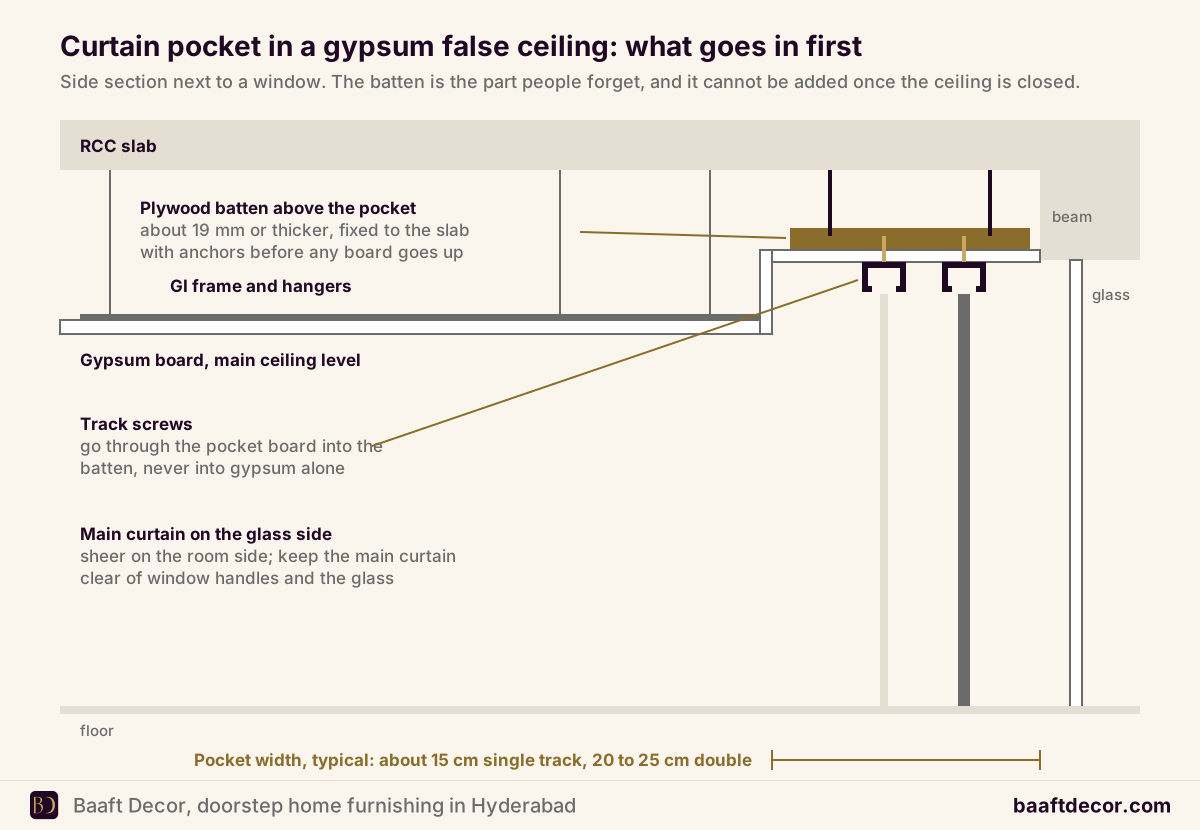
Gypsum board is not a fixing surface for a loaded, moving curtain. The track has to screw into something solid: a plywood batten fixed to the slab along the track line, or the slab itself. The batten must go up before the gypsum is boarded. Once the ceiling is closed, it can’t be added without cutting the board.
As a practical standard, we ask for a plywood batten about 19 mm thick or more, running the full length of the track and fixed to the slab with anchors. Manufacturers set the minimum for their own systems; one recessed track, for example, is designed for recessing into timber at least 20 mm thick, with fixings at 400 mm centres, according to its specification listing.
Pocket size
A track pocket is typically about 15 cm wide for a single track and about 20 to 25 cm for a double. It should be deep enough to hide the channel and the top of the heading. Ripple fold and motorised tracks can need more room, so give your false ceiling contractor the actual track before they build. If we’re doing the false ceiling too, we plan the pocket and batten together with the curtains.
Double channels: sheer plus main curtain
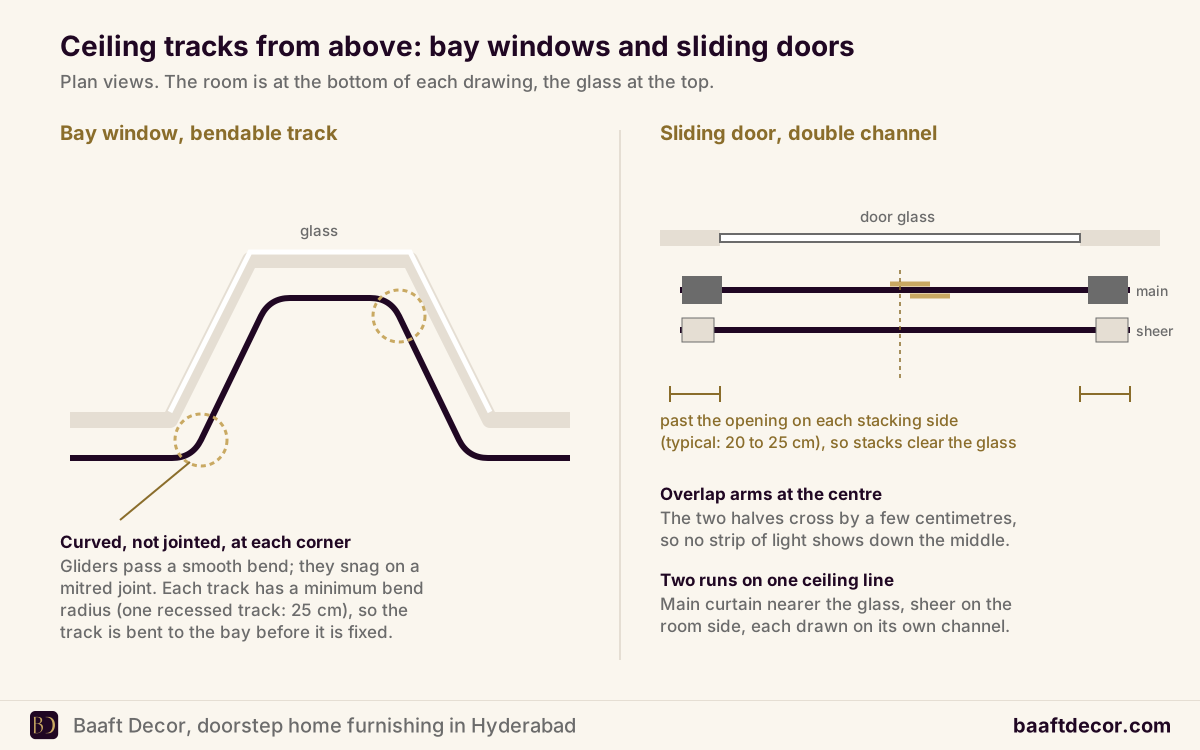
A double channel runs two curtains on parallel tracks from one ceiling line. The usual arrangement is the main curtain (dim-out or blackout) nearer the glass and the sheer on the room side. By day you see the sheer; at night the main curtain closes behind it. The heavier layer near the glass also takes the sun first.
Two details make double channels work:
- Overlap arms at the centre let the two halves of each curtain cross by a few centimetres, so no strip of light shows down the middle.
- Clearance. Check window handles, sliding-door locks and AC pipes before fixing. The glass-side curtain must clear all of them.
Bendable tracks for bay and corner windows
Bendable tracks follow a bay or corner window so one curtain runs the whole way round. The track is bent to the bay before fixing, in smooth curves rather than sharp joints, because gliders pass a curve and catch on a mitred joint. Every track has a minimum bend radius; the recessed track in the specification above bends to a 25 cm radius. We template the bay first, since a bent track can’t easily be re-bent on the ceiling.
Fixing a ceiling track into RCC
Most Hyderabad apartment ceilings are RCC slabs, hard and strong. The channel is screwed up into the slab with nylon plugs, drilled with a masonry bit the same diameter as the plug. Slabs carry conduits for lights and fans, so check switch and light positions before choosing where to drill. Fix at both ends and along the length, roughly every metre for normal curtains and closer for heavy lined ones, or to the manufacturer’s spacing if it’s closer. Our how to hang curtains guide gives bit and plug sizes for each wall type.

How to choose a channel for your window
Start from the curtain, not the channel. Work through these in order:
- Heading. Ripple fold needs a ripple fold track. Pencil and pinch pleat run on any standard or heavy channel. Eyelets can’t go on a channel at all.
- Weight and width. A sheer on a bedroom window is happy on a standard channel with plastic gliders. A lined blackout curtain across a 3 m sliding door needs a heavy-duty channel with wheeled runners and closer fixings.
- Layers. Sheer plus main curtain means a double channel, and a wider pocket if it’s recessed.
- Shape. A bay or corner window needs a bendable track, bent before fixing.
- Ceiling. RCC takes plugs directly; a gypsum ceiling needs a batten, or long fixings to the slab.
- Future motor. If you may motorise later, fit a motor-ready track and a power point now.
Problems we see with curtain channels
- Track screwed only into gypsum: sags within months and cracks the board.
- Pocket too narrow: the double track won’t fit, or the sheer rubs the main curtain.
- Thin standard channel across a wide door: bows in the middle under a lined curtain.
- Gliders from a different brand: tilt, jam or drop hooks.
- Dust-filled channels: construction dust in new gated communities makes gliders drag. Wipe the channel and use a dry silicone spray.
Sagging channels, broken gliders and re-mounting are routine for our curtain repair service, including hardware someone else fitted.
Baaft Decor measures, supplies and fits curtain channels and ceiling tracks, with the curtains, at homes across Hyderabad. False-ceiling flats are a large share of that work, including curtains in Gachibowli, curtains in Kokapet, curtains in Financial District, curtains in Narsingi and curtains in Kondapur.
Plan the channel before the ceiling closes
If your false ceiling is still being built, now is the time to fix the batten and pocket. Book a free home visit for curtains in Hyderabad: we check the ceiling, mark the track line for your contractor, and quote curtains, channel and fitting together. We work 8 AM to 10 PM, all seven days. WhatsApp or call +91 98499 17494.
Frequently asked questions
What is a curtain channel?
A curtain channel is the everyday Indian name for a curtain track. It is a long aluminium, or sometimes PVC, profile with a slot underneath, and small gliders or runners slide inside it carrying the curtain hooks. Channels are sold by the running foot in single and double versions and can be fixed to the wall above a window or directly to the ceiling. Shops name profiles M-track, C-track and so on, but sizes differ between makers, so gliders should always be bought for the same channel.
What is an M track curtain channel?
An M-track is a name Indian shops use for a common aluminium curtain channel profile, sold in single and double versions for wall or ceiling fixing. The name refers to the profile shape rather than a fixed standard, so an M-track from one brand may not take gliders from another. When comparing M-track and C-track channels, look at the actual section, the wall thickness of the aluminium and the glider or runner it comes with. Heavier curtains need a thicker section and wheeled runners.
Can a curtain track be fixed to the ceiling?
Yes, a curtain track can be fixed directly to the ceiling, and in many apartments it is the better choice. A ceiling curtain track lets the curtain fall from the ceiling to the floor, which makes the room look taller and stops light leaking over the top. On an RCC ceiling, the track is screwed into the slab with nylon plugs sized to the drill bit. On a gypsum false ceiling, it must be screwed into a plywood batten or framing above the board, or through to the slab.
Can you fix a curtain track to a gypsum false ceiling?
A curtain track should not be fixed only into gypsum board, because the board is not made to carry a loaded, moving curtain and the screws will loosen or pull through. The safe method is to fix a plywood batten, about 19 mm or thicker, to the slab along the track line before the gypsum is boarded, then screw the track through the board into that batten. If the ceiling is already closed with no batten, the fitter can use long fixings through to the slab or framing instead.
How wide should a curtain pocket in a false ceiling be?
A curtain pocket in a false ceiling is typically about 15 cm wide for a single track and about 20 to 25 cm wide for a double track carrying a sheer and a main curtain. It should be deep enough to hide the track and the top of the heading. Confirm the exact track and heading with your curtain fitter before the false ceiling contractor builds the pocket, because ripple fold and motorised tracks can need more room than a basic channel.
What is a double curtain channel used for?
A double curtain channel holds two curtains on two parallel runs, usually a sheer and a main curtain, fixed along one ceiling or wall line. It lets you keep a sheer drawn for daytime privacy and glare control while the heavier dim-out or blackout curtain stays open, then close the main curtain at night. Fitters normally put the main curtain on the channel nearer the glass and the sheer on the room side, since the sheer is what you see during the day.
Can a curtain track bend around a bay window?
Yes, bendable curtain tracks can follow a bay or corner window, so one curtain runs around the whole bay without joints. The track is bent to the shape of the bay before fixing, and every track has a minimum bend radius; one recessed track, for example, can bend to a 25 cm radius. Smooth curves let gliders pass easily, while sharp mitred joints tend to catch them. Measure the bay carefully, or have the fitter template it, because a bent track cannot easily be re-bent.
Which is better, a wall-mounted or ceiling-mounted curtain track?
A ceiling-mounted curtain track is usually better when the window sits close to the ceiling, when there is a beam above the window, or when you want floor-to-ceiling curtains that block light leaking over the top. A wall-mounted track is better when there is a good height of wall above the window, a cornice or pelmet, or a ceiling you cannot drill. In most new Hyderabad apartments with false ceilings, a ceiling track or a recessed pocket gives the cleanest result.