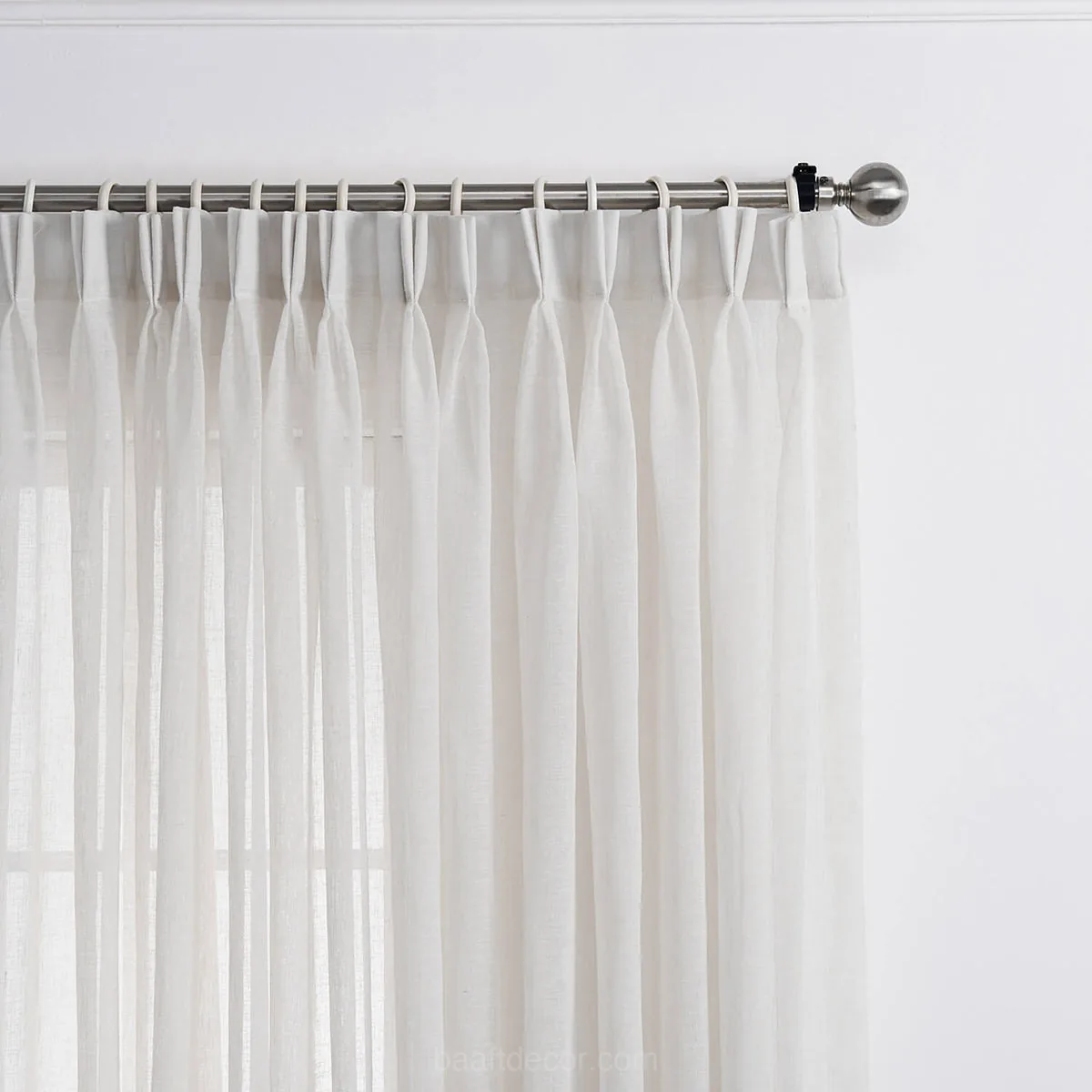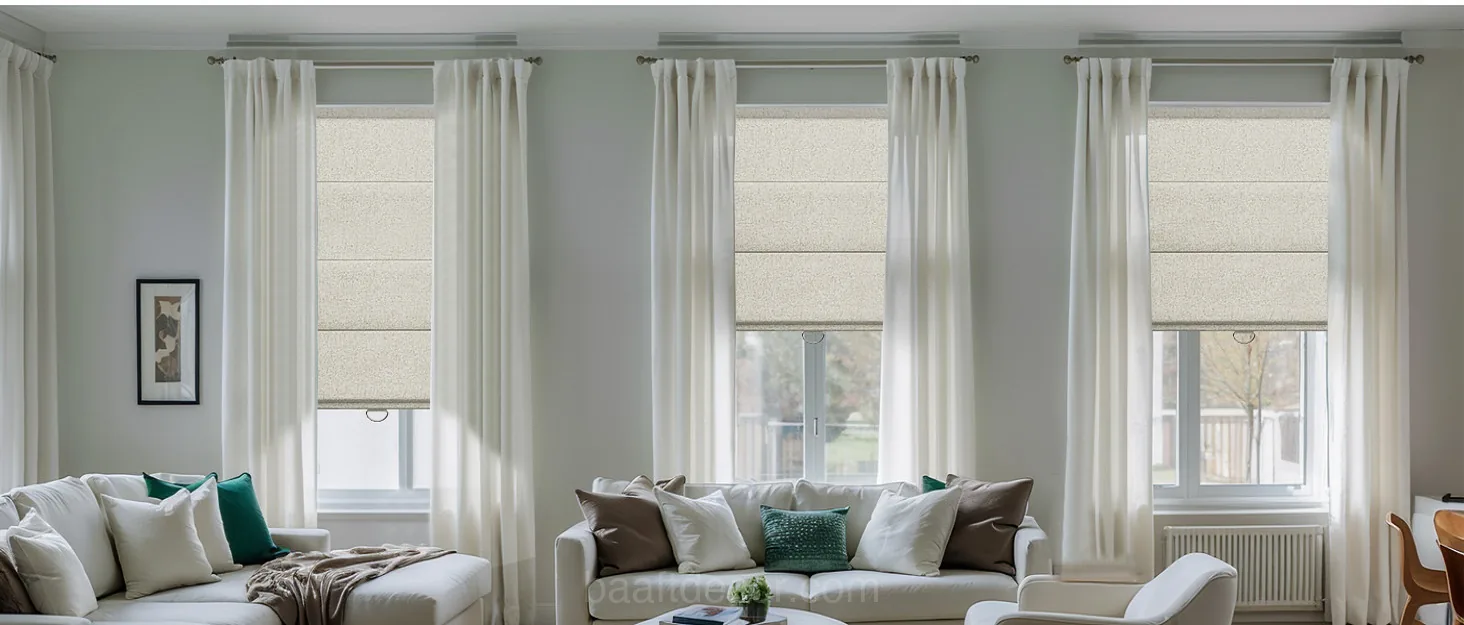
Most curtains that look a bit wrong are hung too low and too narrow. The rod sits right on top of the frame, the fabric covers half the glass when it’s open, and the hem stops somewhere above the floor. Fixing that is mostly a matter of where the hardware goes, which is the first thing we decide when we plan custom curtains for a Hyderabad home.
This guide covers height, width and length. For the full sequence of decisions (light control, fabric, hardware, cost and care), start with our curtains buying guide for Hyderabad homes. Once you know where the rod goes, our guide on how to measure windows for curtains takes you through the tape-measure part.
How high should a curtain rod be above the window?
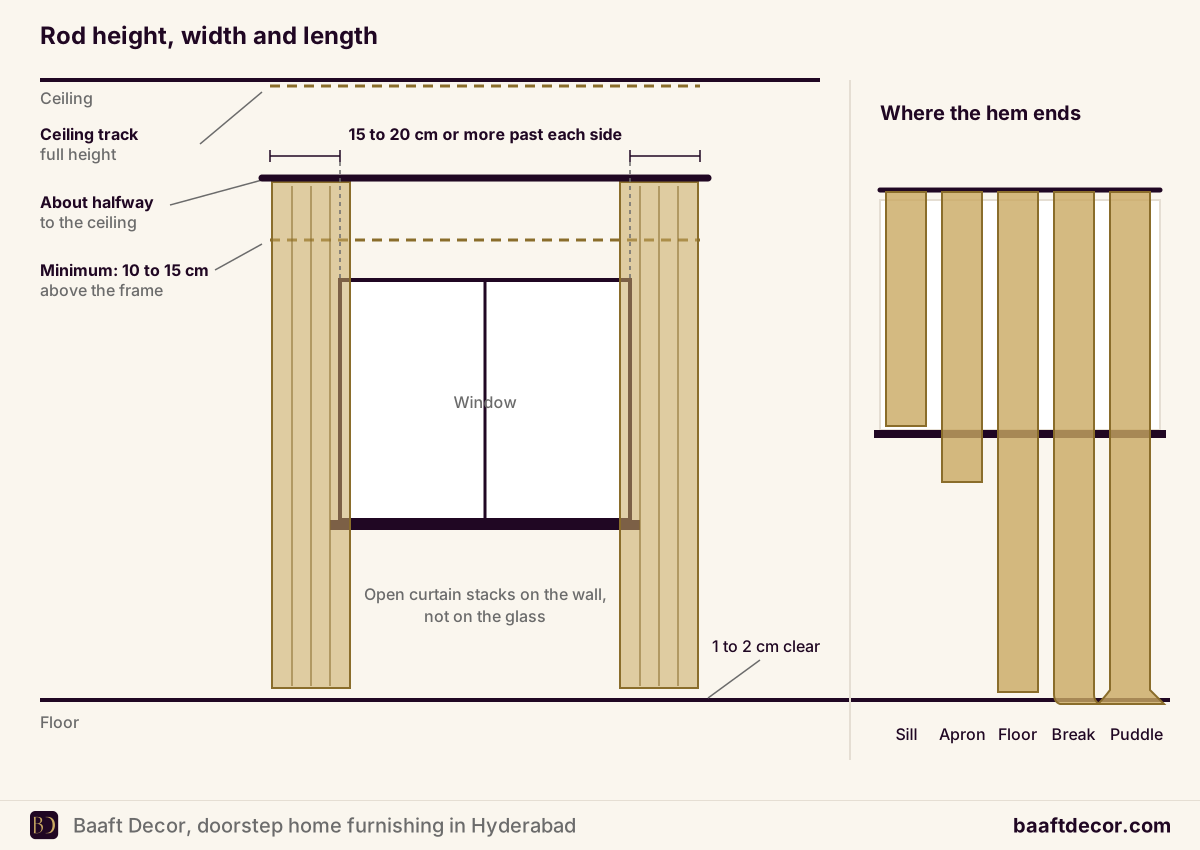
The short rule: never less than 10 to 15 cm above the top of the frame. That much hides the frame, covers the gap where morning light sneaks over the top, and leaves room for brackets to grip solid wall instead of the plaster edge around the window.
From there, go higher if the wall allows it.
| Rod or track position | Effect | When we use it |
|---|---|---|
| 10 to 15 cm above the frame | Minimum; hides frame and top light gap | Little wall above the window, or a beam in the way |
| About halfway between frame and ceiling | Window looks taller, room feels bigger | Most living rooms and bedrooms with plain wall above |
| 2 to 5 cm below the ceiling (wall rod) | Nearly full height | Ceilings without a false ceiling, when you want a rod |
| Ceiling-mounted track | Full height, no light gap at the top | False ceilings, beams over the window, blackout rooms |
Two things decide the real answer in Hyderabad homes. First, look up: many apartments have a concrete beam right above the window, sometimes with very little wall between frame and ceiling. Second, check what else lives up there, usually a split AC, a loft door or a curtain pelmet the builder already put in.
Want this planned for your windows? We visit with samples and a tape, free across Hyderabad. WhatsApp +91 98499 17494.
How far past the window should curtains go?
Height gets the attention, but width is where most rooms lose daylight. Extend the rod or track at least 15 to 20 cm past the frame on each side. On wider windows, go further.
The reason is stack-back: the bundle of fabric left when the curtain is open. A pleated curtain at around 2 times fullness doesn’t fold down to nothing. Hardware maker Bali’s drapery measuring guide puts the total stack at roughly one third of the window width, more for heavy or bulky fabric. If that stack has no wall to sit on, it sits on your glass.
Some practical points:
- Lined and blackout curtains stack wider than sheers. Allow more on each side.
- Ripple fold stacks tighter and more evenly than pinch pleat, which helps when wall space is short.
- A wall or wardrobe right beside the window means the curtain may have to open to one side only.
- Switchboards and AC pipes in the extension zone need checking before brackets go in.
How long should curtains be?
Length is a choice, not a single correct answer. Here’s how the five common finishes compare.
| Length | Where the hem ends | Suits | Watch out for |
|---|---|---|---|
| Sill | About 1 cm above the sill | Windows above a bed, desk or kitchen counter | Can look short in living rooms |
| Apron (below sill) | 10 to 15 cm below the sill | Short windows where you want fewer light leaks | Needs clear wall below the window |
| Floor | 1 to 2 cm above the floor | Most living rooms, bedrooms, balcony doors | Uneven floors: measure at three points |
| Break | Touches the floor with a slight bend, a few cm extra | Formal rooms, softer look | Hem gathers dust |
| Puddle | 5 to 15 cm pooled on the floor | Decorative, rarely opened curtains | Dust, foot traffic, mopping |
For most homes we stitch floor length. It hangs straight, clears the mop, and looks finished. Tiles and marble in new flats are rarely dead level across a wide window, so we take the shortest of three drop readings and work from that.
Break and puddle lengths need a dust-free, low-traffic room. With construction dust drifting in from neighbouring sites for months after handover, that’s rare in a new gated community.
Two layers: where the sheer and main curtain go
Most living rooms and bedrooms here get two layers: a sheer for daytime and a lined curtain for night and the afternoon sun. That changes the height plan slightly.
- Both layers start at the same height. On a double track or double rod, the sheer usually sits on the inner line (closest to the glass) and the main curtain on the outer line. Both should start as high as the room allows.
- Each layer gets its own drop. The two lines sit at slightly different heights and depths, so we measure the drop for each separately. A centimetre of difference shows at the hem.
- Leave clearance from the glass. In the monsoon, a lined curtain pressed against cold, damp glass can get mildew spots. A track bracket that holds the inner layer a few centimetres off the window helps.
Ceiling height, false ceilings and pelmets
False ceilings
If your flat has a false ceiling, or one is going in, the curtain should almost always come from the ceiling. There are two neat ways to do it:
- A recessed track pocket built into the false ceiling along the window wall. The track hides inside and the curtain appears to fall from a slot.
- A surface track fixed to the false ceiling, screwed through into a plywood backing strip or the concrete slab above.
What doesn’t work is a track screwed only into gypsum board. It sags and pulls out under the weight of lined curtains. The pocket and backing strip have to be planned with your false ceiling contractor before the boards are closed. Our curtain rods and tracks guide covers track types and bracket spacing in detail.
Pelmets
A pelmet is a box or panel across the top of the window that hides the track. It’s useful when the track is ugly, when a beam needs disguising, or when you want a traditional look. Mount the pelmet high, close to the ceiling, or it brings back the “low window” problem. See our pelmet and valance ideas for styles.
Low ceilings in older Hyderabad houses
Many older independent houses in the city, and some apartments from the 1980s and 1990s, often have lower ceilings and a deep beam or lintel over each window. The wall between frame and ceiling can be just a few centimetres.
This is where the rules bend:
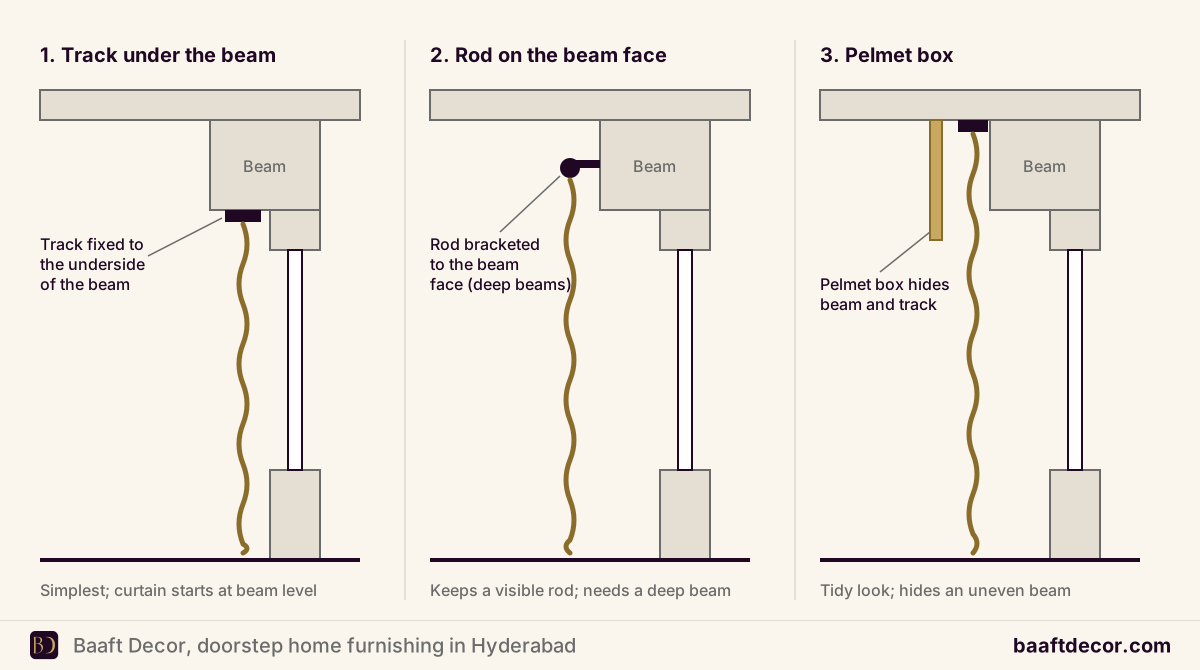
- Use a ceiling track fixed to the underside of the beam or slab. The curtain runs from the highest possible point, so the room reads as tall as it can.
- Skip heavy finials and big rods. On a low wall, a chunky rod with ornate ends sits right in your eye line.
- Choose a heading that sits flush to the track, such as ripple fold or pinch pleat with glider hooks, so you don’t lose a few centimetres to a tall heading.
- Keep the colour close to the wall. A curtain in a similar tone to the wall stops the window from looking chopped off.
- Go floor length. In a low room, short curtains cut the wall in half and make it look lower still.
If a beam is deep enough, fixing the rod on the face of the beam is also fine. What we avoid is squeezing a rod into a 5 cm gap under the beam.
What about sliding doors and floor-to-ceiling glass?
Large glass openings follow the same logic with bigger numbers: more stack-back, heavier panels, and often a ceiling track as the only realistic option. We cover those in our guide to curtains for sliding doors and large windows.

Getting the height right first time
The order matters: fix the hardware position, then measure, then stitch. Change the rod height after the curtains are made and every panel is the wrong length. We fit curtains in Hyderabad in exactly that order, and if you already have curtains that came out short, our curtain installation service covers re-mounting tracks and rods at the right height, along with alterations where the fabric allows.
Book a free home visit and we’ll check your walls, beams and ceiling, mark the rod position with you, and quote for fabric, stitching and fitting. We work across Hyderabad from 8 AM to 10 PM, all seven days. Call or WhatsApp +91 98499 17494.
Frequently asked questions
How high should curtains be hung above the window?
Curtains should be hung with the rod or track at least 10 to 15 cm above the top of the window frame. That is the minimum that hides the frame and stops light spilling over the top. If there is more wall above, going higher, often about halfway between the frame and the ceiling, makes the window look taller. In rooms where the gap is small or a beam sits over the window, a ceiling-mounted track is usually the neatest answer, because the curtain then runs from ceiling to floor.
Should curtains touch the floor?
Curtains usually look best when they end just above the floor, about 1 to 2 cm clear, so they hang straight and do not drag. This floor-length finish suits most living rooms and bedrooms and is easy to clean around. A break, where the hem just touches and bends slightly, looks softer but picks up dust. Puddled curtains that pool on the floor look dramatic in photographs, but in Hyderabad homes they gather construction dust and get trodden on, so we rarely recommend them.
How far past the window should a curtain rod extend?
A curtain rod should extend at least 15 to 20 cm past the window frame on each side, and more on wide windows. The extra width gives the curtain somewhere to stack when it is open, so it does not cover the glass and block daylight. A common rule from hardware makers is that the stacked curtain needs roughly one third of the window width in total, split between the two sides. Heavy or lined fabric needs more stacking room than a light sheer.
Is it better to hang curtains high or close to the window?
In most rooms it is better to hang curtains high rather than close to the frame. A higher rod draws the eye up, makes the ceiling feel taller and blocks the gap where light leaks over the top. Hanging close to the frame only makes sense when there is a beam, an AC unit or a loft directly above, or when the curtain must clear something like a wall-mounted cabinet. In those cases a ceiling track or a pelmet often gives the same tall look without fighting the obstruction.
What length should bedroom curtains be?
Bedroom curtains are usually best at floor length, ending 1 to 2 cm above the floor. A floor-length curtain blocks light leaks at the bottom, which matters for blackout curtains, and it looks calmer than a short curtain. If the window sits above a bed, a desk or a built-in window seat, sill length (just above the sill) or apron length (10 to 15 cm below the sill) is more practical, because the curtain will not crush against the furniture when it is closed.
How do you hang curtains when there is a beam above the window?
When a concrete beam sits directly above the window, as it does in many Hyderabad apartments and older houses, there are three good options. Fix a ceiling track to the underside of the beam so the curtain drops from there. Fix the rod or track on the face of the beam if it is deep enough to take brackets. Or build a pelmet box that hides the beam and the track together. Trying to squeeze a rod into the small gap between frame and beam usually looks cramped and makes the window seem shorter.
How high should curtains be in a room with a false ceiling?
In a room with a false ceiling, curtains look best when they hang from the ceiling itself, either from a track set into a recessed pocket or from a track screwed through the false ceiling into a backing strip or the slab above. The curtain then runs the full height of the room. A track should never hang only from gypsum board, because the board cannot carry the weight and pull of curtains for long. This needs to be planned before the false ceiling is closed.
Do high-hung curtains need more fabric?
Yes, hanging curtains higher means a longer drop, so each panel needs more fabric. Extending the rod wider also adds fabric, because the flat width is the rod length multiplied by the heading fullness, often around 2 times. The extra cost is usually modest compared with the difference in how the room looks, and the fabric quantity is worked out from the final rod position, not the window size. That is why we fix the hardware height first and measure the drop afterwards.