Pelmets and valances divide opinion more than any other part of a curtain. Some people picture the swags and tassels of an old drawing room. Others have seen a slim box pelmet tidy up a wall of mismatched windows. Both are right. When we plan custom curtains in Hyderabad, the question we ask is simple: what problem would a pelmet solve here?
This is one of the spokes of our curtains buying guide for Hyderabad homes. Below we cover what each option is, when it helps, when it dates a room, and the modern alternatives.
Pelmet, valance, cornice: what’s the difference?
| Term | What it is | Material | Look |
|---|---|---|---|
| Pelmet (box pelmet) | Rigid box fixed above the window, open at the bottom | Plywood or MDF; painted, laminated, veneered or fabric-covered | Crisp, straight line |
| Cornice board | Another name for a pelmet, often with a shaped edge | As above | Tailored or decorative |
| Valance | Short fabric piece across the top | Curtain fabric, sometimes stiffened | Soft, traditional |
| False-ceiling pocket | Recess in the false ceiling that hides the track | Gypsum board | Invisible; curtain falls from the ceiling |
As Wikipedia’s entry on pelmets puts it, a pelmet is a framework above a window used to conceal curtain fixtures, and a valance does the same job in fabric. The difference in practice: a pelmet holds a straight line and blocks light at the top firmly; a valance softens the window.
When a pelmet genuinely helps
Hiding an ugly or mismatched track. If the builder left a basic aluminium track, or different windows have different hardware, a pelmet hides all of it.
Stopping light over the top. In a bedroom with blackout curtains, a strip of light over the track at 6 AM undoes half the job. A pelmet closes that gap. It also reduces the convection loop of warm air between the glass and the room, which the same Wikipedia entry notes is how pelmets help insulate a window. Our blackout vs sheer vs dim-out guide covers the other light leaks.
Evening out an uneven ceiling line. Many Hyderabad flats have a concrete beam over some windows and not others, or windows at different heights on one wall. A pelmet at a single height across the wall gives one clean line.
Hiding a blind behind a curtain. Layering a roller or zebra blind with a curtain is common on west-facing windows. A pelmet hides the roll and brackets.
Covering the AC pipe run. Where a split AC sits above or beside a window, the copper pipes and drain line often cross the curtain zone. A pelmet can hide the pipes. It must not box in the indoor unit itself, since blocked airflow hurts cooling; keep the clearances given in the AC’s installation manual.
When a pelmet dates a room
- Swags, tails, fringes and tassels. These belong to a formal, traditional room. In a modern apartment they look heavy fast.
- Frilled or ruched valances in a contrasting fabric.
- Low ceilings. A deep pelmet in a room with a low ceiling chops the window and makes the room feel shorter.
- Pelmets that hide nothing. If there’s a neat ceiling track already, a pelmet only adds a dust shelf.
That last point matters more here than in many cities. In neighbourhoods with construction next door, the top of a pelmet collects fine dust every week.
Pelmet ideas that still look current
1. Slim box pelmet in the wall colour
The quietest option. A shallow box painted the same colour as the wall or ceiling almost disappears and just gives the curtains a clean top line.
2. Fabric-wrapped box pelmet
A plywood box wrapped in the same fabric as the curtain, or in a plain contrast. It works in traditional or formal rooms without swags. Keep the bottom edge straight or gently shaped.
3. Wooden or veneer pelmet
A pelmet in the same veneer or laminate as the wardrobe or TV unit ties the room together. It suits bedrooms where the wardrobe sits on the same wall as the window.
4. Pelmet with a hidden LED strip
An LED strip along the top of a pelmet throws soft light onto the ceiling. It’s a simple way to add cove-style lighting without a false ceiling, but it needs a power point planned in advance.
5. Flat or box-pleat valance
For a kitchen window or a child’s room, a short, flat valance in a cheerful fabric hides a basic rod and adds colour. Keep it plain; frills are what date it.
Concealed tracks and false-ceiling pockets
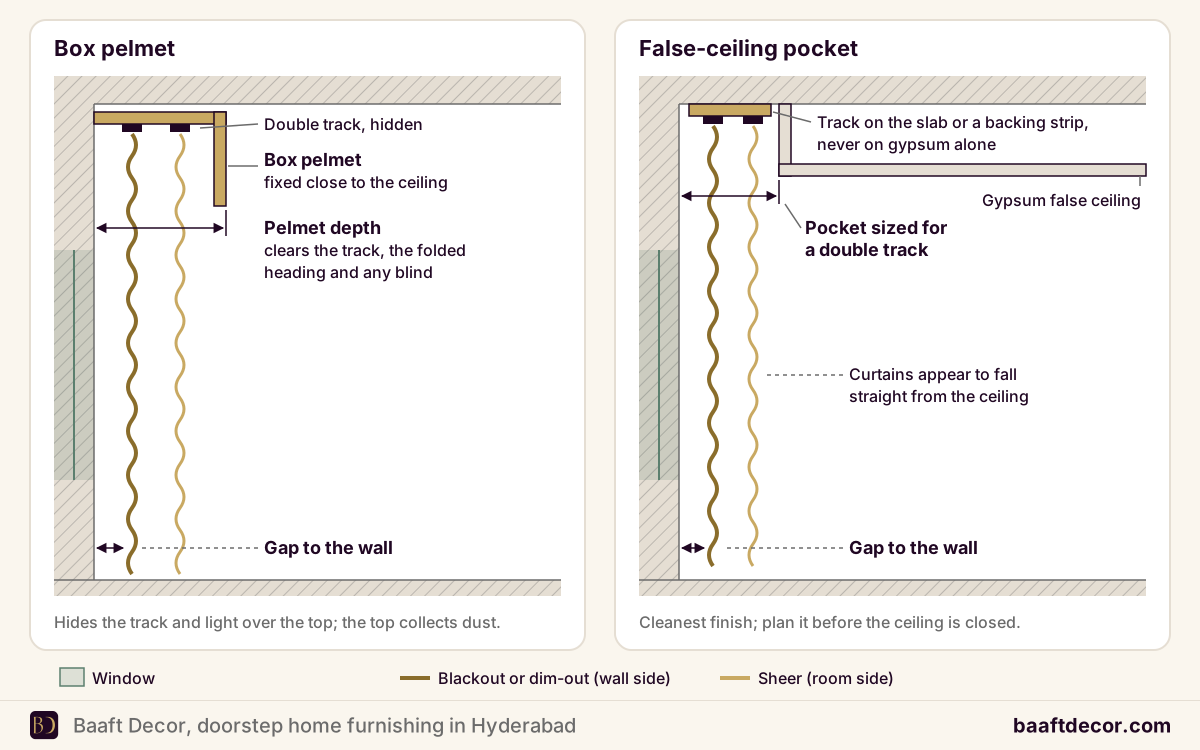
If you’re doing a false ceiling, a curtain pocket is the cleanest solution of all. The track sits inside a recess, and the curtain appears to fall straight from the ceiling.
Three rules we follow:
- Plan it before the ceiling is closed. A pocket can’t be added neatly afterwards.
- Size it for the track. A double track for sheer plus blackout needs a wider pocket than a single one, and a motorised curtain track needs a power point inside or near the pocket.
- Fix the track to the slab or a backing strip, never to gypsum board alone. Gypsum can’t hold the weight of a lined curtain being pulled every day.
Coordinate the pocket with your ceiling contractor, or with our false ceiling service if we’re doing both. The curtain rods and tracks guide covers which tracks suit ceiling and pocket mounting.

Pelmet, pocket or nothing: a quick way to decide
Run through these in order and stop at the first yes.
- Is a false ceiling going in? Use a curtain pocket.
- Is the ceiling finished, but the track ugly or the window line uneven? Use a slim box pelmet.
- Is it a bedroom with blackout curtains and light leaking over the top? A pelmet or a ceiling-mounted track both fix it; the track is cheaper and collects less dust.
- Is the room formal or traditional, and do you like the look? A fabric-wrapped pelmet or a plain valance.
- None of the above? Skip it. A neat ceiling track with a good curtain needs nothing on top.
Getting pelmet proportions right
A pelmet that’s too shallow catches the curtain heading. Too deep, and it looks like a box glued to the wall.
- Depth: enough to clear the track, the folded heading and any blind behind it, with a little air around them.
- Width: extend it past the ends of the track, so the stacked curtain sits under the pelmet when open.
- Returns: close the sides back to the wall, or light and dust get in at the ends.
- Height: in most flats, fix it close to the ceiling. Hanging it just above the window frame makes the window, and the room, look shorter.
Looking after pelmets in Hyderabad
Dust the top of a pelmet with a vacuum brush once a month; in dusty months, more often. Fabric-covered pelmets near a kitchen pick up grease and are hard to clean, so choose painted or laminated finishes there. In older houses or ground-floor flats, use treated plywood. And on an outside wall that turns damp in the June to September monsoon, leave a small gap behind the pelmet so it can dry out.
For more ways to dress windows and doors, see our door curtain ideas and curtain designs for living rooms and bedrooms.
Can’t decide between a pelmet, a pocket or nothing at all? Book a free home visit. We’ll look at the ceiling, beams and existing hardware, bring fabric and finish samples, and give a fixed quote for curtains, tracks and any pelmet work. Call or WhatsApp +91 98499 17494, 8 AM to 10 PM, all 7 days.
Frequently asked questions
What is the difference between a pelmet and a valance?
A pelmet is a rigid frame, usually plywood or MDF that is painted, veneered or covered in fabric, fixed across the top of a window to hide the curtain track. A valance does the same job in soft fabric, hung as a short gathered, pleated or draped piece above the curtain. A pelmet gives a crisp, straight line and blocks light at the top more firmly. A valance looks softer and more traditional. A cornice board is another name for a pelmet.
Are pelmets outdated?
Pelmets are not outdated, but the style has changed. Heavy, ornate pelmets with swags, tails, fringes and tassels now look dated in most new apartments. A slim box pelmet painted in the wall or ceiling colour, a fabric-wrapped box in the curtain fabric, or a recessed false-ceiling pocket that hides the track completely all still look current. The deciding question is whether the pelmet solves a problem, such as a visible track, light leaks or an uneven ceiling, or is only decoration.
What is a box pelmet?
A box pelmet is a three-sided box, open at the bottom, fixed above a window so it covers the curtain track and returns to the wall at both ends. It is usually made of plywood or MDF and then painted, laminated, veneered or wrapped in fabric. Because it closes off the top of the curtain, a box pelmet hides the track and gliders, reduces light leaking over the top, and gives windows of different heights a single straight line across the wall.
Should I choose a pelmet or a false-ceiling curtain pocket?
Choose a false-ceiling curtain pocket if you are installing a false ceiling anyway, because it hides the track completely and the curtain appears to fall from the ceiling. It must be planned before the ceiling is closed, with the track fixed to the slab or a backing strip, not gypsum alone. Choose a pelmet if there is no false ceiling, if the ceiling is already finished, or if you want the top of the window to be a visible design feature.
Can a pelmet hide an AC unit?
A pelmet should not be used to box in a split AC's indoor unit, because blocking the air inlet or outlet reduces cooling and can cause problems with the unit. A pelmet can, however, run alongside the unit and hide the copper pipes and drain line where they cross above the window. Keep the AC's front, top and sides clear by the distances given in its installation manual, and plan the curtain stack so the fabric never blows into the airflow.
What material is best for a curtain pelmet?
Plywood is the most common material for a curtain pelmet because it is strong and holds screws well, and it can be painted, laminated, veneered or wrapped in fabric. MDF gives a smoother painted finish but dislikes damp. In older houses or ground-floor flats with termite history, use treated plywood. On an outside wall that turns damp in the monsoon, choose a moisture-resistant board and leave a small gap from the wall. Gypsum pockets are built as part of a false ceiling.
Do pelmets help keep a room cooler?
Pelmets can help a little with heat and light, mainly when they are paired with lined, dim-out or blackout curtains. By closing the gap at the top of the curtain, a pelmet stops light spilling over the track and reduces the convection current of warm air between the window and the room. On their own they won't cool a west-facing room, but on a bedroom window with blackout curtains they make a noticeable difference to how dark the room gets.
Can you use a pelmet with roller blinds?
Yes, a pelmet works well with roller blinds and zebra blinds. It hides the roll, the brackets and the chain, and gives a neat top line when a blind and a curtain are layered on the same window. Make the pelmet deep enough to clear the rolled-up blind plus any curtain track in front of it, and check that the bottom edge of the pelmet doesn't stop the blind from rolling fully up. Zebra blinds have a fatter roll, so allow extra depth.