Most people pick the rod or track last, once the fabric is chosen, and it’s usually the part that has to be redone. A sagging rod, a stiff track or a bracket pulling out of a false ceiling spoils a good curtain quickly. When we fit curtains in Hyderabad homes, we choose the hardware together with the fabric, because heading, weight and ceiling all affect each other. Hardware is one chapter of our curtains buying guide for Hyderabad homes. This page covers every rod, track, bracket and fixing in more detail.
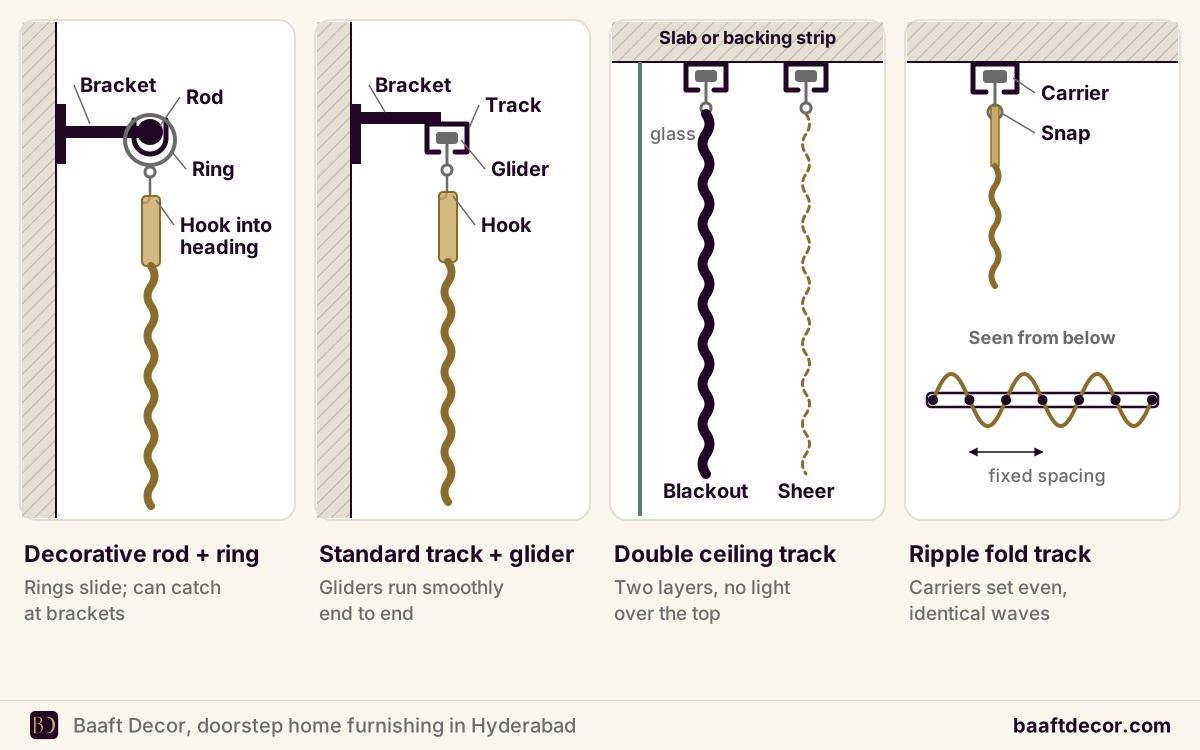
Curtain rod or curtain track?
| Curtain rod | Curtain track | |
|---|---|---|
| Look | Visible, decorative, with finials | Slim, minimal, often hidden |
| Mounting | Wall (ceiling possible with brackets) | Wall, ceiling or recessed pocket |
| Works with | Eyelet, rings, tab-top, pinch pleat with rings | Pinch pleat, pencil pleat, ripple fold |
| Movement | Rings slide; can catch at joints and brackets | Gliders run smoothly end to end |
| Two layers | Double rod, sticks out further | Double track, compact |
| Motorisation | No | Yes, with a motor-rated track |
| Best for | Traditional rooms, rentals, feature hardware | New apartments, sliding doors, false ceilings |
Our take: in most new apartments, a track wins. Rods still make sense where the hardware is meant to be seen, like a black metal rod in an industrial-style room or a wooden pole in a traditional house.
Types of curtain rods
By material
- Aluminium: Light, rust-free, available in many finishes.
- Stainless steel: Strong and rust-resistant if good grade. Good for balconies.
- Powder-coated mild steel: Affordable and strong, but rusts once the coating chips.
- Brass or brass-finish: Traditional look; quality depends on what’s under the finish.
- Wood: Warm and classic. Needs thicker diameters and good brackets on long spans.
By function
- Single rod: One curtain layer.
- Double rod: Sheer and heavier curtain on separate rods.
- Adjustable or extendable rods: Telescopic, fit a range of widths. Fine for rentals, but rings can catch at the joint.
- Tension rods: Spring-loaded, fit inside a window recess with no drilling. Only for light sheers or café curtains.
- Bay and corner rods: Joined with elbows to follow angled windows.
Diameter matters. Slim rods around 16 to 19 mm suit sheers and short windows. Lined or blackout curtains need about 25 mm or thicker. A thin rod across a 3 m balcony door will bow in the middle, however good the brackets are.
Types of curtain tracks
- Standard aluminium track: A slim channel with gliders running inside. Shops often name these by profile shape (you’ll hear “M-track”), but the name doesn’t fix a size, so compare the actual section and wall thickness.
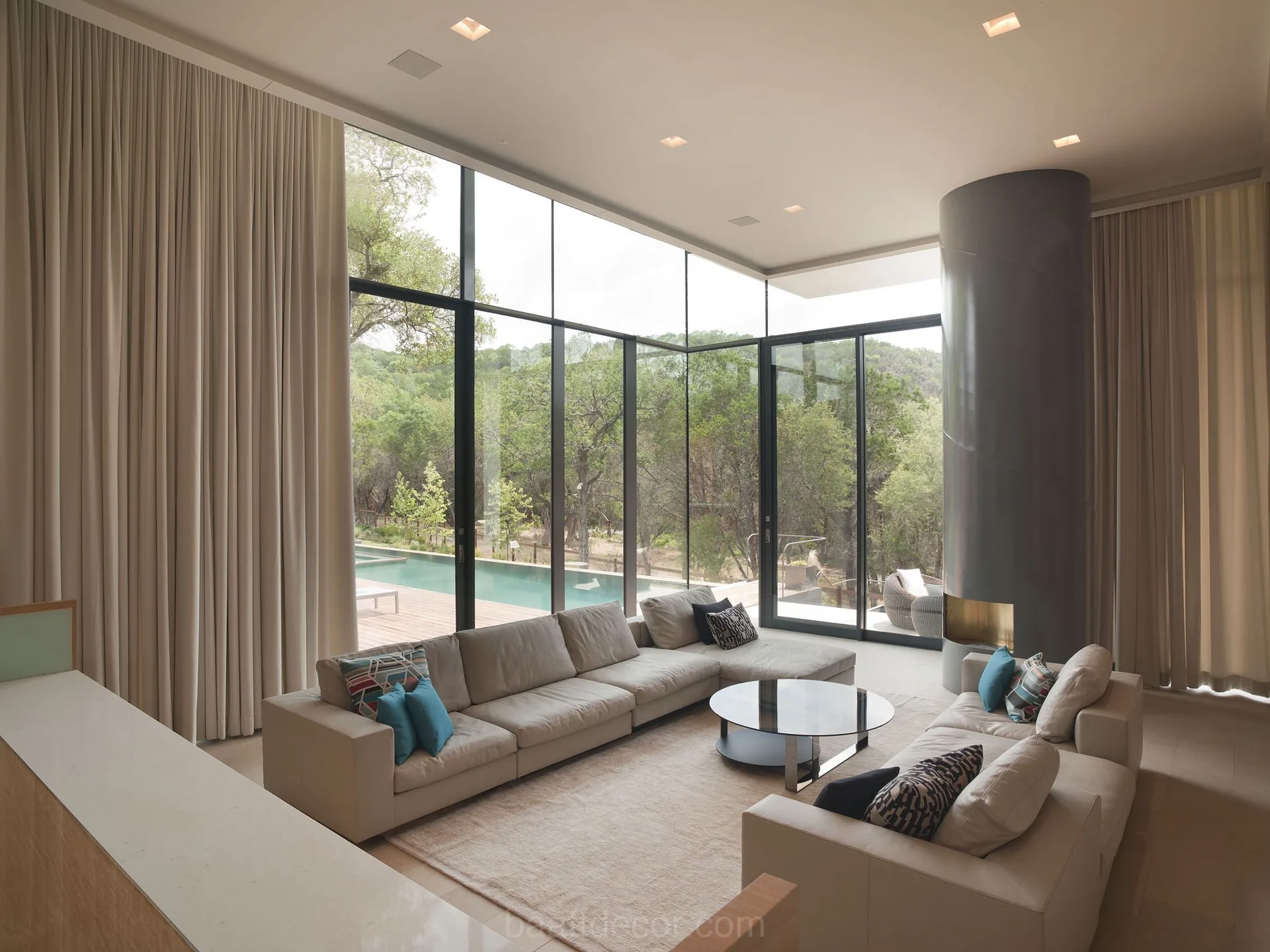
- Ceiling curtain rail: The same track fixed to the ceiling. The curtain falls from ceiling to floor and no light leaks over the top.
- Double track: Two channels side by side for a sheer plus a dim-out or blackout. We usually put the heavier curtain nearer the glass (darker room, better heat reflection) and the sheer room-side, since that’s what you see by day.
- Ripple fold track: Carriers spaced at fixed intervals create even waves. Needed for ripple fold curtains.
- Bendable track: Curved to follow bay or corner windows.
- Motorised track: Belt-driven, paired with a motor. See our motorised curtains and blinds page.
Wall-mounted, ceiling-mounted or recessed?
Wall-mounted works almost everywhere. Fix it 10 to 15 cm above the frame, or higher to make the room look taller.
Ceiling-mounted is our default in apartments where the window sits close to the ceiling, which is common in Hyderabad flats with a beam above the window.
Recessed in a false ceiling gives the cleanest result: the track disappears into a pocket. It has to be planned before the ceiling is closed. If you’re doing a false ceiling, coordinate the pocket with your contractor or our false ceiling service.
Brackets and supports
- End brackets at both ends.
- Centre supports roughly every metre, closer (about 60 to 90 cm) for heavy lined curtains.
- Projection. The bracket must hold the rod far enough from the wall to clear window handles, a protruding sill, or a blind behind the curtain.
- Passing brackets on rods let rings slide past a centre support.
If you’re unsure, add the extra bracket. One more bracket costs far less than taking down a sagged rod and drilling again.
Small parts that make a big difference
- Rings, hooks and gliders: Carry the curtain. Plastic gliders should run smoothly without snagging.
- End stops: Keep gliders from sliding out.
- Overlap arms: Let the two halves cross at the centre so no strip of light gets through.
- Finials: Decorative ends on rods.
- Tie-backs and holders: Hold curtains open. Magnetic and hook-style holders keep fabric off the glass.
- Draw wands: A rod clipped to the leading edge so you pull the wand, not the fabric. It keeps hands and kitchen oil off light-coloured curtains.
Fixing into Hyderabad walls and ceilings
This is where most installation problems come from.
RCC beams. Most apartments have a concrete lintel or beam above the window. Drilling into it needs proper bits and anchors, and takes longer.
AAC and fly-ash blocks. Common in newer gated communities. Ordinary plugs can pull out under weight, so use anchors made for these blocks.
Gypsum false ceilings. Never fix a track only into gypsum board. Fix through to the slab, or into a plywood or timber backing strip installed before the ceiling is closed.
Hidden wiring. Electrical conduits often run above windows and along ceiling lines. Check before drilling.
Sliding doors and high-rise windows
Sliding balcony doors are the widest openings in most flats, and the ones you use most. Run the track 20 to 25 cm past the door on the side the curtain stacks, so the stacked fabric clears the opening completely. If the door slides only one way, a one-way draw curtain that stacks on the opposite side keeps the path clear. Heavy lined curtains on doors wider than about 2.5 m are a good case for a track over a rod, and often for a motor.
High-rise windows bring wind. On upper floors in areas like Kokapet, an open window can pull a light curtain outward or slam it against the frame. Tracks hold the curtain more securely than rings on a rod, and a magnetic holder or tie-back on each side keeps it in place on windy evenings. Check that the bracket screws go into concrete or a proper anchor, not just plaster.
Common hardware mistakes we fix
- A rod that ends at the window frame, so the curtain always covers part of the glass.
- No centre support on wide windows.
- Eyelet curtains bought for a rod that’s too thick to fit the rings.
- Tracks screwed only into gypsum board.
- Powder-coated steel rods on a balcony.
Rust, dust and monsoon care
For balconies and rooms that catch monsoon rain through open windows, choose aluminium or stainless steel. Wipe tracks every few months during construction-dust season. If gliders get stiff, use a dry silicone spray, not oil, which collects dust and stains fabric.
Which hardware for which heading?
| Heading | Rod | Track |
|---|---|---|
| Eyelet | Yes | No |
| Pencil pleat | Yes (with rings) | Yes |
| Pinch pleat | Yes (with rings) | Yes |
| Ripple fold | No | Ripple track only |
| Motorised | No | Motor track only |
Choosing the curtain first? Our types of curtains guide compares headings, and how to measure windows for curtains shows where to place the hardware.
Get the hardware right the first time
Book a free home visit. We’ll check your walls, ceiling and windows, suggest the right rod or track for each room, and quote fabric, hardware and installation together. We’re available 8 AM to 10 PM, all seven days. WhatsApp or call +91 98499 17494.
Frequently asked questions
What are the different types of curtain rods?
The different types of curtain rods are grouped by material and by function. By material, the common options are aluminium, stainless steel, powder-coated mild steel, brass or brass-finish, and wood. By function, there are single rods, double rods for two layers, adjustable or extendable rods, spring-loaded tension rods that fit inside a window recess without drilling, and corner or bay rods joined with elbows. Rods come in different diameters; slim rods suit sheers, while lined curtains and long spans need thicker rods with centre supports.
Is a curtain rod or a curtain track better?
Whether a curtain rod or a curtain track is better depends on the room. A track is better when you want smooth movement, a minimal look, ceiling mounting, ripple fold curtains, a double layer in tight space, or motorisation. A rod is better when you want visible hardware as a design feature, eyelet or ring curtains, or an easy fit in rentals. In most new Hyderabad apartments with false ceilings and sliding doors, a ceiling track is the more practical choice for living rooms and bedrooms.
What is a ceiling curtain rail?
A ceiling curtain rail, or ceiling track, is a curtain track fixed directly to the ceiling instead of the wall above the window. The curtain falls from the ceiling to the floor, which makes the room look taller and removes the gap above the curtain where light usually leaks in. Ceiling rails are common in apartments with false ceilings, where the track can be fitted into a recessed pocket so it is hidden. The rail must be fixed into the slab or a solid backing, not only into gypsum board.
What size curtain rod do I need?
For length, a curtain rod should be the window width plus about 15 to 20 cm on each side, so the curtain stacks on the wall when open and leaves the glass clear. For diameter, slim rods of around 16 to 19 mm suit sheers and short spans, while lined, blackout or heavy curtains need rods of about 25 mm or thicker. On longer spans, add a centre bracket roughly every metre so the rod doesn't sag. For eyelet curtains, the rod must fit through the eyelet rings.
How many brackets does a curtain rod or track need?
A curtain rod or track needs a bracket at each end plus intermediate supports along longer spans. As a practical guide, add a support roughly every metre for normal curtains and closer, around every 60 to 90 cm, for heavy lined or blackout curtains. Rods need centre brackets placed where they will not block the rings, so use passing brackets or split the curtain at that point. Tracks are fixed through their own clips at regular intervals and carry weight better than thin rods over wide windows.
Can a curtain track be fixed to a gypsum false ceiling?
A curtain track should not be fixed only into gypsum board, because the board cannot hold the weight and pull of curtains for long. The safe options are to fix the track through the false ceiling into the concrete slab above, or to have a wooden or plywood backing strip installed above the gypsum along the track line before the ceiling is closed. If a hidden track pocket is planned, the false ceiling contractor and curtain installer should agree its width and position before work starts.
Which curtain rod material does not rust?
Aluminium and good-grade stainless steel curtain rods and tracks do not rust in normal home conditions, which makes them the better choice for balconies, bathrooms and rooms that get monsoon humidity. Powder-coated mild steel rods look good and cost less, but once the coating chips, the steel underneath can rust and stain the curtain. Brass-finish rods vary depending on what is under the finish. For homes in Hyderabad, aluminium tracks and stainless steel rods give the longest life with the least maintenance.
Do motorised curtains need a special track?
Yes, motorised curtains need a motor-rated track designed to work with a specific motor. The track contains a belt or drive system that moves the curtain carriers, and the motor attaches at one end. Ordinary decorative rods and basic channel tracks cannot be motorised. Motorised tracks are available for ceiling or wall mounting and for ripple fold or pleated curtains. Wired motors need a power point near the track, so plan the electrical work before the false ceiling or painting is finished.