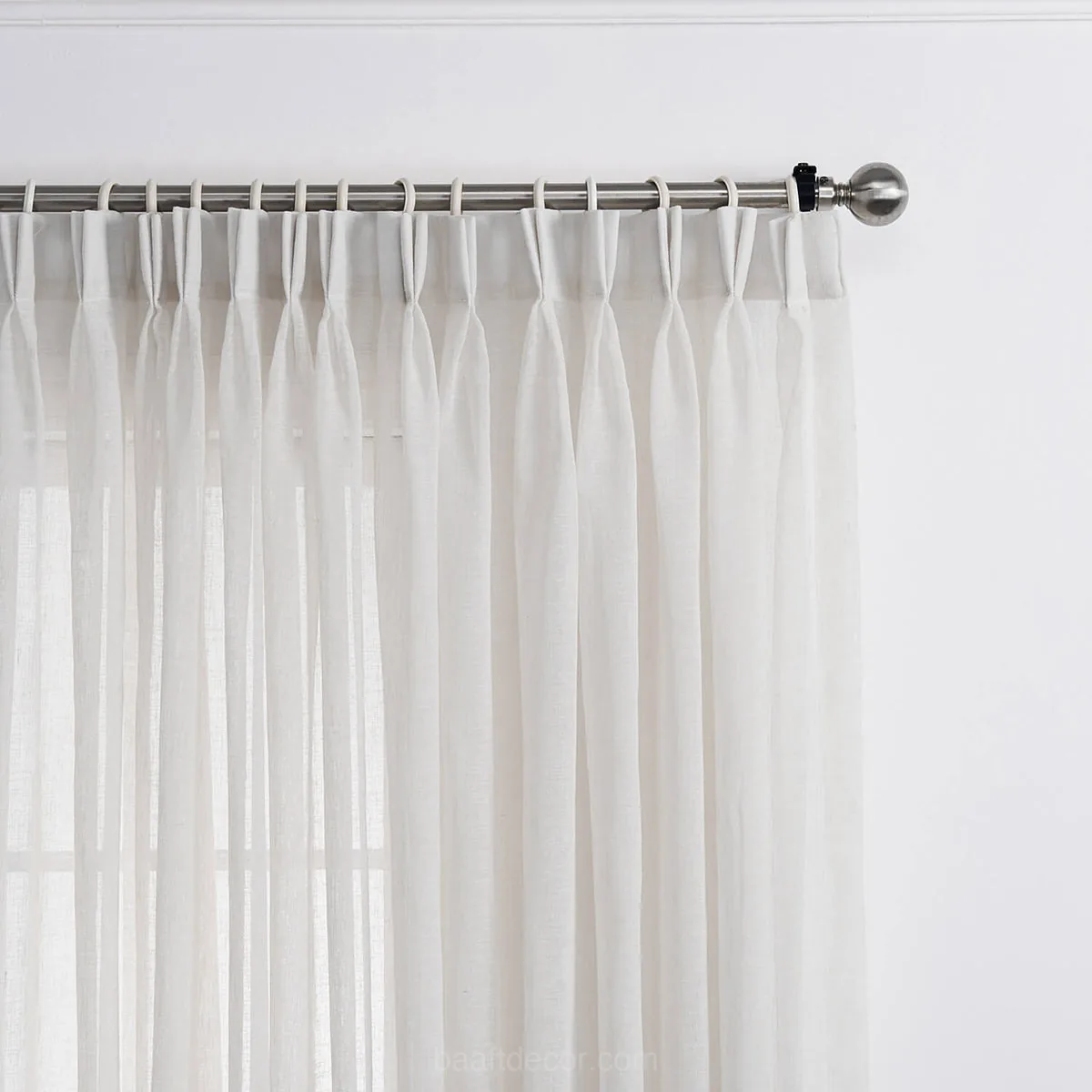
“How do you hang curtains?” sounds like a five-minute job until the drill hits an RCC beam, the plug spins in AAC block, or the track sags off a false ceiling a month later. This is the method we use, written out so you can do it yourself. If you’d rather not, our curtain installation service in Hyderabad does exactly this, with the hardware.
Choosing the hardware is a step before this one: our curtain rods and tracks guide compares the options. Placement height is its own question, covered in how high to hang curtains. For the whole process from fabric to fitting, see the curtains buying guide for Hyderabad homes.
How to hang curtains: the six steps
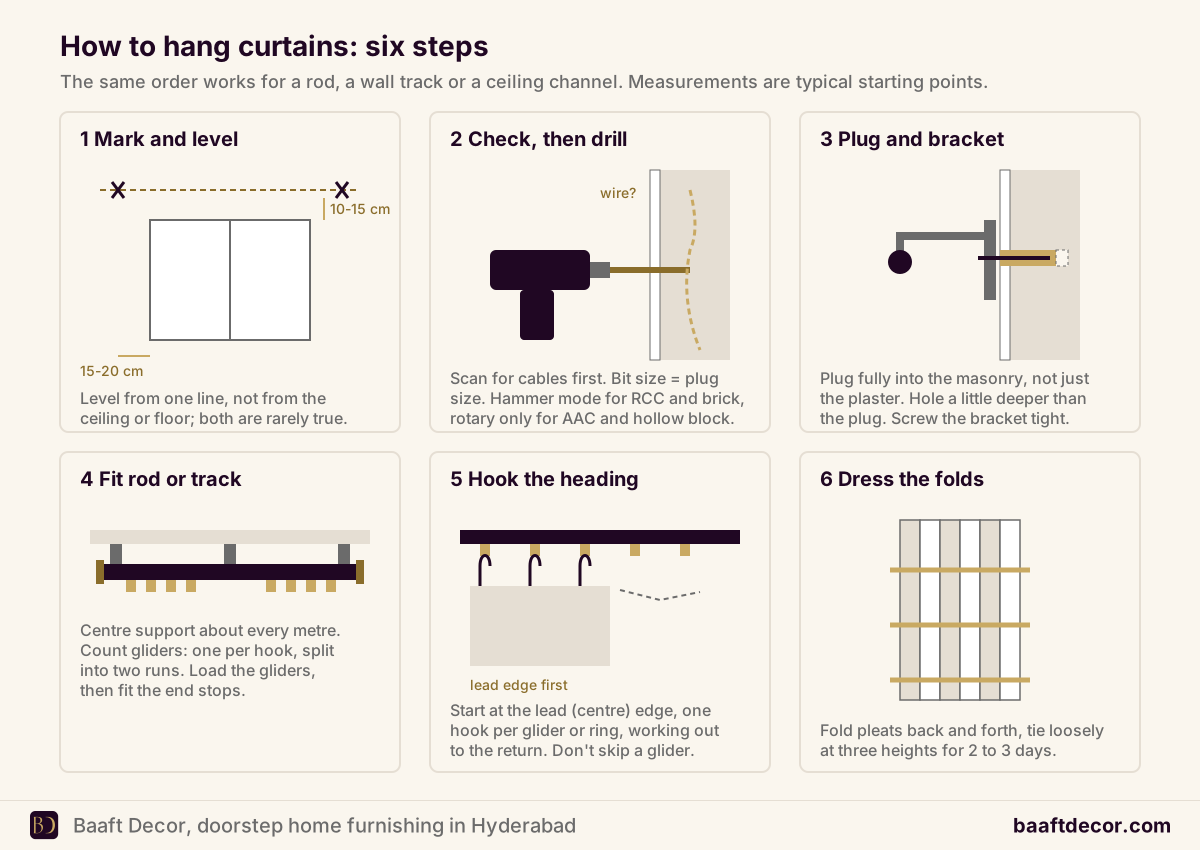
Hanging curtains always follows the same order, whether on a rod, a wall track or a ceiling channel: mark and level, check for wiring and drill, plug and fix the brackets, fit the rod or track, hook the heading, then dress the folds.
What you need: a drill with hammer and rotary-only modes, masonry bits (6 mm and 8 mm), plugs and screws to suit your wall, a spirit level or laser level, a measuring tape, a pencil, a cable detector, a screwdriver and a stable ladder. Measure the windows first; how to measure windows for curtains shows where.
Rather have it fitted? We visit, check your walls and quote hardware and fitting together, free across Hyderabad. WhatsApp +91 98499 17494.
Which drill bit and plug for your wall?
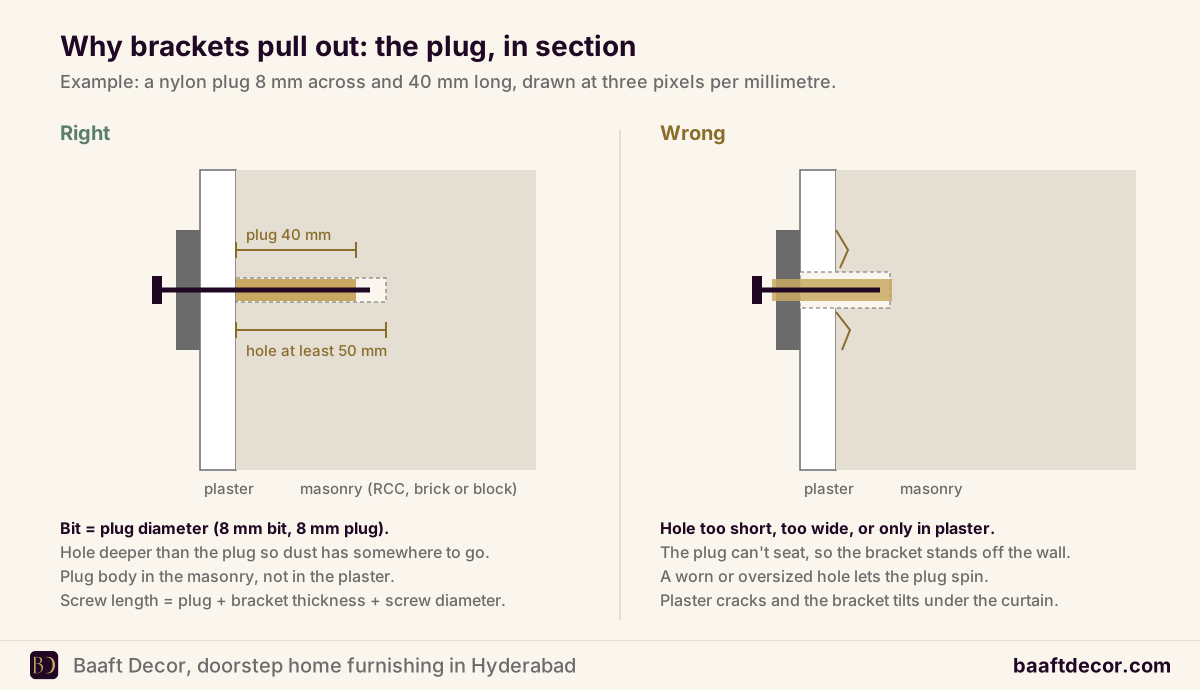
The right drill bit for curtain brackets is the same diameter as the plug, and the right plug depends on what’s behind the plaster. Tap the wall and drill a small test hole if you’re unsure: red dust usually means clay brick, grey dust with hard going means RCC, and pale, powdery dust that comes out with almost no effort means AAC block.
| Wall or ceiling | Drill mode | Typical bit and plug | Notes |
|---|---|---|---|
| RCC slab, beam or lintel | Hammer | 6 mm or 8 mm bit, matching nylon plug | Hard going; conduits often run in slabs |
| Solid brick | Hammer | 6 mm or 8 mm bit, matching nylon plug | Drill into the brick, not the mortar joint |
| Hollow or perforated block | Rotary only | Longer plug made for hollow masonry | Hammer action can break the inner webs |
| AAC block | Rotary only | Aerated concrete plug | Ordinary plugs have little to grip |
| Gypsum false ceiling | Rotary | Screw into batten or slab above | Never fix into the board alone |
| Plywood batten or wood | Rotary, wood bit | Wood screw, no plug | Pilot hole smaller than the screw |
These figures come from fixing makers’ published data. For fischer’s common nylon plug, the SX Plus listing gives a 6 mm bit with 4 to 5 mm screws for the 6 mm sizes and an 8 mm bit with 4.5 to 6 mm screws for the 8 mm sizes, with holes about 10 mm deeper than the plug (an 8 x 40 mm plug needs a 50 mm hole). For aerated concrete, the fischer aircrete anchor specifies rotary drilling, and its 8 mm size needs an 8 mm hole at least 60 mm deep. The same page gives a useful rule: screw length = plug length + thickness of the bracket + screw diameter.
How to hang a curtain rod
- Mark the brackets. Measure up from the window frame and out from each side. A typical starting point is 10 to 15 cm above the frame and 15 to 20 cm beyond each side, so the curtain stacks off the glass.
- Level it. Draw one level line across both marks with a spirit or laser level. Window frames and ceilings in many buildings aren’t true, so don’t measure each end from the ceiling. The exception: if the rod sits just under a ceiling that visibly slopes, split the difference so the gap doesn’t look uneven.
- Add a centre bracket on wider windows, roughly every metre.
- Check, drill and plug. Run a cable detector over each mark, especially above switches. Drill, clear the dust, and push the plugs in flush.
- Screw the brackets tight and check they’re still level.
- Load the rod. Slide the rings or eyelet curtain on, keeping one ring outside each end bracket so the curtain’s edge stays put at the wall. Rest the rod, fit the finials, tighten the grub screws.
How to fit a wall track or ceiling channel
A curtain track is fixed the same way, with two differences: you load the gliders into the channel before fitting the end stops, and you need one glider per hook in each run, plus a spare.
On the wall, screw the brackets on your level line, clip the track into them, and check it runs straight along its full length.
On an RCC ceiling, hold the channel up, mark through its pre-drilled holes, check for conduits near light points, then drill and plug each hole. A ceiling track pulls straight down on its screws, so every fixing must be sound.
On a gypsum false ceiling, find the plywood batten or framing line, then screw the track through the board into the batten. If there’s no batten, use longer fixings through to the slab. The batten and pocket detail is in our curtain channel and ceiling track guide.

How to hang curtains on hooks
- Fit the hooks first, on a table. For pencil pleat, one hook about every 8 to 10 cm, for pinch pleat one behind each pleat, plus one at each edge. Use the same pocket row throughout. Our guide to curtain hooks and gliders explains which hook suits which heading.
- Start at the lead edge, the one that meets in the middle of the window, and hook into the first glider or ring.
- Work outwards to the wall end, one hook per glider or ring. Don’t skip any; a skipped glider leaves a sag.
- Fix the return. The last hook goes into the end bracket or fixed glider so the curtain wraps round to the wall.
- Check the hem. Both curtains should finish at the same height. If one is low, the hooks are in different pocket rows.
Dressing (training) the folds
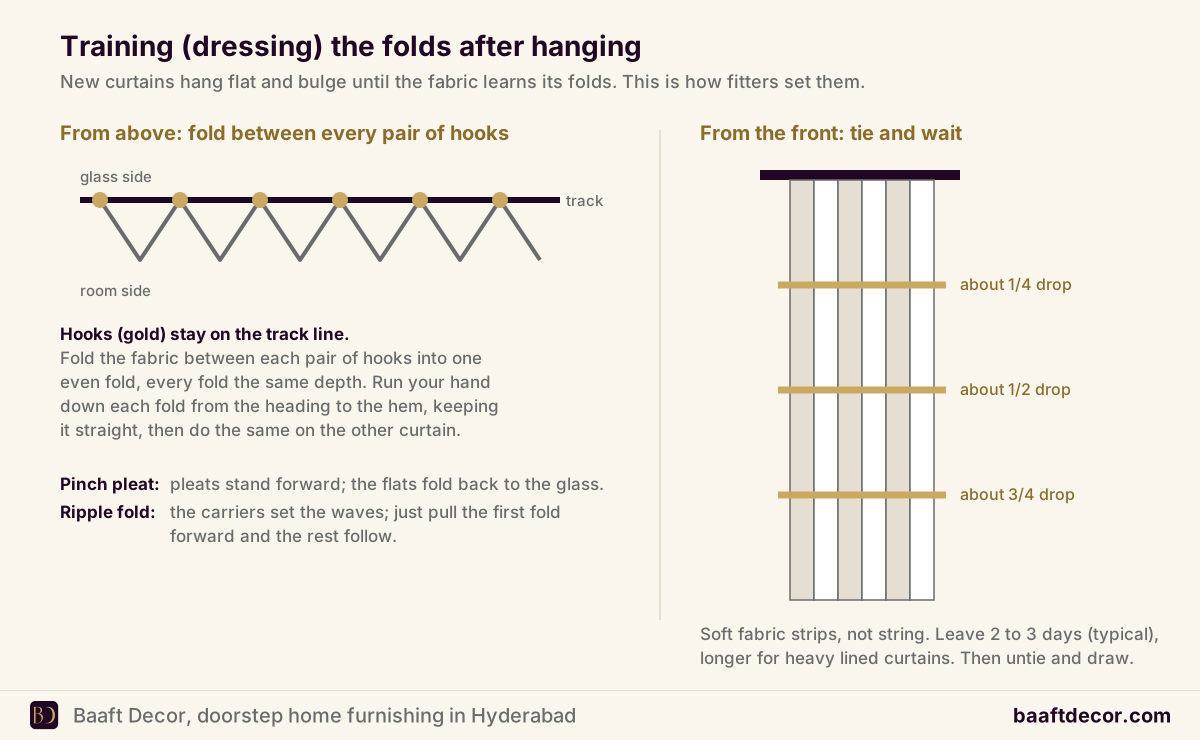
New curtains hang flat and bulge until the fabric learns its folds. Fitters call setting them “dressing” or “training”.
Draw the curtain fully open. Fold the fabric between each pair of hooks into one even fold, all the same depth, and run your hand down each one from heading to hem. On pinch pleat, the pleats stand forward and the flat spaces fold back towards the glass. Then tie the stack loosely with soft fabric strips, not string, at about a quarter, half and three quarters of the drop. A typical wait is two to three days; heavy lined curtains take longer. Ripple fold barely needs it, since the carriers set the waves.
Safety while hanging curtains
- Wiring: conduits run above windows and across ceilings. Scan before every hole, and switch off the circuit if you’re drilling near a light point.
- Ladders: use a stable ladder on a dry floor. Don’t stand on chairs or lean out over balcony railings on high floors.
- Eyes and lungs: drilling RCC throws grit. Wear eye protection and keep children out of the room.
- Weight: don’t hang heavy lined curtains from adhesive hooks or tension rods.
- Cords: keep draw cords and tiebacks out of children’s reach.
- Building rules: many gated communities restrict drilling hours. Check with your RWA before you start.
When to call a fitter
Call a fitter when the wall turns out to be RCC beam, the plugs spin, the track is going into a false ceiling with no batten, or the job is a wide sliding door or a bay window. If a rod or track has already sagged, our curtain repair service re-mounts hardware, including fittings someone else installed.
Baaft Decor measures, stitches and fits curtains at homes across Hyderabad, from new towers to older independent houses with brick walls and RCC lintels, including curtains in Begumpet, curtains in Kukatpally, curtains in Banjara Hills and curtains in Jubilee Hills.
Hang it once, hang it right
If you’d rather skip the drilling, book a free home visit for curtains in Hyderabad. We check your walls and ceiling, bring the right plugs and hardware, and fit and dress the curtains, whether we stitched them or you bought them elsewhere. We work 8 AM to 10 PM, all seven days. WhatsApp or call +91 98499 17494.
Frequently asked questions
How do you hang curtains on a rod?
To hang curtains on a rod, first mark the two end bracket positions on one level line, typically 10 to 15 cm above the window frame and 15 to 20 cm beyond each side, adding a centre bracket on wider windows. Drill with a masonry bit the same diameter as your wall plugs, push the plugs in flush and screw the brackets tight. Slide the rings or eyelet curtain onto the rod, keeping one ring outside each end bracket, rest the rod in the brackets, fit the finials and tighten the bracket screws.
How do you hang curtains on hooks?
To hang curtains on hooks, insert one hook into the heading tape every 8 to 10 cm for pencil pleat, or one behind each pleat for pinch pleat, plus one at each edge, using the same pocket row throughout. Then lift the curtain and hook it onto the rings or track gliders starting from the lead edge at the centre of the window, working outwards to the wall end. Use one glider or ring per hook, never skip one, and check that the hem is level before you dress the folds.
What size drill bit do I need to hang curtains?
The drill bit for hanging curtains should be the same diameter as the wall plug. With common nylon plugs, that usually means a 6 mm masonry bit for a 6 mm plug with screws around 4 to 5 mm, or an 8 mm bit for an 8 mm plug with screws around 4.5 to 6 mm, as listed by plug makers like fischer. Drill the hole about 10 mm deeper than the plug. For heavy lined curtains on RCC or brick, an 8 mm plug is the safer choice.
How do you hang curtains on an AAC block wall?
To hang curtains on an AAC block wall, use plugs made for aerated concrete rather than ordinary nylon plugs, which have little to grip in the soft block. Drill in rotary mode without hammer action so the hole stays the correct size; fischer's aircrete anchor, for example, specifies rotary drilling, an 8 mm hole at least 60 mm deep for its 8 mm size. Keep fixings away from the edges of blocks, and if the wall above the window is an RCC lintel, fix into that instead.
How do you hang curtains from a false ceiling?
To hang curtains from a gypsum false ceiling, the track must screw into something solid above the board, usually a plywood batten fixed to the slab before the ceiling was boarded, or into the slab itself. Locate the batten line, mark the track position, drill through the board into the batten and screw the track up with screws long enough to bite well into the wood. Never fix a curtain track only into gypsum board, because the screws loosen and pull through under the weight and movement of the curtain.
How do you make curtains hang nicely in folds?
To make curtains hang nicely in folds, dress or train them after hanging. Draw the curtain open, fold the fabric between each pair of hooks into one even fold, all the same depth, and run your hand down each fold from heading to hem. Then tie the stacked curtain loosely with soft fabric strips at about a quarter, half and three quarters of the drop and leave it for two to three days, longer for heavy lined curtains. Ripple fold curtains need little dressing because the track sets the waves.
Can I hang curtains without drilling?
You can hang light curtains without drilling using a spring tension rod that fits inside a window recess, adhesive hooks, or brackets that clip onto window frames. These suit light sheers, cafe curtains and rented homes. They are not suitable for heavy lined or blackout curtains, wide sliding doors or ceiling tracks, which need screwed fixings into RCC, brick, block or a batten. Adhesive fixings also tend to lose grip on painted walls in Hyderabad's summer heat and monsoon humidity.