- Same-day reply, and a same-day home visit on request
- Alterations to fit a new home: shortening, lengthening, widening and re-hemming
- Lining added to existing curtains, sewn in or detachable
- Headings changed to suit a new rod or track
- Track and rod repairs: brackets, gliders, end stops and sagging runs
- Honest advice when the fabric is too sun-damaged to be worth altering
A lot of good curtains end up folded in a cupboard because they don’t fit the new flat, or they’re on a heading that doesn’t suit the new track. Most of them can be saved. Curtain repair and alteration sits alongside our full projects for curtains in Hyderabad, and we take these jobs as willingly as new ones. For a wider view of fabrics, headings and hardware, see our complete curtains buying guide.
What curtain repair and alteration covers
| Job | What we do | Worth it when |
|---|---|---|
| Shortening | Cut and re-hem to the new drop, keeping a deep weighted hem | Almost always |
| Lengthening | Let down a deep hem, or add a band at the bottom | The hem has spare fabric, or a band suits the design |
| Widening | Add a width, a contrast side panel, or a matching extra curtain | Fabric can be matched, or a contrast looks deliberate |
| Re-hemming | Redo uneven, torn or dropped hems; add corner weights | Fabric is still strong |
| Adding lining | Sewn-in or detachable plain, blackout or thermal lining | Curtains fade, look patchy or let in too much light |
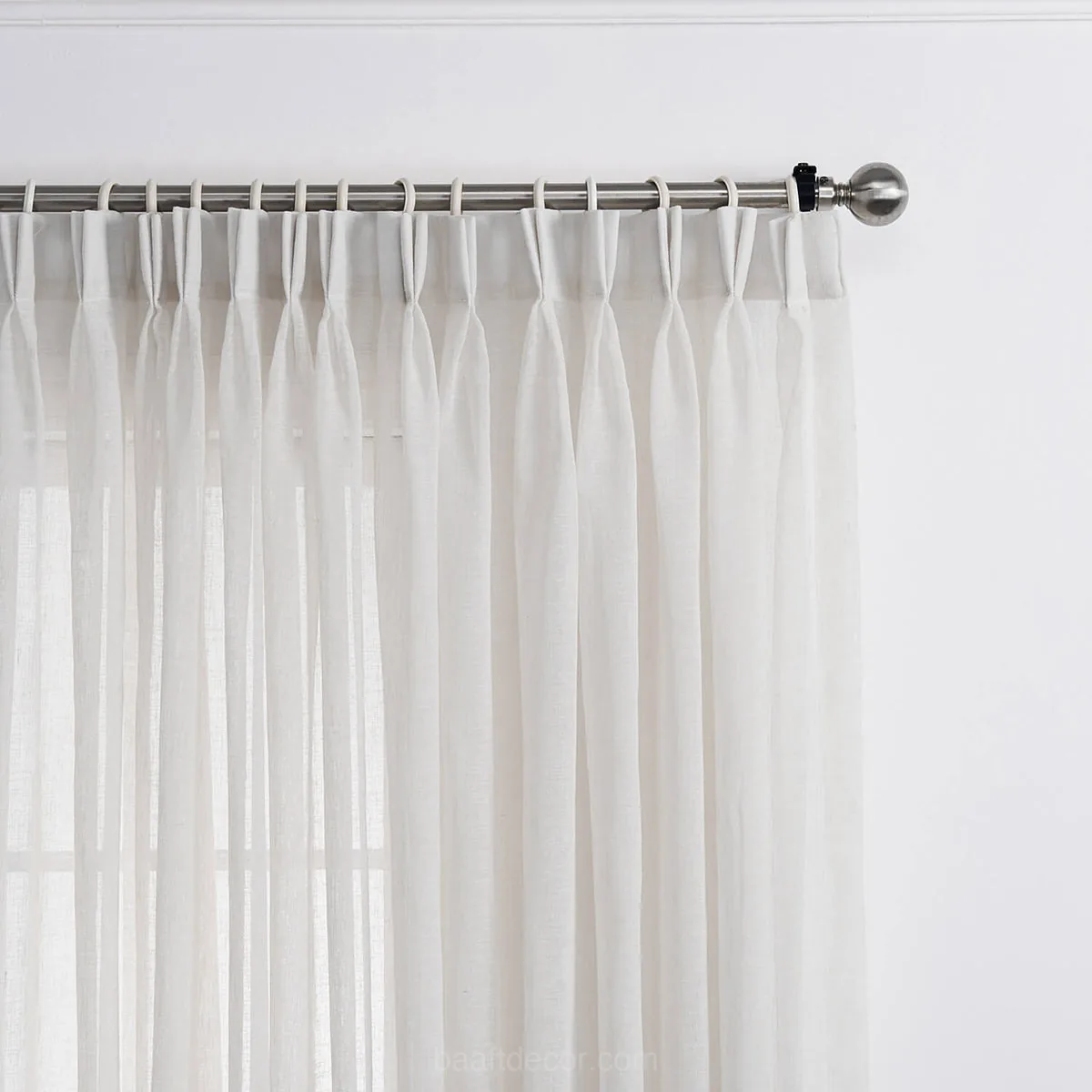
| New heading | Eyelet to pleated, new tape, hooks or eyelets | Moving to a new rod or track, or the old heading has failed |
| Track and rod repair | Brackets, gliders, end stops, sagging runs, re-mounting | The hardware is decent and parts are available |
Want this measured for your windows? We visit with samples, free across Hyderabad. WhatsApp +91 98499 17494.
Curtain alterations: shortening, widening and adding lining
Shortening is the most common job, usually after a move into a flat with lower ceilings or a different rod height. We measure the new drop at three points, since floors are rarely level, then cut and re-hem with a deep double hem.
Lengthening depends on what’s in the hem. Tailored curtains often have a few inches to spare; ready-made ones usually don’t. A band of contrast or lining fabric at the bottom can look intentional if it’s planned rather than patched.
Widening is harder. A new width rarely matches the old fabric exactly, because the original has faded. We usually suggest a contrast side panel or an extra curtain in matching fabric.
Adding lining fixes curtains that fade fast, glow patchy against the light or don’t darken a bedroom enough. In Hyderabad’s west sun, a lining noticeably slows how fast the face fabric fades. Sewn-in lining drapes best; detachable lining can be washed separately.
Re-stitching headings: eyelet to pleated, tapes, hooks and eyelets
Changing the heading is how you reuse curtains on new hardware. Going from eyelets to pinch pleat or ripple fold means cutting away the eyelet band and stitching on new tape, which takes a few inches off the length. Pencil pleat tape that has torn, hooks that have rusted, and eyelets that have pulled out of thin fabric can all be replaced. If you’re moving to a new ceiling track, our curtain installation service fits it on the same visit.
Track and rod repair
- Broken or loose brackets: replaced, or re-fixed with plugs that suit the wall
- Missing or snapped gliders: replaced to match the track profile
- Sagging tracks and rods: extra support brackets, or a stronger track where the old one is too light
- Rods pulled out of the wall: holes filled, bracket moved into sound material and fixed with the right plug. AAC block walls need plugs made for aerated concrete, which grip soft material that ordinary plugs can’t
- End stops and finials: refitted so gliders and rings don’t slide off
What wears curtains out in Hyderabad homes
Most of the repairs we see trace back to the same few causes:
- West and south sun. Afternoon sun from March to June fades the face fabric and makes unlined cottons and silks brittle along the folds.
- Monsoon damp. From June to September, curtains that stay drawn against cold, damp glass can pick up mildew at the hem, especially in ground-floor rooms and bathrooms.
- Construction dust. In areas still being built up, curtains get washed more often, and every hot wash is a chance for cotton to shrink or a hem to drop.
- Daily pulling. Tugging the fabric instead of using a wand or the leading edge loosens brackets and snaps gliders over time.
When a repair isn’t worth it
We’ll tell you when altering a curtain is money spent on fabric that won’t last. Sunlight is the main culprit. The US Department of Energy’s Building America guidance on window attachments points out that UV exposure fades and deteriorates fabrics, and curtains facing west or south take the worst of it.
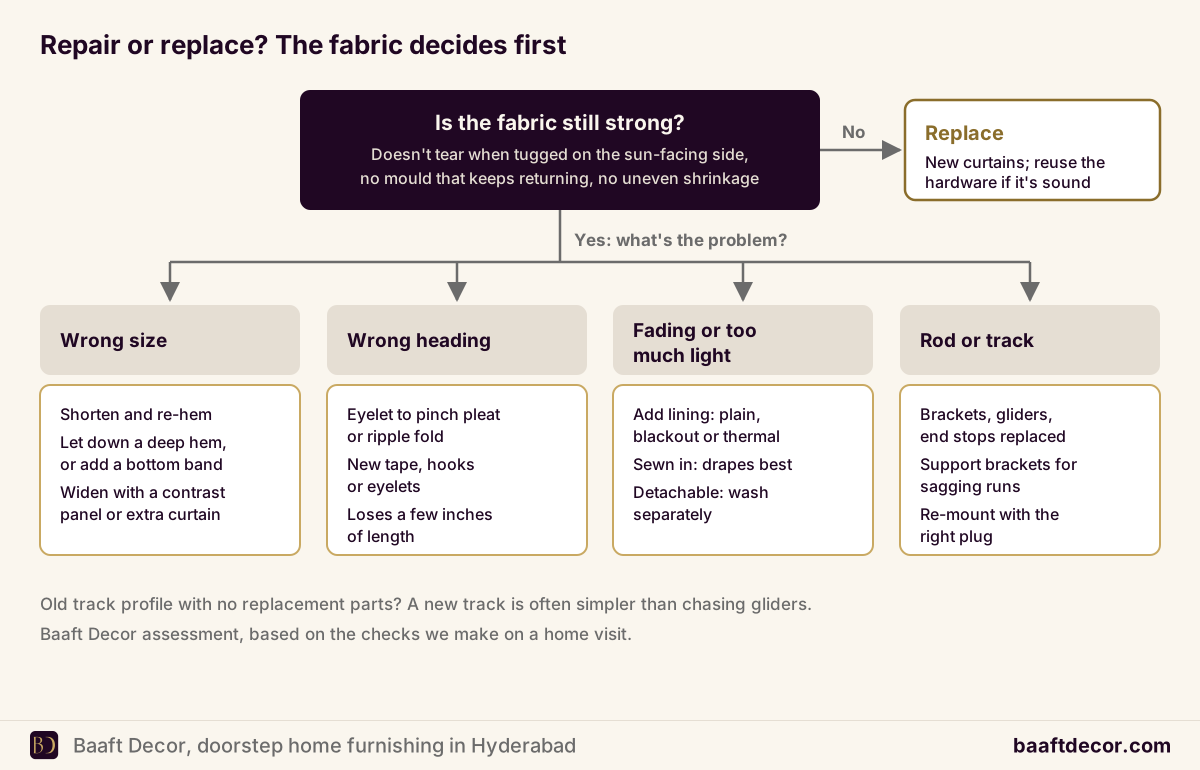
Signs it’s time for new curtains:
- Fabric tears easily when tugged, especially on the side that faced the glass
- Fading in stripes along the folds that won’t match once the curtain is re-pleated
- Mould spots that come back after every monsoon
- Fabric that has shrunk unevenly in the wash
If that’s where you are, our guide to custom vs ready-made curtains helps you choose the replacement, and how to wash and care for curtains helps the new ones last longer.
How long does curtain repair take?
Hardware repairs are usually done on the spot in one visit. Workshop alterations such as hemming, new headings or added lining usually take 2 days, and at most a week, depending on how many curtains there are.
What decides the cost of curtain repair?
- Type of job: a hem costs less labour than a heading change or new lining
- Number and size of panels
- Lining fabric, if being added
- Replacement parts: brackets, gliders, tape, hooks, eyelets or a new track
- Whether we take curtains down and rehang them
You get a fixed, itemised quote after we’ve seen the curtains.
Curtain repair across Hyderabad
We take curtain alterations and track repairs across the city, including Secunderabad and Kukatpally.
WhatsApp +91 98499 17494 with photos of the curtain, its heading and the rod or track, and we’ll tell you whether it’s a repair worth doing before anyone visits.
How it works
- Photos on WhatsApp first Send photos of the curtain, the heading, the hem and the rod or track. For many jobs we can tell you straight away whether it's a repair worth doing.
- Home visit and measuring We check the fabric condition, measure the new drop or width, and look at the hardware and what the wall or ceiling is made of.
- Agree the work You get a clear list of what will be altered or repaired, and where we think new curtains or new hardware would be better value.
- Workshop alterations Curtains are taken down and brought to our workshop for hemming, heading changes or lining, then brought back pressed.
- Hardware repair and rehanging Brackets, gliders and tracks are fixed or replaced on site, the curtains are rehung, and we check they run smoothly end to end.
Frequently asked questions
Can old curtains be altered to fit a new house?
Yes, old curtains can usually be altered to fit a new house in Hyderabad, as long as the fabric is still sound. Shortening is the simplest job. Lengthening works only if the existing hem is deep enough to let down, or if you're happy to add a band of contrasting fabric at the bottom. Widening needs extra fabric, which is hard to match exactly in colour, so a contrast side panel or a new matching curtain for the extra width is often the answer. We check this on the visit before you decide.
Can you change eyelet curtains to pinch pleat?
Yes, eyelet curtains can be changed to pinch pleat, pencil pleat or ripple fold. The eyelet band is cut away and a new heading tape and buckram are stitched on, which takes a few inches off the length. If the curtain is already only just long enough, we add a heading band in matching or lining fabric. Changing the heading also changes the hardware: pleated curtains need a track or a rod with rings and hooks. It's a common job when people move from rods to ceiling tracks.
Can lining be added to existing curtains?
Yes, lining can be added to existing curtains in two ways. A sewn-in lining is stitched to the back of each panel along the sides and heading, which drapes best but means the curtain is washed or dry cleaned as one piece. A detachable lining is stitched separately with its own heading tape and hangs on the same hooks, so it can be removed and washed. Both can be blackout, thermal or plain. Adding lining is a common fix for curtains that fade or let too much light into bedrooms.
Why is my curtain track sagging in the middle?
A curtain track sags in the middle when the brackets are too far apart for the weight of the curtains, when a bracket has worked loose from its plug, or when the track itself is too light for the run. Heavy lined curtains on a long track made for sheers will bend it over time. The fix is to add support brackets, re-fix any loose ones with plugs suited to the wall or ceiling, or replace the track with a stronger profile. We check which it is before replacing anything.
Can you repair a curtain rod that pulled out of the wall?
Yes. When a curtain rod pulls out of the wall, it's usually because the plug didn't suit the wall. AAC block walls, common in newer Hyderabad apartments, need plugs made for aerated concrete, and gypsum false ceilings need the fixing to go into framing or a batten, not just the board. We fill the old holes, move the bracket slightly so it fixes into sound material, and use the right plug. If the rod is bent or the bracket is cracked, we replace that part.
When should I replace curtains instead of repairing them?
Replace curtains instead of repairing them when the fabric itself has failed. Signs are fabric that tears easily on the side that faced the sun, colour that has faded in stripes along the folds, mould spots that have come back after a monsoon, or fabric that shrank badly in the wash. Altering such curtains costs labour on fabric that won't last. Repair makes sense when the fabric is still strong and only the size, heading, lining or hardware needs to change.
Do you repair curtain gliders, hooks and runners?
Yes. Worn or broken gliders, hooks and runners are among the most common curtain repairs we do. Plastic gliders can turn brittle and snap after years near sunny glass, and missing gliders make the curtain droop between hooks. We replace gliders to suit the track, refit end stops so gliders don't slide out, and replace bent or rusted hooks. If the track is an older profile that replacement gliders no longer fit, a new track can be cheaper than chasing parts.