A no-drill curtain rod is the first thing many tenants search for, and for a small window with a light sheer it can be the right answer. For a heavy blackout curtain across a bedroom window, it usually isn’t. We fit curtains in rented flats and new apartments all the time, and when we do curtain installation in Hyderabad, the question of whether to drill comes up early.
Here is what each no-drill option does, where it fails and what to use instead. If you’re comparing rods and tracks generally, our curtain rods and tracks guide covers the standard drilled hardware, and the curtains buying guide for Hyderabad homes covers everything from fabric to fitting.
What is a no-drill curtain rod?
A no-drill curtain rod is any rod or bracket held in place by pressure, adhesive, clamping or magnets instead of screws in the wall. There are five common types, and each works only on a particular surface.
| Type | How it holds | Works on | Suits | Main limit |
|---|---|---|---|---|
| Tension rod | Spring presses pads against two side walls | Window recess, narrow doorway | Sheers, cafe curtains | Needs two solid faces; slips under weight |
| Self-adhesive hooks or brackets | Adhesive pad on the wall | Smooth, sound paint or tile | Light sheers, tiebacks | Heat, humidity, peel |
| Clamp-on frame bracket | Jaw tightened onto the frame | Window frame top | Slim rod for sheers | Can block the sash; frame must be strong |
| Hooks or clips on a grill | Hangs from existing grill bars | Window grill | Light rod or wire | Curtain sits on the grill side |
| Magnetic bracket | Magnet on steel | Steel door or frame | Door curtains, short panels | Steel only |
Want to know what your windows can actually take? We visit with samples, free across Hyderabad. WhatsApp +91 98499 17494.
Tension curtain rods
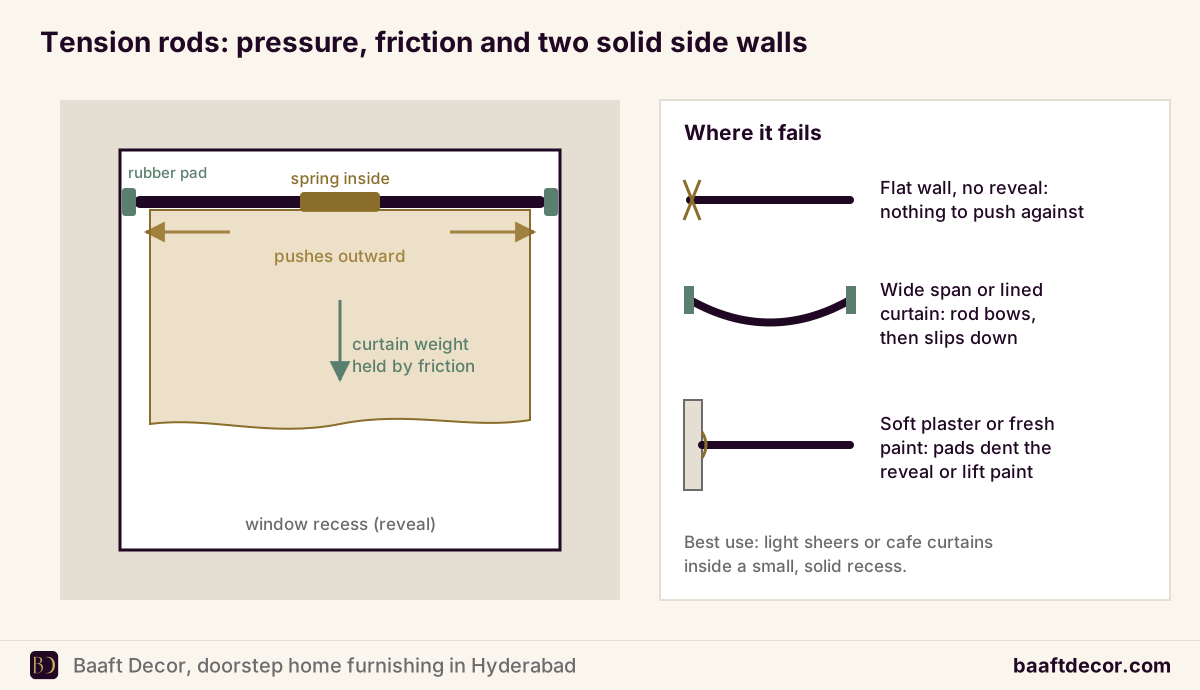
A tension curtain rod is a telescopic rod with a spring inside that pushes rubber pads outward against two facing walls; friction at the pads holds it up. It’s the most common no-drill curtain rod in Indian markets, also sold as a tension bar or spring rod.
Where tension rods work:
- Inside a window recess with plastered or tiled side walls, for a sheer or cafe curtain.
- Kitchen and bathroom windows, where a short, light curtain is all you need.
- Narrow doorways and alcoves, for a light partition or a store cupboard opening.
Where they don’t:
- Flat walls. Most apartment windows in Hyderabad sit flush with the wall, with no reveal deep enough for a rod.
- Wide openings. The more a tension rod is extended, the more it bows and the less it holds. For anything much wider than a standard window, we’d use brackets.
- Lined and blackout curtains. The extra weight slowly drags the rod down.
Check the pack’s rated length and load, set the rod a little longer than the gap so the spring is properly compressed, and keep the pads on solid plaster, not on a loose tile edge or fresh putty.
Adhesive and self-adhesive curtain hooks
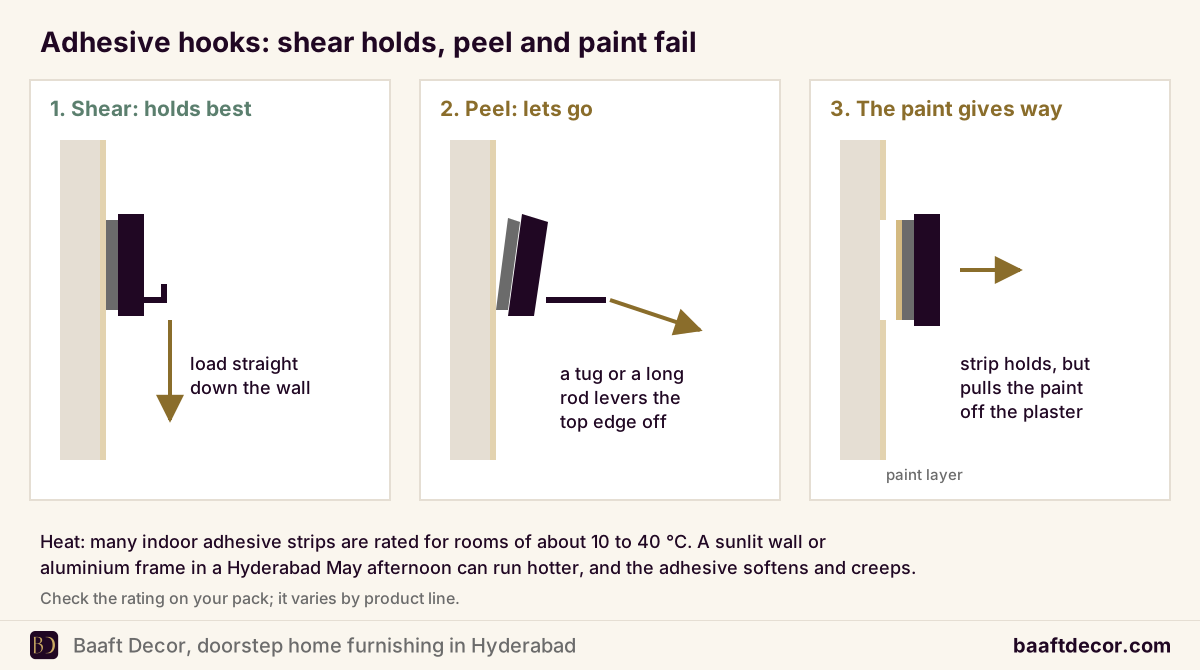
Self-adhesive hooks and rod holders stick to the wall with a foam or gel pad and hold best when the load pulls straight down, not outward. They’re fine for a tieback or a very light sheer, and risky for anything heavier.
Three things work against adhesive hooks in Hyderabad homes:
Heat. Many indoor adhesive strips are rated for rooms of about 10 to 40 °C; 3M, for example, gives that range for its Command indoor strips. Our summers regularly pass 40 °C, and a west-facing wall, aluminium frame or glass in afternoon sun gets hotter than the room air. Warm adhesive softens and creeps.
Humidity. During the June to September monsoon, damp walls and condensation on glass weaken the bond.
Peel. A curtain is pulled sideways every time it’s opened, and a rod sticking out from the wall levers the top edge of the pad. That’s the usual way adhesive brackets fail.
Stick them only onto clean, sound, fully cured paint or tile, away from sun-baked surfaces, and expect to re-stick them. Never put an adhesive bracket on a ceiling.
Clamp-on brackets for window frames and grills
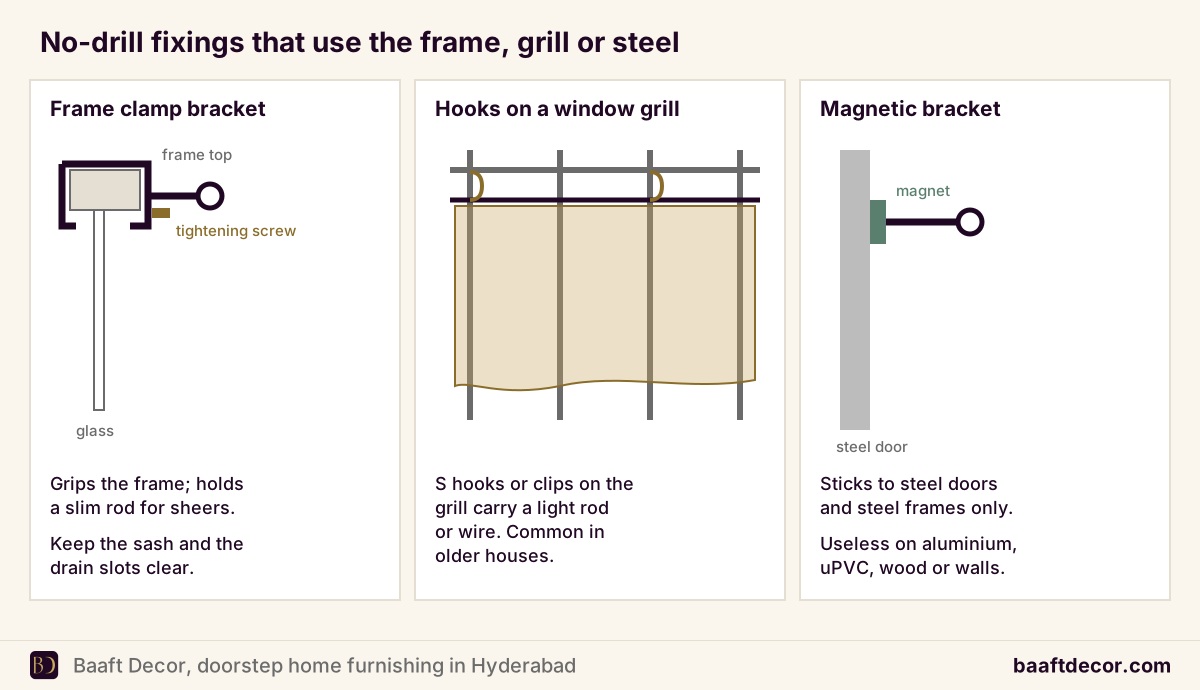
Clamp-on brackets grip the top of the window frame with a tightening jaw, so the rod hangs from the frame instead of the wall. In older Hyderabad houses, a similar trick uses the window grill: S hooks or curtain clips on the grill bars carry a light rod or wire.
A few cautions from fitting these:
- Don’t block the sash. On aluminium and uPVC sliding windows, a clamp on the wrong member stops the shutter from sliding or blocks the drain slots at the bottom of the frame.
- Frame strength varies. Thin aluminium sections can flex under a clamp. Keep the curtain light.
- Grills put the curtain outside the room’s line. The curtain sits against the grill, so it catches rain on open windows during the monsoon and dust from the road.
- Magnetic brackets need steel. They work on steel main doors and some older steel window frames, and not on aluminium, uPVC, wood or walls.
For holding the curtain open without drilling, magnetic tiebacks are the simplest fix; see our curtain holders and tiebacks guide.
Curtain hooks without drilling
For door curtains and light partitions, the hook can often hang from something that’s already there: the top of a door, a grill, a steel frame or an existing rod. These are the options we suggest most often in rented flats.
- Over-door hooks. Metal hooks that sit over the top edge of an internal door and carry a slim rod or a few curtain hooks. They work for a light door curtain, but the door may no longer close fully, so check the gap first.
- Clip rings on an existing rod. If a rod is already fitted, curtain rings with clips let you hang almost any fabric without stitching a heading or adding brackets.
- S hooks on a grill. Cheap and strong, and common on older houses with window grills.
- Magnetic hooks on steel doors and steel almirahs, for short panels.
Each of these still has the same limit: light fabric only, and nothing that gets tugged hard every day.
The honest limits: weight, width and heat
No-drill fittings are for light curtains on small openings; they aren’t a substitute for brackets on wide windows or heavy fabric. This is the short version we give customers:
| Situation | No-drill realistic? | Better option |
|---|---|---|
| Sheer in a small window recess | Yes, tension rod | n/a |
| Kitchen or bathroom cafe curtain | Yes, tension rod | n/a |
| Light curtain on a steel door | Yes, magnetic | n/a |
| Lined or blackout bedroom curtain | No | Drilled brackets or ceiling track |
| Sliding balcony door, 2 to 3 m | No | Ceiling track or rod with centre supports |
| West-facing window in summer sun | Adhesive, no | Tension rod in a recess, or brackets |
| High-floor window that’s often open | No | Track or rod with closed brackets |
If a no-drill fitting has already pulled paint off or dropped a curtain, our curtain repair service can patch the fixing point and refit the curtain on proper hardware.
Rentals and society no-drill rules
Many people looking for no-drill fittings are tenants whose rental agreement says the walls must be returned as they were. Before you settle for a weak fitting, it’s worth reading what the agreement and the society rules actually say.
- Rental agreements often ask for walls to be returned in their original condition rather than banning holes outright. Many landlords accept a few small drilled holes that are filled with putty and touched up at move-out. Ask, and get the answer on WhatsApp or in writing.
- Existing brackets. Many flats are let with brackets or tracks already fixed. Using them is the easiest no-drill solution of all; we can fit new curtains to existing hardware.
- Gated community and RWA rules usually concern the façade, balconies and anything visible from outside, not interior walls. Curtains inside your flat are rarely covered, but balcony fittings may be. Our guide to gated community interior rules in Hyderabad explains what’s typically restricted.
- Ceiling vs wall. Some owners are happier with small holes in the ceiling slab, hidden by the curtain, than with holes in a painted wall.
Baaft Decor measures, stitches and fits curtains at homes across Hyderabad, including rented flats where we work around the landlord’s rules. We visit for curtains in Gachibowli, curtains in Kondapur, curtains in Madhapur and curtains in HITEC City, among other areas.
Not sure whether to drill?
Send us a photo of the window on WhatsApp and we’ll tell you honestly whether a no-drill fitting will hold your curtain. For new curtains in Hyderabad, we’ll suggest the lightest-touch hardware that still keeps them straight. Free home visits, 8 AM to 10 PM, all seven days: +91 98499 17494.
Frequently asked questions
Do no drilling curtain rods really work?
No drilling curtain rods work well within narrow limits. A tension rod holds a light sheer or cafe curtain inside a small, solid window recess. A clamp-on bracket can hold a slim rod on a window frame or grill, and a magnetic bracket works on a steel door. They do not reliably hold lined, blackout or velvet curtains, and they struggle across wide windows and sliding doors. For heavy curtains or anything wider than a small window, a drilled bracket or ceiling track is the dependable choice.
How do tension curtain rods work?
Tension curtain rods work by pressing outward against two facing surfaces. A spring or screw mechanism inside the telescopic rod pushes the rubber end pads against the side walls of a window recess or doorway, and friction at those pads holds the rod and the curtain's weight. That is why a tension rod needs two solid, parallel faces close together. It cannot hang on a flat wall, and the wider it is extended, the more it bows and the less weight it carries before slipping.
How much weight can a tension curtain rod hold?
How much weight a tension curtain rod can hold depends on the model, its diameter and how far it is extended, so check the rating printed on the pack. As a rule, the load it holds falls as the rod gets longer, because a longer rod bows more and the pads grip less. In practice, tension rods are made for sheers, voiles, cafe curtains and light shower curtains. Lined, dim-out or blackout curtains are usually too heavy and slowly slide the rod down.
Do adhesive curtain hooks work in Hyderabad summers?
Adhesive curtain hooks often struggle in Hyderabad summers. Many indoor adhesive strips are rated for rooms of about 10 to 40 degrees Celsius, and walls and window frames in direct afternoon sun during April and May can get hotter than the air. Warm adhesive softens and slowly creeps under load, especially on glass, aluminium or west-facing walls. Humidity during the June to September monsoon also weakens the bond. Use them only for light tiebacks or sheers, away from sun-baked surfaces.
Will adhesive hooks damage my walls?
Adhesive hooks can damage walls even when they hold. On emulsion-painted plaster, the adhesive may grip the paint more firmly than the paint grips the wall, so removing the hook lifts a patch of paint or putty. Damage is more likely on fresh paint, textured finishes and walls that have absorbed monsoon damp. Follow the pack's removal method, pulling the release tab slowly along the wall. On a rented flat, a few small drilled holes filled with putty can be easier to restore than peeled paint.
How can I hang curtains in a rented flat without drilling?
In a rented flat you can hang curtains without drilling using a tension rod inside a window recess, clamp brackets on the window frame or grill, magnetic brackets on steel doors, or the brackets the landlord has already fitted. Keep curtains light, such as sheers or unlined fabric, since no-drill fittings cannot carry heavy blackout curtains. If you need blackout in a bedroom, ask the landlord whether a few small holes are acceptable if they are filled and painted when you leave.
Can I put a no drill curtain rod on a sliding balcony door?
A no drill curtain rod is rarely a good idea on a sliding balcony door. These doors are usually 2 to 3 metres wide, have no recess for a tension rod to press against, and get daily use, so the curtain is pulled often. Balcony doors also face wind on upper floors. A tension rod would bow and slip, and adhesive brackets would peel. For a sliding door, a ceiling track or a drilled rod with centre supports is the reliable option, even in a rented home.
Are magnetic curtain rods any good?
Magnetic curtain rods are good for one job: hanging a light curtain on a steel surface, such as a steel main door, a steel window frame or a metal cabinet. The magnets hold firmly on steel and leave no marks. They do not work on aluminium, uPVC, wood, plaster or tile, which covers most windows in newer Hyderabad apartments. They also slide down if the curtain is heavy or tugged sideways, so keep them for sheers, door curtains and short panels.