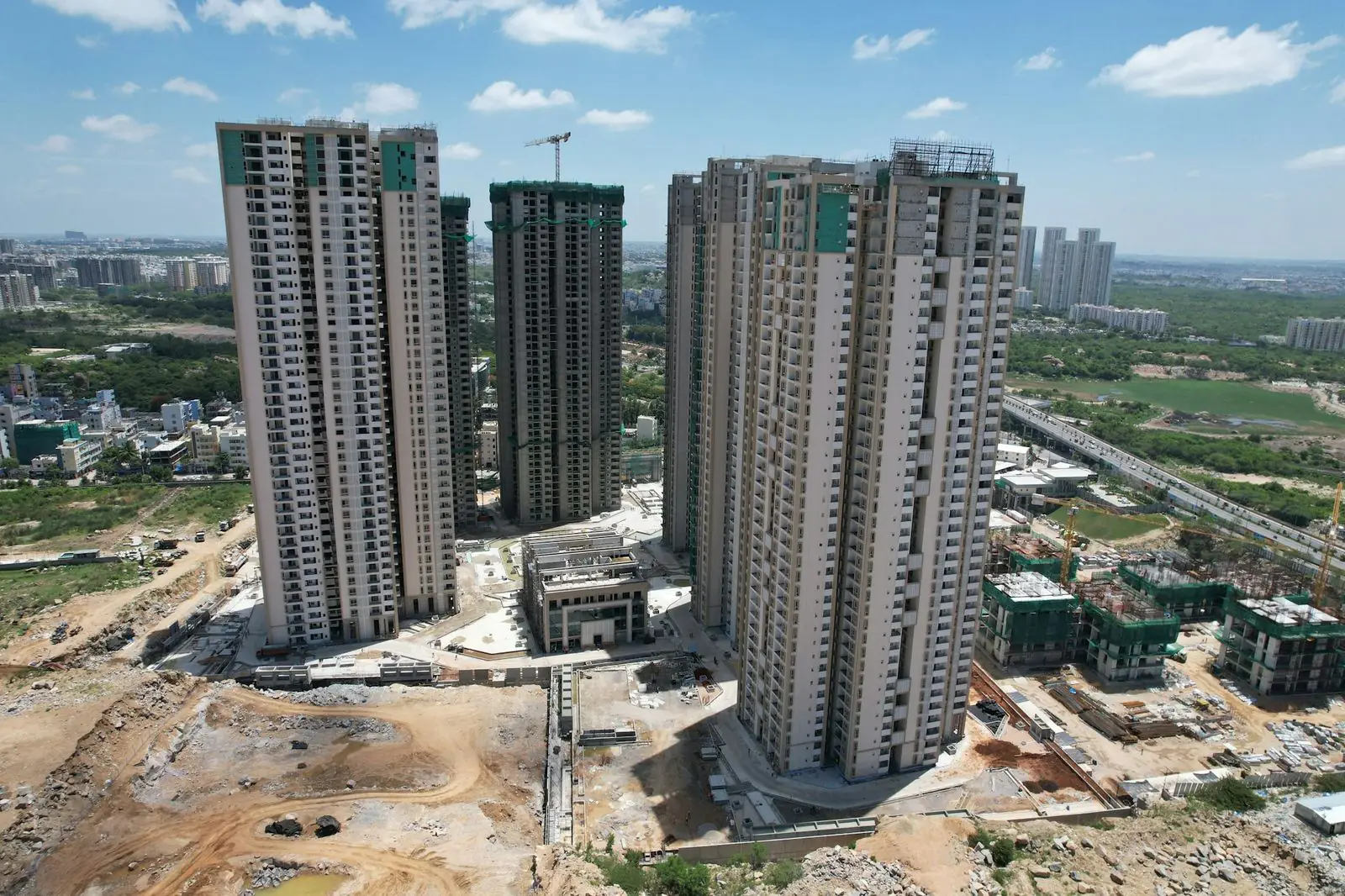
You’ve got the keys, the vendors are lined up, and then the security desk stops your carpenter at the gate because he isn’t registered. Or the facility office emails a photo of your new balcony grill with the word “unapproved”. Every Hyderabad gated community runs interior work a little differently, and finding out on the first day costs you a week. This guide covers the rules most associations apply, so you can ask the right questions before work starts. Our new home furnishing service plans around these rules from the first visit, and our new home furnishing guide for Hyderabad shows where approvals fit in the overall order of work.
One caution before the details. Everything below describes typical rules. We’re not describing any particular community, and your association’s bye-laws and the builder’s fit-out manual are what actually apply to you. Ask for both, in writing.
Where the rules come from
Interior rules in a new community usually come from three places:
- The builder’s fit-out manual. Until the owners’ association takes over, the builder’s facility team runs the community and issues interior guidelines at handover.
- The owners’ association bye-laws. Once the association is formed and registered, its bye-laws and committee decisions take over. Rules can change at this point.
- Your sale documents. The sale agreement and sale deed may restrict changes to the facade, structure or common areas.
Safety norms such as fire regulations sit above all of these, and no association can waive them.
The rules you’re most likely to meet
| Area | Typical rule | What to ask the facility office |
|---|---|---|
| Facade | No change to exterior look, colour or balcony enclosure | Is there an approved list of external items? |
| Balcony grills | Approved design and colour only, inside the railing line | Can I see the approved drawing? |
| Mesh and external blinds | Frame and fabric colour must match the approved shade | Which colours are allowed? |
| AC outdoor units | Only on the designated ledge | Where does the copper piping have to run? |
| Work hours | Daytime on working days; noisy work limited on Sundays and holidays | Exact hours for drilling vs quiet work? |
| Lifts | Service lift only, by booking, with padding | How far ahead can I book? |
| Workers | Registered passes, ID proof, no overnight stay | How do vendors register? |
| Debris | Bagged, removed at owner’s cost, at fixed times | Where and when is the collection point? |
| Deposit | Refundable interior work deposit | What gets deducted, and when is it refunded? |
| Structure and services | No cutting walls, beams or columns; no moving wet areas or gas lines | Is there a structural drawing for my flat? |
Facade and balconies
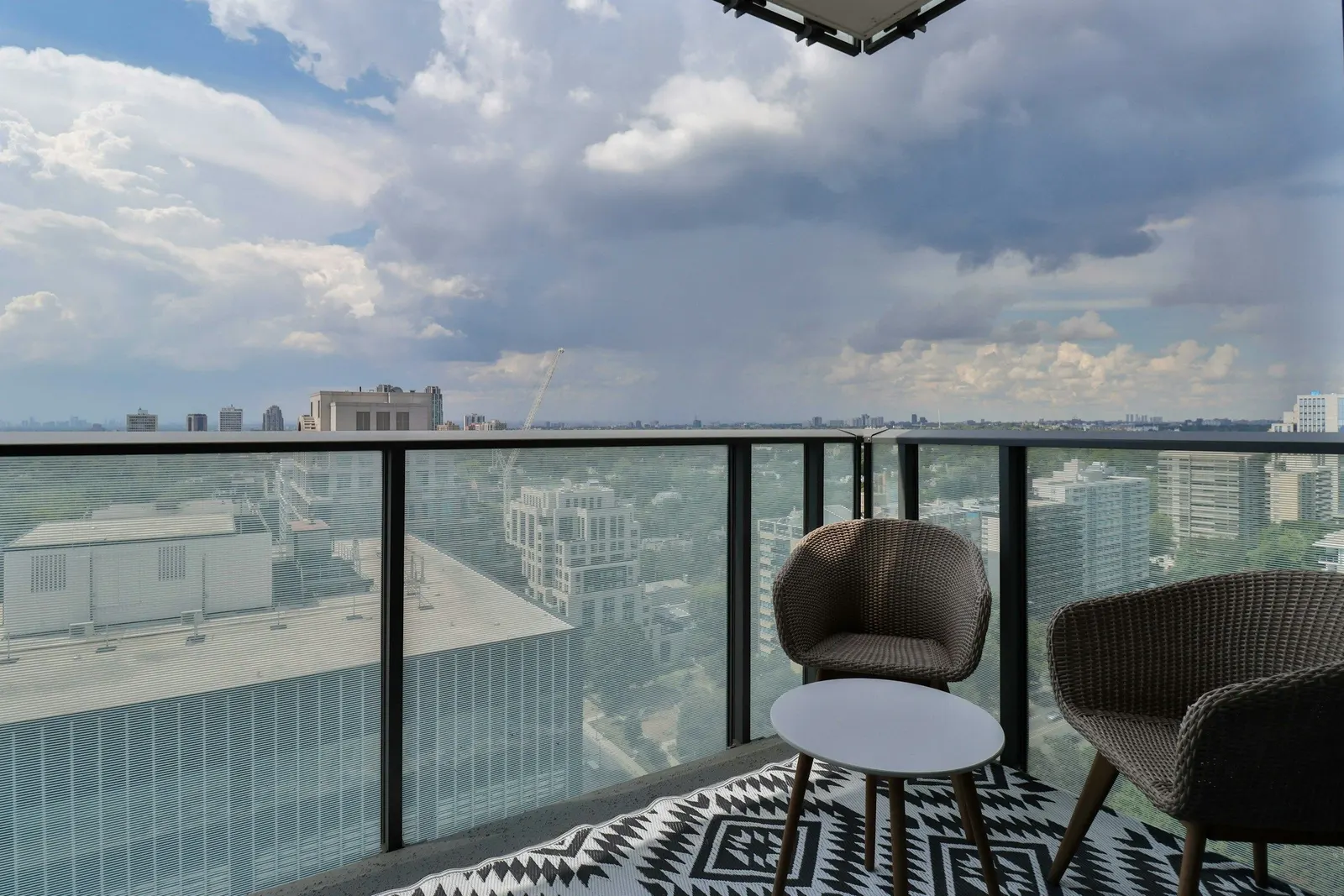
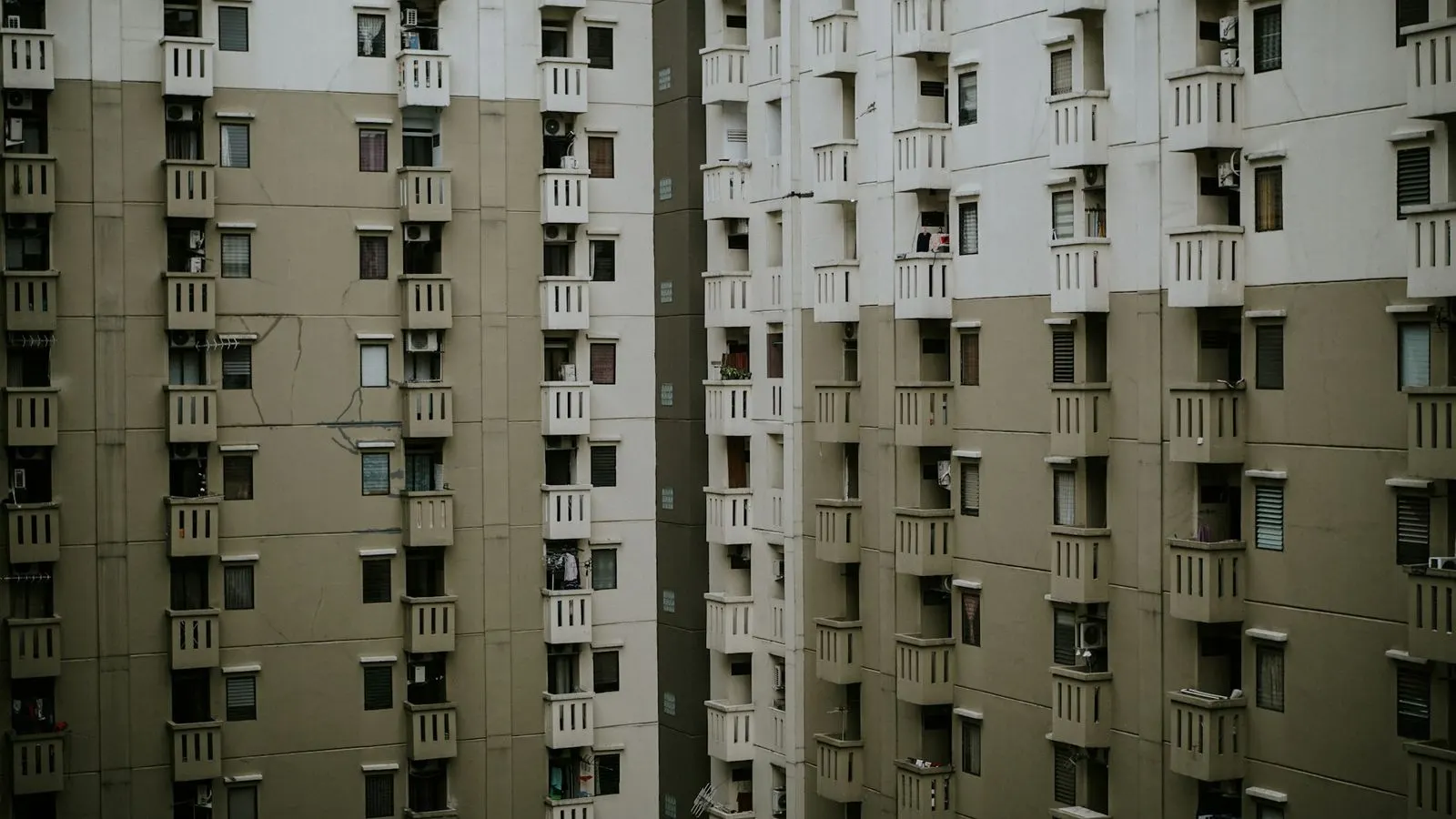
This is where most disputes happen. Associations care about the building looking uniform from the road, so anything visible from outside gets checked: grills, mesh frames, balcony blinds, even the colour of a sun screen. Enclosing a balcony with glass or shutters is commonly refused, because it changes the building’s approved elevation.
Structure: why you can’t move walls
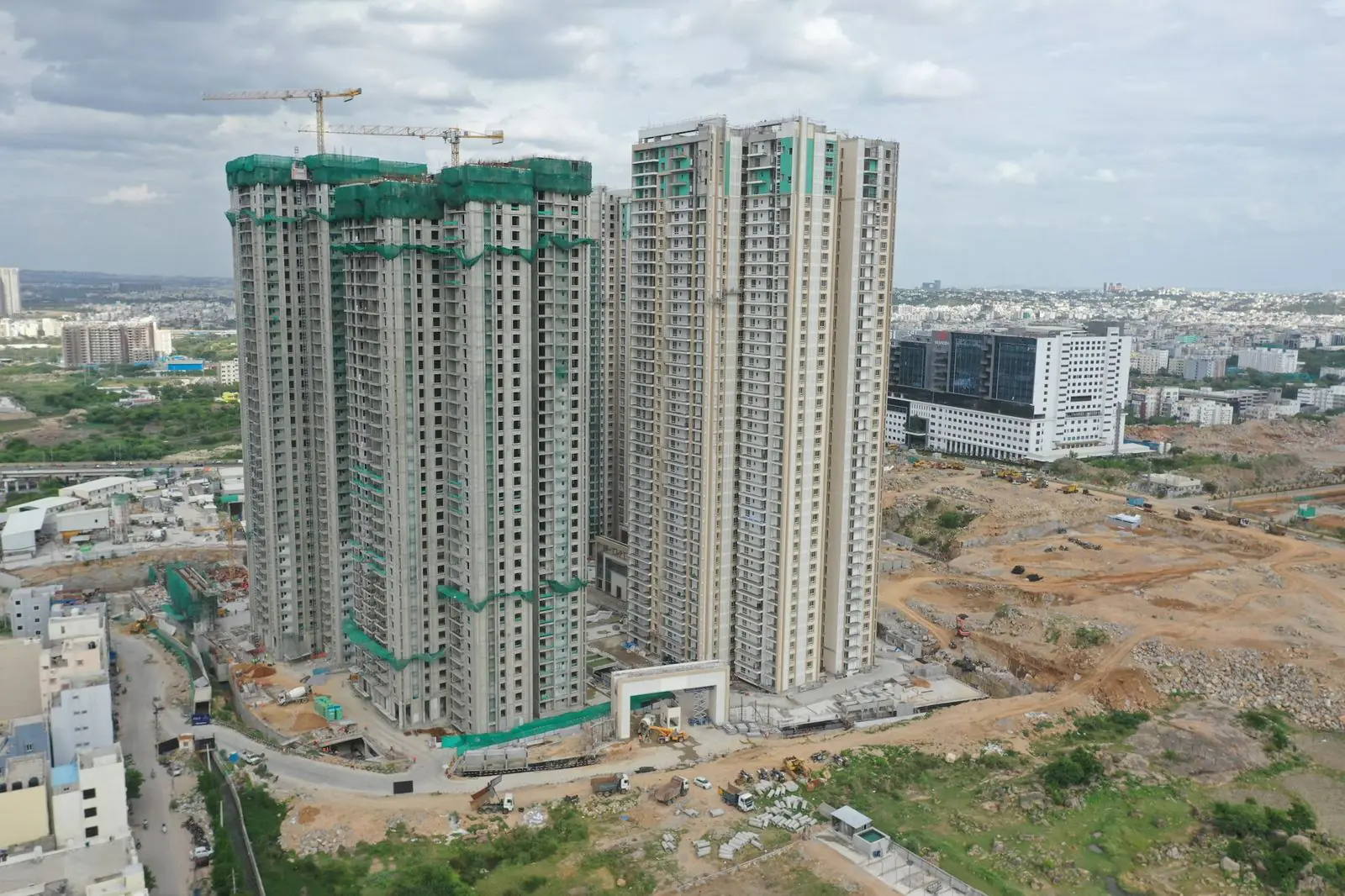
Many new high-rises in Hyderabad are built with aluminium formwork, often called Mivan construction. In these towers most internal walls are reinforced concrete and carry load. Cutting a doorway, removing a wall or chasing a deep groove for wiring can weaken the structure, so builders and associations generally prohibit it. Drilling for curtain brackets, wardrobes and TV mounts is normally fine. This is also why we plan curtain tracks and wiring around the existing walls rather than into them.
Wet areas, waterproofing and gas
Don’t relocate a bathroom or move the kitchen sink to another wall. Drilling into bathroom floors or balcony slabs can break the waterproofing, and the builder may refuse to repair a leak in an area your contractor has drilled. Piped gas lines are the gas supplier’s responsibility; your carpenter should never move them.
Fire safety
Keep sprinkler heads and smoke detectors exposed and working when a false ceiling goes in. Don’t box in shafts or block access panels. If you want to change the main door, ask first, since many towers specify the door type for fire safety.
Balcony grills, invisible grills and mesh
These are the items associations look at most closely, because they are what people see from the road.
- Conventional grills are usually allowed only in the approved pattern and colour, fixed inside the railing, with nothing projecting outward.
- Invisible grills are often easier to approve because thin stainless cables hardly change the facade. Associations still want to see cable colour, spacing and fixing details. Our invisible grills guide explains what to ask a vendor for.
- Mosquito mesh fitted inside window frames is rarely an issue. Mesh doors on balconies and frames visible from outside may need to match a set colour.
Ask first, even if neighbours already have the same item. Their approval may predate a rule change, or they may simply not have asked.
Villas in gated communities
Villa communities have their own set of rules on top of the ones above. Expect restrictions on extending the built-up area, adding a room or a shed on the terrace, putting up pergolas or sheds that are visible from the street, changing the exterior paint colour, and raising or altering the compound wall or gate. Outdoor blinds on a sit-out, artificial grass on a terrace and invisible grills on upper-floor balconies usually need the same facade approval as in a tower. Ask whether the villa guidelines have a list of pre-approved colours and materials; it saves a round of back-and-forth.
Neighbours: the rule that isn’t written down
Most complaints that stop interior work come from the flat next door, not the facility office. Tell your immediate neighbours, above, below and beside, when noisy work will happen and for how long. Keep the corridor clear, and make sure your vendors don’t leave packing outside someone else’s door. A friendly message on day one buys a lot of patience on day five.
How to get approval without delays
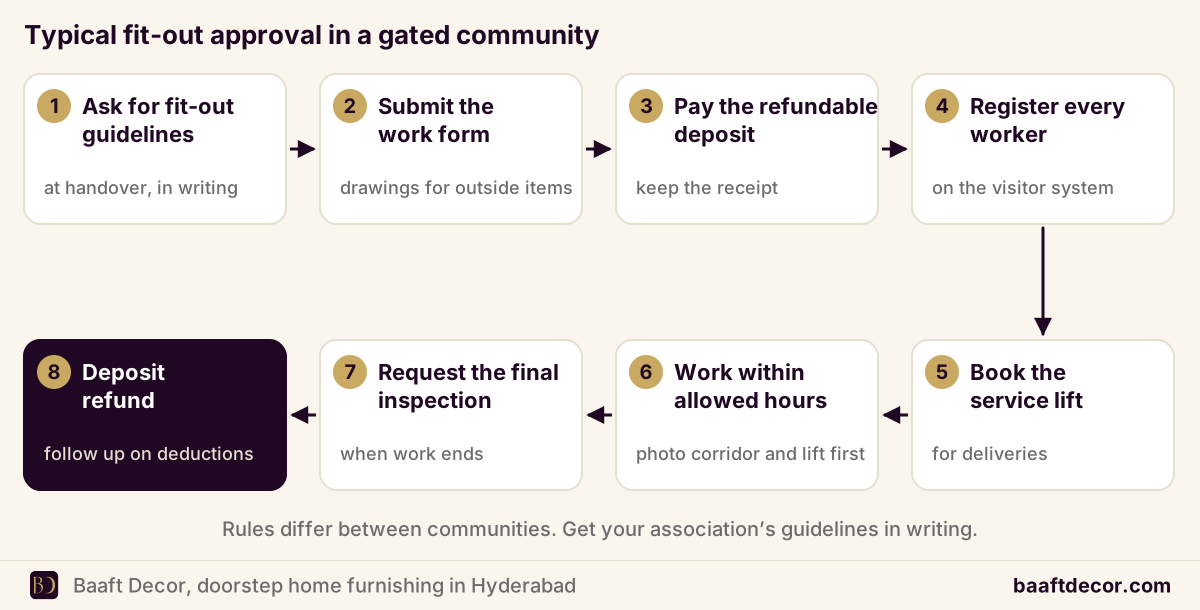
- Ask for the fit-out guidelines at handover, along with the facility office’s contact.
- Submit the interior work form with scope, vendor names, phone numbers and expected dates.
- Attach drawings or photos for anything external: grill design, mesh colour, balcony blind type.
- Pay the refundable deposit and keep the receipt.
- Register every worker on the community’s visitor system before day one.
- Book the service lift for deliveries and heavy material.
- Photograph the corridor and lift outside your flat before work begins.
- Request the final inspection when work ends, and follow up on the deposit refund.
What this means for your timeline
Restricted work hours cut the productive day, so a job that takes three days elsewhere can take four or five in a strict community. During handover months, many owners in the same tower compete for the service lift. Plan noisy work (drilling, cutting) for the allowed hours and keep quiet jobs like curtain fitting, mesh and wallpaper for the rest. Our week-by-week furnishing timeline builds this in, and if you’re on a high floor, our guide to high-rise window solutions covers balcony blinds and wind.
When a rule seems unreasonable
Ask politely which clause of the bye-laws or fit-out manual the rule comes from, and request the answer in writing. If you still disagree, raise it with the committee or at the general body meeting rather than going ahead anyway. For anything that becomes a legal dispute, get advice from a lawyer who handles apartment association matters.
Moving into a gated community soon? We’ll measure your flat for free, list what your association is likely to ask about our part of the work, and schedule installation within your community’s hours. Call or WhatsApp +91 98499 17494, 8 AM to 10 PM, all 7 days.
Frequently asked questions
Do I need association permission for interior work in a Hyderabad gated community?
In most Hyderabad gated communities you need to inform the association or facility management before interior work starts, and get written approval for anything that affects the facade, structure, common areas or services. Typically that means submitting a short form with the scope of work, vendor details and dates, registering workers, booking the service lift and paying a refundable deposit. Purely internal work such as curtains or loose furniture rarely needs more than worker passes, but check your own bye-laws.
Are balcony grills allowed in Hyderabad gated communities?
Balcony grills are allowed in many Hyderabad gated communities, but usually only in an approved design, colour and position so the facade stays uniform. Some associations permit only invisible grills on balconies, while others allow conventional grills inside the railing line. Grills that project beyond the building line or enclose the balcony are commonly refused. Ask the facility office for the approved design before ordering, and keep the written approval with your flat documents.
Are invisible grills allowed in gated communities?
Invisible grills are often easier to get approved in gated communities than conventional grills, because thin stainless steel cables barely change how the building looks from outside. They are still a change to an external element, so most associations want to see the design, cable colour, spacing and fixing method first. Some communities specify one approved type for all flats to keep the facade consistent. Get written permission before installation, even if neighbours already have them.
What are typical interior work timings in Hyderabad apartments?
Interior work timings in Hyderabad apartments are set by each association, but a common pattern is daytime working hours on weekdays, often with a quiet period around lunch, and restrictions on noisy work such as drilling, cutting and hammering on Sundays and public holidays. Some communities allow quiet work like painting or curtain fitting for longer hours. Always get the exact timings in writing before scheduling vendors, because breaking them can lead to work being stopped.
Do I need to book the lift to move furniture into a new flat?
Yes, most gated communities with high-rise towers ask residents to book the service lift for moving furniture, appliances and interior materials, and they usually forbid using passenger lifts for this. The facility team may pad the lift walls and limit bookings to certain hours. During handover months many owners are fitting out at once, so lift slots fill up fast. Book early, and tell every vendor which lift, entrance and time slot to use.
What is an interior work deposit in a gated community?
An interior work deposit is a refundable amount that many gated communities collect before interior work begins, to cover any damage to lifts, corridors, lobbies or common walls and any debris left behind. After work ends, the facility team inspects the common areas near your flat and refunds the deposit, minus any deductions. Keep the receipt, photograph the corridor and lift before work starts, and request the final inspection as soon as your vendors finish.
Can I break or move walls in a new high-rise flat in Hyderabad?
Usually not without approval, and often not at all. Many new Hyderabad high-rises are built with aluminium formwork, sometimes called Mivan construction, where most walls are load-bearing reinforced concrete. Cutting openings, removing walls or chasing deep grooves can weaken the structure, so associations and builders generally prohibit it. Drilling small holes for curtain brackets, wardrobes and TV mounts is normally fine. Check your builder's fit-out manual before any civil change.
Who sets interior rules before the owners' association is formed?
Before an owners' association takes over, interior rules in a new gated community are usually set by the builder's facility management team through a fit-out manual or interior guidelines handed over at possession. Once the association is formed, its registered bye-laws and committee decisions apply, and rules may change. Keep every approval in writing, because a verbal permission from the builder's team may not be recognised later by the association's committee.