Ask for a “curtain holder” at a hardware counter in Hyderabad and you might be handed a rod bracket, a tieback hook or a magnetic clip. All three are sold under the same name. When we do curtain installation in Hyderabad, the holders that keep curtains open are the last fittings to go up, and they’re the ones people notice every day.
This guide covers what holds the fabric open: tiebacks, holdbacks, tassels and magnetic clips, with typical placement and fixing. For the rods, tracks and brackets that carry the curtain’s weight, start with our curtain rods and tracks guide, and for the full sequence from fabric to installation, see the curtains buying guide for Hyderabad homes.
What is a curtain holder?
A curtain holder is any fitting that keeps an open curtain gathered at the side of the window. In India the same words also cover the rod holder (parda holder, curtain socket or bracket) that supports the rod, so it helps to know which one you’re asking for.
| Name you’ll hear | What it actually is | Carries the curtain’s weight? |
|---|---|---|
| Tieback, tie back | Fabric band or rope that wraps the gathered curtain and hooks to the wall | No |
| Holdback, hold-back hook | Rigid arm, U hook or knob fixed to the wall; the curtain is tucked behind it | No |
| Magnetic tieback, magnetic clip | Strap or clip with magnets at the ends; snaps around the fabric | No |
| Tassel tieback | Rope tieback with a decorative tassel | No |
| Rod holder, parda holder, socket | Bracket or cup that holds the rod on the wall or inside the recess | Yes |
If you need the rod holder, our curtain brackets guide explains wall, ceiling and socket brackets, spacing and fixing in detail. The rest of this page is about the first four.
Want holders fitted at the right height on every window? We visit with samples, free across Hyderabad. WhatsApp +91 98499 17494.
Types of curtain holders and tiebacks
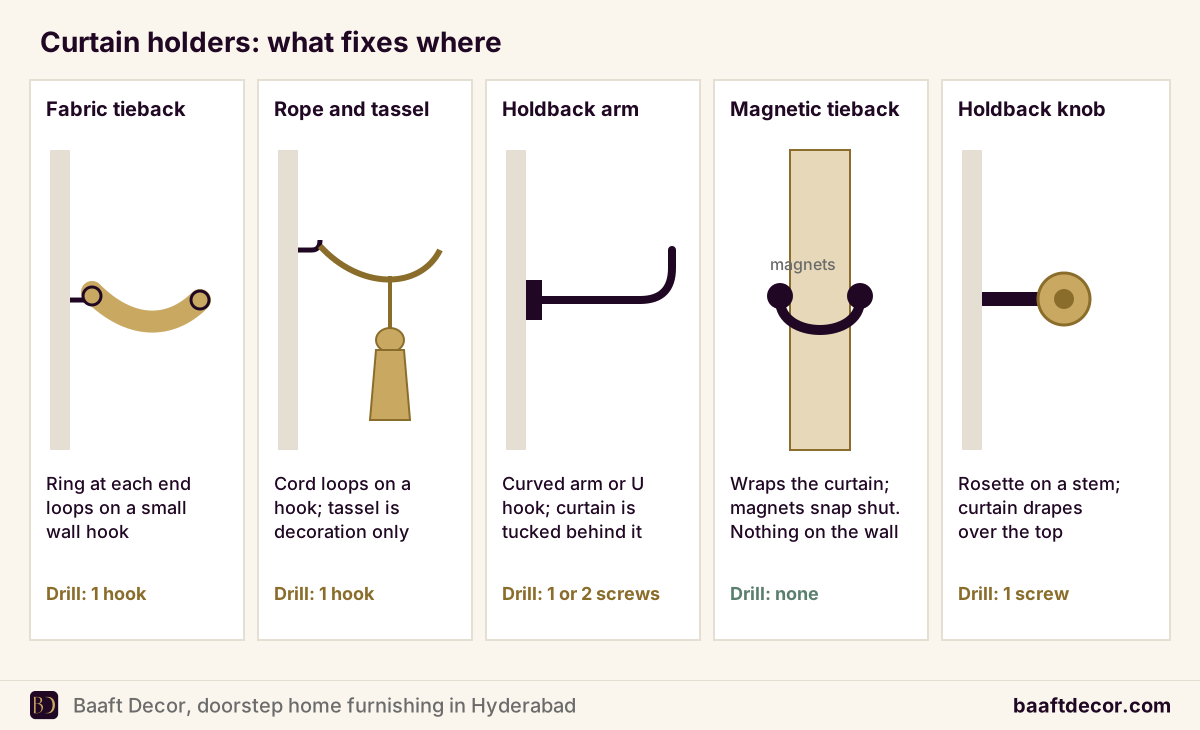
There are four main types: fabric tiebacks, rope and tassel tiebacks, rigid holdbacks, and magnetic tiebacks. Each holds the curtain open in a different way and suits a different room.
Fabric tiebacks
A band of fabric, often cut from the curtain itself, with a ring at each end. The rings slip over a small hook on the wall. It’s the simplest option and matches the curtain exactly. Because the band is soft, the curtain gathers into a gentle curve rather than a tight pinch. When we stitch a full set, matching tiebacks can be cut from the same fabric.
Rope and tassel tiebacks
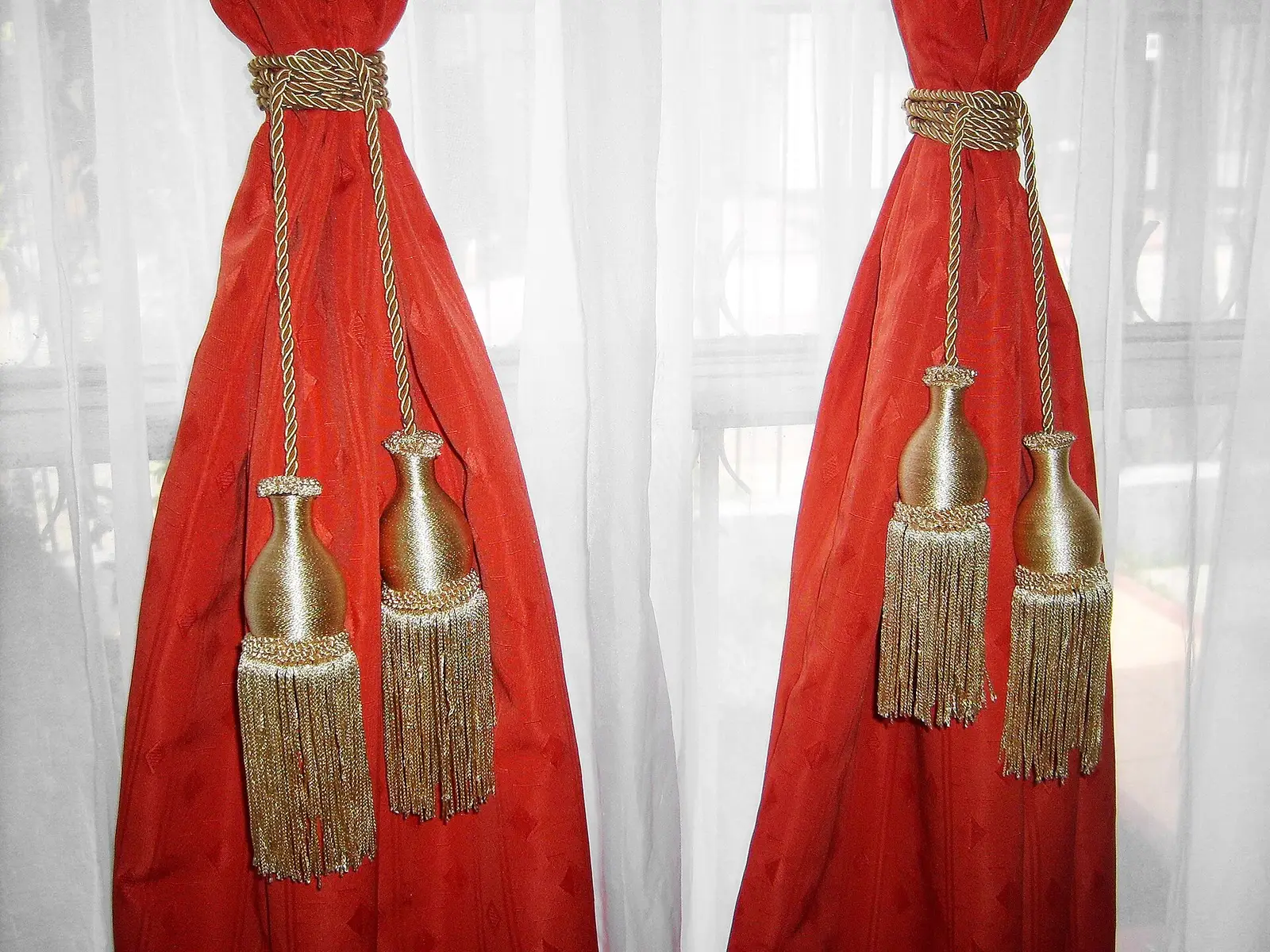
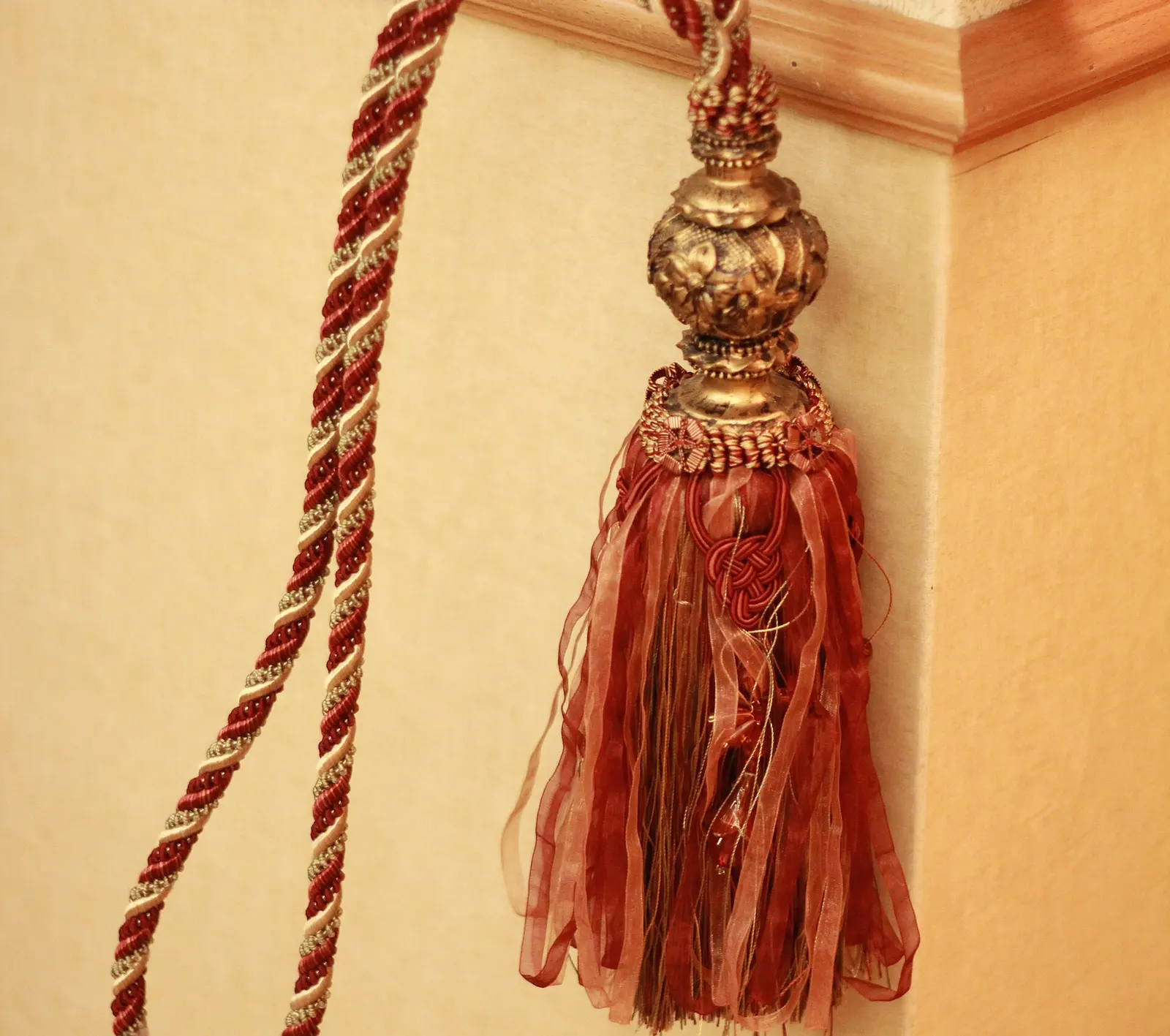
A twisted cord, with one or two tassels hanging from it, looped over a wall hook. Curtain tassels add weight and decoration in formal living rooms, older bungalows and pooja rooms, especially with jacquard or silk-look fabric. They don’t suit every room: in a minimal apartment they can look fussy, and the fringe collects construction dust.
Holdbacks and hold-back hooks
A rigid arm, U hook or knob (a “rosette” on a short stem) screwed to the wall. You sweep the curtain behind it and it stays put. A holdback needs no tying, so it’s quicker to use daily, and it’s the sturdiest choice for heavy lined or blackout curtains. Choose metal in brass, stainless steel or a good powder coat; cheap plated hooks rust in the monsoon and leave brown marks on light fabric.
Magnetic tiebacks and curtain magnetic clips
A strap, cord or clip with a magnet at each end. Wrap it round the gathered curtain and the ends snap together. Nothing goes on the wall, which is why renters like them. They work well on sheers and medium-weight curtains, and loose clips can also hold the two centre edges of a pair together so light doesn’t leak through the middle. Thick blackout fabric weakens the grip, and on a windy high-rise window the strap can pop open.
How high should a curtain holder be?
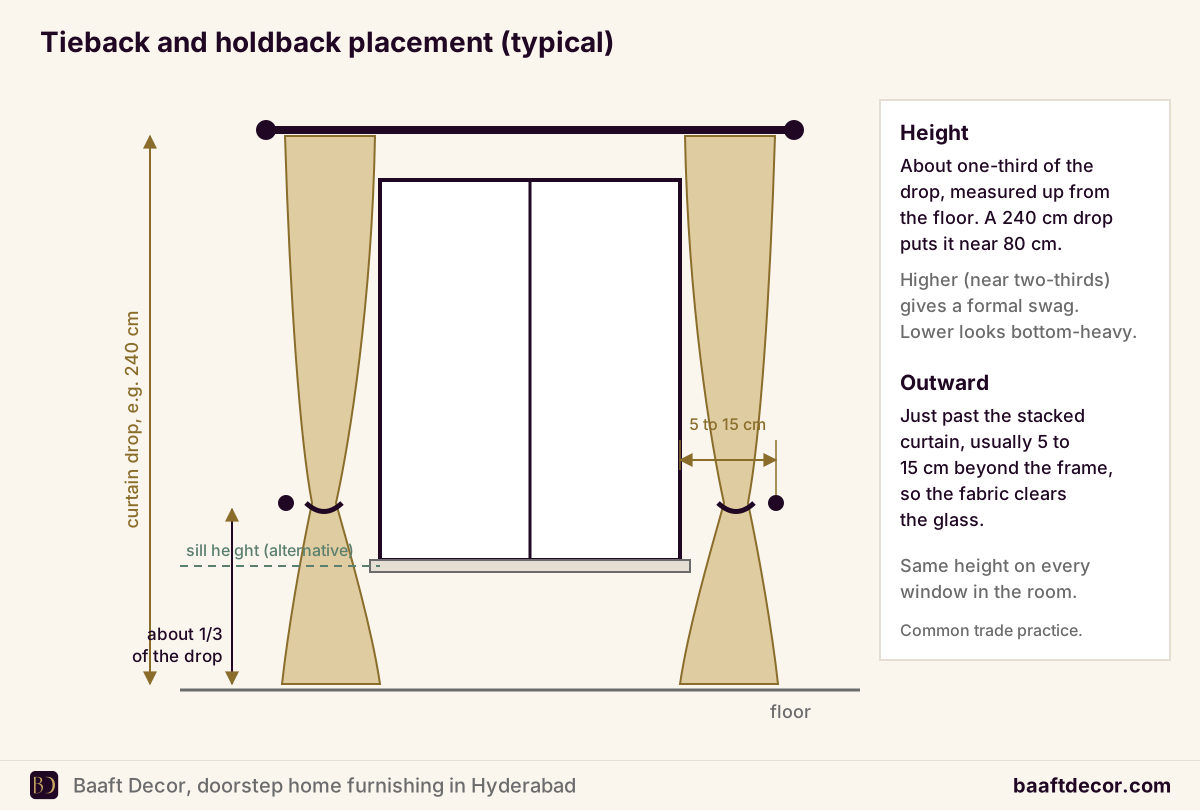
Place a tieback or holdback about one-third of the curtain drop up from the floor; this is the common trade starting point. On a 240 cm (roughly 8 ft) floor-length curtain, that’s near 80 cm from the floor.
Some adjustments we make on site:
- Sill height works well on windows with a sill, because the gathered curtain frames the glass and lines up with the window.
- Higher, near two-thirds up, gives a long swag below the gather. It suits tall, formal living rooms with double-height windows.
- Below one-third tends to look bottom-heavy, and the curtain bunches on the floor.
- Same height everywhere in one room, even when windows differ in size. Different heights are the first thing people notice.
Before drilling, gather the curtain at the height you’re considering and step back to look. It takes half a minute and saves a second set of holes. Curtain height itself (where the rod goes) is covered in how high to hang curtains, and it affects where the tieback looks right.
How far from the window should a holdback go?
A holdback normally sits just outside the edge of the stacked curtain, usually 5 to 15 cm beyond the window frame. The gathered fabric then rests on the wall instead of over the glass, so you keep the full view and light.
Two things decide the exact spot. The first is how much fabric the curtain has: a wide, full curtain stacks thicker, so the holdback moves further out. The second is the rod: we line the holdback up roughly under the end bracket, so the curtain falls straight rather than angling inward.
Depth matters as much as position. The holdback should stand out from the wall about as far as the rod bracket does.
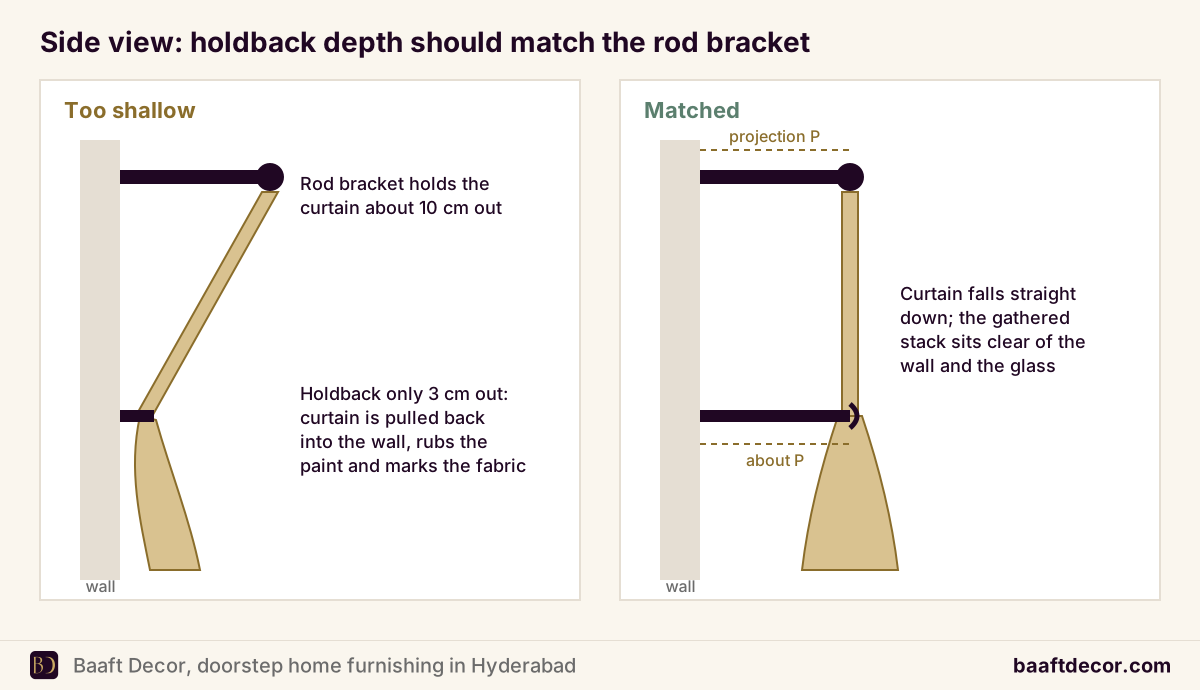
This is the mistake we see most in curtains fixed in a hurry: a short decorative hook under a deep double bracket. The front curtain gets pulled back over the sheer, both crease, and the fabric marks the wall. A holdback arm with the right projection fixes it.
Fixing curtain holders to the wall
A holder carries little weight, but it takes a sideways tug every time someone opens the curtain, so it needs a proper plug, not just a screw in plaster. The wall it goes into matters more than the holder you choose.
- RCC column or beam: Common beside windows in apartments. Hammer drill, masonry bit, nylon plug. The strongest base.
- Brick: Drill into the brick, not the mortar joint, with a plug long enough to pass through the plaster.
- AAC block: Common in newer gated communities. Drill on rotary only, without hammer action, and use an anchor made for aerated concrete, such as the fischer GB aircrete anchor. Ordinary plugs work loose.
- Gypsum or board partition: Use a hollow-wall anchor, or move the holder to a solid section.
Check for hidden wiring first. Switchboards often sit right beside windows in Hyderabad flats, and conduits run from them along the wall. If an old holder has already pulled out and left a crumbling hole, our curtain repair service re-fixes it in sound material nearby.
Which curtain holder suits which room?
| Room | Holder we’d usually suggest | Why |
|---|---|---|
| Living room | Fabric tieback or holdback arm | Neat, matches the curtain, used daily |
| Formal living or bungalow | Rope and tassel tieback | Suits jacquard and silk-look fabric |
| Master bedroom with blackout | Holdback arm | Holds heavy fabric without slipping |
| Kids’ room | Rigid holdback or knob, no loose cords | Cord loops are a hazard for small children |
| Rented flat | Magnetic tieback | No drilling, moves with you |
| Pooja room | Tassel tieback or small knob | Decorative, light use |
| High-floor balcony door | Holdback arm or hook | Wind can open magnetic straps |
For children’s rooms, our kids’ curtains guide covers cord safety and fabrics in more detail.
What Hyderabad conditions do to holders and tiebacks
Sun, dust, monsoon humidity and wind each wear holders differently. A few habits make them last.
West sun. A curtain that’s held back all day for months fades in stripes: the outer fold takes the sun, the inside of the gather doesn’t. On west-facing windows, change the gather now and then, or line the curtain so the face fabric is protected.
Dust. Tassels and rope tiebacks catch construction dust in new communities. Shake them out or use a soft vacuum brush during cleaning.
Monsoon. Between June and September, poorly plated steel holdbacks rust and stain the fabric resting against them. Brass, stainless steel or aluminium holds up better.
Wind. On upper floors, an open window can pull a curtain out of a loose tieback. A rigid holdback, or a hook with a closed ring, keeps it in place.
Baaft Decor measures, stitches and fits curtains at homes across Hyderabad, and we fit matching tiebacks and holdbacks as part of the same visit. We visit for curtains in Gachibowli, curtains in Kondapur, curtains in Kokapet and curtains in Manikonda, among other areas.
Get holders fitted with your curtains
If you’re ordering new curtains in Hyderabad, we’ll suggest holders that suit the fabric and fix them at the right height and depth on the same visit. Already have curtains and just need holders put up, or old ones re-fixed? We do that too. Book a free home visit, 8 AM to 10 PM, all seven days: WhatsApp or call +91 98499 17494.
Frequently asked questions
What is a curtain holder?
A curtain holder is a fitting that keeps a curtain gathered at the side of a window when it is open. In Indian shops the term covers two different things. The first is the holdback or tieback: a hook, arm, knob, rope or magnetic strap that holds the fabric open. The second is the rod holder, also called a parda holder, socket or bracket, which is the support that carries the curtain rod on the wall. When buying, say which one you need, because they are sold side by side and the names overlap.
How high should curtain tiebacks be placed?
Curtain tiebacks are usually placed about one-third of the curtain drop up from the floor, which is common trade practice. On a 240 cm floor-length curtain that puts the tieback near 80 cm from the floor. Sill height is a good alternative on windows with a sill, because the gathered fabric then frames the glass. Placing it near two-thirds up gives a high, formal swag. Whatever height you choose, keep it the same on every window in the room and hold the tieback in place to check before drilling.
How far from the window should a curtain holdback be?
A curtain holdback normally goes just outside the edge of the stacked curtain, which in most rooms is about 5 to 15 cm beyond the window frame. That lets the gathered fabric sit on the wall instead of over the glass, so you keep the full view and light. The holdback should also stick out from the wall about as far as the rod bracket does. If it is much shallower, the curtain is dragged back towards the wall at an angle, rubs the paint and creases unevenly.
Are magnetic curtain tiebacks strong enough?
Magnetic curtain tiebacks are strong enough for sheers and most unlined or lightly lined curtains. They wrap around the gathered fabric and snap shut, so nothing is fixed to the wall and no drilling is needed. With heavy blackout curtains or thick velvet, the magnets have more fabric to grip through and the strap can slide down or pop open when someone brushes past. On high-floor windows with strong wind, a wall-fixed hook or holdback arm holds better than a magnetic strap.
What are curtain magnetic clips used for?
Curtain magnetic clips are small paired magnets that clamp onto fabric. People use them in three ways: as a quick tieback around a gathered curtain, to hold the two centre edges of a pair together so no strip of light comes through, and to fix a curtain edge to a steel window or door frame so it does not blow about. They need no tools and suit rented homes. They will not stick to aluminium, uPVC or wooden frames, and they can mark delicate fabrics if they are pinched on too tightly.
Do curtain tiebacks with tassels suit modern homes?
Curtain tiebacks with tassels suit traditional and formal rooms more than modern ones, but they are still used in many Hyderabad homes, often in living rooms with jacquard or silk-look curtains and in pooja rooms. In a minimal apartment a plain fabric tieback in the curtain fabric, a slim metal holdback arm or a hidden magnetic tieback usually looks cleaner. Tassels also collect dust, so in a new gated community with ongoing construction nearby, plan to shake or vacuum them regularly.
Can a curtain holder be fixed without drilling?
A curtain holder can be fixed without drilling if you use a magnetic tieback, a fabric tie that wraps the curtain without a wall hook, or an adhesive hook rated for the load. Magnetic tiebacks are the most reliable no-drill option because they carry no weight on the wall at all. Adhesive hooks can work for light tiebacks but tend to peel when the curtain is tugged sideways, and they soften in strong summer heat. A wall hook in a proper plug is still the longest-lasting fix.
Are curtain tiebacks safe in a child's room?
Curtain tiebacks can be a hazard in a child's room if they form a loose loop that hangs within reach. Rope and cord tiebacks are the main concern, because a young child can get a cord around the neck. In children's rooms we prefer rigid holdback arms or knobs, fabric tiebacks with no long dangling ends, or magnetic tiebacks fixed high enough to be out of reach. Keep beds, cots and climbing furniture away from windows with any kind of cord.