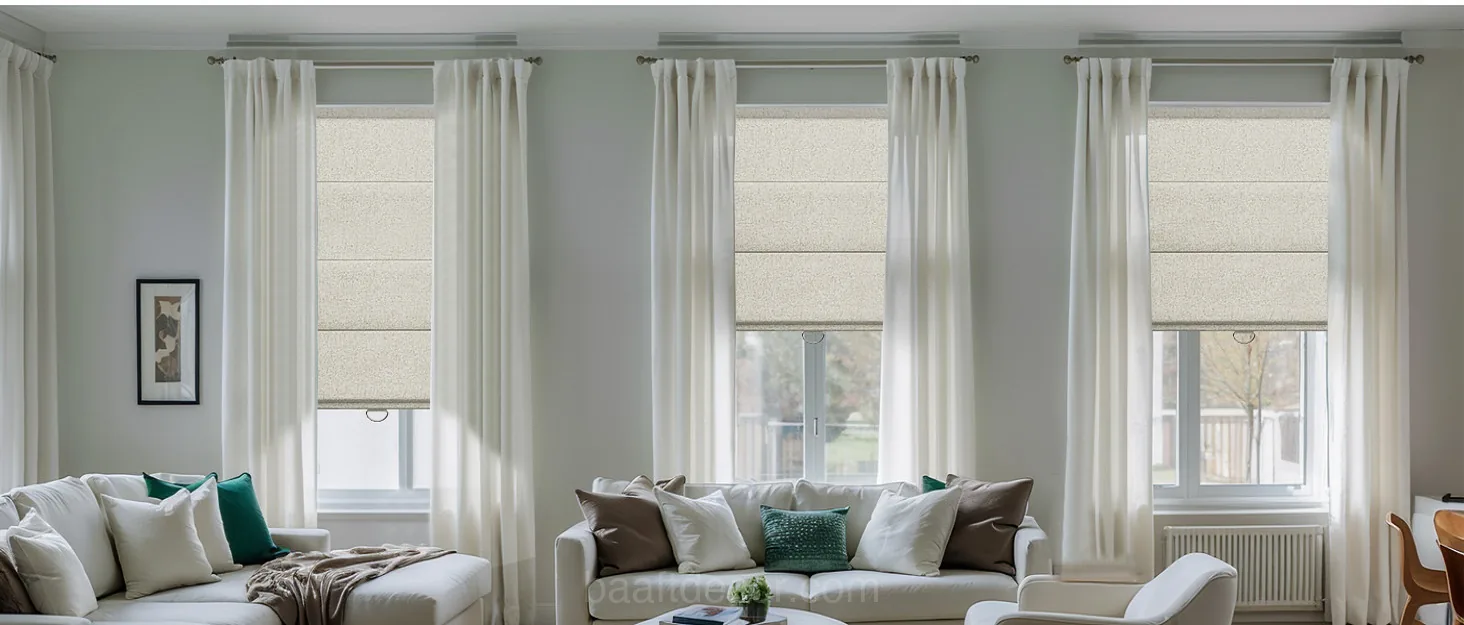
Readymade or custom is one of the first questions people ask us, and the honest answer is: it depends on the window and how long you’ll live with it. We make custom curtains in Hyderabad for a living, so we’re not neutral, but we do tell people when a readymade panel is the smarter buy. This guide sets out the real differences so you can decide room by room.
It sits alongside our curtains buying guide for Hyderabad homes, which covers fabric, lining, hardware and cost in full.
What are the standard readymade curtain sizes?
Readymade curtains in India are sold mainly by length:
| Readymade length | Meant for | Typical width per panel |
|---|---|---|
| About 5 ft | Windows | Around 4 ft |
| About 7 ft | Doors | Around 4 ft |
| About 9 ft | Long doors, tall windows | Around 4 ft |
Sizes vary a little between brands, and the length often includes the eyelet band. Most readymade panels have metal eyelets at the top; a few have rod pockets or tab tops.
Do readymade sizes fit real Indian windows?
Usually not exactly. Floor-to-ceiling heights in Hyderabad apartments vary from project to project, and a false ceiling lowers it again by a different amount in each home. Windows themselves come in all sorts of widths, from a narrow bathroom ventilator to a 12 ft sliding door onto a balcony.
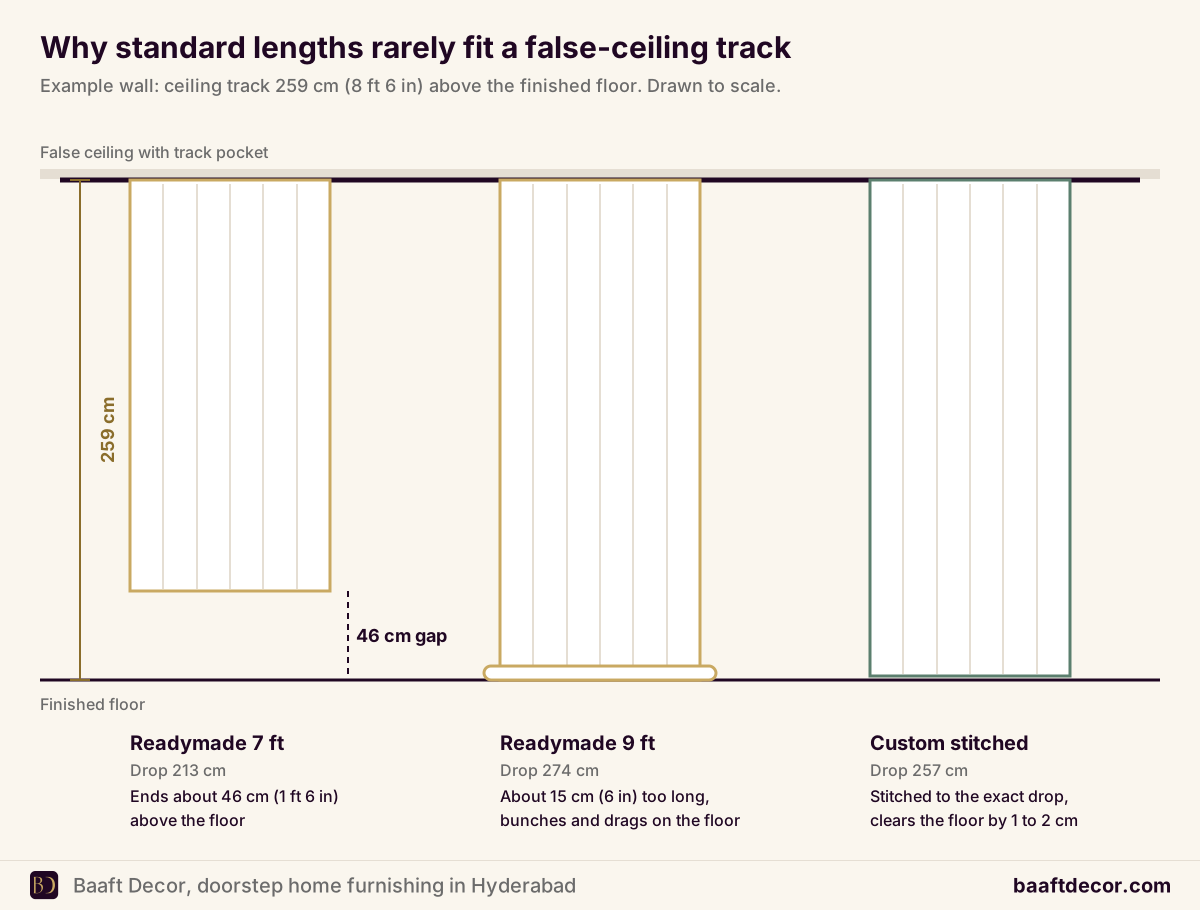
The drawing below shows a typical case. With a ceiling track 259 cm (8 ft 6 in) above the floor, a 7 ft readymade curtain stops about 46 cm short, and a 9 ft one is about 15 cm too long and bunches on the floor. A custom curtain is stitched to the exact drop and clears the floor neatly.
Width is the other half. If you only measure the window and not where the rod or track will go, you’ll buy the wrong size either way. Our guide on how to measure windows for curtains walks through it, and how high to hang curtains explains why the rod height matters as much as the window.
Not sure your windows are standard? We’ll measure them and bring samples, free across Hyderabad. WhatsApp +91 98499 17494.
Fullness: why readymade curtains look flat
Fullness is how much fabric width goes into a curtain compared with the width it covers. Custom curtains are usually stitched at around 2 to 2.5 times the track width, so the folds are deep and even, open or closed.
Readymade panels are a fixed width, so fullness depends on how many you buy. Two 4 ft panels on a 6 ft wide window gives only about 1.3 times fullness. Closed, the curtain looks stretched flat, and light slips through at the sides. To get close to custom fullness you’d need three or four panels, which crowds an eyelet rod and stacks bulkily when open. If you’re working out metres for a custom pair, our guide to how much fabric you need for curtains shows the sums.
Lining, headings and fabric quality
Lining
Most readymade curtains are a single unlined layer. That’s fine for a sheer or a kids’ room, but on a west-facing window in May the unlined fabric fades and lets heat through. Custom curtains can have a dim-out, blackout or thermal lining sewn behind the face fabric. The lining also protects the face fabric from the sun. See our curtain lining guide for how each type performs.
Headings
Eyelets are the default on readymade curtains because they’re cheap to produce and easy to hang on a rod. But eyelets can’t run on a slim ceiling track, which many new apartments now have in a false-ceiling pocket. Custom curtains can have pinch pleat, pencil pleat or ripple fold headings that run on tracks, rods or motors.
Fabric
Readymade ranges vary from good to very thin. Fabrics that fade fast in direct sun are the usual disappointment. Textile makers test colour fastness to light under a standard, ISO 105-B02, that uses a xenon lamp to imitate daylight, but readymade packaging rarely tells you the result. With custom curtains you choose from fabric books, handle the samples and hold them to your own window.
How readymade curtains fit tracks and false ceilings
Homes with false ceilings usually get a track fixed inside a recessed pocket or directly to the gypsum ceiling. A track takes hooks or carriers, not eyelets. So a readymade eyelet curtain either needs a rod fixed below the false ceiling (which spoils the clean ceiling line) or needs its eyelets cut off and a hook tape stitched on.
That alteration works, and we do it often. But by the time a readymade panel has been re-headed, shortened and lined, the saving over a custom curtain is much smaller, and the fullness problem is still there.
When readymade curtains are the right call
Readymade curtains are a perfectly good choice in plenty of situations:
- Rented flats. You may move in a year or two, and the next home’s windows will be different.
- Kids’ rooms. Curtains get pulled, painted on and outgrown. Washable readymade panels are easy to replace.
- Standard windows on a rod. If a 5 ft or 7 ft panel genuinely fits, eyelets on a rod work fine.
- Short-term or urgent needs. Moving in next week and need privacy tonight.
- Utility areas. A store room door or a service balcony where looks matter less.
Custom vs readymade: an honest decision table
| Factor | Readymade | Custom |
|---|---|---|
| Fit to your drop and width | Only if your window matches a standard size | Exact, measured at your home |
| Fullness | Fixed per panel; often too flat | Typically 2 to 2.5 times the width |
| Lining | Usually none | Dim-out, blackout or thermal, as needed |
| Heading | Mostly eyelet, rod only | Pleat, ripple fold, eyelet; rod, track or motor |
| False-ceiling track | Needs re-heading | Made for it |
| Fabric choice | What’s on the shelf | Full fabric books and samples |
| Upfront cost | Lower | Higher |
| Speed | Same day | Stitching time after measuring |
| Best for | Rentals, kids’ rooms, standard windows, urgent needs | Owned homes, living rooms, bedrooms, large sliding doors |
Large sliding doors and high-rise windows
The gap between readymade and custom is widest on the big openings that newer Hyderabad apartments have. A balcony sliding door of 10 to 12 ft needs a lot of fabric width to close fully with proper folds, and a readymade set rarely covers it without four or more panels bunched on one rod. On upper floors, wind through an open sliding door also lifts light unlined panels and slaps them against the frame. A lined, weighted custom curtain on a track hangs steadier, and it can be made to stack to one side so the whole door stays usable. Our guide to curtains for sliding doors and large windows goes into these openings in detail.
What drives the cost difference?
Readymade is cheaper upfront because the sizes are fixed and the panels are made in bulk. A custom quote depends on the fabric grade, how many metres the fullness and drop need, the lining, the heading style, the track or rod, and installation. We give a fixed written quote after measuring, so you can compare it line by line with what readymade plus alterations would come to.
The middle routes: your fabric, or fitting what you bought
Custom and readymade aren’t the only options. Two in-between routes work well:
- Your own fabric, stitched to measure. If you’ve found a fabric you love at a market or online, we stitch customer-bought fabric through our curtain stitching service. Let us measure before you buy, so you get the right metres for width, drop, fullness, hems and pattern repeat.
- Readymade curtains, fitted properly. If you already have readymade panels or a rod, we can do the curtain installation, and alter them where needed: shortening, re-hemming, adding lining or changing eyelets to a pleated heading.
Full projects, with our fabric, stitching and installation, are what we do most. But we’re glad to take on either of these smaller jobs too.
Decide room by room
You don’t need to pick one approach for the whole house. Many homes get custom curtains in the living room and master bedroom, and readymade in the kids’ room and study. Book a free home visit and we’ll measure every window, bring fabric samples to hold up in your own light, and tell you honestly where readymade will do. We work across Hyderabad from 8 AM to 10 PM, all seven days. WhatsApp or call +91 98499 17494.
Frequently asked questions
What is the difference between custom and readymade curtains?
The difference between custom and readymade curtains is mainly fit and construction. Custom curtains are measured and stitched for a specific window, so the width, drop, fullness, lining and heading are chosen for that opening and its hardware. Readymade curtains are mass-produced in fixed sizes, usually around 4 ft wide per panel and 5, 7 or 9 ft long, and are mostly unlined eyelet or rod-pocket panels. Readymade is quicker and cheaper upfront; custom fits better, hangs fuller and usually lasts longer in strong sun.
Are custom curtains worth it?
Custom curtains are worth it for rooms you will live with for years, such as the living room and master bedroom of a home you own, and for any window that is not a standard size. They give the exact drop for false-ceiling tracks, the right fullness for wide sliding doors, and proper lining for heat and light control. For a rented flat, a kids' room or a short-term setup, good readymade curtains are often the more sensible choice, and you can upgrade later.
What are the standard readymade curtain sizes in India?
Standard readymade curtain sizes in India are usually sold by length: about 5 ft for windows, 7 ft for doors and 9 ft for long doors or tall windows, with panels typically around 4 ft wide. Sizes vary a little by brand, and the length often includes the eyelet or heading. Real windows and ceiling heights rarely match these sizes exactly, so readymade curtains often end a few inches above the floor or drag on it, unless they are altered.
Can readymade curtains be hung on a ceiling track?
Most readymade curtains cannot be hung directly on a ceiling track, because they come with eyelets or rod pockets, and those need a rod. A ceiling track uses gliders or carriers with hooks, so the curtain needs a hook tape or pleated heading instead. A tailor can remove the eyelets and stitch on a pleat or hook tape, which also lets them adjust the length. This alteration is common in apartments with false ceilings, where the track sits inside a pocket.
Can I buy my own fabric and get curtains stitched?
Yes, you can buy your own fabric and have curtains stitched to measure. Ask the tailor to measure the windows before you buy, so you get the right number of metres for the width, drop, fullness, hems and pattern repeat. Check that the fabric width suits the job, and buy lining at the same time if you want it. We stitch customer-bought fabric, though we prefer to measure first, because buying too little is the most common problem with this route.
How much fuller are custom curtains than readymade?
Custom curtains are usually stitched at about 2 to 2.5 times the window or track width, which gives deep, even folds. Readymade panels are a fixed width, so the fullness depends on how many you buy. Two standard 4 ft panels on a 6 ft wide window give only about 1.3 times fullness, which looks flat and leaves gaps when closed. To reach similar fullness with readymade, you would need three or more panels on that window, which also crowds an eyelet rod.
Do readymade curtains block light and heat?
Most readymade curtains block only some light and heat, because they are usually a single unlined layer. Some are sold as blackout, using a coated or triple-weave fabric, which helps. But readymade panels often stop short of the floor and are not wide enough to overlap the frame, so light leaks around the edges. Custom curtains can add a dim-out, blackout or thermal lining and be sized to cover the frame fully, which matters on west-facing windows in a Hyderabad summer.
Can readymade curtains be altered to fit?
Readymade curtains can usually be altered to fit, within limits. A tailor can shorten them, re-hem them, add a band at the bottom to lengthen them slightly, sew two panels together for width, add a lining, or replace the eyelets with a pleated heading for a track. What alteration cannot fix is a fabric that is too thin or fades fast. If a readymade curtain needs several alterations, it is often better value to have a custom curtain made instead.