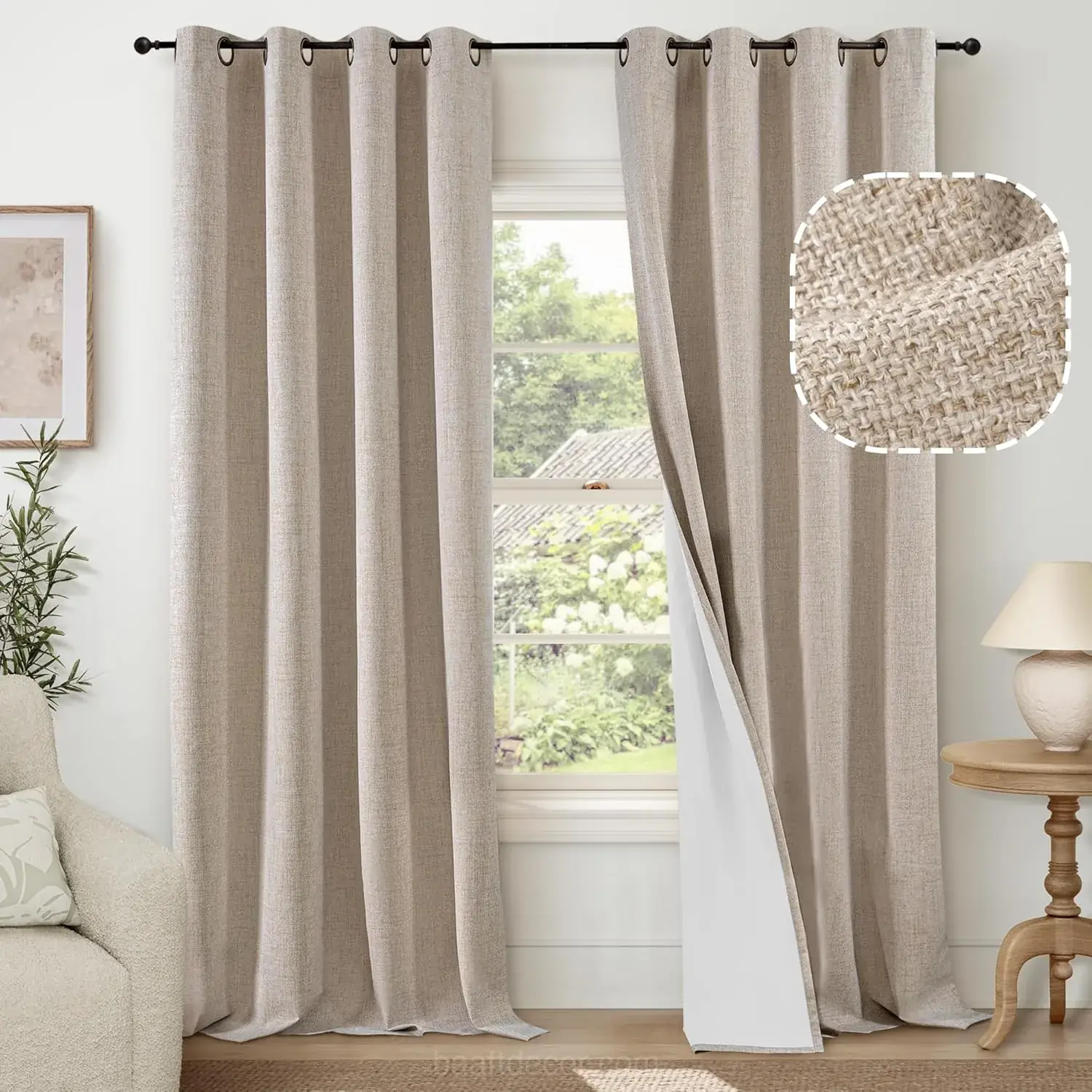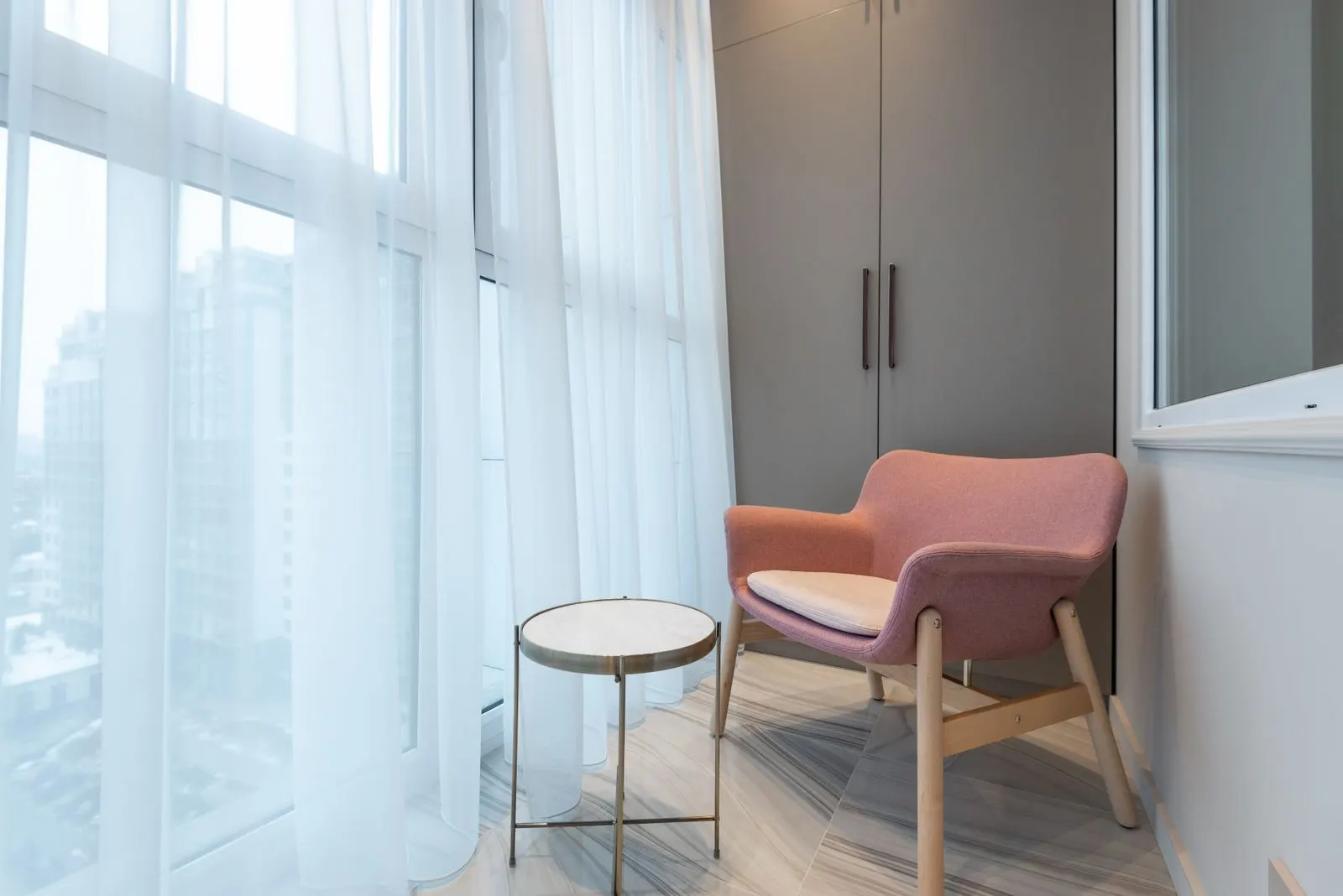
A well-made curtain hangs straight, meets its partner without a gap and keeps its shape through years of washing. Almost all of that comes from steps you never see once it’s up: how the cloth was cut, how deep the hems are, where the weights sit. This guide walks through those steps the way we follow them for curtain stitching in Hyderabad, so you know what to ask for and what to check.
Stitching is one part of a bigger job. Our curtains buying guide for Hyderabad homes covers fabric choice, measuring, hardware and cost.
What happens when curtains are stitched?
Curtain stitching turns flat curtain cloth into finished, hung-ready curtains in a fixed order: check, cut, join, hem, weight, line, head and inspect. Skipping or rushing any one step shows up later as uneven hems, wandering patterns or tops that sag.
- Check the cloth for flaws, shade differences and pattern direction.
- Cut each drop to length, allowing for the heading, hems and pattern repeat.
- Join widths to make up each curtain, matching the pattern.
- Turn and stitch the side hems and the bottom hem.
- Mitre the corners and add weights.
- Attach the lining, sewn-in or detachable.
- Sew on the heading tape or buckram and form the pleats.
- Measure, press and inspect before fitting.
Want your curtains made this way? We visit with fabric samples, measure your windows and quote, free across Hyderabad. WhatsApp +91 98499 17494.
Step 1: checking and cutting the cloth
Unstitched curtain cloth should be checked on a flat table before a single cut. Look for weaving faults, printing flaws and shade variation between rolls, and note which way the pattern or pile runs so every drop faces the same direction.
Curtain cloth in India typically comes 48 to 56 inches wide, and many sheers are made extra wide and used sideways, so the width of the roll becomes the curtain’s drop. Your tailor needs to know which kind you have before calculating.
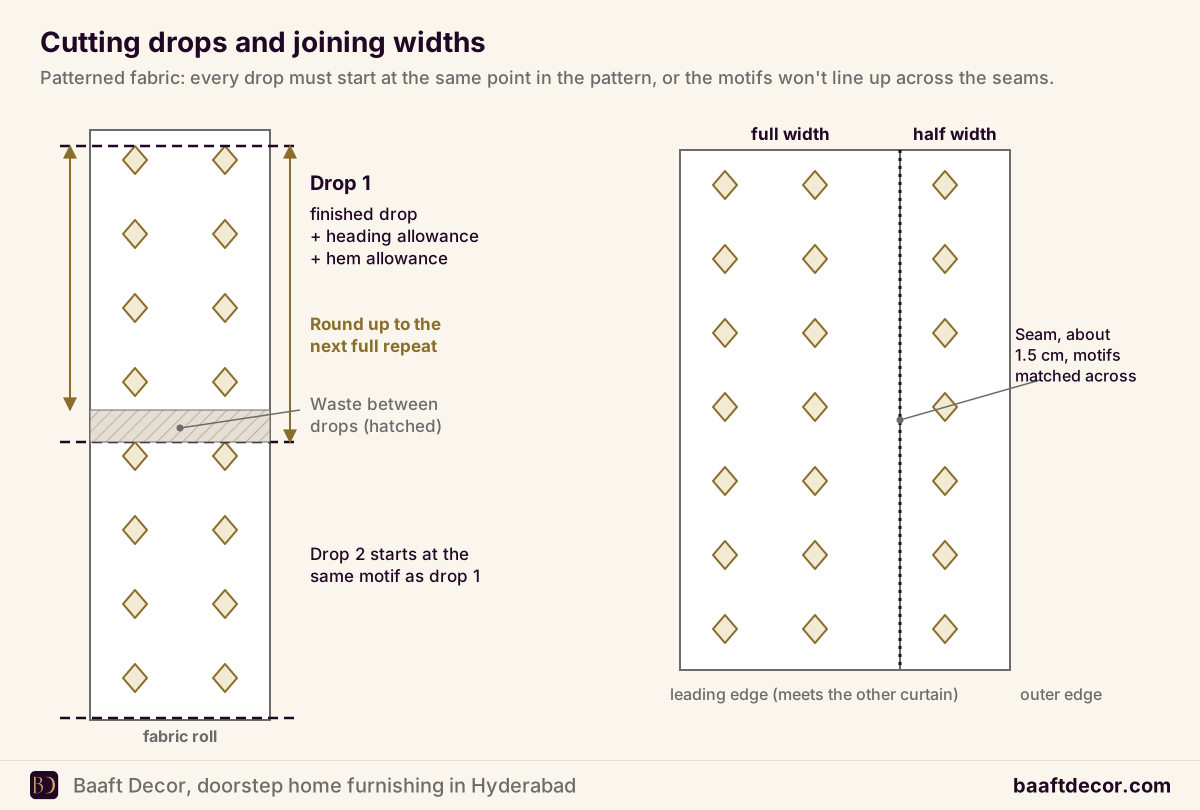
Each drop is cut to:
Cut drop = finished drop + heading allowance + hem allowance
On printed or woven-pattern fabric, round each drop up to the next full pattern repeat. That’s what makes the motif sit at the same height on every width, and it’s also why patterned curtains need noticeably more cloth. Our guide on how much fabric you need for curtains shows the calculation with worked examples.
Step 2: joining widths and matching patterns
Most curtains are wider than one roll, so widths are joined with a narrow seam, typically about 1.5 cm. On patterned cloth the tailor folds and pins along the motif first, then stitches, so the design runs across the join without a step.
Two details separate careful work from quick work:
- Half widths go at the outer edge, next to the wall, not at the leading edge where the pair meets. The seam then hides in the stack when the curtain is open.
- Selvedges are trimmed or snipped before joining. Tight woven selvedges shrink differently from the body of the fabric and pucker the seam after the first wash.
Side hems and bottom hems: typical allowances
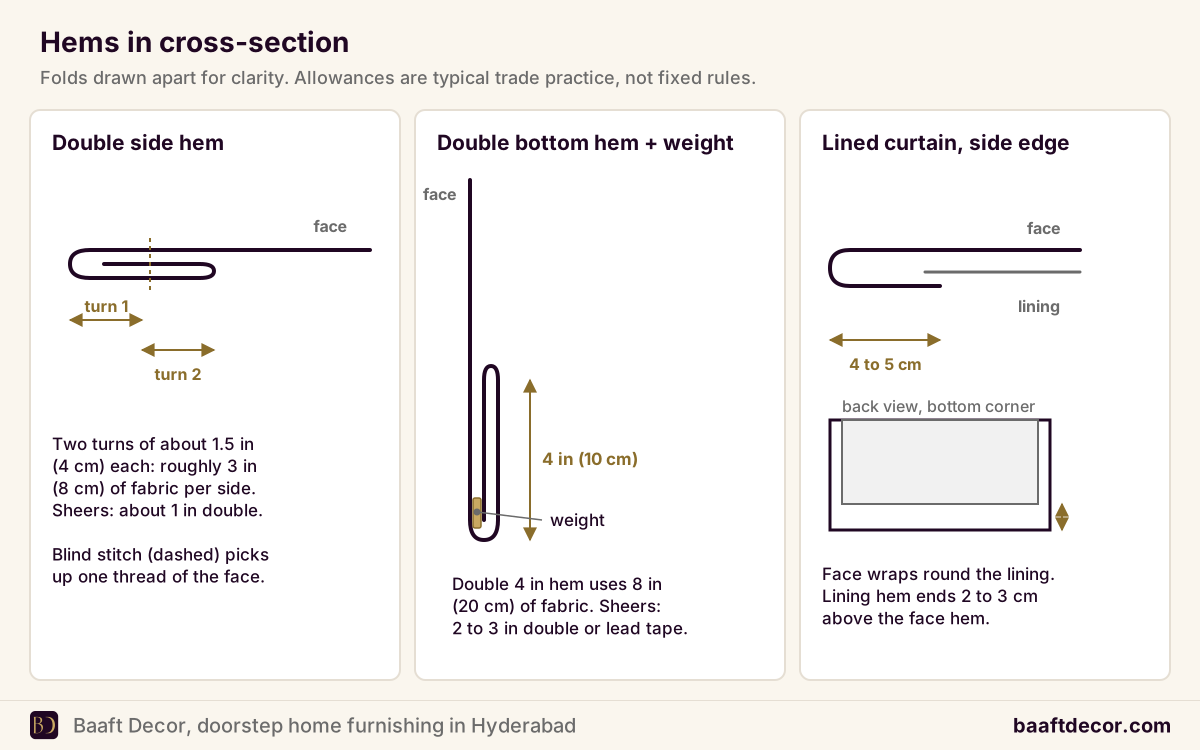
Hems on good curtains are turned twice, so no raw edge is left inside and the extra layer adds weight. The figures below are common trade practice; a tailor may adjust them for sheers or very heavy fabric.
| Hem | Typical finish | Fabric used | Notes |
|---|---|---|---|
| Side hem, curtain | Double 1.5 in (4 cm) | About 3 in (8 cm) per side | Blind stitched |
| Side hem, sheer | Double 1 in (2.5 cm) | About 2 in (5 cm) per side | Narrower so the edge doesn’t show |
| Bottom hem, curtain | Double 4 in (10 cm) | About 8 in (20 cm) | Corner weights inside |
| Bottom hem, sheer | Double 2 to 3 in, or a narrow hem with lead tape | 4 to 6 in | Lead tape keeps sheers straight |
| Lining hem | Separate, ends 2 to 3 cm above the face hem | About 4 in (10 cm) | So lining never shows below |
A deep, double-turned blind hem is also what sewing machine maker BERNINA recommends for drapery: turn 3 to 4 inches, turn again, then blind stitch so the line barely shows on the face. There’s a practical bonus too. A generous hem is stored length, which makes it possible to let the curtain down later.
Corner mitres and weights
A mitred corner is where the side hem and bottom hem meet on a neat 45-degree fold instead of a lumpy overlap. It’s made by folding the corner in diagonally, turning up the hem, then turning in the side so the two folds meet, and slip-stitching the diagonal by hand.
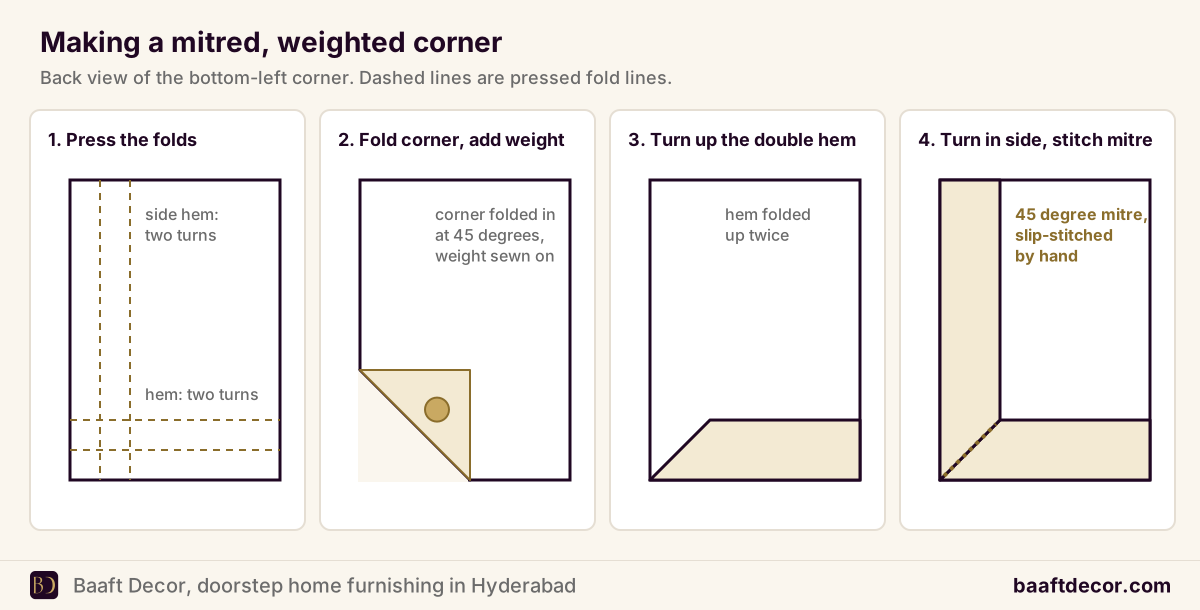
Weights come in three kinds:
- Corner weights: small flat weights sewn inside each mitre and at the foot of each seam.
- Lead tape or chain weight: a continuous weighted cord laid in the hem fold of sheers and light fabrics so the whole hem hangs level.
- Weight pouches: a weight wrapped in lining fabric before it goes in, so it can’t mark pale fabric.
In high-floor flats around the IT corridor, where wind comes through open sliding doors, we’re generous with weights. A light sheer without lead tape will sail into the room.
Attaching the lining: sewn-in or detachable
Lining is the plain fabric behind the curtain. It blocks light, protects the face from sun fading and adds body. It’s attached in one of two ways.
| Sewn-in lining | Detachable lining | |
|---|---|---|
| How it’s fixed | Stitched into side hems and heading | Own lining tape, hangs on the same hooks |
| Look | Neatest, both layers hang as one | Slightly looser; edges free |
| Light control | Best, especially for blackout | A little light leaks at edges |
| Washing | Together, as one curtain | Separately |
| Add to existing curtains | Needs side hems unpicked | Easy |
For bedrooms with blackout lining, sewn-in is our usual choice. On west-facing windows, where Hyderabad’s afternoon sun fades face fabric fast, any lining is better than none. The curtain lining guide compares lining fabrics, including blackout, dim-out, thermal and interlining.
Sewing on the heading: tape or buckram
The heading goes on last because it sets the final finished width. For a tape heading, the top is turned down and pleat tape, pencil tape or ripple tape is stitched across the back with two rows. For a hand-pleated heading, buckram is sandwiched under the turned-down top, pleats are marked out across the width and stitched one by one. Our guide to curtain heading types explains each heading, its fullness and the hardware it needs.
Hook height matters here. It decides whether the curtain top hides the track or sits below it, and whether the hem clears the floor by the planned 1 to 2 cm.
Blind stitch vs machine stitch
| Blind stitch (hand or blind-hem machine) | Straight machine stitch | |
|---|---|---|
| Seen from the room | Almost invisible | A visible line |
| Hang | Smooth, no ridge | Can stiffen or pucker the hem |
| Unpicking later | Easy | Harder, marks may remain |
| Used for | Side and bottom hems on quality curtains | Seams, tape headings, utility curtains |
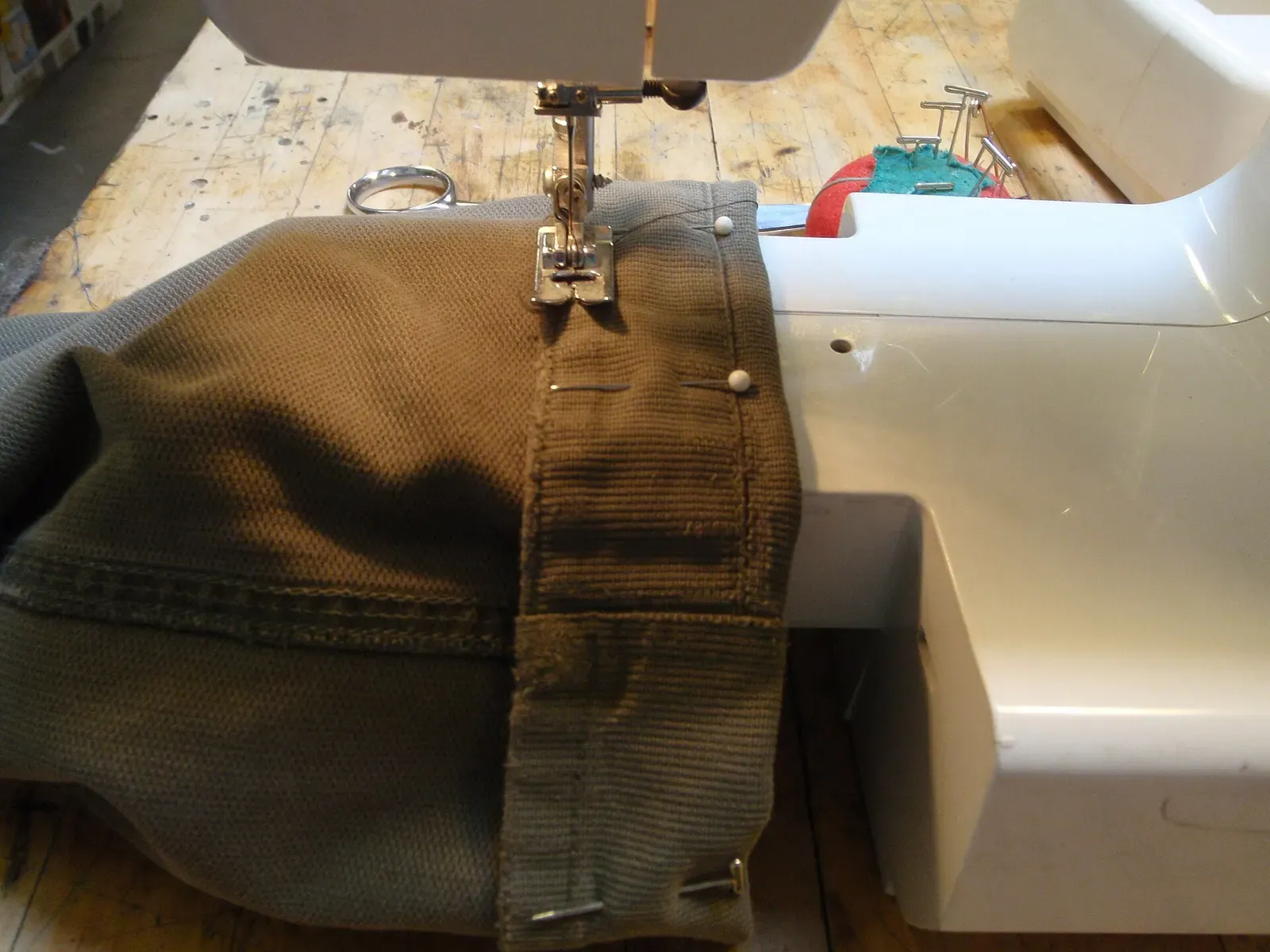
Machine stitching isn’t wrong: seams and heading tapes are always machine sewn. The point is to keep visible stitch lines off the face of side and bottom hems.
Quality checks before fitting
Before a finished curtain leaves the table, check:
- Both curtains in a pair are the same length and width.
- Hems are level and side hems are an even width all the way down.
- Pattern matches across every seam and sits at the same height on both curtains.
- Corners are mitred with no raw edges or bunching.
- Pleats are evenly spaced and hooks are at one consistent height.
- No puckered seams, loose threads or stitching visible on the face.
How we stitch curtains at Baaft Decor
We follow the process above for every job. We visit with samples, measure each window, agree the heading, lining and fullness, cut and stitch the curtains, then fit them and check the hang. Full projects, where we supply the fabric, stitch and install, are most of what we do, but we also stitch cloth you’ve bought elsewhere and alter existing curtains. See our page on curtains in Hyderabad for the full range. In the northern and western suburbs we often fit curtains in Bachupally, curtains in Tellapur and curtains in Kollur.
Have your curtains stitched properly
Book a free home visit and we’ll bring fabric samples, measure every window, check your cloth if you’ve already bought it, and give a written quote. We work across Hyderabad from 8 AM to 10 PM, all seven days. WhatsApp or call +91 98499 17494.
Frequently asked questions
How are curtains stitched step by step?
Curtains are stitched in this order. First the fabric is checked for flaws, shade and pattern direction. Each drop is cut to the finished length plus heading and hem allowances, rounded up to the pattern repeat on printed fabric. Widths are joined with the pattern matched across the seams. Side hems are turned twice and the bottom hem is turned twice, usually with weights at the corners or along the hem. The lining is attached, the heading tape or buckram is sewn on, and the finished curtains are measured, pressed and checked before fitting.
How much extra fabric is needed for curtain hems and headings?
Typical allowances are about 3 inches (8 cm) per side for double side hems, about 8 inches (20 cm) for a double 4 inch bottom hem, and between 2 and 8 inches at the top depending on the heading: a few inches for a tape heading and roughly twice the buckram depth for a buckram heading. Patterned fabric needs extra because every drop must start at the same point in the pattern repeat. These are common trade figures, and a tailor adjusts them for sheers, heavy fabrics and blackout lining.
Can a tailor stitch curtains from unstitched curtain cloth I bought myself?
Yes, most curtain tailors, including Baaft Decor in Hyderabad, will stitch unstitched curtain cloth that you bought elsewhere. Before cutting, the tailor should measure your windows, confirm the heading and lining, and check that you have enough cloth for the fullness, hems and pattern repeat. Shortfalls are common with printed fabric bought by the metre, so it's worth having the windows measured before you buy. Mention any fabric that may shrink, such as cotton or linen, so it can be pre-washed or allowed for.
What is a blind stitch on curtains?
A blind stitch is a hemming stitch that catches only one or two threads of the curtain's face fabric, so the hem looks almost invisible from the room side. It can be sewn by hand or with a blind-hem machine or foot, which runs along the fold and occasionally zigzags into the face. Blind-stitched hems hang more smoothly than hems sewn straight through with a visible machine line, and they're easier to unpick if the curtain needs shortening or lengthening later. Side and bottom hems on quality curtains are usually blind stitched.
Why do curtains have weights in the hem?
Weights in a curtain hem help it hang straight, keep the side edges from curling, and stop the curtain flapping when a window or balcony door is open. Tailors use small corner weights sewn inside the mitred corners and the bottom of seams, and lead tape or chain weight running along the full hem of sheers and lightweight fabrics. On high-floor apartments with strong wind through sliding doors, weighted hems make a noticeable difference. Weights should be enclosed in the hem or a small pouch so they do not rub or stain the fabric.
Is sewn-in or detachable curtain lining better?
Sewn-in lining gives the neatest finish because the face fabric and lining are stitched together at the sides and heading, so they hang as one and the face is fully protected from sun. Detachable lining has its own lining tape and hangs from the same hooks, so it can be removed for separate washing or added to existing curtains later, but its edges are free and a little light can leak around them. For blackout bedrooms a sewn-in lining is usually better; detachable suits rentals and curtains that are washed often.
How do I check the quality of stitched curtains?
Check stitched curtains before they are hung. Both curtains in a pair should be the same finished length and width, and the hems should be level when the curtains hang. Seams should be straight, with any pattern matching across the join. Side hems should be the same width down the full drop, corners neatly mitred with no raw edges, and the heading pleats evenly spaced with hooks at a consistent height. Hold the curtain to the light: puckered seams, loose threads or visible hem stitching on the face are signs of rushed work.
What are the types of curtain stitching?
Curtain stitching is usually described by the heading, because that is the part customers choose. The common types are pinch pleat (double or triple), American pleat made with pleat tape, pencil pleat, box pleat, ripple or wave fold, eyelet, tab-top and rod pocket. Within each, the tailor can stitch the curtain unlined, with a sewn-in lining, or with a detachable lining, and can add interlining for extra body. The heading decides the fabric quantity, so it should be fixed before the cloth is cut.