People usually ask about soundproof curtains after a bad week: a new flyover outside, a tower going up next door, or a bedroom facing a main road. We’d rather give you the honest answer than sell you a curtain that disappoints. Curtains help with some noise problems and barely touch others. When we plan curtains in Hyderabad for a noisy room, we explain exactly which part of the noise the curtain will deal with, and which part needs the window fixed.
This guide covers the physics in plain terms, what actually helps, and when to spend on the window instead. For choosing curtains generally, start with our complete guide to buying curtains for a Hyderabad home.
Do soundproof curtains actually work?
Partly. “Soundproof” is a marketing word. No curtain soundproofs a room. What a heavy, lined curtain does is absorb sound, which brings two real benefits:
- Less echo inside the room. Hyderabad flats with vitrified tile floors, bare walls and big glass doors echo badly. Curtains, rugs and sofas soak that up, and the room feels calmer.
- Softer high and mid-pitched noise. Voices from the corridor, horns, a neighbour’s TV and birds at dawn lose some of their edge.
What it won’t do is stop the low rumble of buses and trucks, the thud of a piling rig, or the vibration of a metro line. That needs a different kind of solution.
Why curtains can’t block noise: mass and gaps
Two things stop sound getting through a barrier: mass and airtightness. Curtains have little of either.
Mass. Building acousticians use the “mass law”: a barrier’s sound insulation rises by about 6 dB each time its mass is doubled, as explained in the National Research Council Canada’s building digest on sound transmission through windows (NRC Canadian Building Digest 240). Now compare the weights. A fairly heavy cotton drapery of 10 oz per square yard is about 340 grams per square metre. Ordinary 5 mm window glass, at about 2,500 kg per cubic metre, weighs around 12.5 kg per square metre. The glass is over 30 times heavier, and even the glass isn’t great at stopping traffic noise.
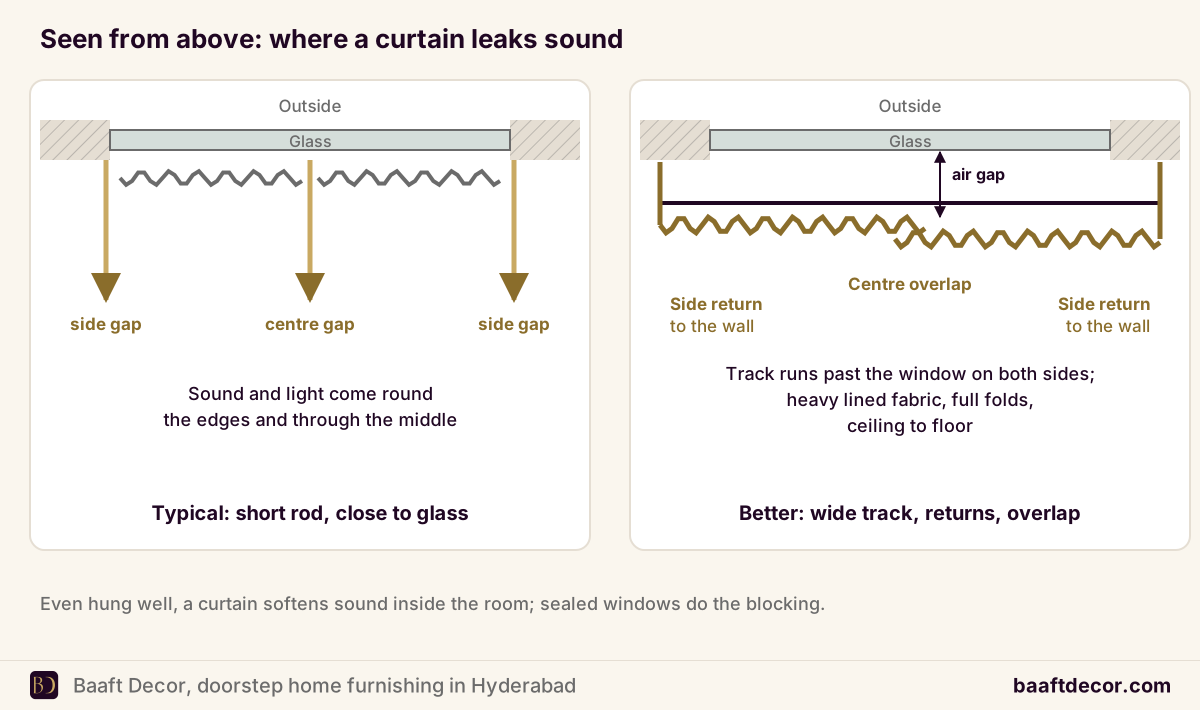
Gaps. The same NRC digest notes that sound passing through cracks can drastically reduce the effective noise reduction of a window. A curtain is full of gaps by nature: at the top, the sides, the floor and the centre where it meets. Sound goes around it.
Low frequencies. Road traffic and aircraft have strong low-frequency content, according to the same source, and low sounds pass through light materials most easily. That’s why a curtain softens a horn but not an idling truck.
Want this measured for your windows? We visit with heavy fabric and lining samples, free across Hyderabad. WhatsApp +91 98499 17494.
Absorption vs blocking: what curtains are good at
Absorption is measured by an absorption coefficient: the fraction of sound energy a surface absorbs when sound hits it, from 0 (none) to 1 (all), and it changes with pitch (Simon Fraser University, Handbook for Acoustic Ecology). That handbook’s table shows something useful for anyone hanging curtains.
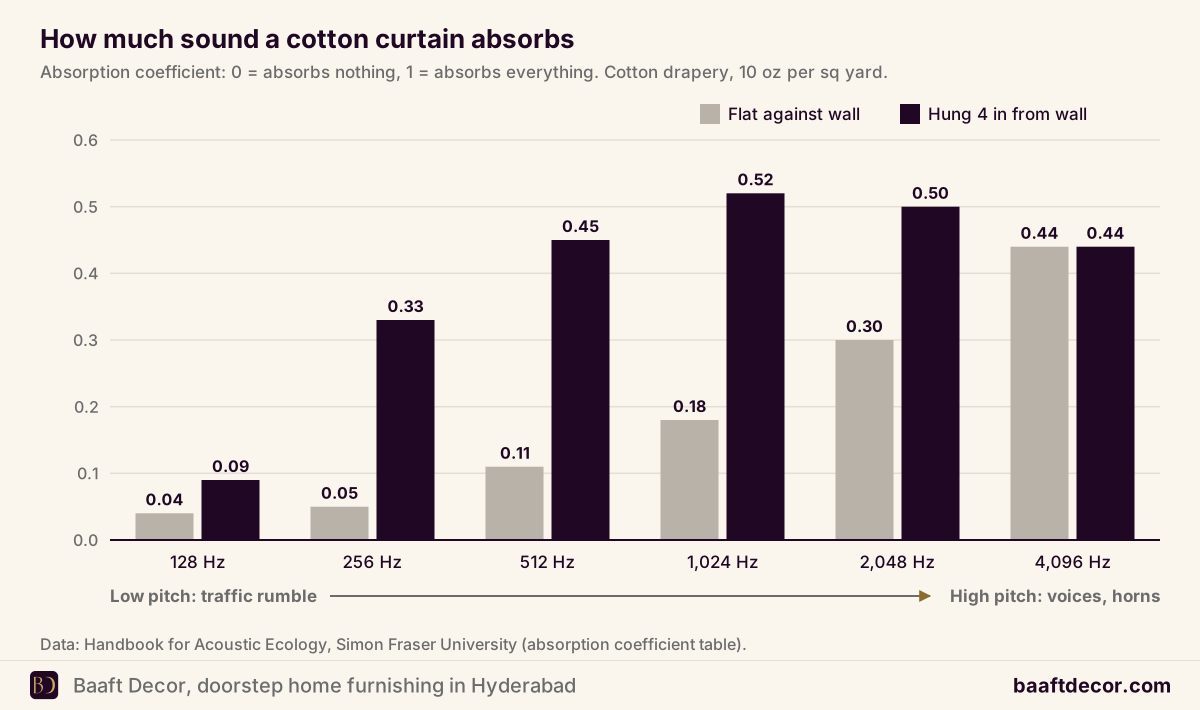
Hung flat against a wall, a 10 oz cotton drapery absorbs about 11 percent of sound energy at 512 Hz. Hung 4 inches away, the same fabric absorbs about 45 percent. At the lowest frequency in the table (128 Hz) it absorbs under 10 percent either way. In plain terms: curtains are good at soaking up mid and high sounds in the room, they work better with an air gap behind them, and they do very little for deep rumble.
What actually helps a curtain reduce noise?
If you want the most a curtain can give, these are the things that make a difference, in rough order of importance.
| Factor | Why it helps | What we do |
|---|---|---|
| Heavy, dense fabric | More mass and a tighter weave absorb more | Velvet or thick polyester rather than light cotton |
| Lining | Adds weight and closes the weave | Blackout, thermal or dim-out lining behind the face fabric |
| Fullness | More folds mean more fabric in the sound’s path | Generous fullness, not a flat panel |
| Ceiling to floor | Closes the gaps at top and bottom | Ceiling track, curtain stops just above the floor |
| Overlap and wrap-around | Closes the centre and side gaps | Overlapping centre, side returns to the wall |
| Air gap from glass | Improves absorption, as the chart shows | Track set a few inches out from the window |
Each of these is covered elsewhere in more depth. The curtain lining guide explains coated and interlined builds, our guide on how high to hang curtains covers ceiling mounting, and how much fabric you need for curtains explains fullness.
Traffic and construction noise in Hyderabad
Most of the noise complaints we hear fall into three groups:
- Main roads, flyovers and metro lines. Constant low rumble with horns on top. Curtains soften the horns; the rumble needs the window sealed.
- Construction next door. New gated communities are often surrounded by sites for years. Piling, cutting, mixers and trucks start early. The vibration part comes through the structure and glass; curtains help only with the sharper sounds.
- Echo inside the flat. Not outside noise at all, but hard tiles, bare walls and glass bouncing every sound around. This is where curtains do their best work, with rugs and soft furniture.
High-rise flats add wind noise around sliding doors, which is almost always a seal problem. Our guide to high-rise apartment window solutions covers that side.

What to expect for each kind of noise
| Noise | Main pitch | What a heavy lined curtain does | What does more |
|---|---|---|---|
| Echo inside the room | Mid and high | Noticeable improvement | Curtains plus a rug and soft furniture |
| Voices, TV from neighbours | Mid | Softens it | Sealed windows and doors |
| Horns, birds at dawn | High | Takes the edge off | Sealed windows, then curtains |
| Buses, trucks, idling engines | Low | Very little | Laminated or double glazing, secondary window |
| Piling, drilling, metro vibration | Low, plus vibration | Almost nothing | Sealed windows; some noise comes through the structure |
A simple test before you spend
Stand in the room at the noisiest time of day and close the window fully. If the noise drops a lot, the window is doing its job and air gaps were the problem when it was open; a heavy curtain will add a little on top. If the noise barely changes with the window shut, the sound is coming through the glass, the frame or the gaps around it. That’s a window problem first. Then hold a thick blanket over the closed window for a minute. The difference you hear is roughly the most a good curtain can add, and it’s a more honest guide than any product label.
When to fix the window seals instead
If the noise is the main problem, spend on the window before the curtain. Check these first:
- Worn gaskets and brush seals. Sliding aluminium and uPVC windows rely on them. Once they’re flattened or missing, sound and dust pour in.
- Sashes that don’t lock tightly. A sliding window that rattles in the wind leaks sound.
- Gaps around the frame. Cracked sealant between the frame and the wall is a common leak.
- The glass itself. For serious traffic noise, laminated glass, double glazing or a secondary window fitted inside the existing one is the real fix. These are window contractor jobs, not curtain jobs, and we’ll tell you so at the visit.
Once the window is sealed, a heavy lined curtain on top adds a useful final layer, especially at night. For echo inside the room, acoustic wall panels on a large bare wall can also help alongside curtains.
Who should buy “soundproof” curtains?
They make sense if your problem is echo, voices, sharp sounds or a bedroom that feels harsh and bright. They’re also worth it when you need blackout anyway, since a heavy lined blackout curtain gives you darkness and some softening together; our blackout vs sheer vs dim-out comparison helps you pick the lining. They are not worth paying extra for as a cure for road rumble or construction thuds.
Talk to us about a noisy room
Book a free home visit and we’ll look at the window, the seals and the room, tell you honestly how much a curtain will help, and bring heavy fabric and lining samples to compare. We work across Hyderabad from 8 AM to 10 PM, all seven days. WhatsApp or call +91 98499 17494.
Frequently asked questions
Do soundproof curtains really work?
Soundproof curtains work only partly, and the name oversells them. A heavy, lined curtain absorbs some sound energy, which reduces echo inside the room and softens mid and high-pitched noise such as voices, horns and television sound from a neighbour's balcony. It cannot block noise the way a wall or a sealed window does, because fabric is light and porous, and sound passes through gaps around its edges. Most people notice a softer, less echoey room rather than a quiet one.
Why can't a curtain block traffic noise?
A curtain cannot block traffic noise well because blocking sound depends mostly on mass and airtightness, and a curtain has very little of either. Building acoustics research describes a 'mass law' in which sound insulation rises by about 6 dB each time the mass of a barrier doubles. A heavy curtain weighs a few hundred grams per square metre, while ordinary 5 mm window glass weighs over 12 kg. Traffic noise is also rich in low frequencies, which pass through light materials most easily.
What is the difference between sound absorption and soundproofing?
Sound absorption and soundproofing solve different problems. Absorption soaks up sound that is already in the room, so it bounces around less, which reduces echo and makes speech clearer. Soft materials such as curtains, rugs, sofas and acoustic panels absorb sound. Soundproofing, or sound insulation, stops sound passing from outside to inside, or between rooms, and needs heavy, airtight construction such as thick walls, laminated or double glazing and well-sealed frames. Curtains are good absorbers but poor sound insulators.
What kind of curtain reduces the most noise?
The curtain that reduces the most noise is heavy, densely woven and lined, made with generous fullness and hung ceiling to floor. Velvet or thick polyester with a blackout or thermal lining works better than a light cotton, and interlining adds a little more. How it is hung matters as much as the fabric: it should overlap in the centre, wrap around to the wall at the sides, and hang slightly away from the glass. Even then, expect a softer room rather than silence.
Do blackout curtains reduce noise?
Blackout curtains reduce noise slightly more than ordinary curtains because their coated lining adds weight and closes the weave, but they are not designed for sound. The foam coating blocks light very effectively while doing far less for sound, which mostly comes in through the window frame and gaps. A blackout curtain hung ceiling to floor with good fullness will make a bedroom feel a little quieter and less echoey. For real noise problems, combine it with better window seals.
How can I reduce traffic noise coming through my windows?
To reduce traffic noise through windows, start with the window itself. Close every gap: replace worn rubber gaskets and brush seals on sliding windows, check that the sashes lock tightly, and seal cracks around the frame. If noise is still a problem, laminated glass, double glazing or a secondary window fitted inside the existing one gives the largest improvement. Heavy lined curtains, hung ceiling to floor and closed at night, then add a final layer of softening on top of a sealed window.
Do curtains help with construction noise?
Curtains help only a little with construction noise. Piling, drilling, concrete mixers and heavy vehicles produce strong low-frequency sound and vibration that passes through glass and even the building structure, which fabric cannot stop. Heavy lined curtains can soften the higher-pitched part of the noise, such as cutting and hammering, and closing the window tightly makes more difference than the curtain. For a work-from-home room facing an active site, sealed windows and a closed curtain together are the practical answer.
Does hanging curtains away from the wall make a difference to sound?
Hanging curtains slightly away from the wall or glass does make a measurable difference to how much sound they absorb. Published absorption data for a cotton drapery shows that, hung straight against a wall, it absorbs about 11 percent of sound energy at mid frequencies, but hung 4 inches from the wall the same fabric absorbs around 45 percent. The air gap lets the fabric work better on mid and lower sounds. That is one reason ceiling tracks with some clearance from the glass perform better.