Not every curtain goes on a window. A curtain on a ceiling track is one of the simplest ways to split a big hall, hide a study corner or give a studio bed some privacy, and it opens back into one room in a second. We stitch and fit these partition curtains alongside regular window curtains for Hyderabad homes, and the planning is surprisingly different.
If you’re still deciding on fabrics and linings in general, our curtains buying guide for Hyderabad homes covers the basics. This guide is about curtains that divide space.
Where partition curtains work best
| Space | What the curtain does | Typical choice |
|---|---|---|
| Hall and dining split | Marks off the dining area, hides the table during guests | Sheer or semi-sheer, ceiling track, opens to a wall |
| Hall and study corner | Hides a desk and clutter, cuts screen glare | Lined dim-out, ripple fold |
| Studio flat (bed area) | Separates sleeping from living, darkens the bed side | Double-sided or lined blackout |
| Kitchen entrance | Hides an open kitchen from the hall | Washable polyester, kept clear of the hob |
| Office cabins and meeting corners | Quick privacy without building a partition | Durable polyester, often flame-retardant |
| Clinics and consultation bays | Patient privacy around beds and couches | Cubicle curtain with mesh top, ceiling track |
Hall and dining split
In many Hyderabad apartments the hall and dining run as one long room. A partition curtain across the middle lets you close the dining side when guests come, or close off the hall in the afternoon so the AC cools one half. A sheer keeps both halves bright. A lined curtain hides the dining table and anything stacked on it.
Studio flats
For a studio or 1RK, a floor-to-ceiling curtain round the bed area is the cheapest way to get a “bedroom”. Use a lined or blackout curtain so the bed side stays dark when someone’s still working in the living side. Make it double-sided if the living side sees it all day.
Offices and clinics
In offices, partition curtains give meeting corners and cabins quick privacy. They’re common in clinics, physiotherapy rooms and diagnostic centres around consultation couches. For larger office fit-outs we also handle blinds and other furnishing under our office furnishing service.
Want this planned for your space? We visit with samples and a tape, free across Hyderabad. WhatsApp +91 98499 17494.
Partition curtain or something else?
A curtain isn’t the only way to divide a room. Here’s how it compares with the other common options.
| Option | Privacy | Opens fully | Blocks sound | Building work | Best for |
|---|---|---|---|---|---|
| Partition curtain | Sight only | Yes, stacks to a wall | Very little | Track fixing only | Flexible zones, rentals, studios |
| Glass partition | Low (unless frosted) | Only with sliding glass | Some | Moderate to high | Offices, permanent cabins |
| Sliding panel or door | Good | Partly | Some | Moderate | Permanent room divisions |
| Vertical or panel blind | Sight only | Yes | Very little | Track fixing only | Offices, modern homes |
| Brick or board wall | Full | No | Good | High | Permanent extra room |
The curtain wins on cost, speed and flexibility. It loses when you need real quiet or a lockable room.
Ceiling tracks for partition curtains
A partition curtain needs to look like a soft wall, not a sheet on a string. That means a ceiling track running the full width, so the curtain starts at the ceiling with no gap.
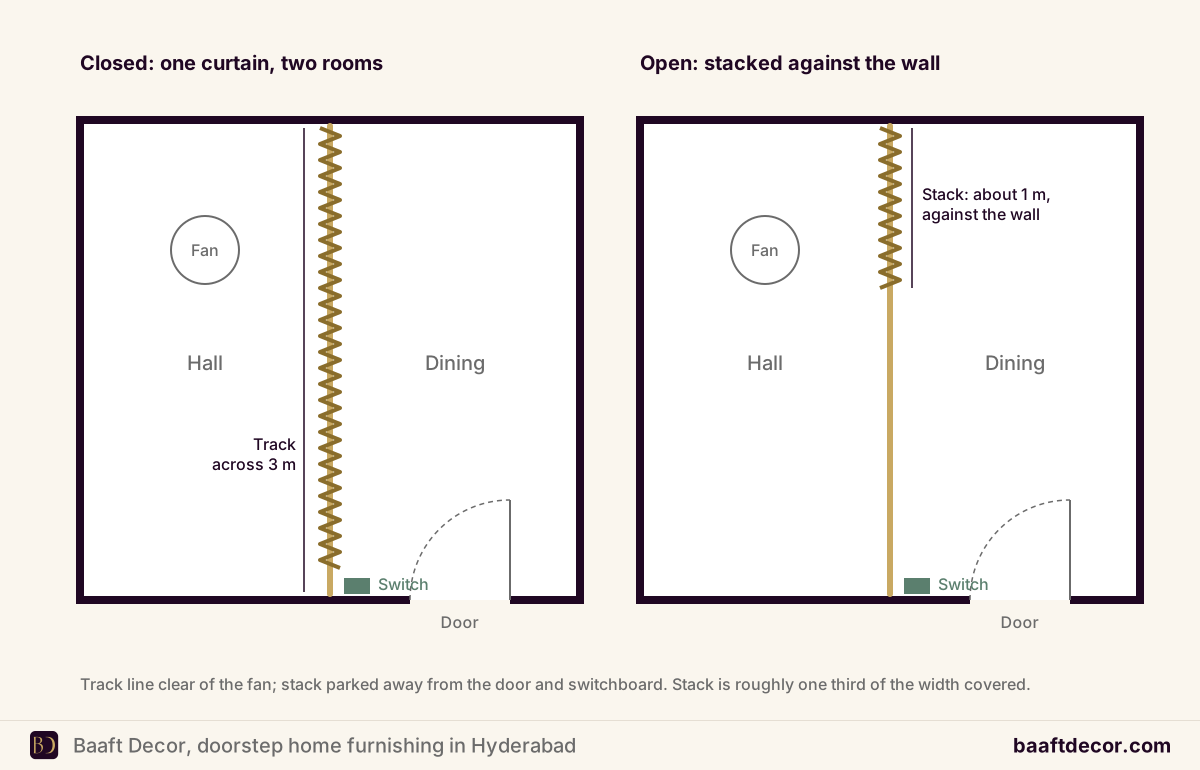
Points we check on every partition job:
- What the track fixes into. The concrete slab is ideal. Above a false ceiling, the track goes through into a plywood backing strip or the slab. Gypsum board alone won’t hold it.
- Where the stack sits. Hardware maker Bali’s drapery measuring guide puts stacked fabric at roughly one third of the width covered. Across a 3 metre hall, that’s about a metre of curtain parked at the end, so it needs a wall, not a doorway.
- Fans, lights and AC vents. A track line under a ceiling fan or right in front of an AC outlet causes trouble. We shift the line or the fixture plan.
- Bends. Tracks can curve round a corner or follow an L, useful for wrapping a bed area in a studio.
- Floor clearance. We keep partition curtains 1 to 2 cm off the floor, so they slide freely over tiles and clear the mop.
Our curtain rods and tracks guide covers track types and materials. Fitting is part of every full project, and our curtain installation service also covers tracks for curtains you already own.
Sheer, opaque or double-sided?
This choice decides whether the partition feels open or private.
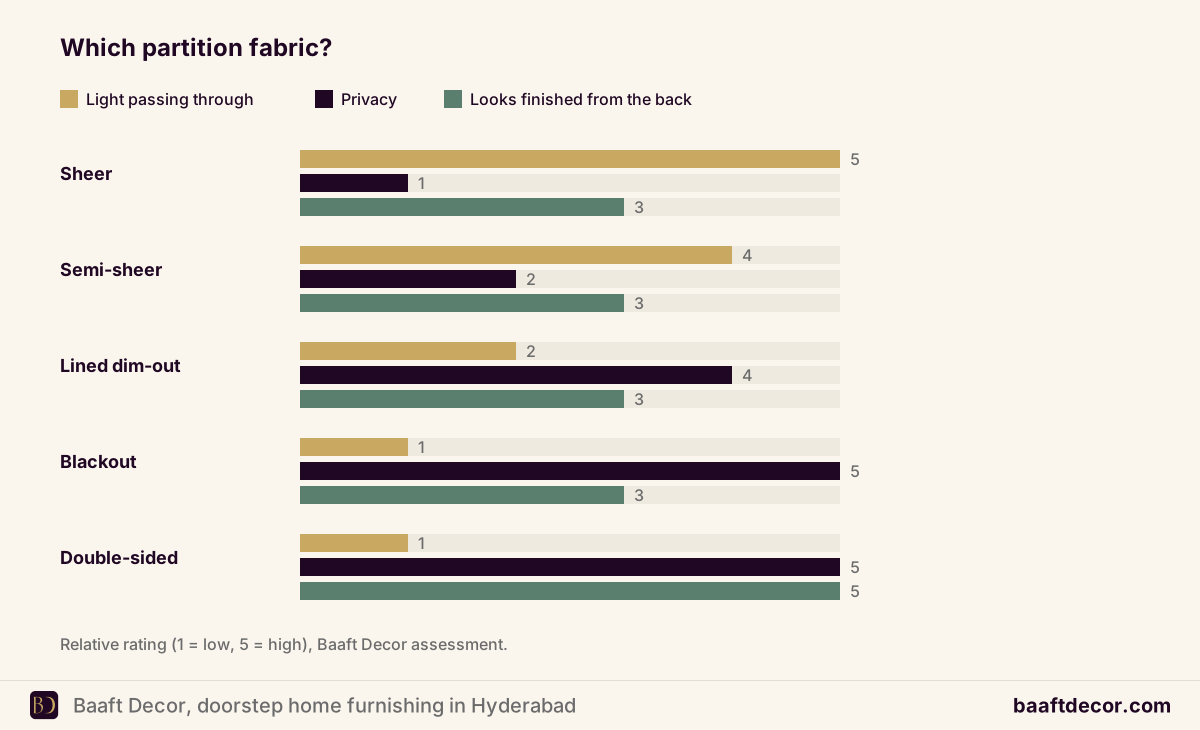
- Sheer and semi-sheer. Zone the room without darkening it. People can still see shapes and movement through them, especially at night with lights on one side. Our sheer curtains guide covers the fabrics.
- Lined dim-out. Hides what’s behind it and cuts light, while staying soft. Good for study corners and kitchens.
- Blackout. For studio bed areas and day sleepers. Heavier, so it stacks wider.
- Double-sided. Two face fabrics stitched back to back. Both rooms see a finished curtain, and each side can match its own room. The most expensive option, and the one that looks best in the middle of a home.
An unlined curtain shows heading tape, side hems and seams on the back. On a window, nobody sees that. Across a hall, half the house does.
How we make a partition curtain
A partition curtain is built a little differently from a window curtain.
- Heading. Ripple fold or pinch pleat on glider hooks, so the curtain runs smoothly across the full width every day. Eyelets don’t run on ceiling tracks.
- Fullness. Around 2 times the track length for pleated curtains. Less than that and the partition looks thin and flat from both sides.
- Weighted hem. A weighted hem keeps the curtain hanging straight and stops it swaying when someone walks past or the fan is on.
- Overlap at the ends. Where the curtain meets a wall when closed, we allow a small overlap so there’s no gap to see through.
- Panels. Wide partitions are split into two or more panels so each one is easier to take down and wash.
Will a partition curtain block sound?
Not really. A curtain blocks sight and softens echo, but sound passes over, under and through fabric. A heavy lined curtain makes a hall sound less echoey; it won’t make a study quiet while the TV runs on the other side. For what curtains can and can’t do acoustically, see our soundproof curtains guide.
Fabric and safety in offices and clinics
Commercial spaces have different priorities:
- Flame retardance. Where fire safety rules apply, ask for fabric tested to a recognised flame-propagation standard. NFPA 701 is one widely used test method for curtain and drapery textiles. Keep the supplier’s test certificate.
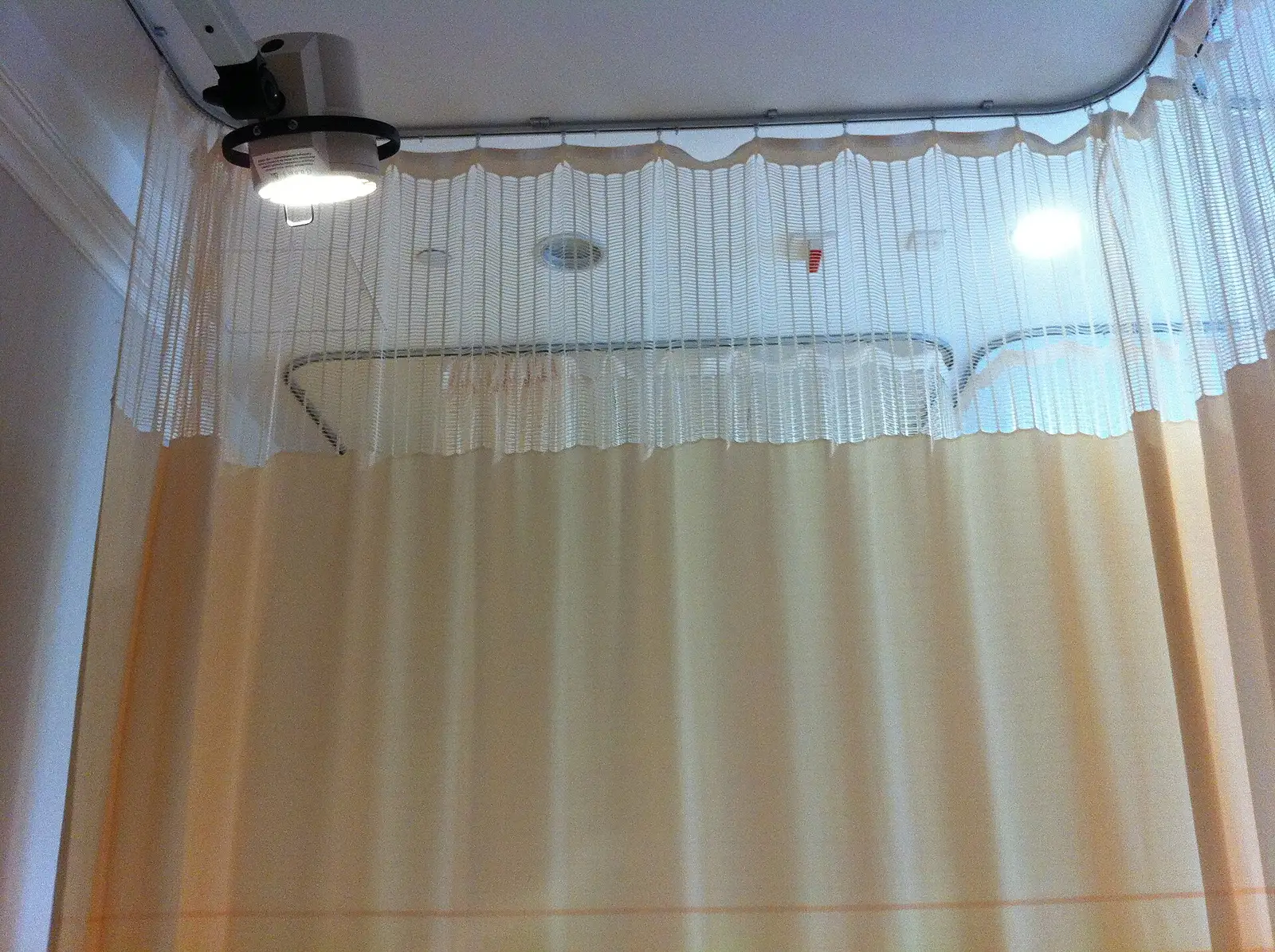
- Mesh tops on cubicle curtains let light and air pass over the curtain.
- Washability. Curtains should come off the track easily for regular laundering, with hooks or clip-on carriers rather than stitched-on fixings.
- Durability. Polyester takes daily pulling better than cotton or linen.
Kitchen entrance curtains
Open kitchens are common in newer apartments, and a curtain at the kitchen entrance hides the counter when guests arrive. Keep it well away from the hob, use a washable polyester that doesn’t soak up oil smells as badly as cotton, and stop the hem short of the floor so it clears spills. For short doorway curtains rather than full partitions, see our door curtain ideas.
Hyderabad conditions to plan for
- Dust. New gated communities stay dusty for months. A partition in the middle of the hall catches it from both sides, so pick washable fabric.
- Monsoon humidity. Between June and September, thick partitions in poorly ventilated rooms can smell musty. Draw them open on dry days.
- RWA rules. Partition curtains are interior work and usually need no approval, but some communities restrict drilling hours. We work to your society’s timings.
Getting started
A partition curtain is quick to fit once the track line is settled, and that’s the part worth getting right. Book a free home visit for curtains in Hyderabad, including partitions: we’ll check your ceiling, fans and switchboards, mark the track line and stacking wall with you, bring sheer, lined and double-sided samples, and give you a written quote. We work from 8 AM to 10 PM, all seven days. Call or WhatsApp +91 98499 17494.
Frequently asked questions
What is a partition curtain?
A partition curtain is a curtain used to divide a room rather than cover a window. It usually hangs from a ceiling-mounted track, runs from ceiling to floor, and slides across to separate two areas, such as a hall from a dining space, a bed from a living area in a studio flat, or consultation bays in a clinic. When it is open, it stacks against a wall and the space becomes one room again. It is cheaper, quicker and more flexible than building a partition wall.
Which curtain is best for a hall partition?
The best curtain for a hall partition depends on what you want to hide. A sheer or semi-sheer curtain is best when you only want to mark off a zone, such as the dining area, while keeping light and a sense of space. A lined dim-out curtain is best when you want to hide clutter or give a study corner some privacy. Because both sides of a hall partition are visible, a double-sided or fully lined curtain looks finished from either room, which a plain unlined curtain does not.
Can a curtain be used instead of a wall?
A curtain can be used instead of a wall when the aim is visual privacy and flexible space, not sound or security. A floor-to-ceiling partition curtain blocks sight lines, softens light and can be drawn back to open the room, which a wall cannot do. It does not stop sound in any meaningful way, does not lock and does not carry fixtures. For a home office or bedroom that needs quiet, a curtain helps with echo but a solid partition or wall is needed for real sound separation.
Do partition curtains need a ceiling track?
Partition curtains work best on a ceiling track. A track fixed to the ceiling lets the curtain run the full height of the room with no gap at the top, so it reads as a soft wall rather than a hanging sheet. It can also bend round a corner or follow an L-shape. The track should be fixed into the concrete slab or into a plywood backing strip above a false ceiling, never only into gypsum board. Tension rods suit only very small, light curtains.
Are partition curtains good for studio apartments?
Partition curtains are one of the most practical ways to divide a studio apartment, because they separate the sleeping area at night and fold away during the day without taking floor space. A lined or double-sided curtain gives privacy for the bed area and blocks light from the living side. In rented studios, a ceiling track can be fixed with a few small holes that are easy to fill when moving out, which is far simpler than building a partition wall. Check the lease first.
What fabric is used for partition curtains in offices and clinics?
Offices and clinics usually use partition curtains in durable, easy-clean polyester, often flame-retardant, with a sturdy ceiling track. Clinic and hospital cubicle curtains commonly have an open mesh band at the top so light and air pass over the curtain, and a plain opaque body below for privacy. Where fire safety rules apply, ask for fabric tested to a recognised flame-propagation standard, such as NFPA 701, and keep the test certificate. Fabric should also be removable for regular washing.
How much space does a partition curtain need when open?
A partition curtain needs wall space to stack against when it is open, roughly a third of the width it covers, more for heavy or lined fabric. A partition across a 3 metre hall will leave a stack of around a metre at one or both ends. Plan the track so the stack sits against a wall, a pillar or beside a cabinet, not across a doorway or in front of a switchboard. Ripple fold headings stack more compactly than pinch pleat.
Can a partition curtain look good from both sides?
A partition curtain can look good from both sides if it is made double-sided or fully lined. A double-sided curtain is two face fabrics stitched back to back, so each room sees a finished fabric, and the two can even be different colours to match each room. A lined curtain shows the face fabric on one side and a neat lining on the other. An unlined curtain shows its seams, hems and heading tape on the back, which is fine on a window but looks unfinished across a room.