A motorized curtain is a normal stitched curtain on a special track, with a small motor that does the pulling. Nothing about it is magic, but the planning is different from a manual curtain, and most of the problems we see come from decisions made months earlier, when the electrician and the false ceiling contractor were on site. If you’re looking at motorized curtains and blinds in Hyderabad, this guide walks through what actually matters: motor and track types, controls, wiring, battery or wired, noise and power cuts.
Motorization is one decision among many. Fabric, lining, measurements and hardware are covered in our complete curtains buying guide for Hyderabad homes, and they all still apply here.
How do motorized curtains work?
A track is fixed to the ceiling or the wall above the window. Inside it runs a belt or cord connected to the leading carriers of the curtain. The motor sits at one end of the track, usually tucked into the corner of a ceiling pocket, and when it turns the belt the curtain slides open or shut. During installation we set the end limits, so the motor knows where “fully open” and “fully closed” are.
There are a few layouts:
- Centre opening (two-way): the curtain splits in the middle and both halves move. This is the most common layout in living rooms and bedrooms.
- One-way: the whole curtain stacks to one side. Useful for a sliding door where one side has a wall or a TV unit.
- Curved or bay tracks: possible with some systems, but the track has to be bent to the exact shape, so we measure these carefully.
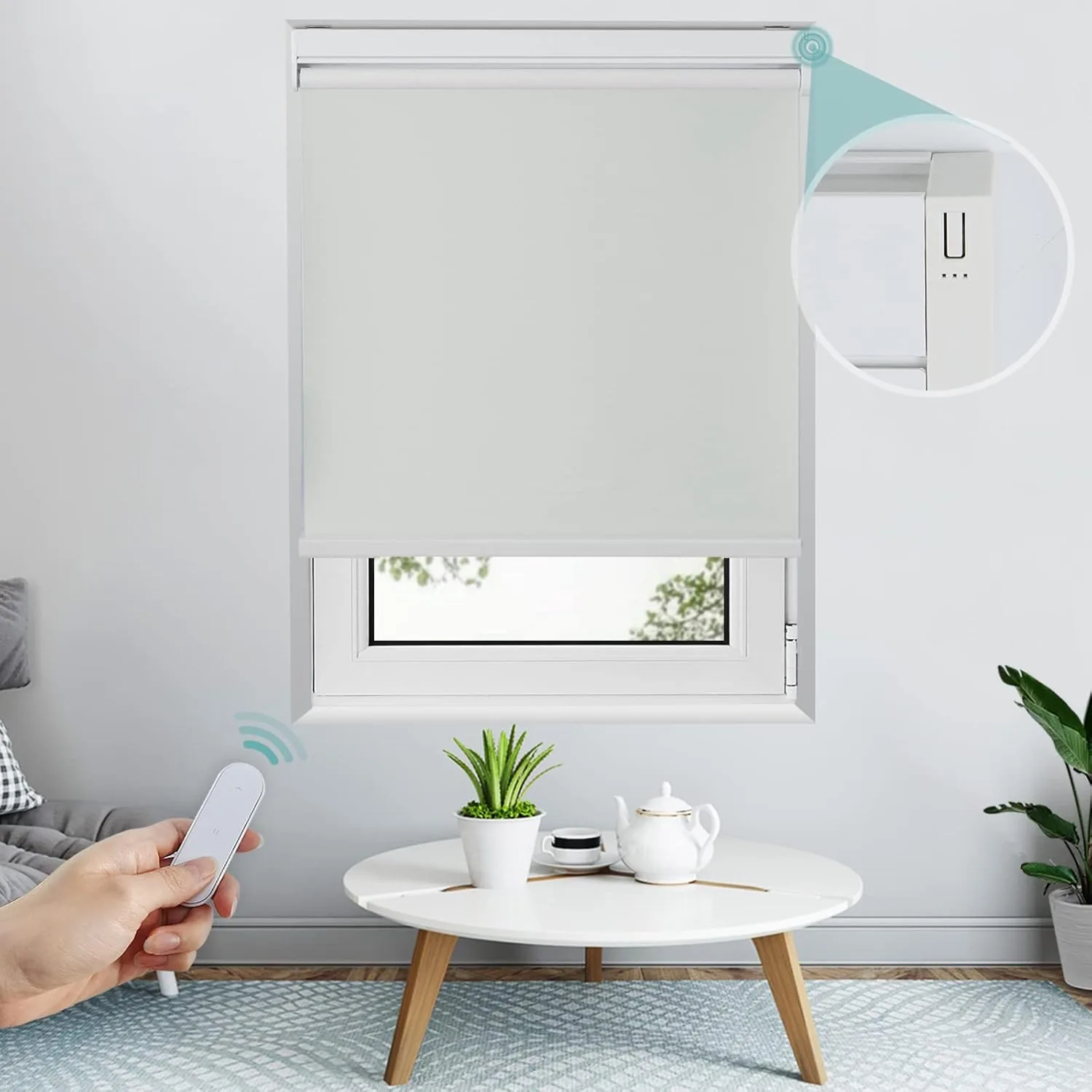
Blinds work differently. A roller or zebra blind uses a tubular motor hidden inside the roller tube, not a track motor. The same home can have both, controlled from one app.
Why ripple fold suits motors
Most motorized curtains use a ripple fold (wave) heading. The curtain snaps onto carriers spaced at fixed intervals in the track, so every fold is the same depth whether the curtain is open or closed. That even, predictable stack is exactly what you want from a curtain that moves on its own. Pinch pleat curtains also work on motor-ready tracks with the right gliders. Eyelet curtains don’t, because eyelets need a rod. Our guide to curtain rods and tracks explains the hardware side in more detail.
Motor capacity
Motors are rated for a maximum curtain weight and track length. A lined blackout curtain across a 12 ft sliding door is heavy, and an undersized motor strains, slows down and wears out early. As one example of what manufacturers publish, Somfy’s specification for its Glydea track motor quotes a 60 kg capacity on a 10 m two-way straight track (Somfy Glydea specification, PDF). We match the motor to the actual fabric, lining and width rather than picking one model for every window.
Want this planned for your windows? We visit with fabric samples and track options, free across Hyderabad. WhatsApp +91 98499 17494.
How do you control motorized curtains?
| Control | How it works | Good for | Watch out for |
|---|---|---|---|
| Handheld remote | Radio signal to the motor | Every home, simplest setup | Remotes get lost; multi-channel remotes need labelling |
| Wall switch | Wired switch or a wireless wall-mounted transmitter | Bedrooms, guests, elderly parents | Wired switches need a cable run planned early |
| Phone app | Motor or hub on home Wi-Fi | Schedules, controlling from office | Needs stable Wi-Fi near the window |
| Voice assistant | App linked to Alexa or Google Assistant | Hands-free, grouping rooms | Only works if the brand supports your assistant |
| Schedules and scenes | App timers or sunrise and sunset settings | West-facing rooms, holiday security | Set them seasonally, Hyderabad sun angles change |
Most homes end up with two: a remote or wall switch for everyday use and an app for schedules. A schedule that closes the west-facing curtains at 2 PM from March to June does more for afternoon heat than anything else on this list. Our article on keeping a Hyderabad home cool in summer covers the rest of that problem.
A practical note on apps: before committing to a brand, check that its app works in India, that it lists your voice assistant, and whether a separate hub is needed. Basic remote-only motors cannot be added to Alexa or Google later without a bridge.
Planning power before the false ceiling closes
This is the single most important step, and it has to happen during civil work. A wired motor needs a power point within reach of its cable, at the motor end of the track. If the track sits in a false ceiling pocket, the point goes inside that pocket.
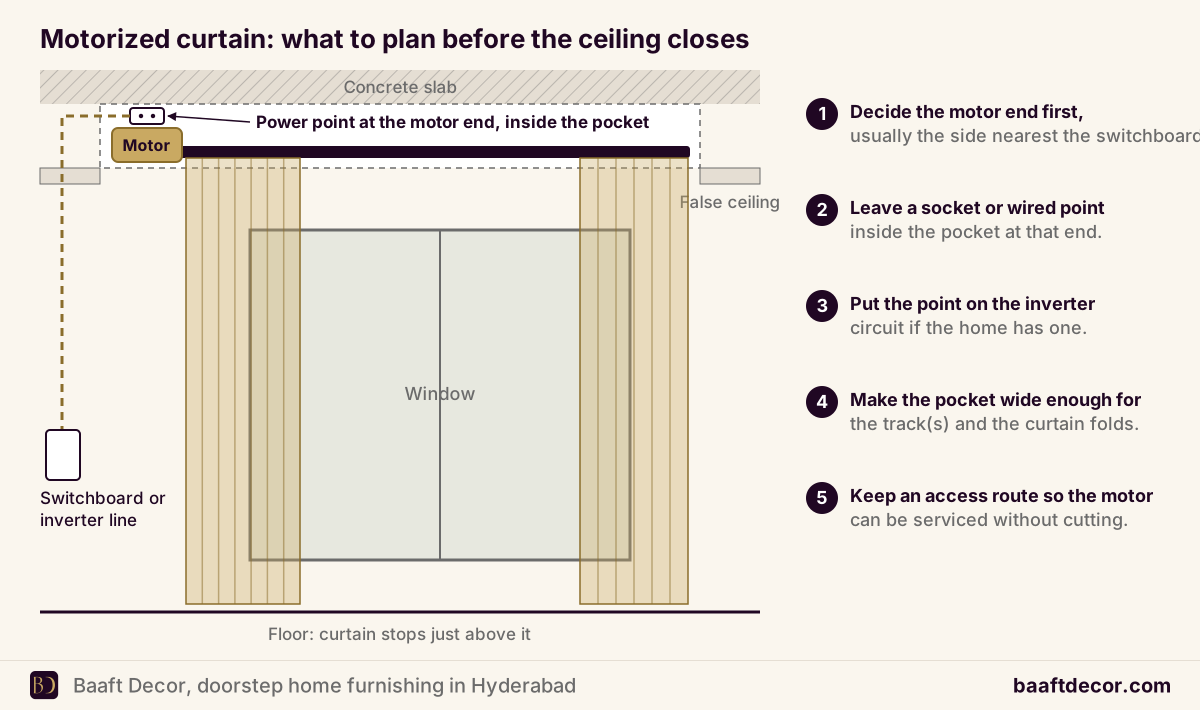
What we ask for on site:
- Decide the motor end first. For a centre-opening curtain, pick the side closest to the switchboard or the inverter line. The point goes there.
- A socket or wired point inside the pocket, not on the wall below, so no cable hangs visibly down the curtain.
- Put it on the inverter circuit if the home has one. More on this below.
- Leave the pocket wide enough for the track (or two tracks, if you’re adding a sheer layer) plus the curtain’s folds, so the fabric doesn’t rub the gypsum edge.
- Keep access. A small removable panel or an open pocket means the motor can be serviced without cutting the ceiling.
If you’re still at the planning stage, coordinate this with the false ceiling work so the pocket and the point are drawn together, not patched later.
Battery or wired: which motor should you choose?
| Wired (mains) motor | Rechargeable battery motor | |
|---|---|---|
| Power | Needs a point near the track | No wiring; charged by cable |
| Best for | New flats, wide or heavy curtains, daily schedules | Finished homes, rentals, single windows |
| Power cuts | Stops unless on inverter or UPS | Keeps working |
| Upkeep | None beyond occasional servicing | Recharge from time to time |
| Weight and width | Handles heavy lined curtains | Check the rating for big sliding doors |
Our honest view: in a new home where you can still run wiring, choose wired. It’s set-and-forget. Battery motors are the right answer when the walls are painted and the ceiling is finished, and nobody wants to cut into them. How often a battery motor needs charging depends on the curtain weight and how often it runs, so ask the supplier for their figure for your curtain, not a general claim.
Noise, power cuts and manual override
Noise. A good motor gives a soft hum for the few seconds it runs. Manufacturers publish noise figures; Somfy’s specification for the Glydea motor, for instance, puts it under 44 dB(A) measured in a finished installation (same source as above). Most noise complaints we get come from a misaligned track, an overloaded motor, or carriers scraping the side of a tight ceiling pocket, not from the motor itself.
Power cuts. If your area sees outages, plan for them. A mains motor stops when power goes, so if the bedroom curtain is your only way to darken the room at 6 AM, put its point on the inverter line. Battery motors carry on regardless.
Manual override. Ask whether the curtain can be pulled by hand with the power off. Many track motors are built to allow it; the same Somfy specification states that the motor disconnects from the track for manual operation in both directions. Some budget motors resist being pulled and can be damaged if forced. Check this before you buy, not after the first outage.
Motorized curtains on high-rise sliding doors
Large sliding glass doors to the balcony are where motorization earns its keep. A lined curtain 10 to 14 ft wide and floor-to-ceiling tall is heavy, and pulling it daily by the leading edge stretches the fabric and wears the gliders. A few things we plan for in towers across Kokapet, the Financial District and Gachibowli:
- Wind. With the door open on a high floor, wind pushes the curtain into the room. A motor can’t fight that, so we keep the curtain clear of the door track and suggest closing the door before running it.
- Clearance. The track has to sit far enough from the glass that the curtain clears the door handle and frame in both directions.
- One-way stacking. Stacking the whole curtain to the wall side keeps the opening clear for walking out to the balcony.
- Sun schedules. West-facing balcony doors take the worst of the afternoon. A schedule closes them before you get home.
- Dust. Construction dust in new communities settles on the track. Wiping the track every few months keeps the motor running smoothly.
Our guides on curtains for sliding doors and large windows and high-rise apartment window solutions go deeper into both problems.
What to check before you buy
- Motor rating against your actual curtain weight and track length
- Wired or battery, and where the point will be
- Whether the curtain can be pulled by hand with the power off
- Which controls you want now, and whether app or voice support can be added later
- Heading (ripple fold or pinch pleat) and whether existing curtains need re-stitching
- Service access to the motor after the ceiling is finished
If you’re comparing options for the whole home rather than one room, it helps to see how motorized windows fit with the rest of your curtains in Hyderabad, from sheer layers to blackout bedrooms.
Get motorized curtains planned for your home
Book a free home visit and we’ll check your ceiling, power points and window sizes, bring fabric and track options, and tell you plainly whether wired or battery suits each window. We take full projects (fabric, stitching, track, motor and installation) and also motorize existing curtains where the fabric allows. We work across Hyderabad from 8 AM to 10 PM, all seven days. WhatsApp or call +91 98499 17494.
Frequently asked questions
How do motorized curtains work?
Motorized curtains work by fitting a small electric motor to one end of a curtain track. Inside the track, a belt or cord runs along its length and is attached to the leading carriers of the curtain. When the motor turns, the belt pulls the curtain open or closed, and the motor stops at limits set during installation. The curtain itself is a normal stitched curtain, usually with a ripple fold heading, that clips onto carriers in the track. Control signals come from a remote, wall switch, app or voice assistant.
Do motorized curtains need electrical wiring?
Most motorized curtains need a power point close to the motor end of the track, because mains-powered track motors are the most reliable choice for wide or heavy curtains. In a new flat, the electrician should leave a socket or a wired point inside the false ceiling pocket before the ceiling is closed. If the home is already finished, rechargeable battery motors avoid new wiring altogether. They need charging from time to time, and how often depends on the curtain weight and how many times a day it runs.
What happens to motorized curtains during a power cut?
During a power cut, a mains-powered curtain motor stops working until power returns, unless its point is on the home's inverter or UPS circuit. Many track motors are designed so the curtain can still be pulled by hand when the power is off; one major manufacturer's specification, for example, says its motor disconnects from the track to allow manual operation in both directions. Battery motors keep working through outages. In Hyderabad homes we usually suggest putting the curtain point on the inverter line if one exists.
Can I control motorized curtains with Alexa or Google Assistant?
Yes, motorized curtains can usually be controlled with Alexa or Google Assistant, but only if the motor or its hub connects to your home Wi-Fi and supports that assistant. Basic remote-only motors cannot talk to voice assistants on their own. Before buying, check that the motor brand has a working app in India, that it lists your assistant as supported, and whether a separate bridge or hub is needed. Once set up, you can say a command, group curtains by room, or run them on a schedule.
Are motorized curtains noisy?
Good quality motorized curtains are quiet, giving a low hum for the few seconds they run rather than a loud mechanical noise. Manufacturers publish noise ratings; one widely used track motor, for example, is specified at under 44 dB(A) measured in a finished installation. Noise rises when the track is poorly aligned, the curtain is too heavy for the motor, or carriers rub against a pelmet or ceiling pocket. For bedrooms, ask for the noise rating before buying and avoid the cheapest unbranded motors.
Which curtain heading is best for motorized curtains?
Ripple fold, also called wave fold, is the best curtain heading for most motorized curtains. The curtain snaps onto evenly spaced carriers in the track, so it opens into a neat, even stack and closes into identical folds every time, which suits automatic movement. Pinch pleat curtains can also be motorized on a suitable track using hooks and gliders. Eyelet curtains cannot be motorized, because eyelets need a rod and the motor works with a track, not a rod.
Can existing curtains be converted to motorized curtains?
Existing curtains can often be converted to motorized curtains, but usually the track has to change and the heading often has to be re-stitched. A manual track is replaced with a motor-ready track, and pleated curtains may work on it with new gliders. Eyelet curtains have to be re-stitched with a pleated or ripple fold heading. Power is the other question: if no point exists near the window, a battery motor avoids opening up the ceiling. We check the fabric, heading and power options at the home visit.
Are motorized curtains worth it for large sliding doors?
Motorized curtains are worth it for large sliding doors, especially in high-rise flats where a single curtain can be wide, tall and heavy with lining. Pulling such a curtain by hand every day strains the track and soils the leading edge. A motor moves it smoothly, and a schedule can close it before the afternoon sun hits a west-facing balcony door. The track must be mounted so the curtain clears the door handle and the sliding frame when it opens and closes.