Ask a furnishing shop in Hyderabad for drapes and you’ll most likely be shown curtains. That’s not wrong. In India, “curtains” covers almost everything that hangs at a window. But “drapes” in a catalogue, a designer’s mood board or an American website means something more specific, and knowing it helps you ask for what you want. Here’s how we explain it when planning custom curtains in Hyderabad. For the decisions around it (light control, fabric, measuring, hardware), see our curtains buying guide for Hyderabad homes.
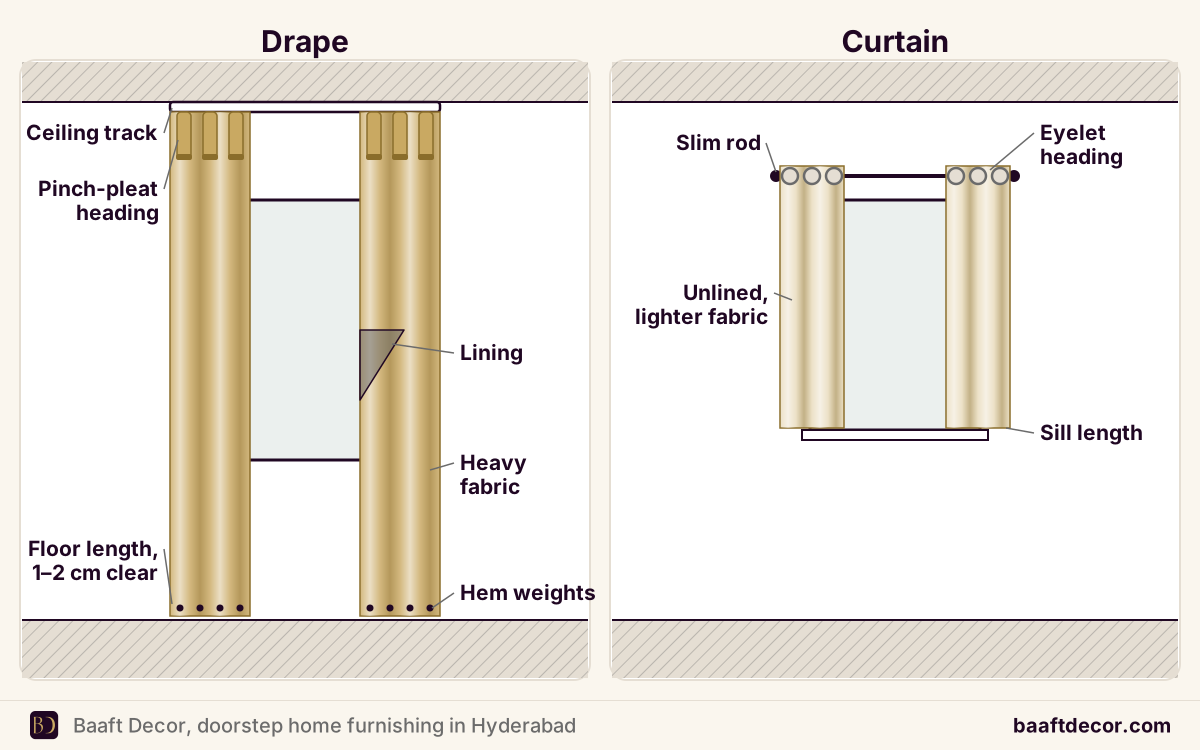
The short answer: drapes are heavy, lined, floor-length and tailored. Curtains are lighter, often unlined, and come in any length.
What is the difference between drapes and curtains?
| Drapes (draperies) | Curtains | |
|---|---|---|
| Fabric | Heavier: velvet, jacquard, thick blends, silk | Lighter: cotton, polyester, sheers |
| Lining | Almost always lined (often blackout or thermal) | Often unlined |
| Length | Floor length, sometimes puddled | Sill, below sill or floor |
| Heading | Pinch pleat, goblet, box pleat, ripple fold | Eyelet, tab-top, rod pocket, pencil pleat |
| Sizing | Made to measure | Often ready-made sizes |
| Hardware | Sturdy rods or tracks | Lighter rods, even tension rods |
| Light and heat | Blocks much more | Filters more than blocks |
| Care | Usually dry clean | Usually machine washable |
| Feel | Formal, tailored | Casual, relaxed |
Window-covering maker Hunter Douglas draws the same lines in the buyer’s guide to curtains and drapes on its US site: thicker, lined, floor-length drapes that need sturdier rods and often professional cleaning, against lighter, washable curtains.
The boundary is blurry, though. A lined, pinch-pleat curtain in a mid-weight polyester, which is what most Hyderabad apartments get, sits somewhere in between. That’s fine. The name doesn’t matter as much as the fabric, the lining and how it’s made.
Where the word “drapes” comes from
“Drapery” comes from the Old French drap, meaning cloth, and the word was once used for the cloth trade itself. Later it came to mean fabric hanging in folds. In American furnishing catalogues today, “drapes” usually means the heavy, lined panels and “curtains” the lighter ones. Indian English mostly says “curtains” for both. So when a Hyderabad customer asks for “blackout drapes”, they usually mean lined blackout curtains, and that’s what we make.
When drapes make sense
- Formal living rooms with high ceilings, where a heavy fabric with deep pinch pleats suits the scale of the room.
- Master bedrooms that need darkness. A lined drape with blackout lining, ceiling to floor, stops early morning light.
- West-facing windows. A heavy lined drape takes the edge off the afternoon sun from March to June.
- Home theatres and music rooms, where heavy fabric absorbs some sound and cuts echo.
- Large villas and independent houses, for example in Jubilee Hills, where tall windows and formal rooms suit a tailored, weighty treatment.
If darkness is your main goal, our blackout curtains service covers linings and fitting.
When lighter curtains make more sense
- Kids’ rooms, where curtains get pulled, grabbed and need frequent washing.
- Rented homes, where you may move in a year or two.
- Study and guest rooms that need privacy but not darkness.
- New gated communities still under construction nearby. Heavy fabrics hold the fine cement dust that settles everywhere for months; washable curtains are easier to live with.
- Small windows, where heavy drapes overwhelm the wall.
What “heavy” actually means
Fabric weight is measured in GSM, grams per square metre. You don’t need the numbers. Just lift a metre of each. A sheer voile feels almost weightless, while a drapery velvet or jacquard feels closer to a bedsheet folded three or four times. A lined drape adds the lining’s weight on top.
Weight changes how the curtain behaves:
- How the folds fall. Heavier fabric hangs in deep, straight folds and doesn’t flutter. Lighter fabric moves with every breeze, which matters on high floors.
- How much light and heat it stops, even before lining.
- What the hardware must carry. A pair of lined floor-length drapes on a wide window is genuinely heavy, and all of that hangs from a handful of brackets.
When you’re comparing samples at home, hold each one up against the window at midday. The difference between a curtain fabric and a drapery fabric is obvious within seconds.
Hardware for drapes
Because drapes are heavy, the rod or track is not the place to save. Use a rod of about 25 mm diameter or more, or an aluminium track with good gliders, and add supports roughly every 60 to 90 cm. Ceiling tracks for drapes should be fixed into the concrete slab or a solid backing above a false ceiling, never into gypsum board alone. Our curtain rods and tracks guide covers brackets and ceiling fixing in detail.
Drapes and curtains in Hyderabad’s climate
Summer heat. Lined drapes help more than unlined curtains on sun-facing windows. The lining also protects the face fabric from fading, which is why we line almost everything on west windows.
Dust. Heavy textures and velvet trap dust. Vacuum them with a soft brush every few weeks. Light curtains can simply be washed.
Monsoon humidity. Between June and September, heavy drapes pressed against cold, damp glass or walls can develop mildew. Leave a small gap from the glass and open the room on dry days.
Cleaning. Coated linings and silk or velvet face fabrics usually need dry cleaning. If you want easier upkeep, ask for a detachable lining, so the lining and face fabric can be cleaned separately.
Do drapes cost more than curtains?
Usually, yes. A drape uses more fabric (floor length, higher fullness), adds a full lining, takes more tailoring for pleated headings, and needs stronger hardware. Our curtain cost guide breaks down each of those drivers.
Combining them
The most useful setup in Indian homes uses both:
- A sheer curtain (or “sheer drape”) close to the room for daytime privacy and soft light.
- A lined drape on a second track for night, heat and darkness.
Our guide to blackout, dim-out and sheer curtains explains how the layers work together.
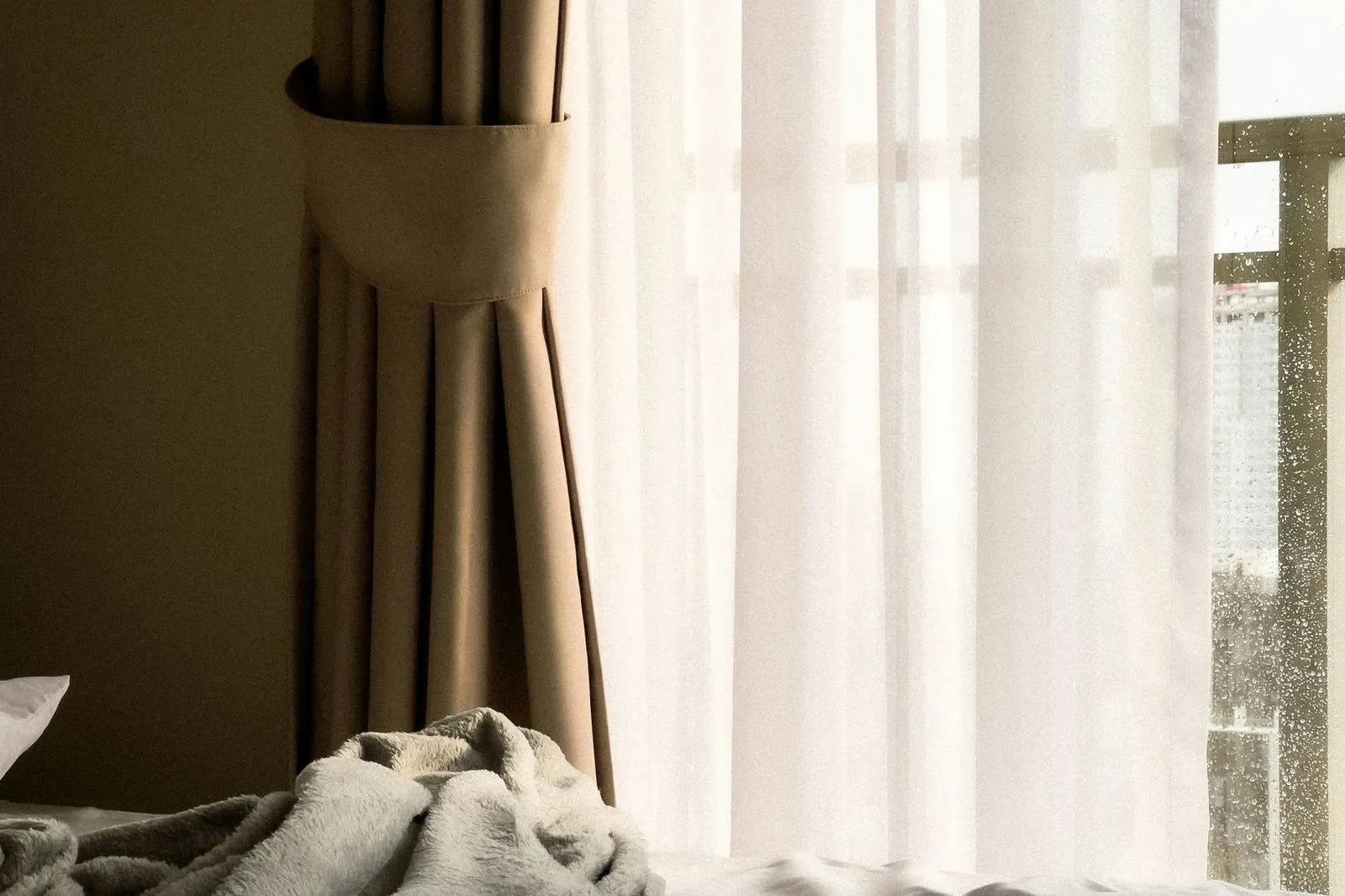
Questions to ask before you order
Whatever the shop calls it, these questions tell you what you’re actually getting:
- Is it lined, and with what? Regular lining, dim-out, blackout or thermal.
- What fullness is the quote based on? Around 2x or more gives proper drapery folds; 1.5x looks thin on a heavy fabric.
- What heading? Pinch pleat and ripple fold behave like drapes; eyelet behaves like a curtain.
- Does the finished length include floor clearance? It should end 1 to 2 cm above the floor.
- Are hem weights included? They help drapes hang straight.
- Can the lining be detached for cleaning?
A clear answer to each of these is a better sign of quality than any label.
Other terms you’ll hear
| Term | What it means |
|---|---|
| Sheers | Translucent curtains that filter light |
| Panels | Individual curtain pieces, often one fabric width each |
| Valance | A short fabric piece across the top of a window |
| Pelmet | A rigid box (fabric-covered or wooden) that hides the track |
| Swag | Fabric draped in a curve across the top, used in formal styles |
| Blinds | Coverings that move up and down or tilt, close to the glass |
For a full breakdown of curtain types and headings, see our types of curtains guide.
Not sure which you need?
Bring the question to us, not the catalogue. Book a free home visit and we’ll show you light curtain fabrics and lined drape fabrics side by side at your window, measure, and quote. We’re available 8 AM to 10 PM, all seven days. WhatsApp or call +91 98499 17494.
Frequently asked questions
What is the difference between drapes and curtains?
The difference between drapes and curtains lies mainly in weight, lining, length and construction. Drapes, or draperies, are made from heavier fabrics such as velvet, jacquard or thick blends, are usually lined, run to the floor, and have a tailored pleated heading. Curtains are lighter, often unlined, can be sill or floor length, and are commonly sold ready-made with eyelet or tab tops. In India, shops and customers usually call both curtains, so ask about the fabric, lining and heading rather than the name.
Are drapes more expensive than curtains?
Drapes are usually more expensive than curtains because they use more and heavier fabric, include a lining, need more tailoring for pleated headings, and require sturdier rods or tracks to carry their weight. A floor-length lined drape on a large window can need twice the fabric of a light unlined curtain on the same window. Professional cleaning adds to the long-term cost. The final price depends on fabric grade, window size and hardware, so it is best judged from an itemised quote.
Are drapes better than curtains for blocking heat and light?
Drapes are generally better than light curtains for blocking heat and light, because their heavier fabric and lining stop more sunlight and reduce glare. A drape with a blackout or thermal lining that has a light backing facing the window reflects some of the sun's heat and can darken a room almost completely. A light unlined curtain mostly filters light. For the best result on a hot west-facing window, choose a lined drape that is wider and longer than the window.
Do drapes have to touch the floor?
Drapes do not have to touch the floor, but they are traditionally floor length, usually ending 1 to 2 cm above the floor so they hang straight without dragging. Some formal designs let the fabric puddle on the floor, which looks dramatic but collects dust and gets stepped on, a real problem in dusty cities like Hyderabad. Shorter drapes look unfinished in most rooms. If a window sits above a bed, desk or kitchen counter, a lighter sill-length curtain or a blind is usually more practical.
Can drapes be washed at home?
Many drapes cannot be safely washed at home, especially those with coated blackout linings, silk or velvet fabrics, or stiff pleated headings. Machine washing can crack linings, shrink natural fibres and distort pleats, so dry cleaning is usually recommended. Some drapes are made with detachable linings so the face fabric and lining can be cleaned separately. Regular vacuuming with a soft brush attachment between cleanings removes dust and extends the time between professional washes. Always check the care label first.
What is the difference between drapes, curtains and blinds?
Drapes and curtains are both fabric panels that hang from a rod or track and slide sideways to open, with drapes being the heavier, lined, floor-length version. Blinds are a different window covering that sits close to the glass and moves up and down or tilts, using fabric, PVC, wood, aluminium or bamboo. Blinds take less space and suit kitchens, bathrooms, study windows and offices, while drapes and curtains feel softer and suit living rooms and bedrooms. Many homes combine a blind with curtains.
Are drapes old-fashioned?
Drapes are not old-fashioned, but heavy ornate styles with swags, fringes and tassels can look dated in modern apartments. Contemporary drapes use plain or textured fabrics, simple pinch-pleat or ripple-fold headings, and hang from slim ceiling tracks from ceiling to floor. This cleaner version is common in new apartments and villas. Ornate drapes still suit traditional or formal homes with high ceilings, period furniture and large windows, where a more decorative treatment matches the rest of the room.
What are sheer drapes?
Sheer drapes are floor-length curtains made from light, translucent fabric such as voile, linen sheer or organza, tailored with a pleated or ripple-fold heading like a drape but without a lining. They filter daylight, reduce glare and give daytime privacy while keeping the room bright. Sheer drapes are usually hung on a double track or rod with a heavier lined drape, so the sheer can stay closed during the day and the lined layer can be drawn at night.