- Same-day reply, and a same-day site visit on request
- Full stage sets or single pieces: main curtain, pelmet, legs, borders, backdrop
- Velvet and flame-retardant fabric options explained side by side
- Manual cord-drawn or motorised traverse tracks sized for heavy curtains
- Tracks fixed to the slab, beams or steelwork, not to a false ceiling
- Re-hanging, re-stitching and track repair on existing stage curtains
- Written quote listing every curtain, its fabric and the track
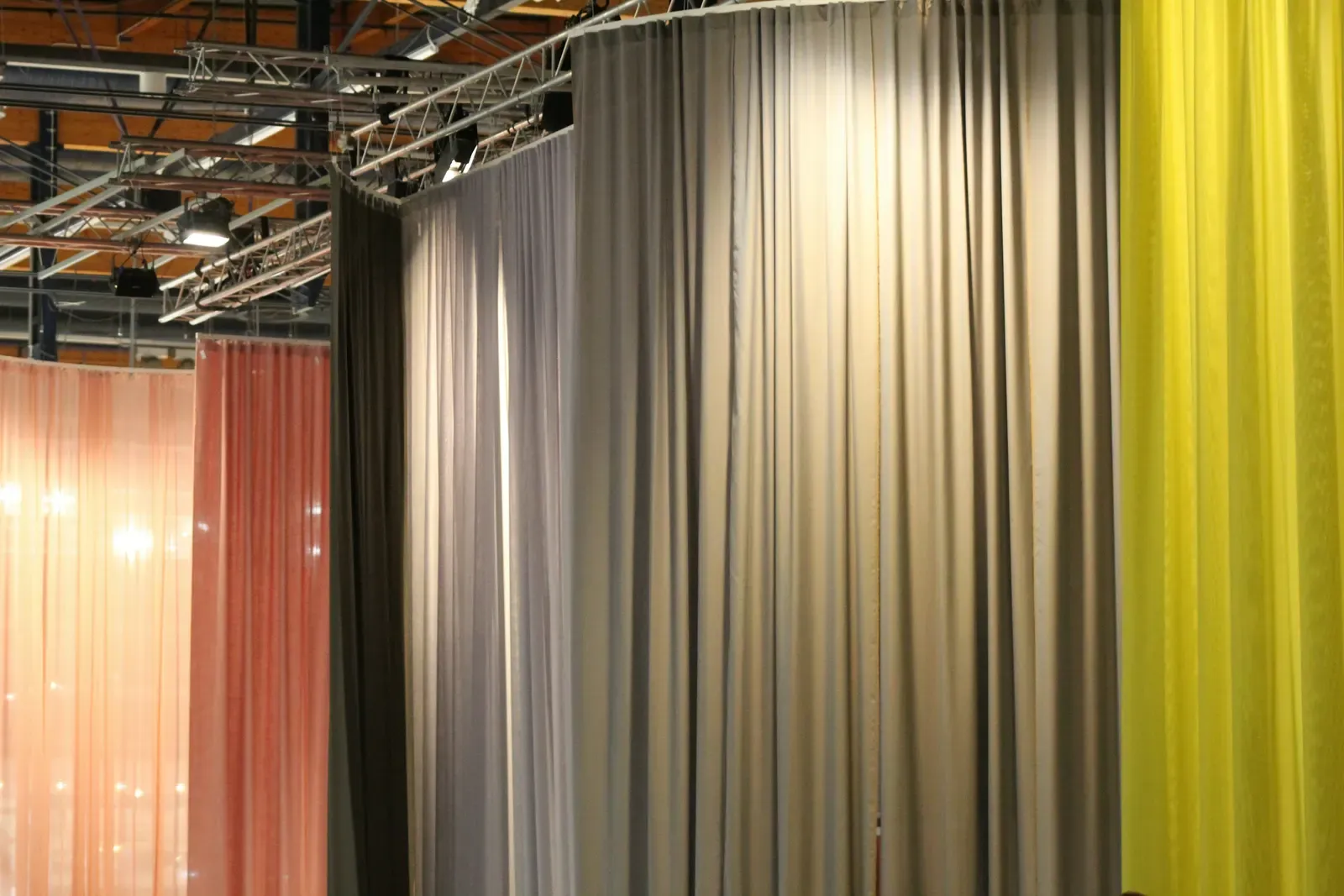
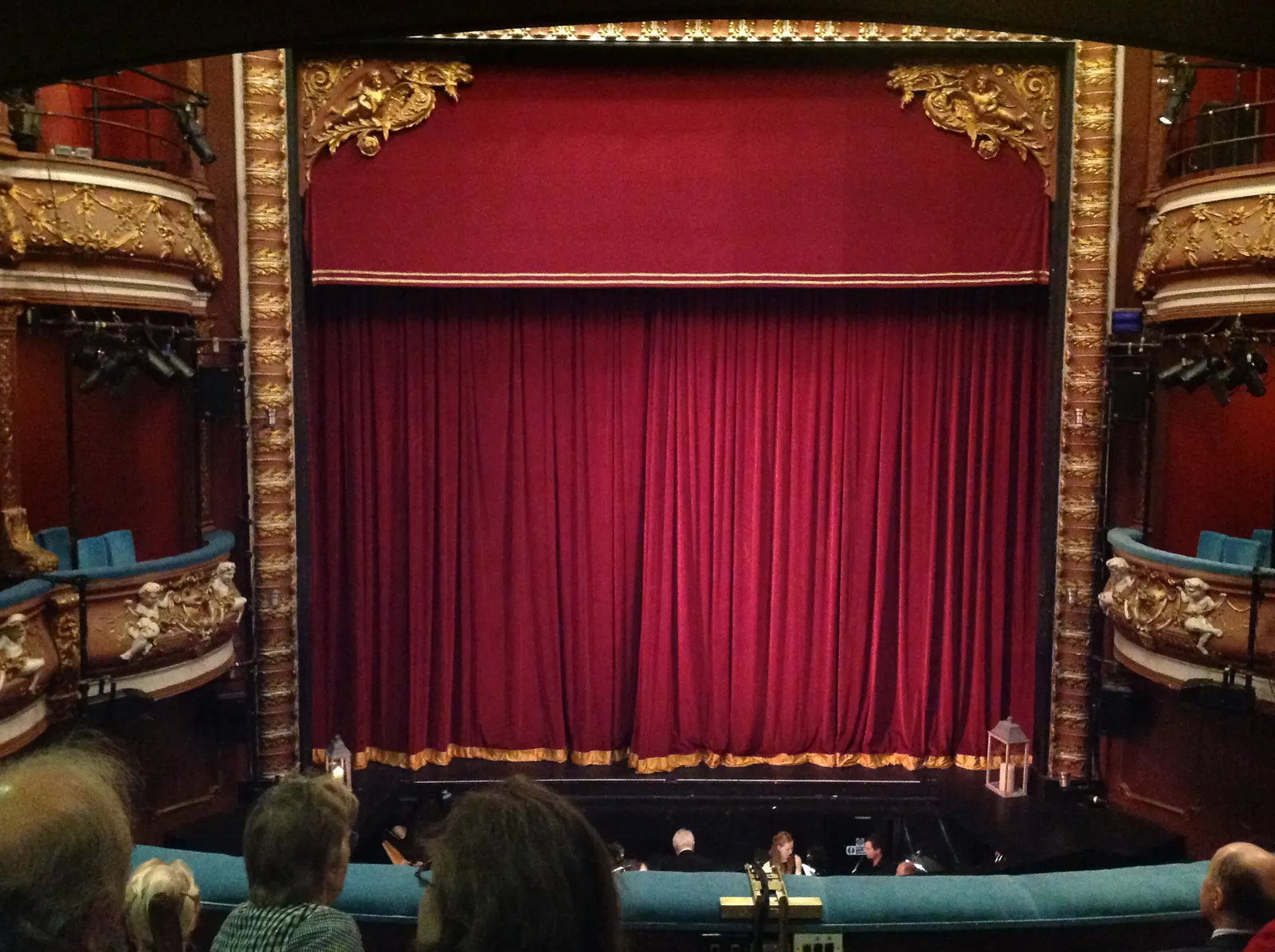
Stage curtains are the heavy curtains that frame, open and close a stage: the main front curtain, the pelmet above it, the side legs, overhead borders and the curtains or cloths at the back. They’re part of our commercial work on curtains in Hyderabad, for school stages, college auditoriums, banquet halls and community halls. We visit, measure the stage and what’s above it, and quote in writing for a full set or a single curtain.
Which stage curtains does a hall need?
A typical school or hall stage needs a main curtain with a pelmet, a back curtain, and, on deeper stages, legs and borders to hide the wings and lights. The terms vary between venues, so here’s how we use them:
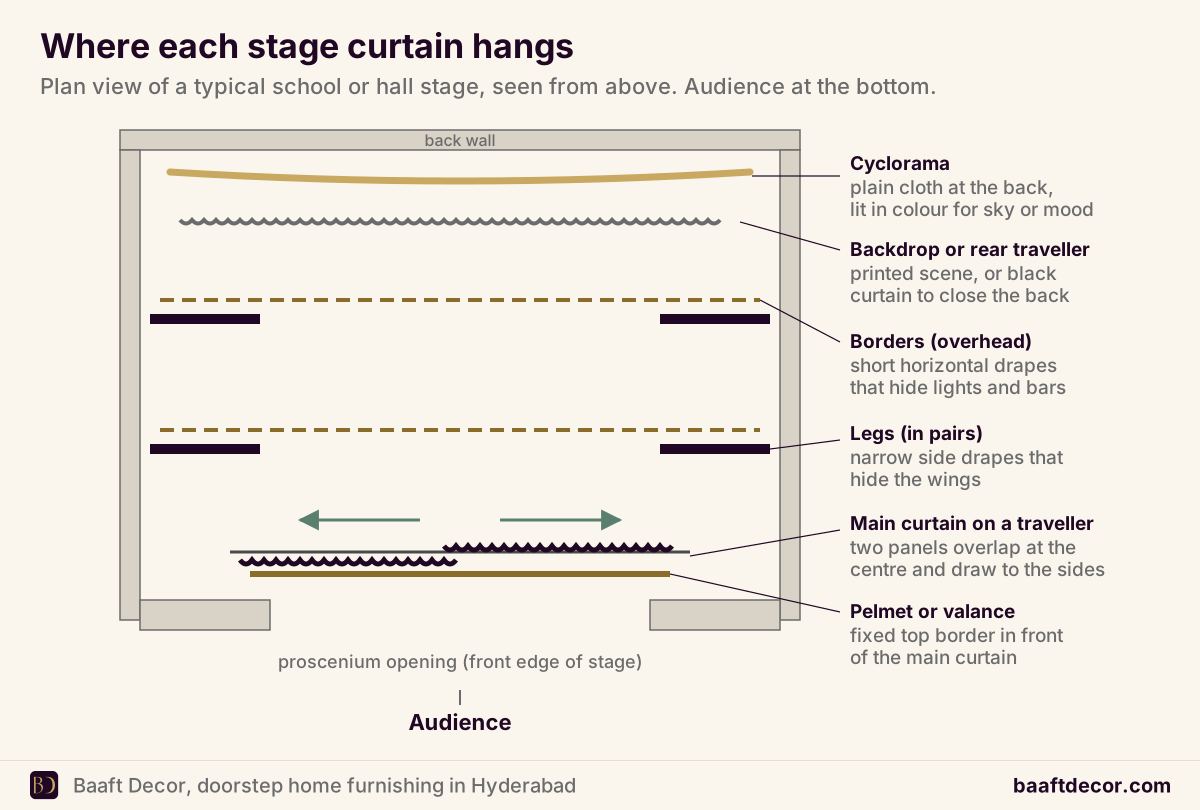
- Main or front curtain. The curtain the audience sees before the show. It opens as a draw (traveller) curtain or a tableau curtain.
- Pelmet or valance. A short fixed curtain across the top of the opening that hides the track and frames the stage.
- Legs. Narrow side drapes, always in pairs, that hide the wings where performers wait.
- Borders. Short horizontal drapes overhead that hide lights and bars.
- Backdrop or rear traveller. A printed or plain cloth, or a black draw curtain, that closes off the back wall.
- Cyclorama. A plain, light-coloured cloth stretched at the very back and lit in colour for sky or mood.
Small banquet hall stages often need only a main curtain, a pelmet and a backdrop for the event banner. School stages that host annual days and plays benefit from a full set of legs and borders.
Planning a stage? We visit, measure and quote in writing, across Hyderabad. WhatsApp +91 98499 17494.
Traveller or tableau main curtain?
The main curtain opens one of two ways in most halls: sideways on a traveller track, or diagonally upward as a tableau.
| Traveller (draw) | Tableau | |
|---|---|---|
| How it opens | Two panels draw apart to the sides on a track | Each half is lifted diagonally by lines into swags |
| Look when open | Straight stacks at each side | Draped swags at the top corners |
| Hardware | Traverse track with overlap at centre | Lines, rings and pulleys sewn and fixed behind |
| Wing space needed | Enough to stack the curtain | Very little |
| Suits | Most school, college and hall stages | Stages with little wing space, or a more theatrical look |
A third style, a curtain that flies straight up, needs a fly tower or rigging that few school halls have, so we rarely recommend it.
Fabrics: velvet and flame-retardant
Velvet is the usual choice for main curtains because its pile soaks up light and the folds look deep from the back rows. Legs, borders and back curtains are usually heavy black fabric with no sheen, so they disappear under lights. Our curtain fabric guide covers velvet and polyester in more detail.
| Fabric | Strengths | Watch for |
|---|---|---|
| Polyester velvet | Holds colour, lighter on the track | Pile marks if folded wet |
| Cotton velvet | Soft, deep pile and rich colour | Heavier, fades faster in sun |
| Inherently flame-retardant polyester | Protection built into the fibre | Ask for the fabric’s flame test report |
| Treated flame-retardant fabric | Wide choice of looks | Treatment can weaken with cleaning and age |
Trevira CS is a widely used example of inherently flame-retardant polyester: the flame resistance is part of the fibre’s structure, whereas an applied finish can be lost through wear, age or washing. For a hall full of students or guests, with hot lights a few feet from the curtain, we’d always discuss a flame-retardant option. If your venue needs test documentation for an inspection, tell us at the site visit.
Stage main curtains are typically stitched with 50 to 100 percent fullness, so the fabric is one and a half to two times the track width. Legs and borders are often flat or lightly gathered. We usually use a pleated heading with hooks or ties; our curtain heading types guide shows the options.
Manual or motorised traverse track?
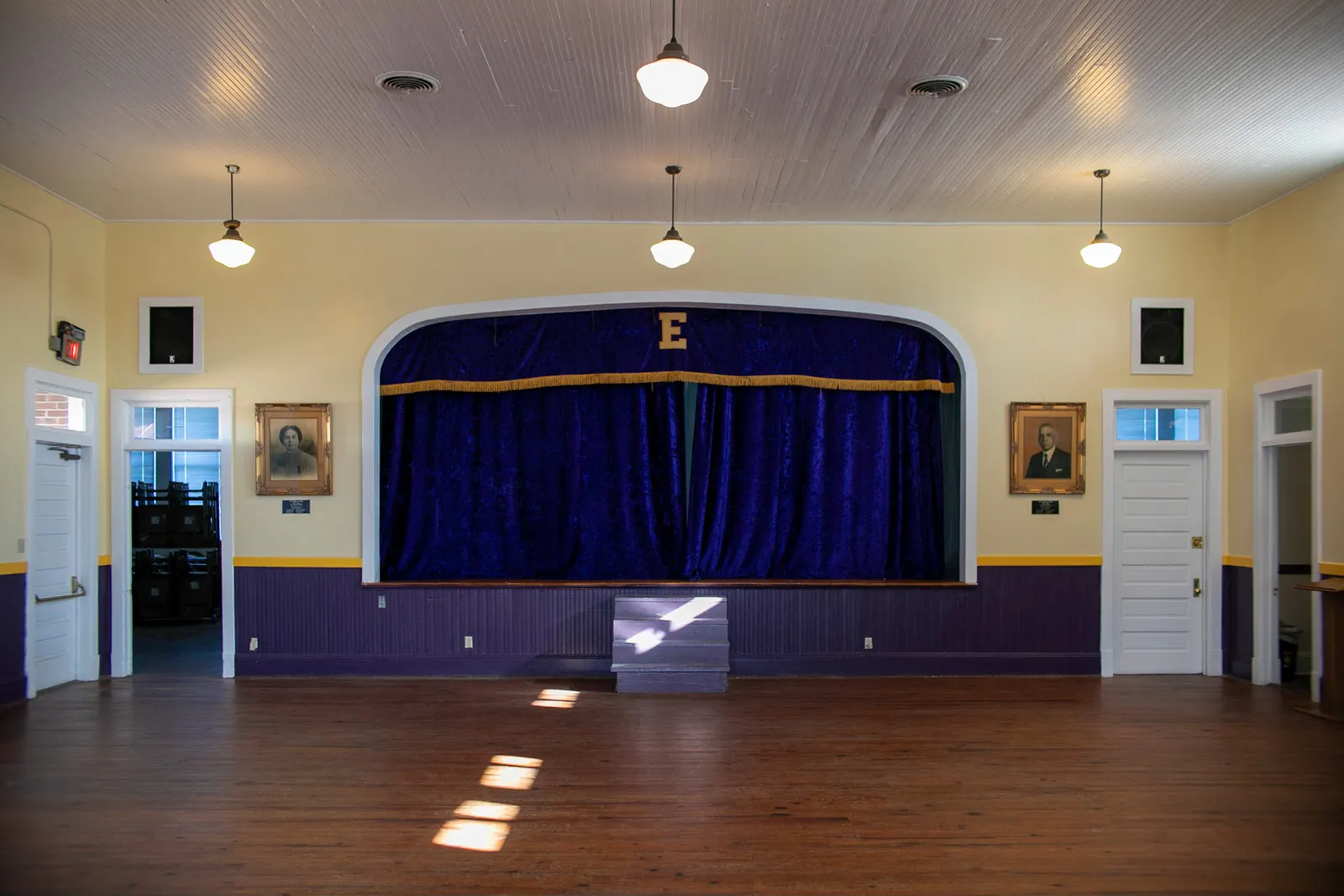
A traverse track carries the main curtain or rear traveller. It’s either drawn by hand with an endless cord, or driven by a motor.
- Manual, cord-drawn. Runners in a heavy track with pulleys at each end, drawn by a cord at the side of the stage. Simple, reliable and easy to repair.
- Motorised. A motor drives the track from a wall switch, remote or the control desk. It suits big velvet curtains, stages run by one person, and halls where the curtain opens many times a day. See our motorised curtains service for how we wire and set up motors.
Either way, the track has to be rated for the curtain’s weight and fixed to something that can carry it: the slab, beams or steelwork. Many Hyderabad halls have a gypsum false ceiling above the stage, and a velvet main curtain can’t hang from that, so we check the structure at the site visit.
Schools, colleges, auditoriums and halls
- Schools. Main curtain, pelmet and back curtain for assemblies and annual day, with legs and borders on larger stages.
- Colleges and auditoriums. Full sets including cyclorama, rear traveller and motorised main curtain.
- Banquet and function halls. Main curtain and backdrop that frame the stage for events and photos.
- Community and apartment clubhouse halls. A main curtain and backdrop on a simple manual track.
We also repair and re-hang existing stage curtains: broken runners, sagging tracks, torn hems and headings, or a curtain that now drags on a raised floor.
Care
Vacuum velvet with a soft brush attachment every few months, working with the pile. Hyderabad’s dust settles quickly on stage curtains that stay closed between events. Leave big velvet curtains to a professional dry cleaner rather than washing them. Draw the curtain fully open and closed now and then even between events so runners don’t stick.
What decides the cost?
- Number of curtains, and the width and drop of each
- Fabric: polyester or cotton velvet, inherently flame-retardant or treated
- Fullness and heading
- Track: manual or motorised, length and weight rating
- Fixing conditions: slab, beams, steelwork or height access
After the site visit you get a written, itemised quote.
Areas we cover
We fit stage curtains for schools, colleges and halls across Hyderabad, including Kukatpally, Dilsukhnagar and Gachibowli.
WhatsApp +91 98499 17494 with the stage width and height and a few photos, any day from 8 AM to 10 PM. We’ll visit, measure and send a written quote that lists every curtain and the track.
How it works
- Site visit We measure the stage opening, the height to the slab or beams, the depth of the stage and the wing space, and check what the tracks can be fixed to.
- Curtain plan We list which curtains you need, where each hangs, how it opens (draw, tableau or fixed) and whether the track is manual or motorised.
- Fabric choice We bring velvet and flame-retardant samples. Main curtains are usually a rich colour; legs and borders are usually black so they disappear under stage lights.
- Written quote The quote lists each curtain's size, fabric, fullness and heading, and the track and motor if any.
- Stitching and installation Curtains are stitched to the measured drops, then we fix the tracks, hang and dress the curtains and test the draw from the operating side.
Frequently asked questions
What are the main types of stage curtains?
The main types of stage curtains are the main or front curtain, which opens and closes across the stage opening; the pelmet or valance, a fixed short curtain across the top in front of it; legs, narrow side drapes in pairs that hide the wings; borders, short horizontal drapes overhead that hide lights; backdrops and rear travellers that close the back of the stage; and the cyclorama, a plain cloth at the very back lit in colour. A school or community hall stage usually needs at least a main curtain, pelmet and back curtain.
What is the difference between a traveller curtain and a tableau curtain?
A traveller curtain is a stage curtain made of two panels that overlap at the centre and draw sideways along a track to open, gathering at each side of the stage. A tableau curtain also splits at the centre, but each half is lifted diagonally by lines sewn to the back, so it opens upward and outward and drapes in swags at the top corners. Travellers are simpler and suit most school and hall stages; tableau curtains give a more theatrical opening and need their own lines and pulleys.
Which fabric is best for stage curtains?
Velvet is the classic fabric for stage main curtains because its deep pile absorbs light, hangs heavily and looks rich from the audience. Polyester velvet is lighter and holds colour well; cotton velvet has a softer pile. For legs, borders and back curtains, a heavy black fabric with no shine is used so it disappears under stage lights. In public venues, flame-retardant fabric is the safer choice. Inherently flame-retardant polyesters keep their rating permanently, while treated fabrics can lose it with washing and age.
Do stage curtains need to be flame retardant?
Stage curtains hang close to hot stage lights and wiring, in rooms full of people, so flame-retardant fabric is strongly recommended for schools, auditoriums and halls, and venues, insurers or fire authorities may ask for it. Inherently flame-retardant fabric has the protection built into the fibre, so it doesn't wash or wear out. Treated fabric has a flame-retardant finish applied to it, which can weaken with dry cleaning, washing and age. If your venue needs test documentation for an inspection, tell us at the site visit.
Can stage curtains be motorised?
Yes. A stage main curtain or rear traveller can be hung on a motorised traverse track that opens and closes it from a wall switch, a remote or the sound and light desk. Motorised tracks suit large or heavy velvet curtains that are hard to draw by hand, stages where one person runs the whole programme, and halls where the curtain is opened many times a day. The motor and track have to be rated for the curtain's weight and width, so we size them after measuring the stage and choosing the fabric.
How much fullness should stage curtains have?
Stage main curtains are typically stitched with 50 to 100 percent fullness, meaning the fabric is one and a half to two times the width of the track, which gives deep, even folds when closed. Legs and borders are often stitched flat or with less fullness, since their job is to mask rather than to be looked at. More fullness looks richer and blocks more light but uses more fabric and adds weight to the track. We suggest fullness for each curtain once we know the stage size and the fabric.
Can you repair or re-hang our old stage curtains?
Yes. Baaft Decor repairs and re-hangs existing stage curtains in Hyderabad: replacing broken runners and pulleys, re-fixing sagging or loose tracks, re-stitching torn headings and hems, shortening curtains that drag, and adding a new pelmet or back curtain to an existing set. If the old velvet has faded or torn badly, we can make a new main curtain and reuse the track if it's sound. Send us photos of the stage and the damage on WhatsApp and we'll tell you what a site visit should check.