Small and oddly shaped windows cause more curtain trouble than big ones. A short window above a bed, a narrow bathroom ventilator, an arched window in an older bungalow or a corner window in a new villa all need a different answer from the standard pair of floor-length curtains. Most of what goes wrong is about hardware and placement, not fabric.
This guide covers each of these windows in turn. For the bigger picture on fabric, lining and cost, start with our curtains buying guide for Hyderabad homes. If you’d rather have someone measure, make and fit them, our custom curtains service handles everything from the first sample to the last bracket. Large sliding doors and picture windows have their own problems, covered in curtains for sliding doors and large windows.
What curtains work best on small windows?
The best curtains for small windows are light, simple curtains hung from a rod or track that runs wider and higher than the frame, so the fabric stacks on the wall instead of over the glass. The length is decided by what sits below the window: a bed, desk or counter means sill or apron length; open wall means you can go to the floor.
Older independent houses in Hyderabad are full of small windows: wooden frames, iron grills inside or out, a ventilator above, deep concrete sills and often a sunshade (chajja) outside. The common mistake is fixing a short rod right on the frame. When the curtain opens, half the glass stays covered and a room that was already dim gets darker.
| Option | Length | Best for | Watch out for |
|---|---|---|---|
| Sill length | About 1 cm above the sill (typical) | Windows above beds, desks, kitchen counters | Light leaks below if the sill is deep |
| Apron length | 10 to 15 cm below the sill (typical) | Short windows where you want fewer light leaks | Catches on anything placed under the window |
| Floor length, mounted wide | 1 to 2 cm above the floor | Small windows on open walls; makes them look taller | Needs clear wall below and to the sides |
| Cafe curtain | Lower half of the window | Ground-floor privacy, kitchens, bathrooms | No darkness at night |
| Blind instead | Inside or outside the recess | Ventilators, windows above sinks | Less soft, but far easier to keep clean |
A few rules hold for almost every small window:
- Go wide. Extend the rod or track 15 to 20 cm past each side of the frame (typical) so the open curtain clears the glass.
- Go a little higher. Fixing 10 to 15 cm above the frame makes the window look taller. Check for a beam or lintel first; older houses often have one right above.
- Keep the fabric light. Heavy lined curtains swamp a small window. A sheer, or a single light layer with dim-out lining, is usually enough.
- Use less fullness. Small curtains look neat at about 1.5 to 2x fullness. Over-full curtains on a short rod bunch up and never close straight.
Got a set of awkward windows? We visit with samples and measure, free across Hyderabad. WhatsApp +91 98499 17494.
Bathroom and stair windows
Bathroom and stair windows are small windows with an extra problem each: humidity in the bathroom, height and reach on the stairs. Both suit simple, washable curtains or blinds rather than anything lined or heavy.
Bathroom windows
Bathrooms stay damp, and during the June to September monsoon they barely dry out. Lined or cotton curtains there tend to pick up mildew spots. What we fit instead:
- A short, unlined polyester curtain on an aluminium or stainless steel rod, which won’t rust like plain iron.
- A frosted film or a PVC blind for ventilator windows, which are too small and high for a curtain to make sense.
- A cafe curtain on a tension rod where the window faces a neighbour and you only need privacy below eye level.
Keep any curtain clear of the shower area. For shower curtains themselves, and for wet-area fabrics in more detail, see our bathroom and shower curtains guide.
Stair windows
Stair windows are often tall and narrow, set at an awkward height on a landing, and hard to reach once a curtain is up. A curtain that has to be opened by leaning over the stairs is a curtain nobody opens. We usually suggest:
- A fixed sheer that stays closed, for glare and privacy without daily handling.
- A cord-drawn track or a wand, so nobody reaches across the railing.
- A blind on a chain where the window is above the stairs rather than beside the landing.
Rental flats where drilling isn’t allowed can use a spring tension rod inside the recess for light curtains on small windows. It’s fine for a sheer, not for anything heavy.
How do you hang curtains on an arched window?
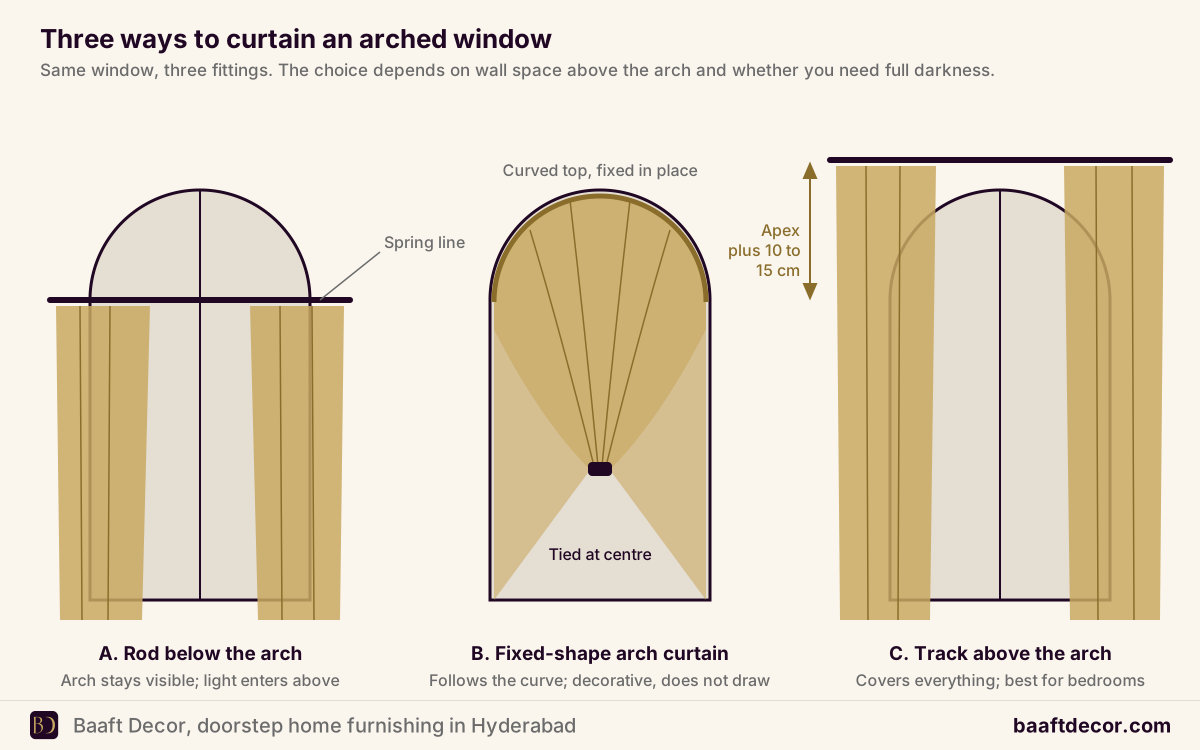
There are three ways to curtain an arched window: a rod or track at the spring line below the arch, a fixed-shape curtain that follows the curve, or a straight track above the arch so ordinary curtains cover everything. Which one suits depends on how much wall there is above the arch and whether the room needs real darkness.
Arched windows turn up in older bungalows and villas with a traditional facade. Wall space around the arch varies a lot, so we measure before suggesting one.
| Method | Opens and closes? | Light control | Needs | Best for |
|---|---|---|---|---|
| Rod or track at the spring line | Yes, below the arch | Arch stays open; light always comes in at the top | A straight wall section at the spring line | Living rooms where the arch is a feature |
| Fixed-shape arch curtain | No | Filters light across the whole window | A curved rod or a shaped top made to a template | Decorative windows, landings, pooja rooms |
| Straight track above the arch | Yes, fully | Full cover, can be blackout | 10 to 15 cm of wall above the apex (typical) | Bedrooms and anywhere you need darkness |
A fixed-shape curtain has to be made from a template. We trace the arch on paper or measure the width, the height at the centre and the spring-line height, then gather the fabric onto a curved top so it follows the curve exactly. Because it doesn’t open, it’s usually a sheer, tied back at the centre or sides. If you also need privacy at night, pair it with a separate draw curtain or blind below the spring line.

How do you put curtains on a corner window?
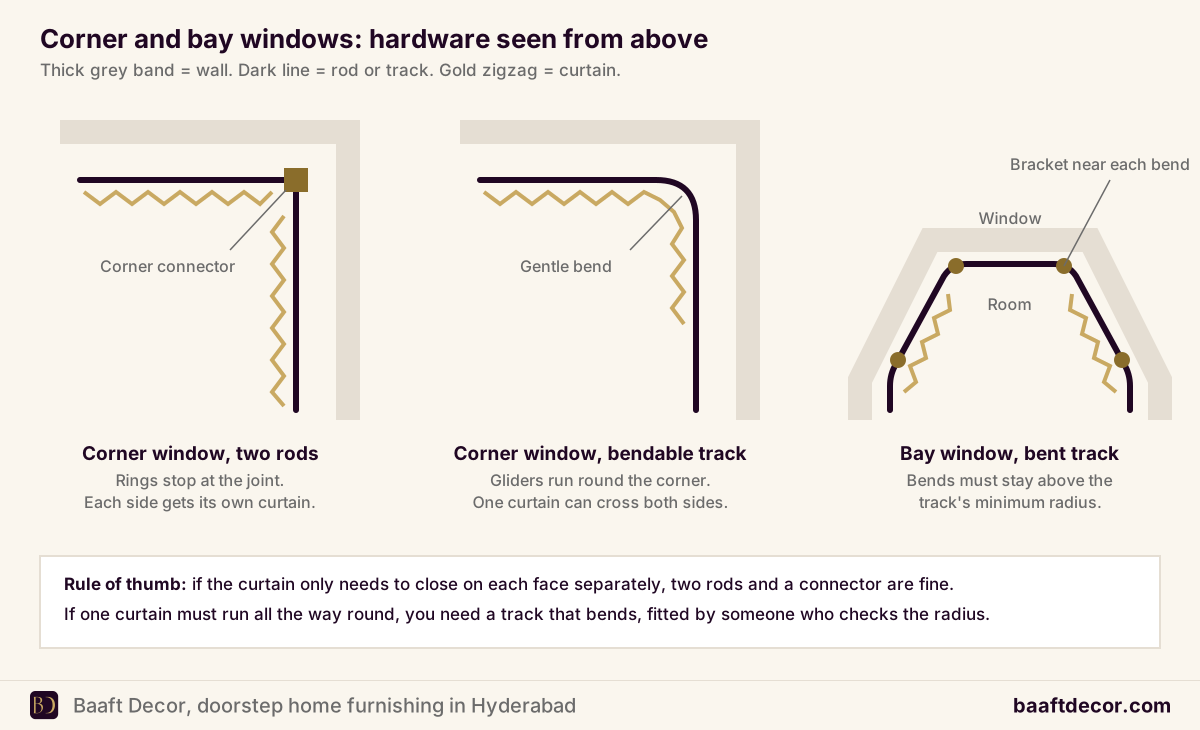
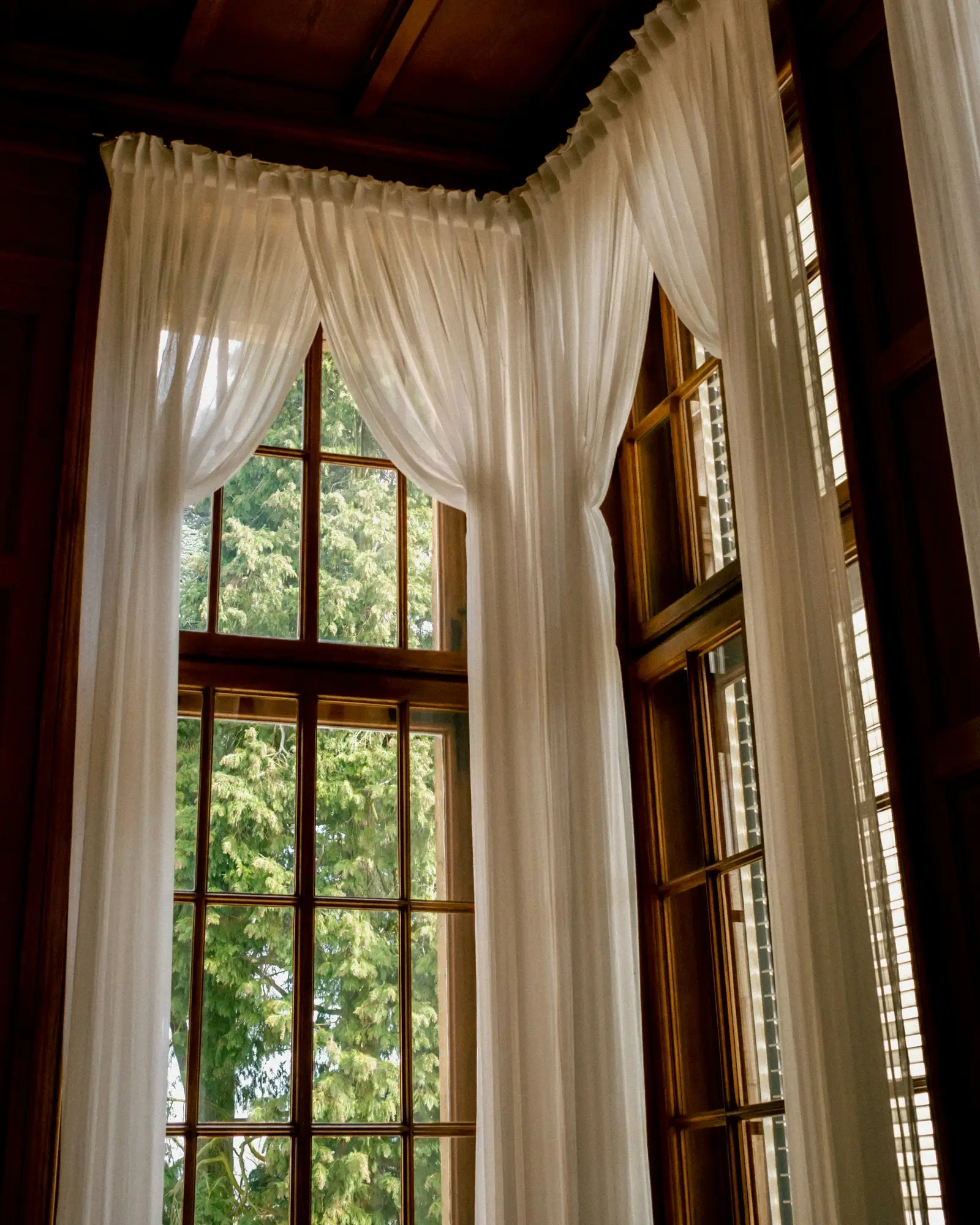
Corner windows meet at a right angle, so you either use two rods or tracks joined by a corner connector, with a separate curtain on each side, or a single bendable track curved around the corner so one curtain can travel across both.
- Two rods and a corner connector. The connector or corner bracket joins the rods at 90 degrees. It’s neat and simple, but rings generally can’t pass the joint, so each side’s curtain opens outwards, away from the corner. Fine when you rarely need both sides closed as one.
- L-shaped track with a bend. A track bent around the corner lets gliders run through it, so a curtain can stack on either wall. It needs a gentle bend rather than a sharp elbow, and a bracket close to the corner on both sides.
- Ceiling track. In flats with false ceilings, a ceiling-mounted track around the corner hides the hardware and avoids the wall-corner clash altogether.
Corner windows in newer villas and some top-floor flats take a lot of afternoon sun on two sides at once. On west-facing corners, a lined curtain on the sunny side and a sheer on the other often works better than matching both.
Bay windows
A bay window projects outward in three or more angled faces, and curtains for it either run on one bent track that follows every face, or on separate rods joined by angled connectors. The bent track gives the cleaner result; the jointed rod is easier to buy off the shelf.
Every bendable track has a minimum bending radius set by the maker. One hand-operated Silent Gliss track, for instance, is specified to bend to a 100 mm radius at minimum, 200 mm as standard. Bend tighter than the rated radius and the profile kinks, and gliders jam at that point. That’s why bay tracks are bent before fixing, on the floor, against a template of the bay.
Bays in Indian houses are seldom symmetrical: the side faces often differ by a few centimetres and the angles aren’t always equal. We measure each face and the angles separately rather than assuming a standard bay. Fixing is also harder than it looks. The top of a bay is often a concrete slab edge or a sunshade beam, so we check what each bracket will screw into before marking holes.
Measuring small, arched and angled windows
Measuring odd windows follows the same logic as any curtain: decide where the hardware goes first, then measure width and drop from that point. The differences are in what you record.
- Small windows: note what sits below (bed, counter, switchboard) and how much clear wall each side has.
- Arched windows: measure the width, the height at the spring line and the height at the apex, plus the wall space above the apex.
- Corner and bay windows: measure each face separately along where the track will run, and the angle between faces.
Our step-by-step guide to measuring windows for curtains covers drop, fullness and the common mistakes. For anything with curves or angles, it’s worth having the fitter measure, since the track is bent to those numbers. Our curtain installation service covers corner connectors, bendable tracks and fixing into awkward lintels, including install-only jobs where you already have the curtains or hardware.
Small and arched windows are most common in older homes, so a lot of this work is in independent houses: we fit curtains in Begumpet, curtains in Banjara Hills, curtains in Jubilee Hills and curtains in Kukatpally regularly.
Get awkward windows measured properly
Odd windows are where a home visit pays for itself. For curtains in Hyderabad, book a free visit and we’ll bring fabric samples, measure every small, arched or corner window, suggest the hardware that fits, and give you a written quote. Baaft Decor measures, stitches and fits curtains at homes across Hyderabad, 8 AM to 10 PM, all seven days. WhatsApp or call +91 98499 17494.
Frequently asked questions
What type of curtain is best for a small window?
The best curtain for a small window is usually a light, unlined or lightly lined fabric in a simple heading such as eyelet, pencil pleat or a slim pinch pleat, hung from a rod or track that extends 15 to 20 cm past each side of the frame. That extension lets the curtain stack off the glass so the window doesn't lose light. Sill or apron length suits windows above a bed, counter or desk. Where only the lower half needs privacy, a cafe curtain on a rod across the middle works well.
How do you make a small window look bigger with curtains?
To make a small window look bigger with curtains, fix the rod or track higher and wider than the frame, typically 10 to 15 cm above it and 15 to 20 cm past each side, so the curtain frames wall as well as glass. Floor-length curtains make the window look taller, if nothing like a bed or counter blocks the drop. Choose a fabric close to the wall colour, avoid heavy valances that eat into the glass, and keep the stack of fabric off the window when open.
How do you put curtains on an arched window?
There are three ways to put curtains on an arched window. You can fix a rod or track at the spring line, where the arch begins, and leave the curved glass open for light. You can fit a fixed-shape arch curtain, gathered onto a curved top that follows the arch, which looks decorative but does not open and close. Or you can mount a straight track 10 to 15 cm above the top of the arch so a full curtain covers the whole window, which is best for bedrooms that need darkness.
Can curtains cover the arch part of a window?
Curtains can cover the arch part of a window in two ways. A fixed-shape arch curtain is stitched to follow the curve and stays in place, so it covers the arch permanently but cannot be drawn. A straight track or rod mounted above the highest point of the arch lets ordinary draw curtains cover the whole window, arch included, and open fully. The second option needs enough wall between the top of the arch and the ceiling or beam, which some older houses with low lintels don't have.
How do you hang curtains on a corner window?
To hang curtains on a corner window, either use two rods or tracks joined by a corner connector, or fit one bendable track curved around the corner. With a corner connector, rings or gliders stop at the joint, so each side gets its own curtain that opens away from the corner. With a bendable track, gliders run through the bend so one curtain can travel across both sides. Fix a bracket close to the corner in both cases, because that joint carries the most load.
What is a bendable curtain track?
A bendable curtain track is an aluminium or PVC track that can be bent to follow a bay window, a corner or a curved wall, so gliders and the curtain can run smoothly around it. Each model has a minimum bending radius set by the maker; one hand-operated Silent Gliss track, for example, is specified to bend to 100 mm minimum and 200 mm as standard. Bends tighter than that kink the profile and jam gliders, so the track is usually bent before fixing and supported with a bracket near every bend.
Which curtains are best for a bathroom window?
The best curtains for a bathroom window are short, washable, quick-drying polyester or poly-blend curtains on a rustproof rod, aluminium or stainless steel rather than plain iron. Bathrooms stay humid, so cotton and lined curtains can develop mildew, especially during the June to September monsoon in Hyderabad. Keep the curtain clear of the shower area and away from the glass so air circulates. For small ventilator-style bathroom windows, a PVC or aluminium blind is often more practical than a curtain.
Do bay windows need special curtain brackets?
Bay windows usually need brackets placed close to every angle, not just at the ends, because each bend in the rod or track is a weak point. With a bendable track, ceiling or face brackets are fixed near each bend and along the straight runs at normal spacing. With rods, bay systems use angled connectors or special corner brackets that join straight sections at the bay's angle. Measure each face and the angle between them before buying, since bays in Indian houses are rarely perfectly symmetrical.