Most people in Hyderabad pick an interior designer the same two ways: a friend’s recommendation or the lowest quote. Both can work out. Neither tells you much about whether the designer measures properly, specifies decent board, or turns up when the tiling contractor has cracked a wardrobe panel. This checklist is what we’d want a family member to run through before signing, whether they hire us as their interior designers in Hyderabad or someone else.
It covers the hiring decision only. For what happens after you sign (the order of work, false ceilings, materials that suit Hyderabad’s climate, room-by-room planning), see our home interior design guide for Hyderabad.
What does an interior designer actually do?
Three kinds of business call themselves interior designers, and they sell different things.
| Type | What you get | Suits | Watch out for |
|---|---|---|---|
| Design-only studio or freelancer | Layouts, 3D views, drawings, material list | People with their own trusted contractor | You manage execution and quality checks |
| Design-and-build (turnkey) firm | Design plus production, installation and site management | New flats with a move-in date, busy owners | Less say over individual brands unless you ask |
| Decorator or furnisher | Curtains, upholstery, wallpaper, rugs, styling | Homes that already have built-in storage | No kitchen or wardrobe design |
Be honest with yourself about which one you need. A couple moving into a bare Kokapet flat in eight weeks needs someone who can build. A family refreshing a ten-year-old villa in Jubilee Hills may only need new curtains, reupholstered sofas and better lighting.
How much should you pay for an interior designer?
There’s no single going rate, because designers charge in different ways:
- Percentage of project value. The fee rises as the project grows. Fair, but it also rises if you upgrade from laminate to acrylic halfway through.
- Per sq ft design fee. Predictable and tied to carpet area. Check whether site supervision is included or extra.
- Fixed fee for a defined scope. Clear, as long as the scope and number of revisions are written down.
- Built into execution. Design-and-build firms often don’t charge a separate design fee and recover it in the production price instead. That’s normal; just compare their unit rates with the same care.
Whichever model you’re offered, ask one question: “What exactly does this fee buy, and do I own the drawings if I don’t proceed?” Our 2BHK and 3BHK interior cost guide explains what drives the execution side of the bill.
The checklist: what to verify before you sign
- See a finished home, not just renders. A 3D view shows the idea. A lived-in kitchen shows whether drawers still glide after a year and whether shutters line up.
- They measure the site themselves. A quote from a builder’s floor plan alone will change once someone finds the beam drop over your wardrobe wall.
- An itemised bill of quantities. Every unit with its size in running feet or sq ft, not “master bedroom: complete”.
- Materials named in writing. Carcass grade with IS mark, shutter finish with catalogue code, hardware brand, countertop type. Our kitchen cabinet materials guide explains what those grades mean.
- Who builds it. In-house factory, in-house carpenters, or subcontractors? Any of these can be fine. Not knowing isn’t.
- Site supervision. How often does someone from the design side visit, and who is your daily contact?
- Revisions. How many design rounds are included, and how are changes after production priced?
- Timeline with milestones. Design sign-off, production, installation, snag fixing, handover.
- Payments tied to stages. Avoid paying most of the contract before anything reaches your site.
- After-handover support in writing. What gets fixed, who to call, and how quickly someone comes.
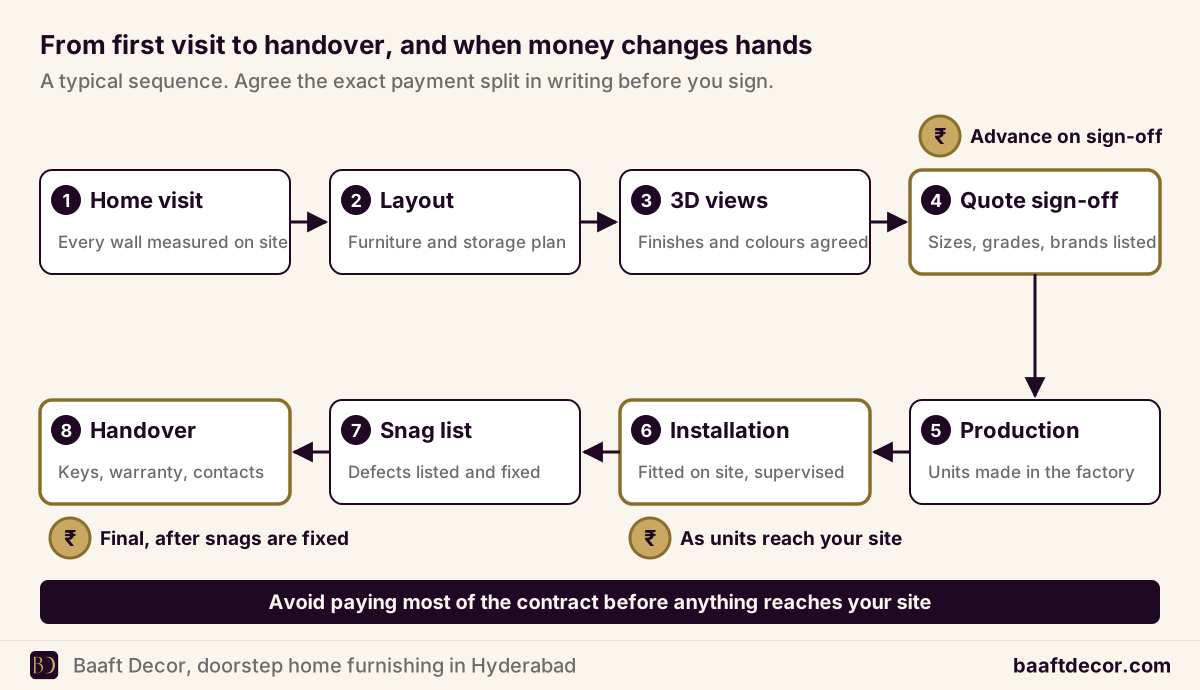
Questions to ask in the first meeting
- Which of your recent projects is closest to mine in size and budget, and can I see it?
- Who will be on site every day?
- What’s excluded from your quote: electrical, plumbing, appliances, painting, GST?
- What happens if the work runs late?
- How do you handle damage to existing flooring or fittings during work?
Listen to how specific the answers are. “Don’t worry, we’ll manage” isn’t an answer.
How to compare two interior quotes fairly
Put the quotes side by side and check the same rows in each. The total is the last thing to look at.
| Check | Why it matters |
|---|---|
| Wardrobe height and loft | One quote may stop at 7 ft, another go to the ceiling with lofts |
| Carcass grade and brand | BWP vs a lower grade changes both price and lifespan near water |
| Shutter finish code | ”Acrylic” covers a wide range of thickness and quality |
| Hardware brand | Soft-close hinges and runners vary a lot between brands |
| Internal accessories | Baskets, pull-outs, wardrobe drawers and mirrors may be counted or left out |
| Exclusions | Electrical, painting and GST shift the real total |
When one quote is far lower, it’s usually because a row is missing, not because the firm is more efficient. Ask them to quote the missing rows, then compare again.
Does it matter where the designer is based?
More than people think. Interiors need someone on site at the right moments: when the electrician marks points, when the ceiling is framed, when shutters are hung. A designer who has to cross the city in peak traffic, say from Kompally to the Financial District, will visit less often than one who works in your part of Hyderabad regularly. Ask how many site visits are planned and who makes them. If the answer is “the carpenter will update you on WhatsApp”, decide whether that’s enough supervision for you.
Red flags worth walking away from
- A single-line quote with no sizes or brands.
- A discount that expires today if you sign now.
- Reluctance to show material samples or name the board brand.
- No written contract, or a contract that doesn’t match the quote.
- A request for most of the money before production starts.
- A designer who never asks how you actually live: who cooks, where shoes go, whether elderly parents visit.
What a good designer should raise about Hyderabad homes
A designer who knows the city will bring these up before you do:
- West and south-west sun. Fading on sofas and veneers, and heat through large sliding doors. They should plan curtains or blinds with the furniture, not after.
- Monsoon humidity. Water-resistant board near sinks and on walls shared with bathrooms.
- Hard water. Stains on glass shower partitions and chrome; matt or brushed finishes hide it better.
- Construction dust. New gated communities stay dusty for months; closed storage beats open shelving.
- Association rules. Working hours, lift booking and debris rules vary by community. See our guide to gated community interior rules in Hyderabad.
If you’re furnishing a brand-new flat, do the builder’s snag inspection before the designer starts. Our flat handover checklist covers it.

Design studio, turnkey firm or freelancer?
There’s no universally right answer. Turnkey works when time matters more than choosing every hinge yourself. Freelancers work when you have a contractor you trust and time to supervise. Studios with strong design but no production are good for villas and renovations where much of the work is civil. What matters more than the label is the paperwork: drawings, an itemised quote and a payment schedule you understand.
You can see how we run a project, from the first visit to installation, on our how it works page. If you’d like us to look at your flat, or give a second opinion on a quote you already have, book a free home visit. We bring samples, measure the space and send an itemised quote. Call or WhatsApp +91 98499 17494, any day from 8 AM to 10 PM.
Frequently asked questions
How much should I pay for an interior designer in Hyderabad?
What you pay an interior designer in Hyderabad depends on the fee model. Some designers charge a percentage of the total project value, some charge a design fee per sq ft of carpet area, some quote a fixed fee for a defined scope, and design-and-build firms usually fold the design charge into the execution price. None of these is wrong. What matters is knowing which one you're on, what it covers, and how the fee changes if you upgrade materials midway.
What does an interior designer actually do?
An interior designer plans how your home works and looks: furniture layout, storage, lighting, ceiling, colours, materials and finishes. A design-only designer hands over drawings, 3D views and a material list for your own contractor to execute. A design-and-build firm also manufactures and installs the kitchen, wardrobes and other units and manages the site. A decorator or furnisher focuses on soft items such as curtains, upholstery, wallpaper and rugs. Many Hyderabad homeowners need a mix of these.
Is it better to hire a turnkey interior company or a freelance designer?
A turnkey or design-and-build interior company suits busy homeowners who want one point of responsibility for design, production and installation, especially in a new flat with a fixed move-in date. A freelance designer suits people who want more say over each material and already have a reliable carpenter or contractor. The trade-off is control versus convenience. Whichever you choose, insist on an itemised quote and a written scope, because both models can go wrong without them.
Should I pay a design fee before seeing a quote?
Paying a design fee before seeing a quote is reasonable if the fee buys something concrete, such as measured drawings, a layout and a material list that you own and can take to another contractor. Ask in writing what the fee includes, how many revisions are covered, and whether it is adjusted against the final contract if you go ahead. Be cautious about large booking amounts that only reserve a slot and give you nothing you can use elsewhere.
How many interior design quotes should I compare?
Comparing two or three interior design quotes is usually enough for a Hyderabad flat, provided they are for the same scope. Give every designer the same list: rooms, units, preferred finishes and what's excluded. Then compare line by line on unit sizes, board grade, shutter finish, hardware brand and countertop. A quote that looks much cheaper often has smaller units, a lower board grade or exclusions hidden in the fine print, so read it before you rank it.
What should an interior design contract include?
An interior design contract should include the full scope with drawings, an itemised bill of quantities with sizes and brands, the agreed material grades and finishes, a list of exclusions, a timeline with milestones, a payment schedule tied to those milestones, how design changes are priced, and what support you get after handover. It should also name who is responsible on site. If any of these exist only as verbal promises, ask for them to be added before you pay.
How do I check an interior designer's past work?
Check an interior designer's past work by asking to see a finished, lived-in home, either in person or on a video call, rather than relying only on 3D renders and stock-looking photos. Look closely at shutter alignment, edge banding, drawer movement and how the ceiling meets the walls. Ask for the contact of one or two past clients and ask them about delays, site behaviour and how problems were fixed after handover. Recent work tells you more than an old portfolio.
Can an interior designer work with my own carpenter?
Many interior designers will work with your own carpenter on a design-only or design-plus-supervision basis. It can save money, but it splits responsibility: if a wardrobe shutter sags, the designer may blame the build and the carpenter may blame the drawing. If you go this way, agree in writing who checks material grades on site, how often the designer visits, and who signs off each stage. Design-and-build firms usually prefer to use their own production team.