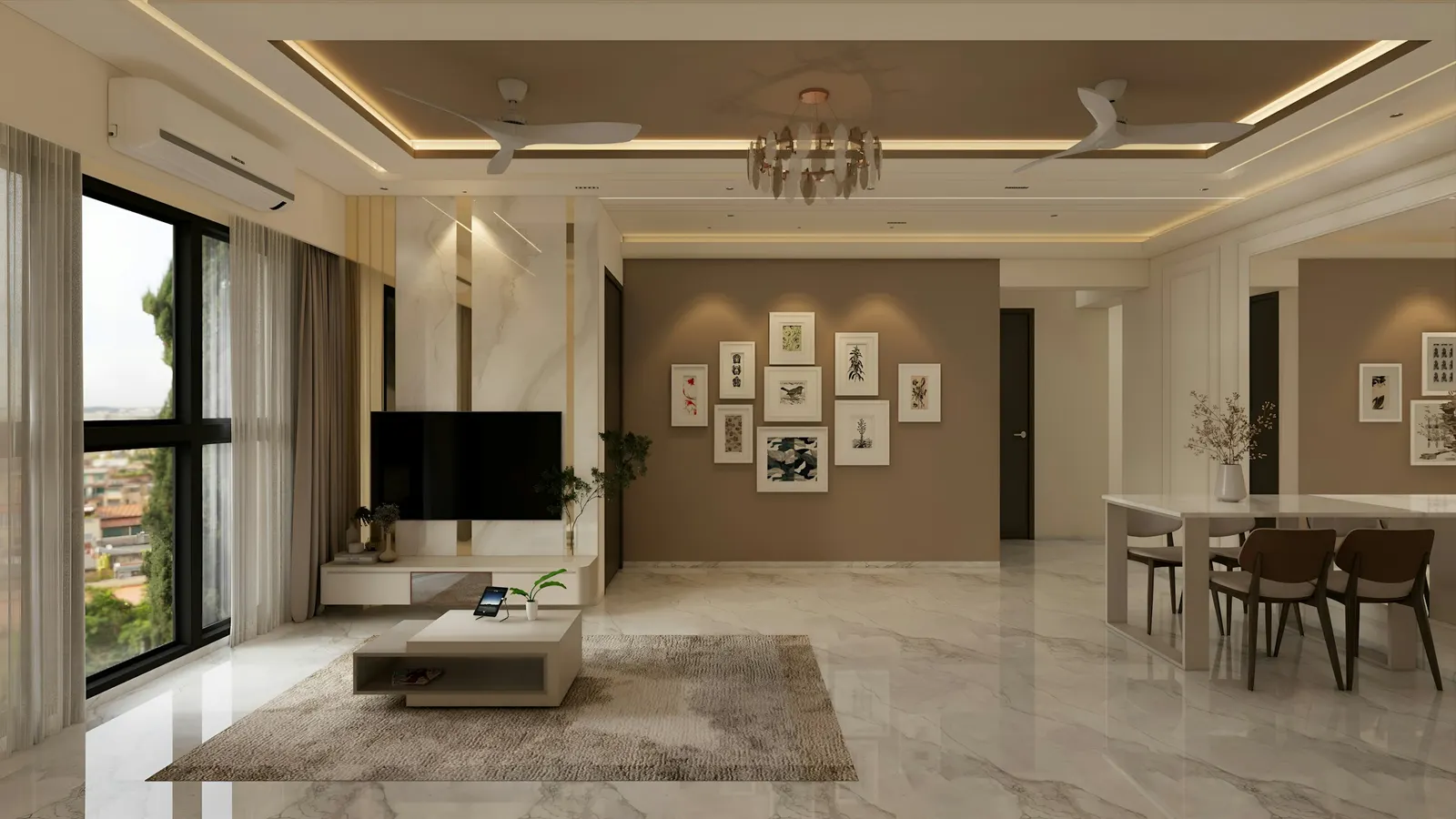
Ask three contractors in Hyderabad for a “POP ceiling” and you may get three different things: true plaster of Paris on mesh, gypsum board with a POP finish, or PVC panels. The names get used loosely, and the materials behave very differently in a humid monsoon or under a hot kitchen hob. Here’s how each type actually works, so you can pick by room rather than by habit. If you already know what you want, our false ceiling service in Hyderabad covers design, framing and lighting in one visit.
A ceiling is one stage in a bigger sequence: services first, then the ceiling, then carpentry and finishes. Our home interior design guide for Hyderabad explains that order and what to settle before the boards close.
Which false ceiling is best: gypsum, POP or PVC?
For living rooms and bedrooms, choose gypsum board. It’s factory-made, quick to install, smooth when finished and handles cove lighting well. Choose POP only for curves, domes or cornice work where you can accept a slower, wetter job. Choose PVC for bathrooms, balconies and utility areas where water matters more than looks. Choose a grid ceiling for offices that need access above.
Gypsum vs POP vs PVC vs grid: side-by-side
| Factor | Gypsum board | POP (plaster of Paris) | PVC panels | Grid (lift-out tiles) |
|---|---|---|---|---|
| What it is | Gypsum core between paper liners, made in a factory | Powder mixed with water on site, applied over mesh | Hollow interlocking plastic strips | Tiles laid into an exposed metal T-grid |
| Installation | Boards screwed to a galvanised steel frame | Hand-plastered, shaped, then left to dry | Clipped or screwed to a frame | Tiles drop into the grid |
| Site mess and time | Low dust, fast | Wet, dusty, slower | Clean, fast | Clean, fast |
| Finish | Smooth after taping and putty | Smooth, depends on plasterer | Visible joint lines, plastic look | Visible grid |
| Curves and mouldings | Gentle curves possible | Best for ornate work | Not really | No |
| Moisture | Standard board dislikes water; moisture-resistant board for kitchens and bathrooms | Dislikes water | Waterproof | Depends on tile |
| Heat near lights or hobs | Good | Good | Softens and can sag | Good with mineral tiles |
| If it catches fire | Gypsum doesn’t burn readily | Same as gypsum | Burns with dense, toxic smoke | Mineral tiles resist fire |
| Access above | Needs a trap door | Needs a trap door | Panels can be removed | Every tile lifts out |
| Best rooms | Living, bedrooms, dining | Feature ceilings, heritage-style rooms | Bathrooms, balconies, utility | Offices, shops |
Gypsum board false ceiling
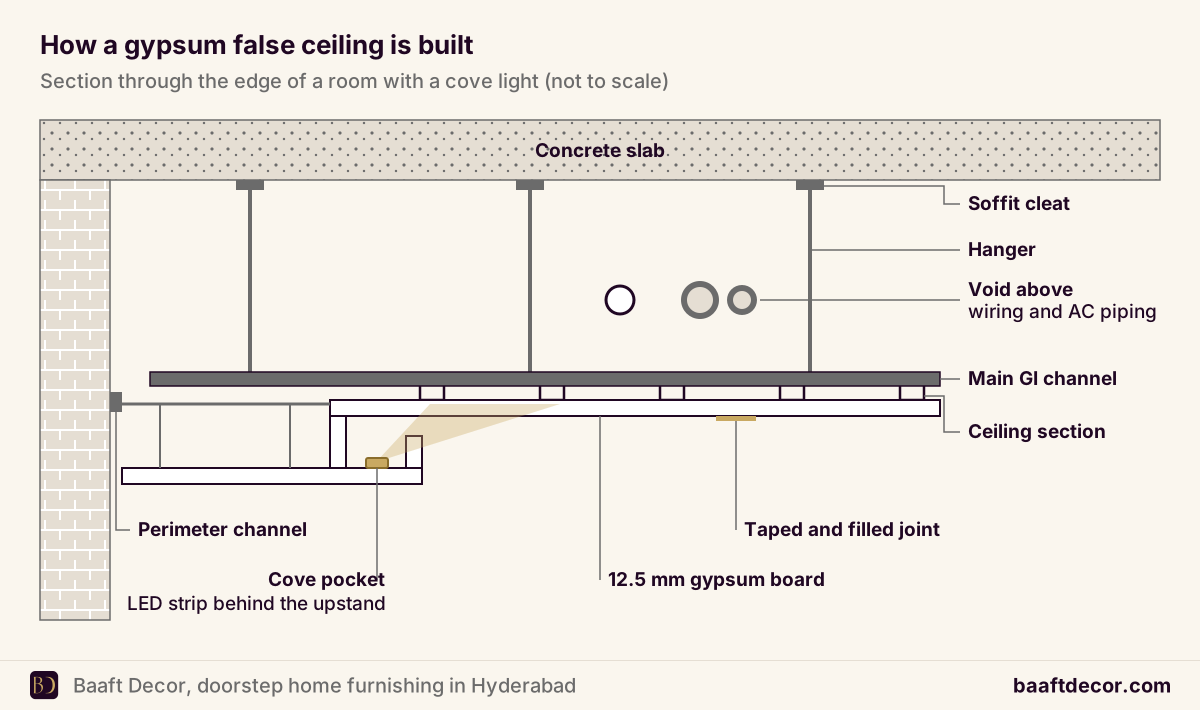
Gypsum board is a flat sheet with a gypsum core sandwiched between paper liners. In India, plain gypsum boards are made to BIS standard IS 2095 (Part 1). The boards are screwed to a frame of galvanised steel channels hung from the slab, then the joints are taped, filled and puttied so the ceiling looks like one surface before painting.
Ordinary board doesn’t like water. For kitchens and bathroom dry zones, there are moisture-resistant boards (usually with a green paper face) made for that job. Gyproc’s moisture-resistant board, for example, is sold for kitchen and bathroom ceilings and made to IS 2095.
The usual complaint is cracking. Joint cracks almost always trace back to installation, not the board:
- Joints finished without tape, or with too little compound
- Ceiling channels spaced too wide for the board
- Boards butted hard against walls with no allowance for movement
- Fans or chandeliers hung from the board instead of the slab
- A slow leak from the bathroom or AC drain line above
Get the framing right and a gypsum ceiling stays crack-free for a long time.
POP false ceiling
Plaster of Paris is gypsum that has been heated to drive off most of its water (chemically, calcium sulphate hemihydrate). Mix it with water and it sets back into gypsum. That’s what makes it so good for shaping: a skilled plasterer can run domes, curved coves and cornices that boards can’t easily follow.
The trade-offs are practical. POP is wet work: dust while mixing, slurry on the floor, and drying time before primer and paint. The finish depends entirely on the person holding the trowel. In a furnished, occupied flat, that mess matters.
One more thing. When a quote says “POP false ceiling”, ask whether they mean POP on mesh, or gypsum board with POP used only for finishing the joints. Both are common in Hyderabad, and the price and durability are different.
PVC false ceiling
PVC ceilings are long, hollow plastic panels that click together and fix to a light frame. They’re waterproof, quick to fit and easy to wipe, which makes them sensible for bathrooms, open balconies and utility areas.
They have real limits, though. PVC softens with heat far below the temperatures gypsum shrugs off, so panels near a gas hob or a hot lamp can sag or yellow. The joint lines stay visible. And if PVC catches fire, it gives off thick, toxic smoke. PVC doesn’t belong in kitchens, and it’s best avoided above a pooja area where a diya burns daily. If you like the wipe-clean idea for walls too, our PVC vs WPC vs fluted wall panels guide compares those materials.
Grid ceilings and other options
A grid ceiling is a visible metal T-grid, usually in 2 × 2 ft (600 × 600 mm) squares, with mineral fibre or gypsum tiles dropped in. Any tile lifts out, so electricians and AC technicians can reach cables and ducts without breaking anything. That’s why you see them in offices; if you’re fitting out a workplace, our office furnishing service covers grid ceilings with blinds and partitions. In homes they look out of place.
Other materials you’ll hear about:
- Wooden or wood-look slats for warmth in living rooms, usually as a strip over a gypsum base
- Metal (aluminium) panels for balconies and commercial spaces
- Calcium silicate boards where extra moisture resistance is needed
Is a false ceiling good for your home?
A false ceiling earns its place when it solves something:
- Hiding services. Split-AC piping, wiring for lights, beams that cut across the room.
- Lighting. Cove strips and downlights give layered light that a single tube light can’t.
- Heat on top floors. Under a sun-baked roof slab, the air gap and board slow the heat coming through. On middle floors, the gain is small.
- Proportion. A peripheral band can visually square up a room with awkward beams.
The downsides deserve equal weight. You lose height, usually 4 to 8 inches depending on lights and AC piping. Unsealed edges become homes for lizards and cockroaches. A leak from the flat above ruins gypsum quickly. And in a room under about 9 ft, a full-cover ceiling can feel oppressive. For a low room, a narrow peripheral design or simply good surface lights may be the smarter call. Our false ceiling designs for the hall and bedroom give a height rule of thumb for each design, from slim bands to layered ceilings.
Which false ceiling for which room?
| Room | Our usual recommendation | Why |
|---|---|---|
| Living and dining | Gypsum, peripheral or single-level with cove | Clean finish, hides AC piping, easy lighting |
| Bedrooms | Gypsum, simple profile | Quiet look, fan fixed to slab through the ceiling |
| Kids’ room | Gypsum with simple shapes | Easy to repaint as tastes change |
| Kitchen | Moisture-resistant gypsum, or painted slab | Heat and steam rule out PVC |
| Bathroom | PVC or moisture-resistant board in the dry zone | Water is the main threat |
| Balcony | PVC or metal panels | Exposed to rain |
| Pooja room | Gypsum or POP for a small dome or cove | Avoid plastics near open flame |
| Office | Grid ceiling | Access to cables and ducts |

If you’re comparing options for a specific room, we can bring board samples, check your slab height and AC routing, and sketch a ceiling that fits. Our interior designers can also plan it alongside wardrobes and lighting. For how the price is worked out, read our false ceiling cost guide for Hyderabad. To book a free home visit, call or WhatsApp +91 98499 17494, any day from 8 AM to 10 PM.
Frequently asked questions
Which ceiling is best, PVC or gypsum?
Gypsum is the better false ceiling for living rooms, bedrooms and most dry areas because it gives a smooth, paintable, joint-free finish, handles cove lighting well and doesn't soften with heat. PVC is better only where water is the main problem, such as bathrooms, open balconies and utility areas, because its panels are waterproof and wipeable. PVC softens with heat, shows panel joints and gives off dense, toxic smoke if it burns, so keep it away from kitchens, hobs and lamps.
Is a false ceiling good for a home?
A false ceiling is good for a home when you need to hide AC piping, wiring or beams, or want layered lighting such as cove lights and downlights. On a top-floor flat or villa, the air gap and board also slow some heat coming through the roof slab. The downsides are lost ceiling height, a space where pests can nest if edges aren't sealed, and damage if water leaks from above. In rooms with low ceilings, a narrow peripheral design is often the better compromise.
What is the difference between gypsum and POP false ceiling?
Gypsum and POP false ceilings are chemically related but built differently. A gypsum false ceiling uses factory-made boards with a gypsum core and paper facing, screwed to a galvanised steel frame, so installation is fast, clean and consistent. A POP ceiling uses plaster of Paris powder mixed with water on site and applied over mesh on a frame, then shaped by hand. POP handles curves and mouldings better, but it is messier, needs drying time and depends heavily on the plasterer's skill.
Does a false ceiling reduce heat in Hyderabad?
A false ceiling reduces heat noticeably only where heat comes through the roof slab, such as top-floor flats, penthouses and independent houses, because the trapped air gap and gypsum board slow heat transfer into the room. On middle floors of an apartment block the slab above is shaded by the flat upstairs, so the difference is small. For most Hyderabad flats, heat enters mainly through west-facing glass, where curtains, blinds or solar film do far more than a ceiling.
Why do gypsum false ceilings crack?
Gypsum false ceilings usually crack at board joints or where the ceiling meets the wall. Common causes are joints finished without proper jointing tape, framing channels spaced too far apart, boards fixed tight against walls without allowing for movement, heavy fittings hung from the board, and water leaking from a bathroom or AC drain above. Hairline joint cracks can be re-taped and repainted. Cracks that keep returning, or brown stains, point to framing problems or a leak that needs fixing first.
Can I hang a ceiling fan from a false ceiling?
No, a ceiling fan should never hang from the false ceiling board or its framing. The fan must be fixed to the concrete slab through the slab hook, with a longer down rod passing through a neat opening in the false ceiling. The same applies to heavy chandeliers. Plan fan positions before the ceiling is framed so the opening, the down rod length and any decorative canopy are sized correctly, and so the fan sits centrally in the finished ceiling design.
Is PVC false ceiling safe for the kitchen?
PVC false ceiling is not a good choice for Indian kitchens. Regular cooking heat over a gas hob, especially combined with oil vapour, can soften, sag or discolour PVC panels over time, and if a fire starts PVC burns with dense, toxic smoke. For kitchen ceilings, moisture-resistant gypsum board with a washable paint finish is the safer option, or simply a well-painted concrete slab with surface-mounted lights. PVC works better in bathrooms, balconies and utility areas away from flames.
How much height does a false ceiling take?
Most residential false ceilings drop between about 4 and 8 inches below the slab, depending on the light fittings, cove pockets and any AC piping or ducts that must run above. Simple peripheral designs with slim LED downlights can stay at the shallow end, while concealed split-AC piping, ducted AC or deep coves need more depth. In apartments with lower ceilings, keep the drop to a perimeter band and leave the centre at slab height to preserve headroom.