Office blinds have a harder job than home blinds. They have to stop glare on screens all day, keep a glass facade looking uniform from the street, survive hundreds of hands on the chain, and in some rooms black out completely at the press of a button. This guide covers which blinds work in which part of an office, the specs worth asking for, and where Hyderabad’s glass-heavy buildings change the answer. If you’re fitting out a whole floor, our office furnishing service in Hyderabad handles blinds alongside curtains, carpet tiles and other soft furnishings.
For blind types, fabrics and mechanisms in general, including home use, see our window blinds buying guide for Hyderabad. This page sticks to what changes in a workplace.
What kind of blinds for an office? The short answer
For most workstations, sunscreen roller blinds with a 3 to 5% openness factor are the best default. They reduce screen glare and solar heat while keeping daylight and the view. Then adjust by room:
- West-facing or unshaded glass: 1 to 3% openness, or a darker fabric.
- Conference rooms: blackout rollers, or a double roller (sunscreen plus blackout).
- Cabins and glass partitions: zebra or venetian blinds for adjustable privacy.
- Wide windows and sliding doors: vertical blinds.
- Tall or hard-to-reach glazing: motorised rollers.
Understanding openness factor
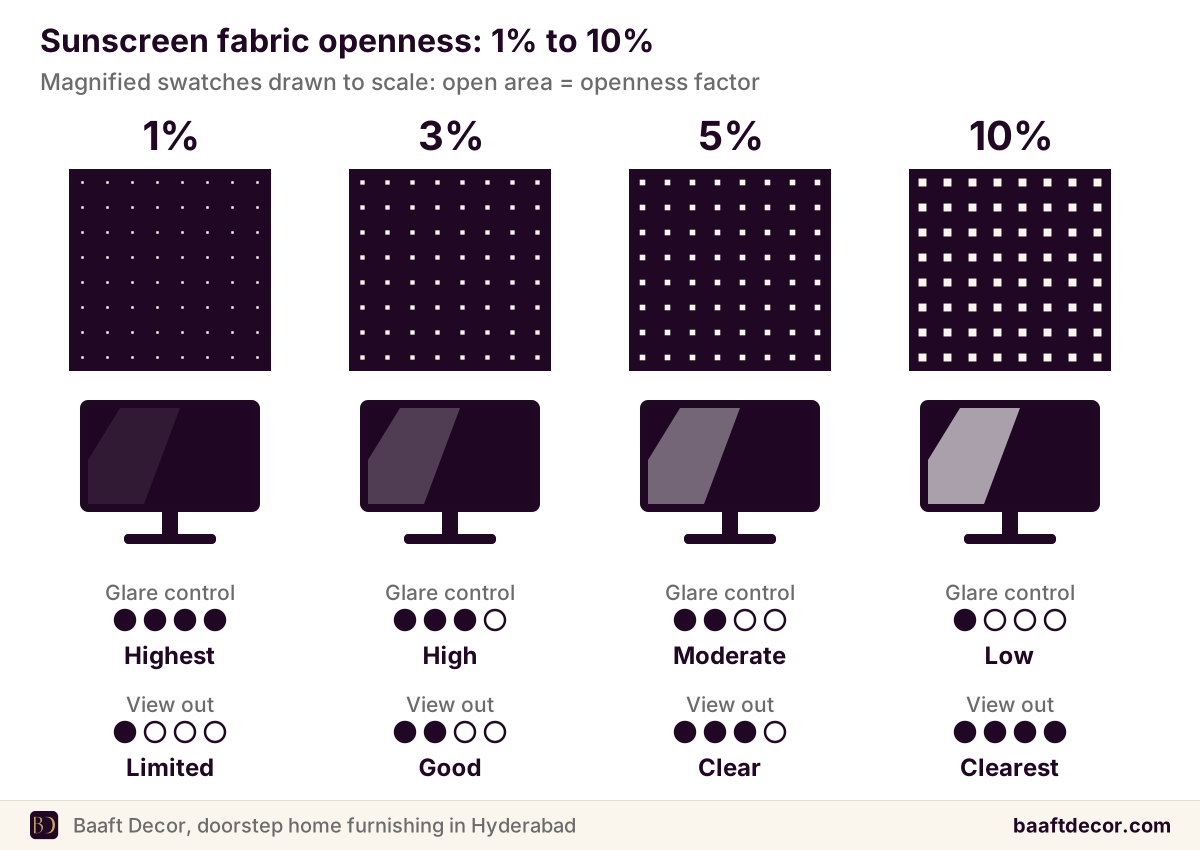
Sunscreen fabrics are woven technical meshes. The openness factor is the percentage of the fabric that is open weave.
| Openness | Glare control | View out | Best for |
|---|---|---|---|
| 1% | Highest | Limited | Harsh west sun, screen-heavy desks |
| 3% | High | Good | Most workstations |
| 5% | Moderate | Clear | Shaded facades, mixed areas |
| 10% | Low | Clearest | Reception, pantry, areas without screens |
Colour matters as much as openness. Darker fabrics (charcoal, black, bronze) absorb glare and give a clearer view out, because your eye isn’t fighting a bright fabric surface. Lighter fabrics (white, grey-white) reflect more solar heat back out but look brighter and can glow in direct sun. Many offices choose a dark interior face for staff comfort, or a fabric that is light outside and dark inside.
Matching blinds to each zone of the office
Open workstations
Sunscreen rollers in a consistent colour along the facade. Choose openness by orientation: 3% on most sides, 1 to 3% where the afternoon sun hits directly. Chain-operated rollers are simple and reliable; spring rollers look cleaner but take more wear in busy offices.
Conference and meeting rooms
These need two modes: daylight for discussions and dark for screens and projectors. A double roller, with sunscreen and blackout fabrics on one bracket, handles both. Rooms with large displays rather than projectors often manage with a 1% sunscreen alone. If the room has glass walls on the corridor side, add zebra or venetian blinds there for privacy during meetings.
Cabins and private offices
Zebra (day-night) blinds alternate sheer and solid bands, so you shift between light and privacy without raising the blind. Aluminium venetian blinds with 25 mm slats tilt to direct light and close tight for privacy. Both suit glass-partitioned cabins. Our comparison of zebra vs roller blinds explains the trade-offs.
Reception, pantry and breakout areas
Brand and atmosphere come first. Lighter sunscreen fabrics, wooden or faux-wood venetians, or PVC blinds in the pantry where wipe-clean matters.
Wide windows and sliding doors
Vertical blinds, with louvres that rotate to angle light and stack to one side, suit wide spans and sliding glass doors. Long horizontal blinds can sag in the middle over wide openings; verticals hang straight.
When to choose motorised blinds
Motorising makes sense for floor-to-ceiling glazing, double-height lobbies, conference rooms and any space where 10 or 20 blinds should move together. Groups can be scheduled, for example lowering on the west facade every afternoon. For a few standard windows in a small office, manual blinds are simpler and keep working through power cuts. Our motorised curtains and blinds service covers the options.
Specs worth putting in writing
When you ask for quotes, specify:
- Fabric type and openness factor for each zone (e.g. “3% sunscreen, charcoal”).
- Flame retardancy. Many buildings and insurers expect flame-retardant fabrics, tested to standards such as NFPA 701 (USA) or BS 5867-2, the British flammability specification for curtain, drape and window blind fabrics. Ask for the test certificate for the exact fabric range.
- Operation: chain, spring or motorised, and chain side.
- Mounting: inside the window recess or on the face, and bracket type for ceiling or mullion fixing.
- Facade colour. Some commercial buildings’ fit-out guidelines fix the colour of blinds visible from outside. Check with facility management before choosing.
- Cleaning: sunscreen fabrics can be vacuumed or wiped; venetians need slat-by-slat dusting.
What Hyderabad’s office buildings add
Offices in HITEC City and the Financial District are mostly glass-fronted towers. Two things follow. First, west and south-west facades take intense afternoon sun from March to June, and those desks need lower openness or darker fabric than the rest of the floor. Second, fine construction dust is constant in the newer parts of the western corridor, which makes smooth roller fabrics easier to maintain than venetian slats that collect dust on every surface.
Older office buildings in Begumpet, Somajiguda and Secunderabad often have smaller, recessed windows, where inside-recess rollers or venetians look neatest.
Home offices
If you work from a spare bedroom in Gachibowli, Kondapur or Kokapet, the same logic applies at a smaller scale: a 3 to 5% sunscreen roller cuts laptop glare and keeps the room bright for video calls. If the room doubles as a bedroom, choose a double roller or zebra blind for night-time privacy. Our blinds service handles a single home office as readily as a full floor.
One tip that costs nothing: place the desk so the window is beside you, not behind the monitor and not behind your chair. Side light causes the least glare on the screen and the least squinting on video calls, and the blind then only has to deal with direct sun for a few hours of the day rather than all of it.
Blinds or curtains in an office?
Blinds win on most office glazing: they sit close to the glass, take up no floor space beside desks, look uniform from outside and are easier to clean. Curtains still have a place. A director’s cabin or a boardroom can feel warmer with lined drapes over a sunscreen roller, and heavy blackout drapes absorb sound better than a hard blind, which helps in rooms with glass walls and echo. If you’re considering that layered look, our blackout curtains service covers lined and blackout fabrics. For a softer look on a single cabin window without full drapes, fabric Roman blinds are the middle ground; our Roman blinds guide explains fold styles and linings.
Common mistakes in office blind projects
- One fabric for every facade. The east side and the west side of the same floor need different openness.
- Choosing white sunscreen for screen-heavy desks. It glows in direct sun; staff end up closing blinds fully and switching lights on.
- Ignoring the corridor side. Glass-walled meeting rooms need privacy on the inside wall too, not only on the windows.
- Measuring one window and multiplying. Office glazing that looks identical often isn’t.
- Forgetting the AC vents and sprinklers. Ceiling-mounted blinds need clearance from vents, sprinkler heads and light fittings. Check before fixing brackets.
Planning installation without disrupting work
Measure every window individually; office glazing that looks identical often varies by a few millimetres, enough to leave a light gap. Install zone by zone so teams keep working. Book contractor access and lift slots with facility management in advance.
We work 8 AM to 10 PM all seven days, so measurement and installation can happen before staff arrive, after they leave, or on a weekend. To plan blinds for your office, book a free site visit: we bring fabric samples including sunscreen openness options, measure each window and give a zone-by-zone quote. Call or WhatsApp +91 98499 17494.
Frequently asked questions
What kind of blinds are best for an office?
The best blinds for most offices are sunscreen roller blinds, made from a technical mesh fabric with a stated openness factor, usually 3% or 5%. They reduce glare on computer screens and cut solar heat while keeping daylight and the outside view, they're easy to clean, and they look uniform across a glass facade. Conference rooms usually add blackout or double rollers for presentations, cabins suit zebra or venetian blinds for adjustable privacy, and very wide or tall glass often works best with motorised rollers.
What openness factor is best for office roller blinds?
The openness factor is the percentage of a sunscreen fabric's weave that is open. For most office workstations, 3% or 5% is the best balance, because it cuts glare on screens while keeping a clear view and plenty of daylight. On harsh west-facing or unshaded glass, 1% to 3% controls glare and heat better, though the room feels darker. 10% gives the clearest view but the least glare control, so it suits shaded windows or areas without screens.
Which blinds are best for a conference room?
The best blinds for a conference room combine daytime glare control with the option of near-darkness for presentations. A double roller system works well: a sunscreen roller for everyday use and a blackout roller on the same bracket for screens and projectors. Where the room has glass walls facing a corridor, add zebra or venetian blinds on that side for privacy during meetings. Motorised blinds make sense in larger rooms, so the presenter can lower everything from one switch or remote.
Are vertical blinds or roller blinds better for offices?
Roller blinds are better for most office windows because they look cleaner, collect less dust and offer sunscreen fabrics with defined openness factors for glare control. Vertical blinds are better for very wide windows and sliding glass doors, because the louvres stack to one side, rotate to angle light, and don't sag across long spans the way wide horizontal blinds can. Many offices use both: rollers on the main glazing and verticals on wide sliding doors or older buildings with broad windows.
Do office blinds need to be fire retardant?
Office blinds should ideally be made from flame-retardant fabric, and some buildings, landlords or insurers require it as part of their fit-out guidelines. Flame-retardant fabrics are tested to recognised standards such as NFPA 701 or BS 5867, and suppliers can usually provide a test certificate for the fabric range. Before ordering, check your building's fit-out guidelines or ask facility management, and request documentation for the fabric so you have it on file for inspections or audits.
What blinds are best for a home office?
For a home office in an apartment, a roller blind with a 3% or 5% sunscreen fabric is usually best, because it removes glare from laptop and monitor screens while keeping the room bright for video calls. If the same room is a bedroom, choose a double roller with a blackout layer, or a zebra blind, which switches between filtered light and privacy. Position the desk so the window is to your side rather than behind the screen, which reduces glare before any blind is involved.
Can office blinds be installed outside working hours?
Yes, office blinds can be installed outside working hours to avoid disturbing staff. Baaft Decor works from 8 AM to 10 PM on all seven days, so measurement visits and installation can be scheduled early in the morning, in the evening or on a weekend, subject to your building's access rules for contractors. Larger floors are often done in phases, one zone at a time, so the office stays usable throughout. Confirm work permits and lift bookings with facility management in advance.
Should office blinds be motorised?
Office blinds are worth motorising when windows are tall or hard to reach, when one room has many blinds that should move together, or in conference rooms where the presenter needs quick control. Motorised rollers can be grouped and run on schedules, for example lowering on west-facing glass every afternoon. For a few standard-height windows in a small office, chain or spring-operated manual blinds are simpler and cheaper, and they keep working during power cuts without any backup.