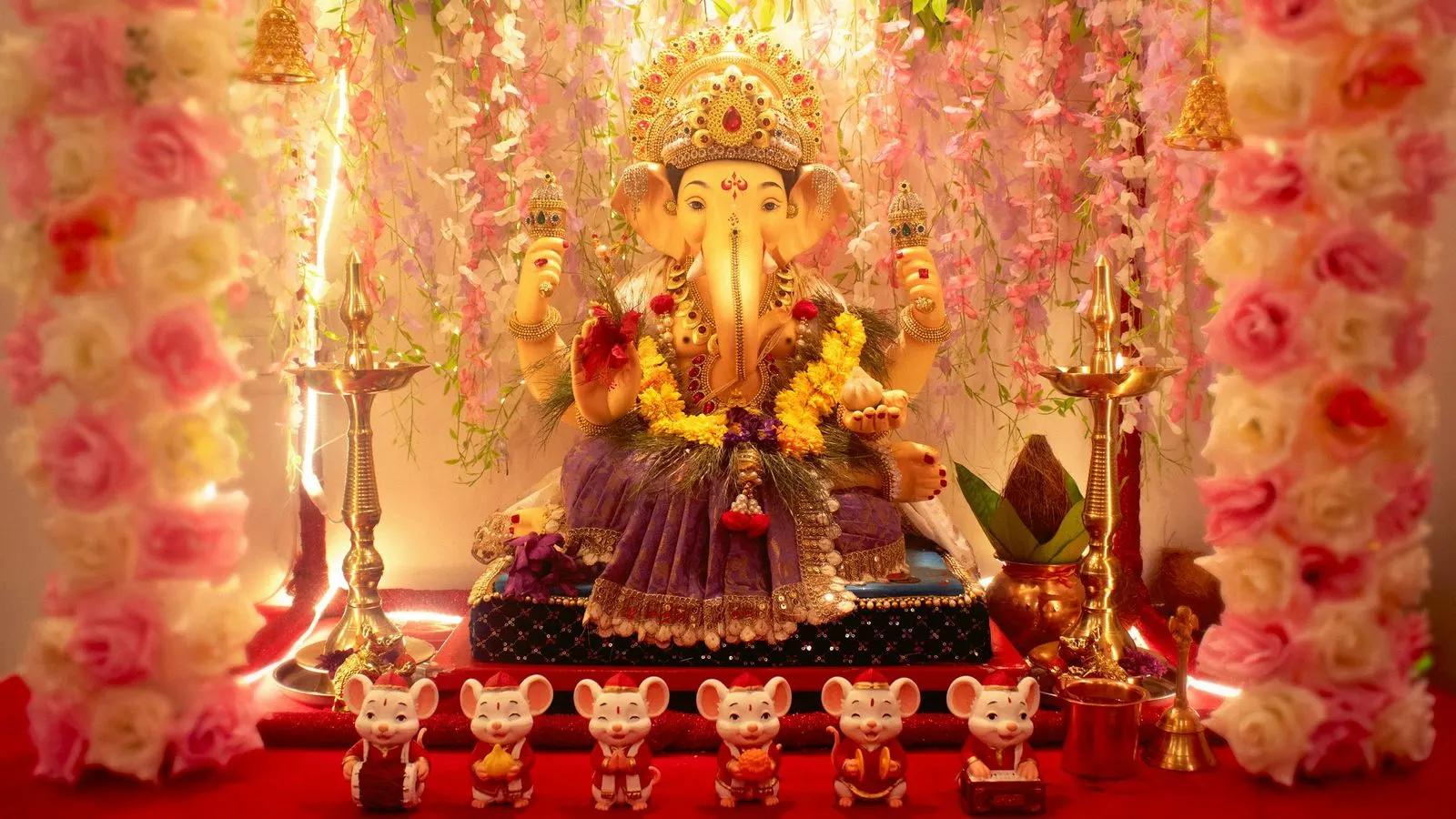
Ask ten families how their pooja space should look and you’ll get ten answers, which is how it should be. Some want carved teak and brass bells. Others want a quiet white niche with one lamp. Our job is to fit your tradition into the space you actually have, and to make sure a lit diya never sits next to something that can burn. If you’d like a designer to plan it with you at home, our interior designers in Hyderabad start with a free home visit.
This is one part of our home interior design guide for Hyderabad. Below are layouts for apartments and villas, the materials that work, backdrops, and the safety details that matter most.
Where can a pooja space go in an apartment?
Most Hyderabad flats don’t come with a dedicated pooja room, so the space usually comes out of the living or dining area.
| Location | Works well when | Watch out for |
|---|---|---|
| Living room wall niche | There’s a quiet wall away from the main walkway | Keep it clear of curtains and the AC airflow, which can blow out or tilt a flame |
| Corner of the dining area | You want privacy without losing floor space | Kitchen heat and oil nearby; keep the flame away from both |
| Part of the TV wall | Space is very tight | Separate the two clearly; see our TV unit design ideas |
| Builder’s small pooja room near the kitchen | The flat has one | These are often unventilated; plan a vent or exhaust |
| Cabinet in a bedroom | There’s truly no other wall | Many families prefer not to do this; doors let you close it |
Direction and neighbouring rooms matter a lot to many families. Some prefer a particular direction for the deity or for the person praying, and some prefer the pooja space not to share a wall with a bathroom. These are family decisions, so settle them at home or with your purohit first. We’ll plan the unit around whatever you choose.
Pooja room design ideas for apartments
Wall-mounted mandir
A floating unit about 2 to 3 ft wide and 12 to 18 inches deep is the most common answer in compact flats. It keeps the floor free for daily mopping and rangoli. Set the diya shelf at a height you can reach comfortably while standing or sitting, whichever way your family does pooja.
Corner mandir
Corners in Indian living rooms are often dead space. An L-shaped or angled unit uses that corner, gives a sense of enclosure, and keeps the mandir out of the walkway. Add a small jaali screen on the open side if you want more privacy.
Cabinet mandir with folding doors
This suits homes with heavy dust or curious toddlers. Bi-fold or pocket doors close the unit when it’s not in use. The rule is simple: doors stay open whenever a lamp or agarbatti is lit.
Floor-standing unit with storage
If you sit for pooja, a floor unit with a low platform, drawers below and about 3 ft of clear floor in front is more comfortable than a wall-hung shelf. A pull-out tray for the pooja thali saves a lot of bending.
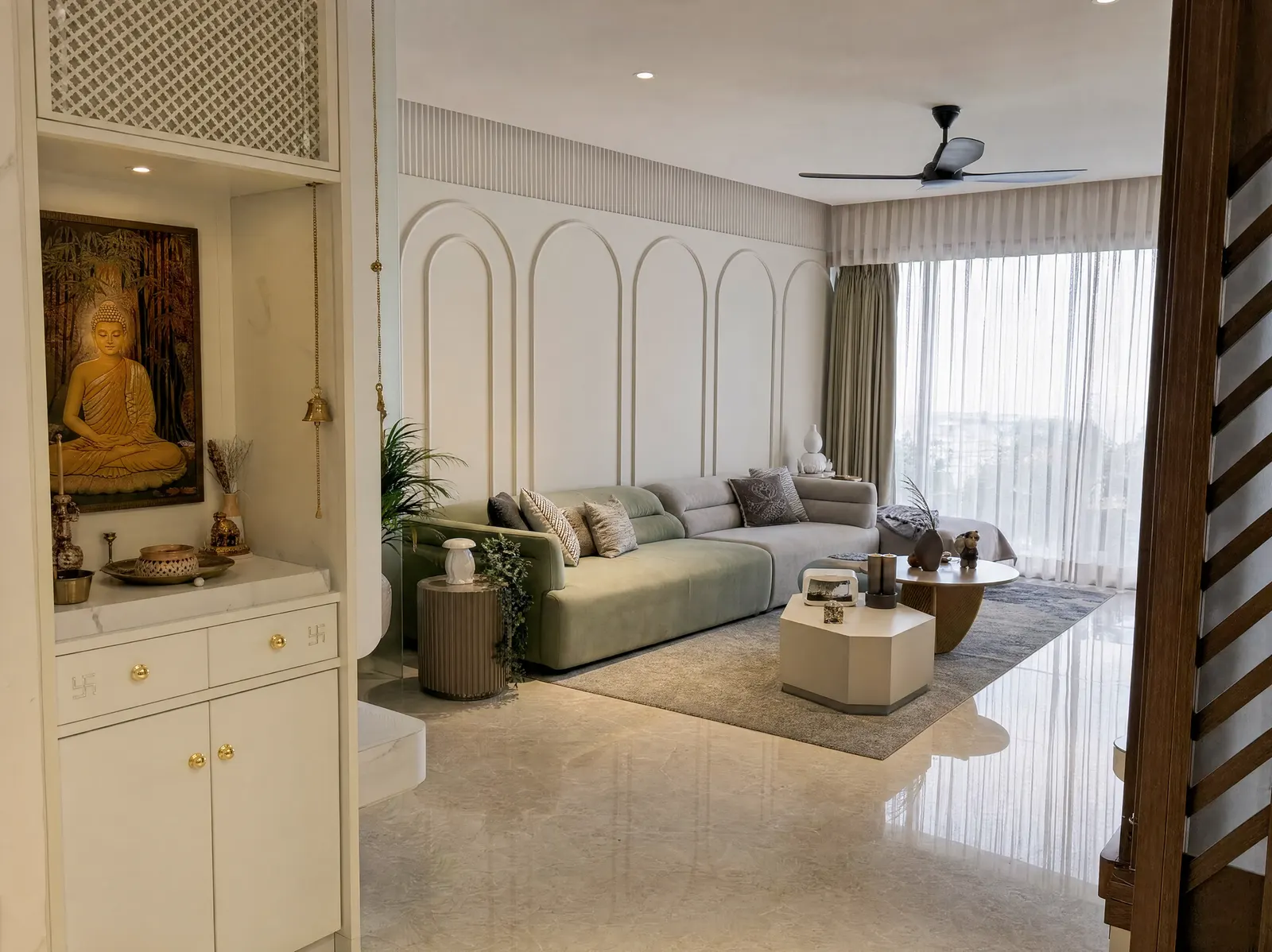
Pooja room designs for villas and independent houses
A villa can give the pooja space its own room, and that changes the design. You can use double doors with jaali or glass panels set in a wooden frame, a raised threshold, a stone floor that’s easy to wash, and cupboards for pooja items, books and festival decorations. A carved teak frame or a temple-style arch looks right at this scale.
Two things get forgotten in separate pooja rooms. The first is air: a closed room with a lamp and agarbatti needs a window or a small exhaust. The second is light: one tube light on the ceiling flattens everything, while soft backlighting plus a focused light on the deity feels calmer.
Which materials work for a pooja unit?
| Material | Look | Best used for | Keep in mind |
|---|---|---|---|
| Solid wood (such as teak) | Traditional, carved | Villa pooja rooms, door frames | Needs polish and termite treatment |
| Plywood or HDHMR with veneer or laminate | Clean and modern | Most apartment units | Edges must be sealed; protect the lamp shelf |
| CNC jaali (MDF, WPC or metal) | Patterned screens | Doors, back panels, partitions | Only metal jaali belongs near the flame |
| Marble or granite | Cool, temple-like | Lamp shelf, base, back wall behind the diya | Heavy; needs a solid wall or floor support |
| Marble-look sheets | Marble look, light weight | Back panels away from the flame | Plastic-based, so keep heat and flame off it |
| Backlit translucent panels | Soft glow | Modern mandirs | Leave access to the LED driver |
Jaali has a long history in Indian buildings for good reason. A perforated screen lets light and air through while still giving privacy and shade (Wikipedia on jali). In a pooja unit that means smoke escapes and the lamp’s glow shows through the pattern. Our wall panelling design ideas include CNC jaali options.
Backdrops: wallpaper, panels and backlighting
The back wall sets the mood more than anything else. Three approaches work:
- Wallpaper. Small lotus, bell or Pichwai-style motifs in soft gold or pale tones suit a small mandir. Choose washable vinyl so incense residue wipes off. Our wallpaper design ideas include a section on pooja rooms, and our wallpaper service brings sample books to your home.
- Panels. A fluted or carved panel, or a marble-look sheet, gives depth without stone’s weight. Our wall panels service covers WPC, PVC and fluted options.
- Backlighting. A warm LED behind a jaali or translucent panel gives the whole unit a soft glow. LEDs run far cooler than old halogen spots, but they still need a driver, so leave a removable panel to reach it.
Whatever the backdrop, the area directly behind and around the diya should be stone, tile or metal.
How do you keep a diya safe in a pooja unit?
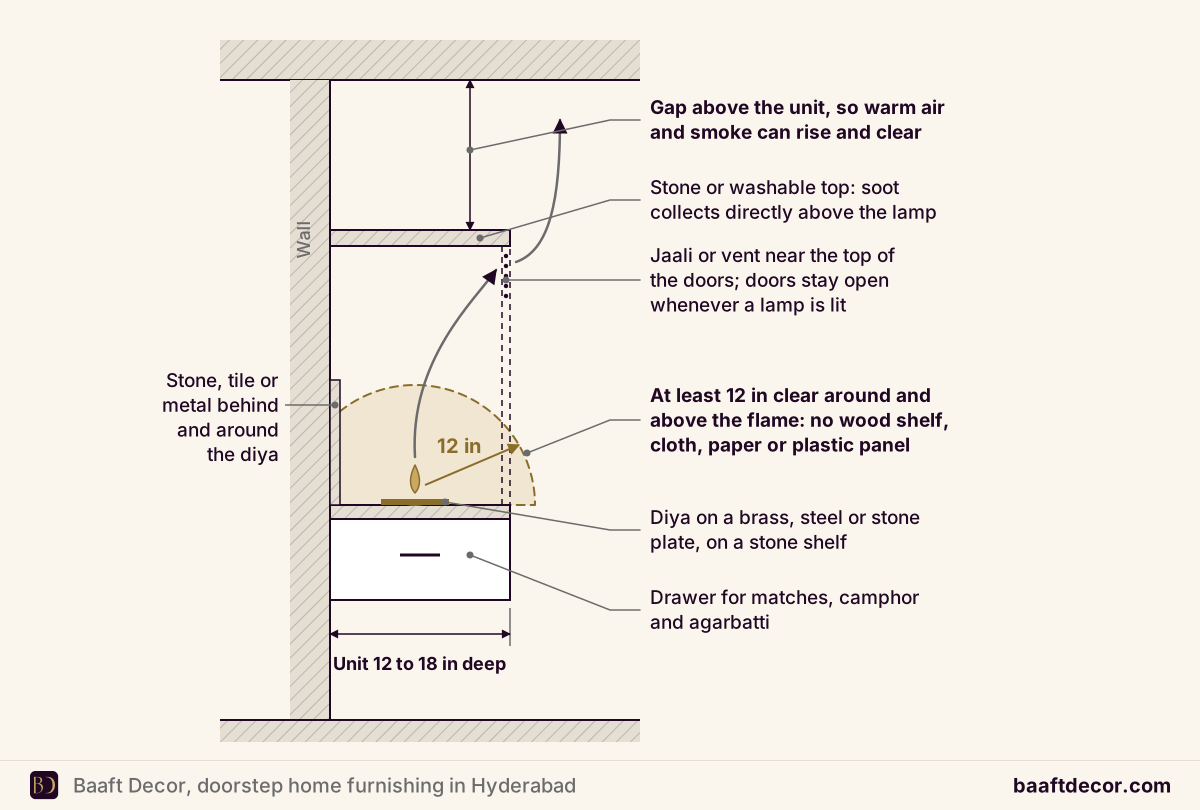
The US National Fire Protection Association gives a clear rule for candles: keep them at least 12 inches from anything that can burn (NFPA candle safety). A diya is an open flame too, so we treat it the same way.
- Put the diya on a brass, steel or stone plate, never directly on wood or laminate.
- Keep at least a foot of clear space around and above the flame. That rules out low shelves directly above the lamp.
- Keep curtains, cloth torans, paper and plastic panels out of that zone.
- Keep doors open while anything is lit, and add a jaali or vent near the top of the doors.
- Don’t box the unit tight to the ceiling. Leave a gap so warm air and smoke can rise and clear.
- For a lamp that burns through the night, an electric diya is the safer choice.
Soot is the slow problem. Over months, smoke darkens whatever is directly above the lamp. A stone top or a washable surface there saves repainting every year.
Small details that make daily pooja easier
- A drawer for matches, camphor and agarbatti, kept apart from flowers and kumkum
- A pull-out tray or slab for the pooja thali
- A hook for the bell and a small rail for garlands
- Two or three shelf levels, so idols and photos aren’t crowded on one line
- A plug point for lights or an electric diya, with the switch outside the unit
- A stone or quartz base that takes oil and water spills
Planning a pooja space in a new flat
For many families the pooja space has to be ready on the day of the gruhapravesam, even if the rest of the furniture follows later. Decide the position before the electrician finalises points, so the light and socket land in the right place. Our gruhapravesam furnishing timeline shows what to order first.
If you’d like help, book a free home visit. We’ll look at the walls you have, talk through your family’s preferences, bring wood, jaali, panel and wallpaper samples, and give you a fixed quote. Call or WhatsApp +91 98499 17494, any day from 8 AM to 10 PM.
Frequently asked questions
How can I design a pooja room in a small flat?
In a small flat, design the pooja space as a wall-mounted or corner mandir rather than a separate room. A floating unit about 2 to 3 ft wide keeps the floor clear, and a corner unit uses space that is otherwise wasted. Add a drawer for agarbatti, camphor and matches, a stone or metal shelf for the diya, and a warm light with its own switch. If dust is a concern, a cabinet mandir with folding doors keeps the space clean, as long as the doors stay open while a lamp is lit.
Which material is best for a pooja unit?
For most apartment pooja units, a carcass of good-grade plywood or HDHMR finished in veneer or laminate is the most practical material, because it is stable, easy to clean and affordable to shape. Solid wood such as teak suits carved, traditional designs in villas. Wherever the diya sits, use real stone, granite or a metal plate rather than wood, MDF or PVC, because a flame and hot oil can scorch or deform them. CNC jaali in MDF, WPC or metal works well for doors and back panels.
Is wallpaper suitable for a pooja room?
Yes, wallpaper is suitable for a pooja room if you choose the right type and keep it away from the flame. A washable vinyl wallpaper lets you wipe off incense and oil residue, and small motifs such as lotus, bells or Pichwai-style art suit the small scale of a mandir. Keep the wallpaper well clear of diyas and camphor, because heat and smoke discolour paper and metallic foils. Behind the lamp itself, a stone, tile or metal panel is the safer surface.
How do I ventilate a closed pooja cabinet?
To ventilate a closed pooja cabinet, keep the doors open whenever a diya or agarbatti is lit, and design the doors with a jaali or perforated panel near the top so warm air and smoke can escape. Leave a small gap above the cabinet rather than building it tight to the ceiling. For a separate pooja room, a window or small exhaust fan helps. If the lamp must burn while the doors are closed, an electric diya is the safer choice.
Can a pooja unit be placed in the living room?
Yes, a pooja unit can be placed in the living room, and in many Hyderabad apartments it is the most practical spot. A wall niche, a corner mandir or a section of the TV wall all work, provided the pooja area is clearly separated with a jaali panel, a gap or a change of material and has its own light. Many families have preferences about direction or nearby rooms, so check what matters to your household before fixing the position, and keep the flame away from curtains and electronics.
What lighting is best for a pooja room?
The best lighting for a pooja room is warm and soft, roughly the warm-white range used for living spaces, with no harsh glare on the idols or photos. Backlighting behind a jaali or translucent panel gives a gentle glow, and one or two small focused lights can highlight the deity. Put the switch outside the unit, so nobody reaches past a lit diya. Choose LED fittings, which run much cooler than old halogen spots, and keep the LED driver accessible for future replacement.
What size should a pooja unit be?
A wall-mounted pooja unit in an apartment is usually about 2 to 3 ft wide and 12 to 18 inches deep, which is enough for idols or photos, a diya shelf and a drawer. A floor-standing unit can be wider, with storage below. If you sit on the floor for pooja, leave about 3 ft of clear space in front. In villas, a separate pooja room can be anything from a small alcove to a full room. Measure the idols and lamps you already own before fixing shelf heights.