A false ceiling is the one part of an interior you can’t easily change later. Once the gypsum is up, painted and wired, moving a light means cutting the board. So the design deserves more thought than flipping through photos of hotel lobbies. If you’d like it planned and built properly, our false ceiling service in Hyderabad starts with a free home visit and a measured layout.
This guide is part of our home interior design guide for Hyderabad. Here we cover design ideas for the hall and the bedroom, how much height each one needs, and the lighting plan that makes them work.
Which false ceiling design suits a hall or bedroom?
Start with height. A design that looks generous in a villa can make a flat feel cramped.
| Design | Best for | Comfortable from (floor to slab) | Typical drop |
|---|---|---|---|
| Slim peripheral band with profile lights | Low rooms, minimal look | Under 9 ft | About 4 in at the edges |
| Peripheral with cove light | Most halls and bedrooms in flats | About 9 to 10 ft | 5 to 8 in at the edges |
| Two-step layered ceiling | Large halls, living plus dining | About 10 ft and above | 8 in or more at the lowest step |
| Tray or coffered ceiling | Master bedrooms, formal living rooms | About 10 ft and above | Varies with depth of the tray |
| Wooden rafter or slat ceiling | Dining zones, villas, feature areas | About 10 ft and above | Slats add 2 to 4 in |
The heights are practical rules of thumb, not building rules. They come from one simple test: once the ceiling is up, does the room still feel open when you stand in it?
Check your ceiling height first
Measure from finished floor to slab in the middle of the room and near each wall. Beams, sloping slabs and thick floor tiles all change the number, sometimes by several inches within one room.
Then list what has to go above the ceiling: split AC piping, a concealed curtain track, cove lights, wiring. Each one needs depth. A curtain pocket needs about 6 inches of width at the window wall, and split AC piping sets the drop on that side.
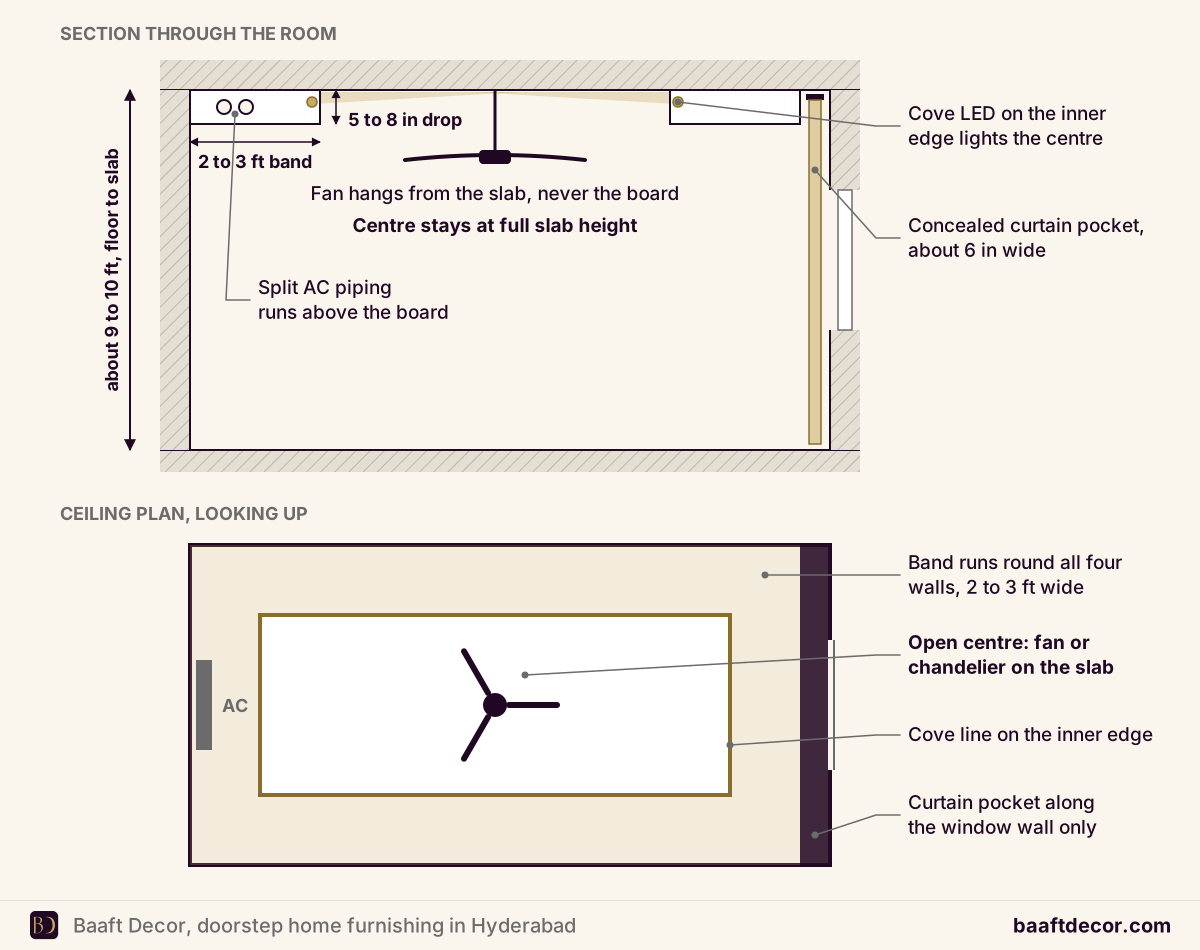
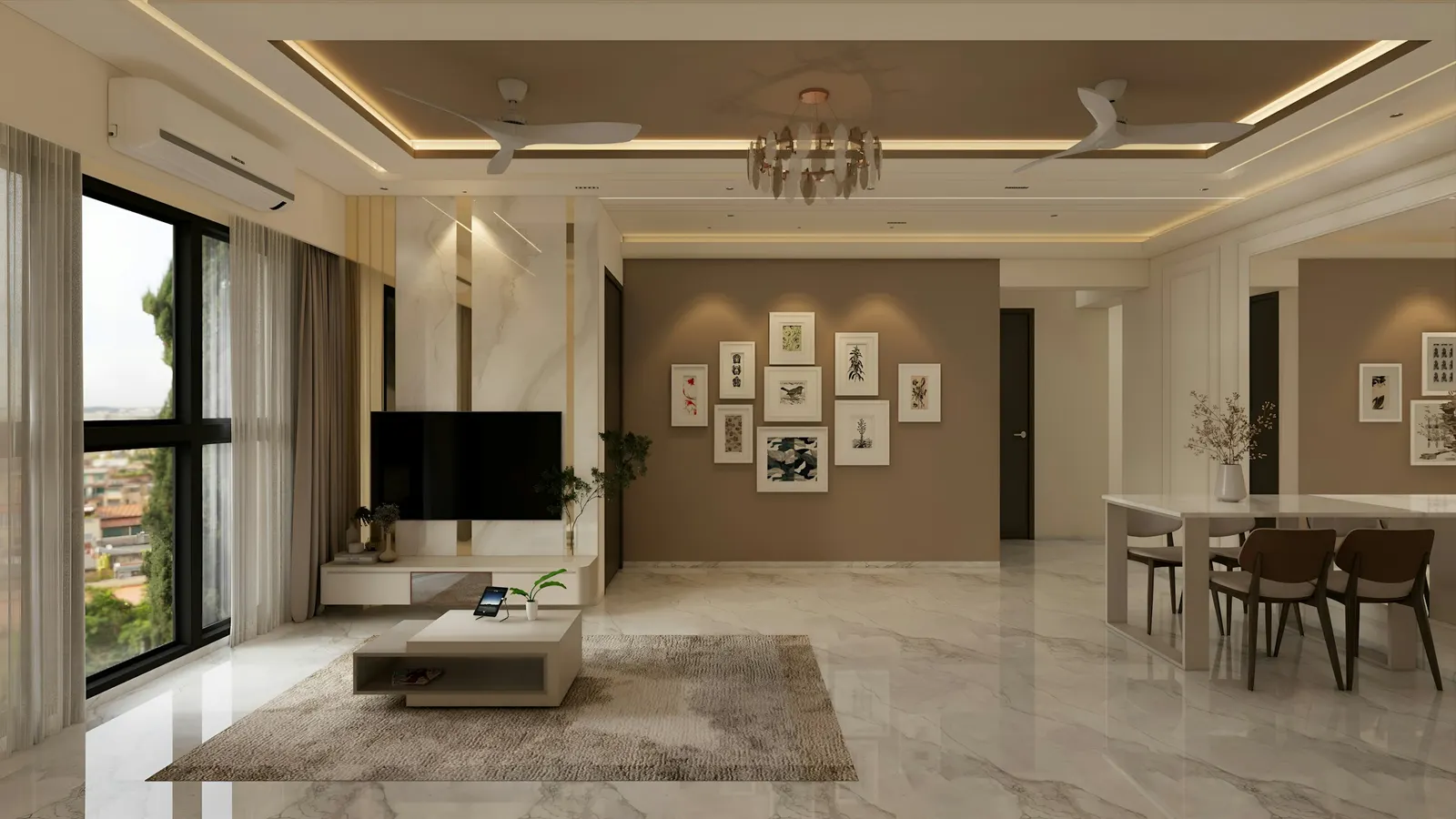
Two rules apply whatever the design. Fans and heavy chandeliers hang from the slab, never the board. And the centre of a low room should stay at full height wherever possible.
False ceiling designs for the hall
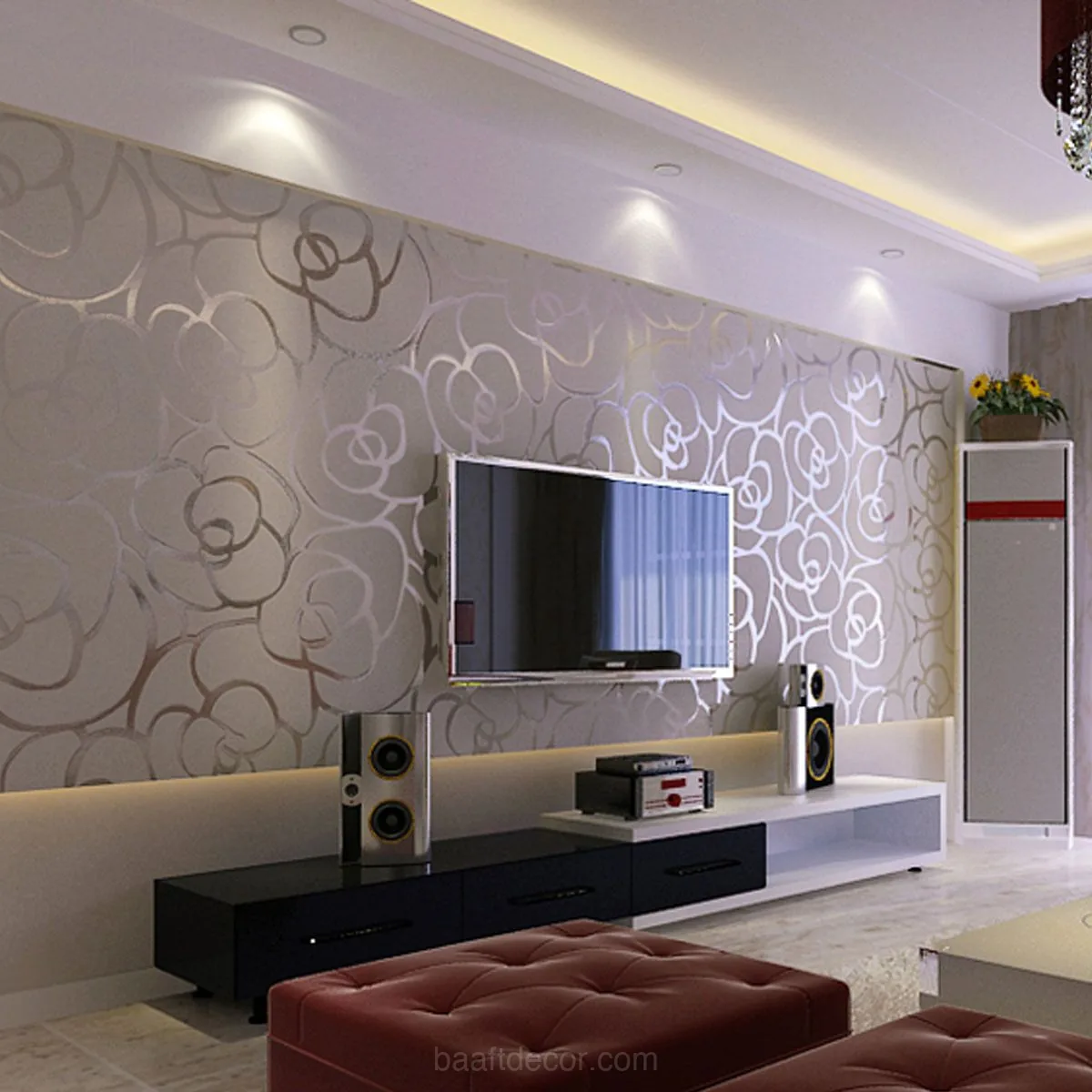
Peripheral ceiling with cove light
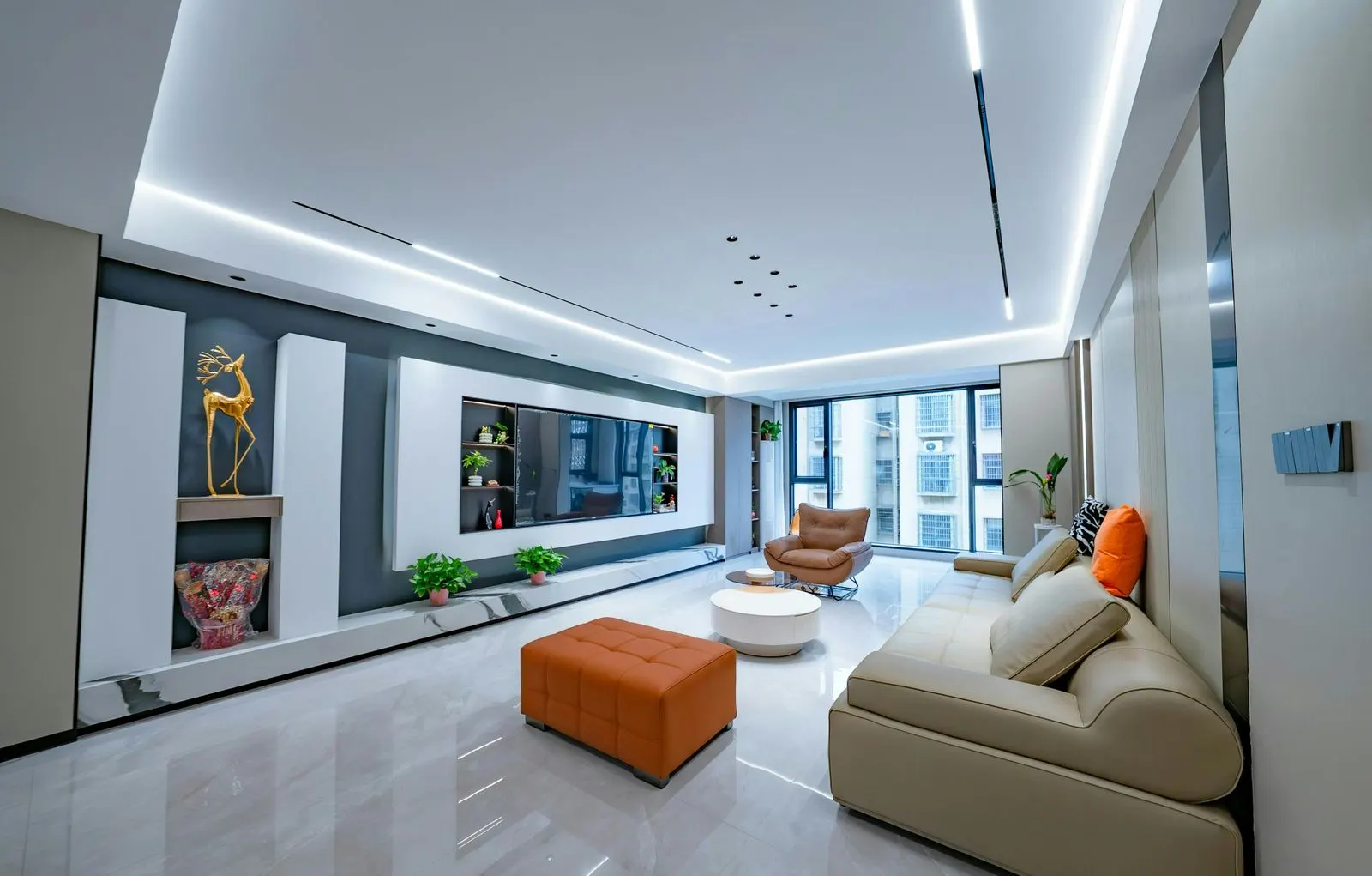
This is the default in Hyderabad apartments for good reason. A gypsum band about 2 to 3 ft wide runs around the room, the cove on its inner edge throws light up onto the centre, and the room keeps its height. It also hides the AC piping that would otherwise run across the wall.
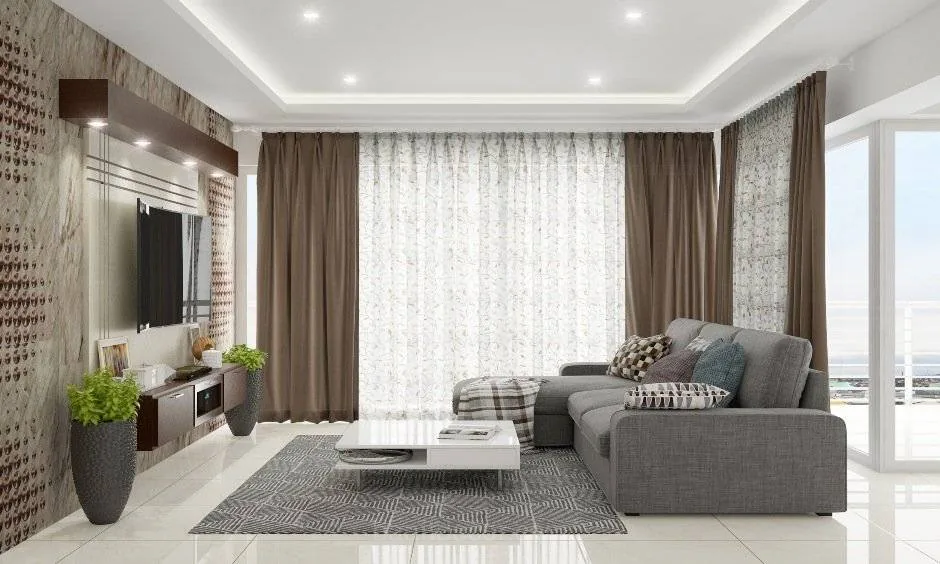
Peripheral ceiling with a concealed curtain pocket
Add a recessed pocket along the window wall and the curtain track disappears into the ceiling. Curtains then fall from the very top, which makes windows look taller. Read our guide to curtain rods and tracks before you fix the pocket size, because the track type decides the width.
Layered ceiling to separate living and dining
In an L-shaped or long hall, a two-step ceiling over the living area and a separate shape over the dining table quietly divides the space. Keep the steps few and the lines clean. Three or four levels with different light colours on each starts to look dated quickly.
Wooden rafter or slat ceiling
Wood-finish slats or battens, either over a gypsum base or as a floating section, bring warmth to a dining zone or a villa living room. In flats, keep them to one zone rather than the whole ceiling, and pick a lighter shade in lower rooms. Slats collect dust on their top edges, so they suit homes that don’t mind an occasional wipe.
Island over the dining table
A simple rectangle or circle dropped over the table, with a pendant hanging from its centre, anchors the dining area without touching the rest of the ceiling. Our living room interior design ideas cover how this fits with the TV wall and seating.
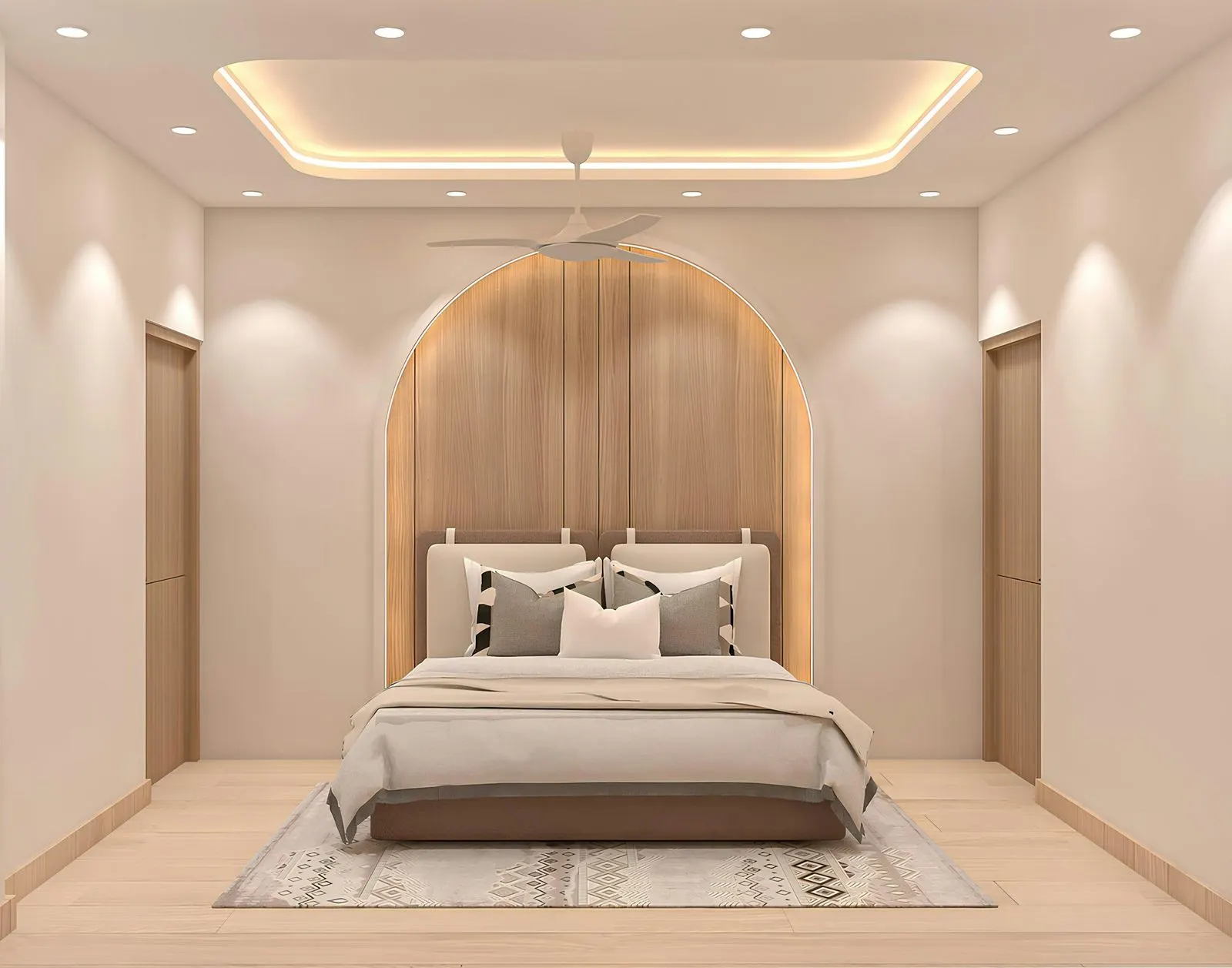
False ceiling designs for the bedroom
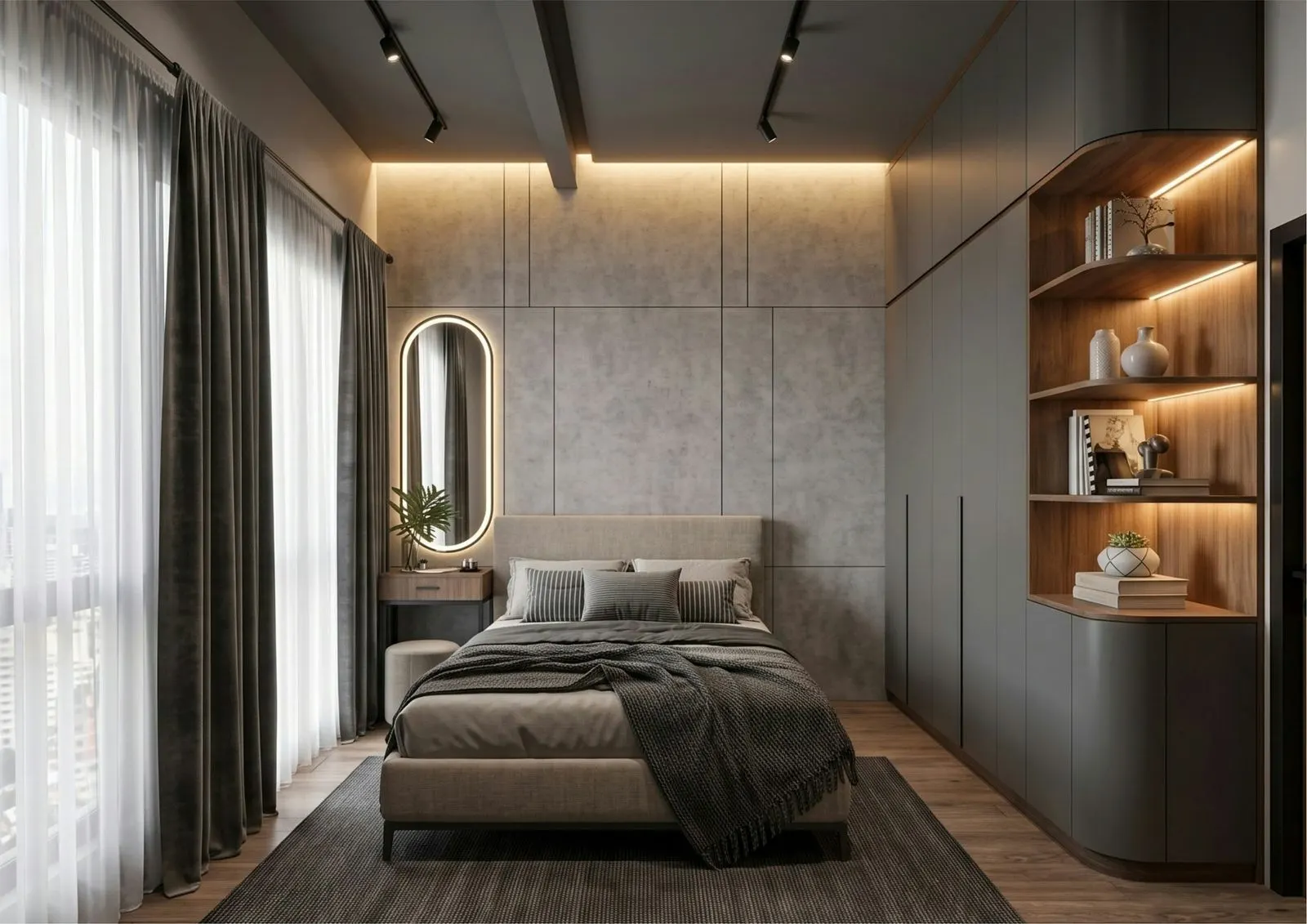
Bedrooms are seen lying down, which changes everything. What looks fine from the doorway can glare straight into your eyes from the pillow.
- Peripheral with warm cove: soft, even light, the safest choice for most bedrooms.
- Floating panel above the bed: a rectangle a little larger than the bed, lit from its hidden edge. It frames the bed without lights shining down on it.
- Tray ceiling: a recessed centre with a stepped edge, best in master bedrooms with good height.
- Simple flat ceiling with profile lights: for kids’ rooms and low ceilings. Star cut-outs and cartoon shapes date faster than children grow.
Our guide to bedroom interior design ideas covers the rest of the room, from the wardrobe wall to curtains.
POP or gypsum: which suits which design?
| Gypsum board | POP | |
|---|---|---|
| Straight lines and coves | Excellent | Good, slower |
| Curves, cornices, carved details | Limited | Excellent |
| Speed and mess | Quick, clean | Slow, dusty, needs drying |
| Finish | Smooth after jointing | Smooth when done well |
Most of the designs above are built in gypsum, sometimes with POP for a curved detail or a finishing coat. Our detailed comparison of gypsum, POP and PVC false ceilings covers moisture, cracks and which board suits which room.
How to plan false ceiling lighting
Lighting is the real reason most people want a false ceiling, so plan it on paper before the framing goes up.
- Ambient light: the cove or profile lights, for soft general light in the evening.
- Task light: a few downlights where you actually do things, such as over the dining table, in front of the wardrobe and by a reading chair.
- Accent light: an adjustable spot or two to wash the TV wall or a painting.
- Decorative light: a chandelier or pendant, if you want one, fixed to the slab.
Warm white suits halls and bedrooms after dark. The Sleep Foundation notes that low, warm-toned light may help you relax before sleep (Sleep Foundation on light and sleep), which is one more reason to keep bedroom coves warm and dimmable.
A few details save trouble later. Put coves and downlights on separate switches. Add a two-way switch by the bed for the main light. Use LED strips in an aluminium profile with a diffuser so you don’t see the dots. And leave a small access hatch near each LED driver, because drivers fail long before the board does.
Hyderabad-specific things to plan
- Top-floor flats and villas: the air gap above a false ceiling slows some heat coming through the roof slab, a real benefit in May.
- Seepage from above: check the slab for damp patches after a monsoon before you close it up. Gypsum doesn’t like water, and moisture-resistant board exists for kitchens and bathrooms (Gyproc’s moisture-resistant board is one example).
- Dust: open cove ledges collect construction dust in new communities. A closed profile light needs less cleaning.
- Pests: seal the edges where the ceiling meets the wall, or lizards and cockroaches move in.
Mistakes that are hard to undo
- Building first and deciding light positions later
- A grid of downlights that makes a living room look like an office
- Lights directly above the bed
- A layered ceiling in a room that didn’t have the height for it
- No access to LED drivers or AC piping joints
If you’re weighing up budget, our false ceiling cost guide explains what drives the price. When you’re ready, book a free home visit: we’ll measure your heights, mark beams and AC lines, sketch the ceiling and lighting plan with you, and give you a fixed quote. Call or WhatsApp +91 98499 17494, any day from 8 AM to 10 PM.
Frequently asked questions
Which false ceiling design is best for a hall?
For most apartment halls, the best false ceiling design is a peripheral ceiling: a gypsum band around the room with cove lighting on its inner edge and the centre left at full slab height. It hides AC piping and a concealed curtain track, gives soft evening light and doesn't make the room feel low. In large halls with more height, a two-step layered ceiling can separate the living and dining areas, and a wooden slat section over the dining table adds warmth.
Which false ceiling design is best for a bedroom?
For a bedroom, a simple peripheral false ceiling with warm cove lighting is usually the best design, because it gives soft, indirect light that is comfortable when you are lying down. Avoid downlights directly above the pillows, which shine straight into your eyes. Master bedrooms with good height can take a tray ceiling or a floating panel above the bed with hidden light around its edge. Keep the design calm; busy patterns overhead are tiring to look at every night.
What is the minimum ceiling height for a false ceiling?
There is no single height that suits every home, but as a practical rule, if your floor-to-slab height is under about 9 ft, keep the false ceiling to a slim peripheral band or skip it and use good surface lights. Between about 9 and 10 ft, a peripheral ceiling with a cove works well. Above 10 ft, layered, tray and wooden-rafter designs become comfortable. Measure in several places, because beams and sloping slabs change the height across a room.
How much height does a false ceiling reduce?
A false ceiling usually drops about 4 to 8 inches below the slab where it is built. A slim peripheral band with LED profile lights sits at the shallow end, while a cove with an LED strip, a concealed curtain pocket or split AC piping above needs more depth. In a peripheral design, the centre of the room keeps its full height, so the loss is only around the edges. Layered ceilings drop further at their lowest step, which is why they need taller rooms.
Is POP or gypsum better for false ceiling designs?
Gypsum board is better for most false ceiling designs in Hyderabad homes because it is factory-made, quicker and cleaner to install, and gives straight, even lines for coves and layered steps. POP is better for curves, ornate cornices and carved patterns, because it is shaped on site, but the work is slower, messier and needs drying time. Many homes use both: gypsum board for the structure and POP for decorative details or a smooth finish on top.
Can I put a ceiling fan in a false ceiling?
Yes, you can have a ceiling fan in a room with a false ceiling, but the fan must hang from the concrete slab, never from the gypsum board or its frame. The fan hook stays in the slab, and a longer down rod passes through a neat opening in the false ceiling. Plan the fan position before the ceiling is built so it sits centrally and its blades clear any cove lip or chandelier. Heavy chandeliers need the same slab fixing.
What lighting should I plan with a false ceiling?
Plan a false ceiling's lighting in layers: cove or profile lights for soft general light, a few downlights where you need task light such as reading spots, the dining table and wardrobe fronts, and an accent light for the TV wall or art. Warm white suits halls and bedrooms in the evening. Put cove lights and downlights on separate switches or dimmers, add a two-way switch by the bed, and leave access to LED drivers so a failed one can be replaced without breaking the ceiling.