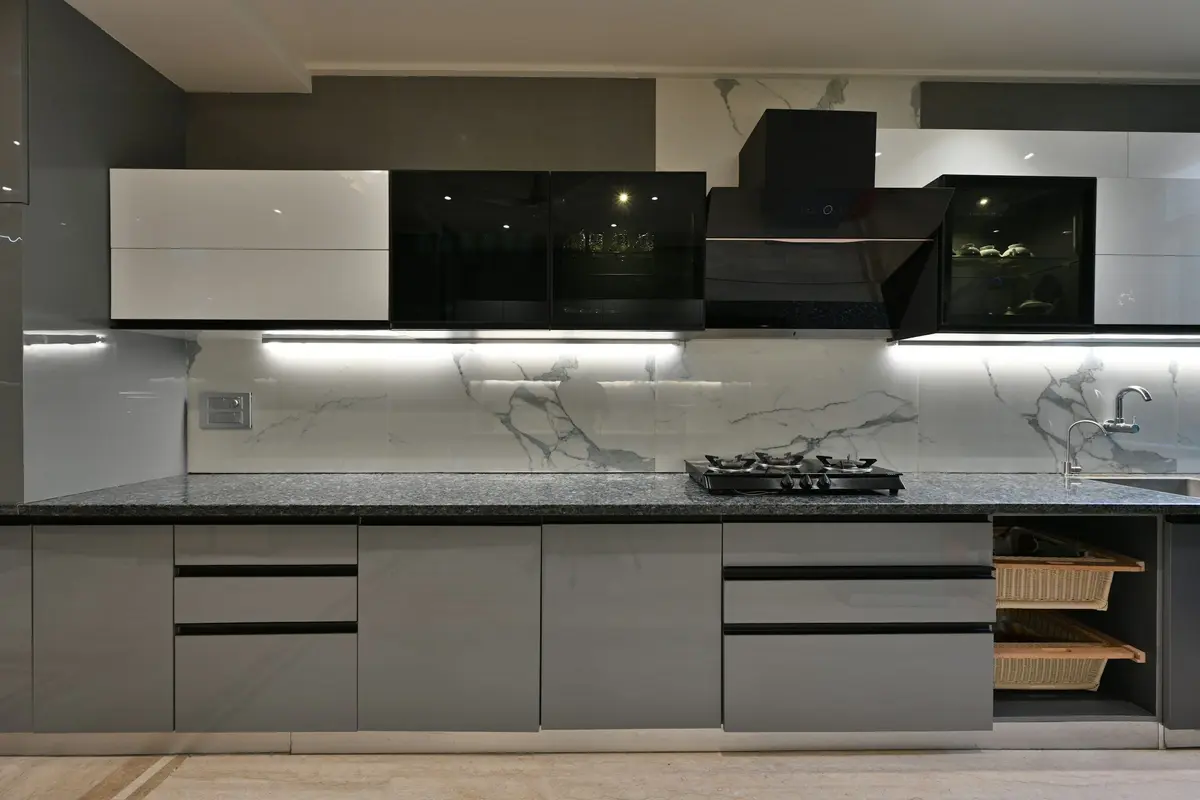
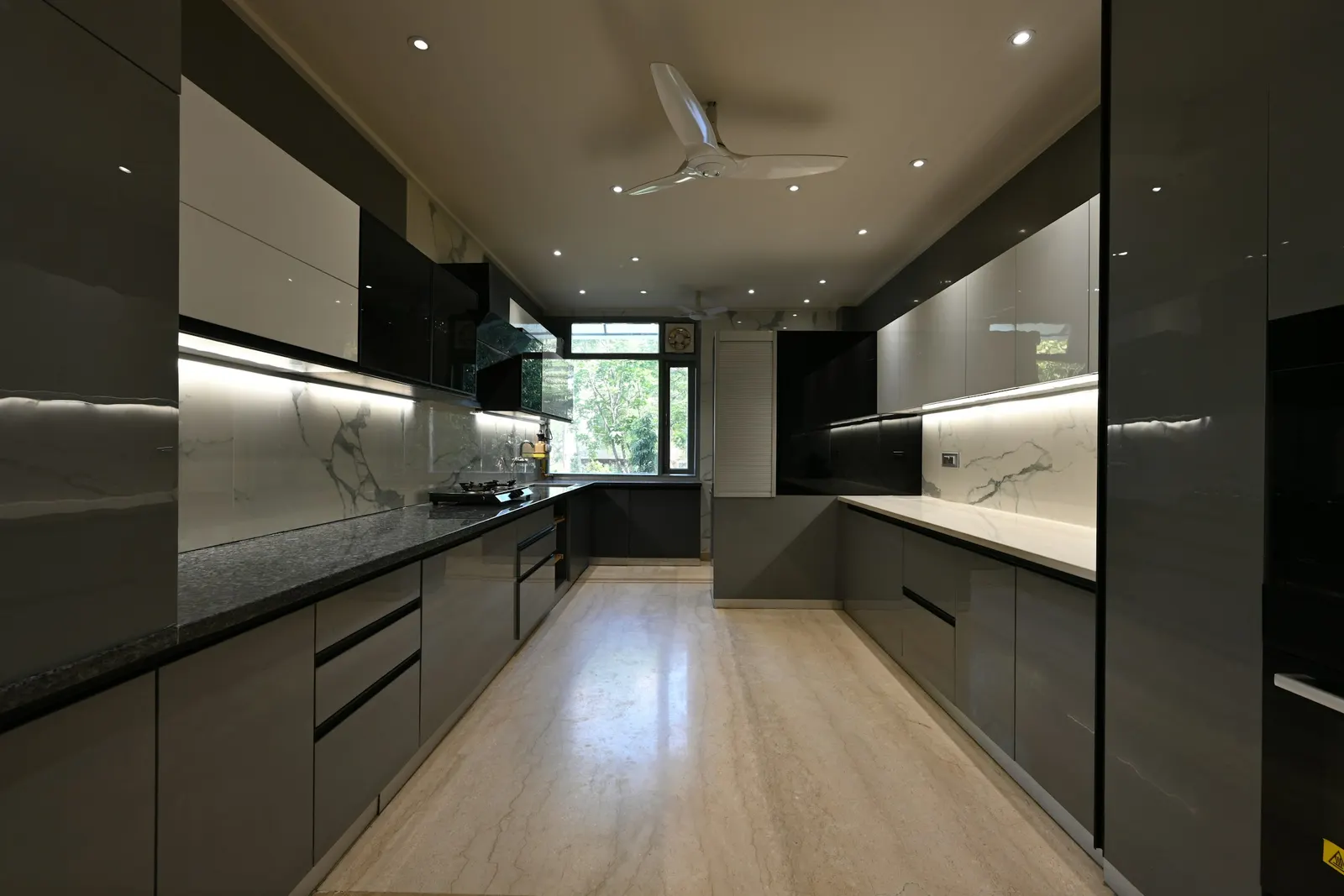
Your kitchen shutters get all the attention, but the boxes behind them do the hard work. They sit next to a leaking tap, a steaming pressure cooker and a mop bucket for years. Pick the wrong board and the sink cabinet starts swelling before the first monsoon is over.
Here’s how we choose materials when building modular kitchens in Hyderabad: what BWP, BWR, HDHMR and MDF actually mean, how they behave around water, and where each one belongs. Board choice is one chapter of our complete modular kitchen guide for Hyderabad, which also covers layouts, shutters, countertops and cost.
The short answer
- Sink unit and wet zone: BWP plywood (IS 710 marine or IS 303 BWP grade).
- Other base units and wall units: BWR plywood or HDHMR.
- Shutters with acrylic, PU or membrane: HDHMR (or moisture-resistant MDF in dry areas).
- Avoid in base units: ordinary MDF and particle board.
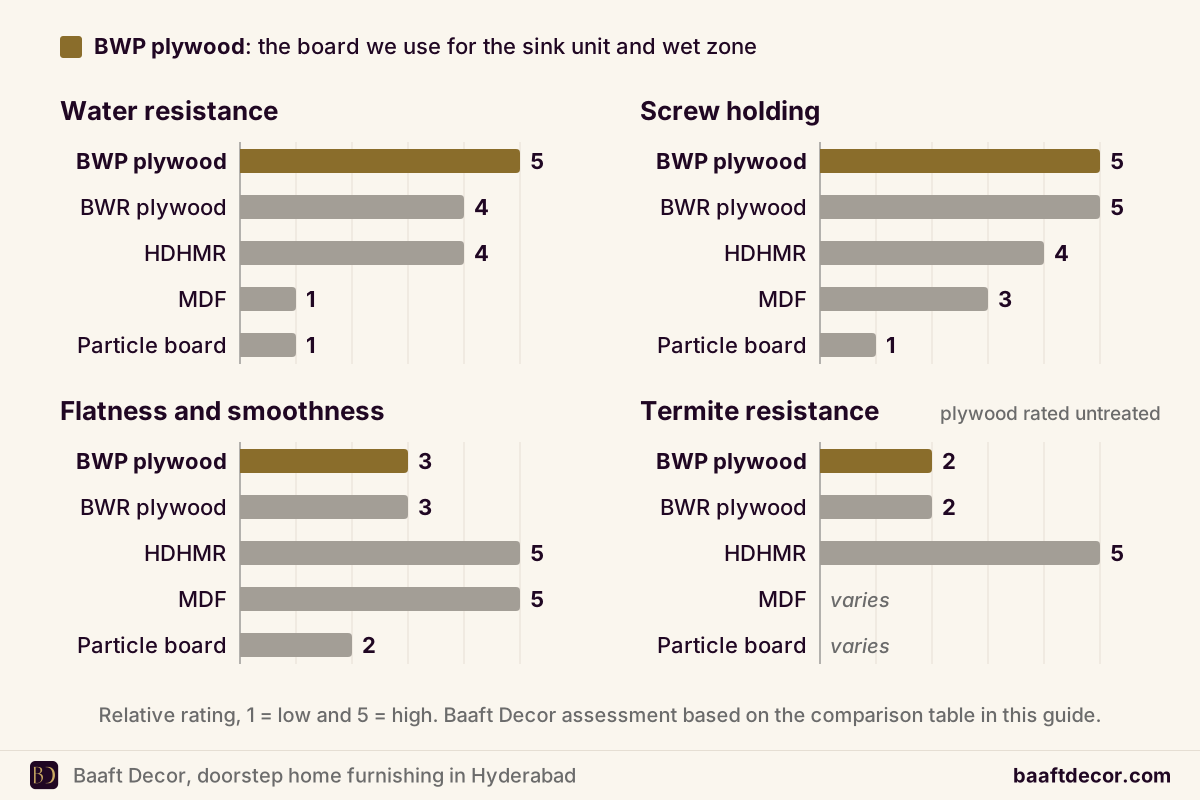
Kitchen cabinet materials compared
| Material | What it is | Water | Termites | Screw holding | Best use in a kitchen |
|---|---|---|---|---|---|
| BWP plywood | Veneers bonded with boiling-water-proof resin | Highest of the wood boards | Needs treatment | Very good, also at edges | Sink unit, wet base units |
| BWR plywood | Veneers with boiling-water-resistant bonding | Good | Needs treatment | Very good | Base and wall units away from sink |
| MR plywood | Moisture-resistant, interior grade | Fair | Needs treatment | Very good | Dry areas; wardrobes, not kitchens |
| HDHMR | Wood fibres pressed with moisture-resistant resin, about 850 to 900 kg/m³ | Good, not waterproof | Resistant from manufacture | Good across the face | Shutters, wall and tall units |
| MDF | Fine wood fibres pressed with resin | Poor (swells) | Varies | Moderate | Shutters for paint, decorative panels |
| Particle board | Wood chips bonded with resin | Poor | Varies | Poor | Avoid in kitchens |
What do IS 710 and IS 303 mean?
These are Bureau of Indian Standards (BIS) specifications for plywood, and you’ll see them printed on genuine sheets next to the ISI mark.
IS 303 covers general-purpose plywood. For decades it had two grades: MR (moisture resistant) for dry interiors and BWR (boiling water resistant) for humid ones. Its 2024 revision added a BWP (boiling water proof) grade for general use as well, partly to clear up confusion in the market, as Ply Reporter explains.
IS 710 is the marine plywood standard. It specifies BWP bonding with stricter construction requirements, originally for boat building. Many kitchen vendors use “710” plywood for sink units because it’s the most water-tolerant wood board you can buy.
In practice: IS 710 or IS 303 BWP for the sink zone, IS 303 BWR for the rest of a kitchen, IS 303 MR for bedrooms.
BWP plywood vs HDHMR
This is the comparison most homeowners get stuck on, and both sides have a point.
HDHMR (high density, high moisture resistance) is pressed to around 850 to 900 kg/m³, denser than most plywood, according to CenturyPly’s comparison. It’s dead flat, very smooth (good for acrylic and PU), resists termites from manufacture and handles steam and splashes well. But it isn’t waterproof. Standing water or a slow leak that reaches an unsealed edge can still make it swell.
BWP plywood has cross-layered wood veneers, so it’s strong along its length, sags less on long shelves and holds screws well even at the edges. It tolerates water better than any other wood board. It needs anti-termite and borer treatment, and its surface isn’t as smooth, so it’s less ideal under high-gloss finishes.
Our usual split: BWP plywood for the sink unit and base cabinets beside it, HDHMR for shutters, and either one for wall and tall units depending on budget.
Where MDF and particle board fit
MDF has a fine, even surface that takes paint beautifully, which is why PU shutters are often MDF-cored. But ordinary MDF drinks water through its edges and swells. Keep it to shutters in dry zones, decorative panels and wardrobe doors.
Particle board is the cheapest board and a common cause of swollen, sagging kitchen cabinets. It holds screws poorly, chips easily and swells fast. We don’t recommend it anywhere in a kitchen base.
Stainless steel and aluminium carcasses are also available. They don’t swell or attract termites, but finish choices are limited and they can dent and sound tinny.
Don’t forget the countertop load
Many Hyderabad kitchens have a granite or quartz countertop, and stone is heavy. In many apartments the builder’s granite sits on a masonry platform, and the modular cabinets slide in underneath. Where the stone sits directly on the cabinets, the carcass carries the full weight, so 18 mm plywood or HDHMR sides with proper support at every joint and around the sink cut-out are essential. A thin or weak carcass under stone is how countertops crack at the sink corners. If you’re choosing a new top, our kitchen countertop materials guide compares granite, quartz and the other options, and how to plan the top together with the cabinets.
A zone-by-zone specification
| Zone | Carcass | Shutter | Notes |
|---|---|---|---|
| Sink unit | BWP plywood | HDHMR or BWP with laminate | Aluminium or PVC sink tray |
| Base units beside hob | BWR or BWP plywood | HDHMR | Matte laminate near the hob |
| Other base units | BWR plywood or HDHMR | HDHMR | Deep drawers for vessels |
| Wall units | BWR plywood or HDHMR | HDHMR | Lift-up or hinged |
| Tall or pantry unit | BWR plywood or HDHMR | HDHMR | Good place for gloss finishes |
| Skirting | PVC or aluminium | Not applicable | Stops mopping water wicking up |
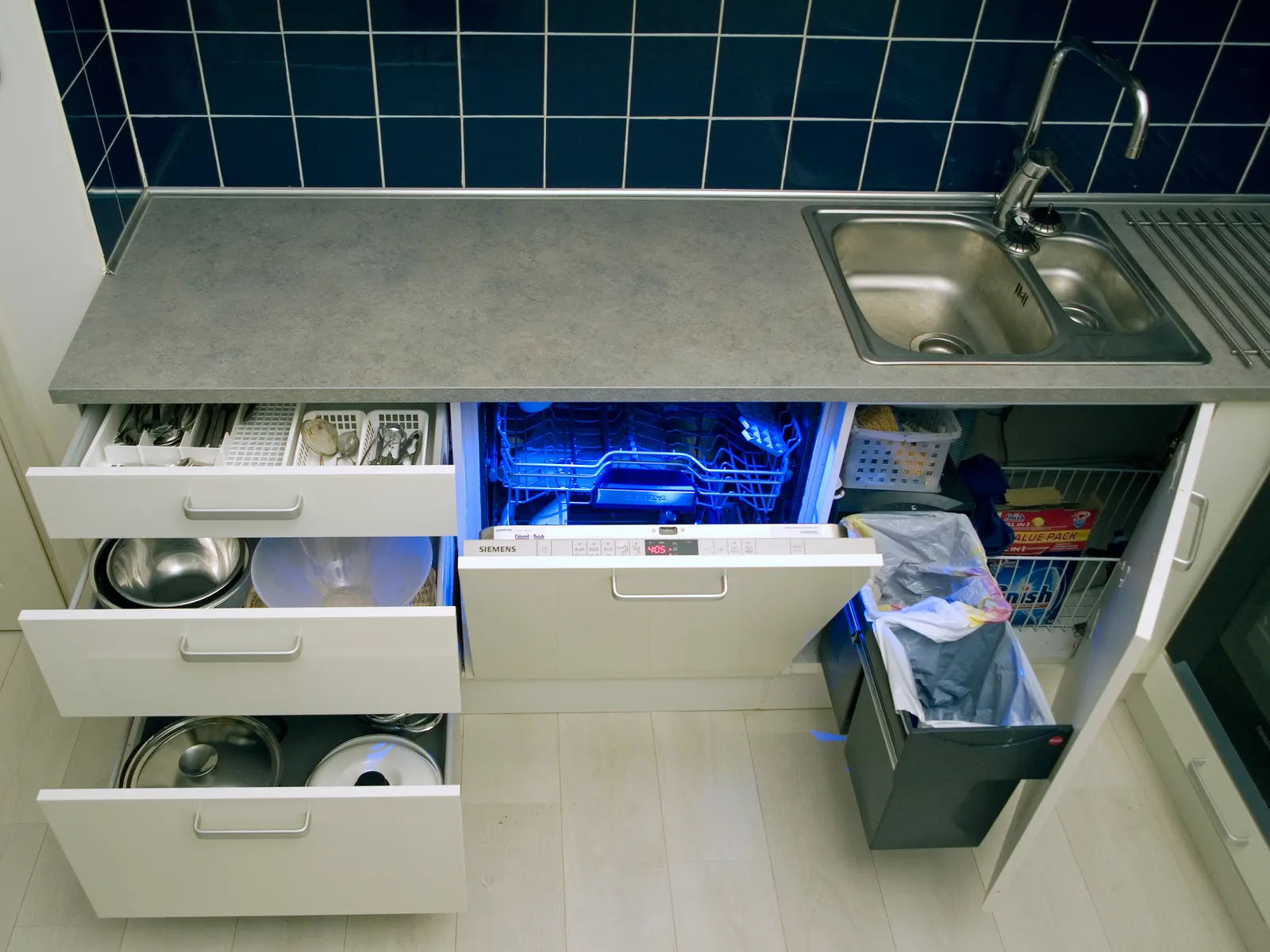
Thickness matters as much as grade. Carcass sides, shelves and shutters are usually 18 mm; backs are thinner. Every edge, including the hidden ones, should be edge-banded, because unsealed edges are where water gets in. The finish on top is a separate decision; our laminate vs acrylic vs PU guide applies to kitchen shutters too.
Common mistakes when choosing kitchen materials
- One board for everything. Using the cheapest board throughout, or the most expensive one, wastes money either way. Match the grade to the zone.
- Upgrading the shutter, not the sink unit. A premium acrylic front on a particle board sink cabinet is the wrong way round.
- Ignoring the edges. Hand-glued or missing edge banding on hidden edges lets water in where you can’t see it. Ask for machine-pressed edges all round.
- Cheap hinges on heavy shutters. HDHMR and lacquered glass shutters are heavy. Unbranded hinges sag within months, and the shutter edge starts rubbing.
- No gap at the back. A small air gap between the cabinet back and an exterior wall stops damp from soaking into the board.
- Choosing before the layout. Decide the layout first (our kitchen layouts guide helps), because it tells you how many units sit in the wet zone.
How to check you’re getting what was quoted
- Look for the ISI mark, standard number and grade printed on every sheet.
- Check the brand and batch number against the invoice.
- Measure thickness with a tape before cutting.
- Ask for the manufacturer’s test certificate if the grade matters (it does for the sink unit).
- Inspect boards on site before fabrication, not after.
Hyderabad conditions to plan for
Monsoon humidity from June to September is when weak boards and poor edge banding show up. Sealed edges and the right grade prevent nearly all of it; our monsoon home care guide covers airing cabinets and spotting damp early.
Termites and borers are common in older buildings and ground-floor flats. Treated plywood or HDHMR, plus checking the walls first, keeps them out.
Hard water leaves deposits around taps, and slow leaks under the sink often go unnoticed for weeks. That’s exactly why the sink unit gets BWP.
Material grade is one of the biggest levers in our modular kitchen cost guide, and the same board logic applies to bedroom wardrobes on walls shared with bathrooms.
On a free home visit we bring board and finish samples, check your plumbing and walls, and give a fixed quote that names the exact grade, brand and thickness for each zone. Call or WhatsApp +91 98499 17494, any day from 8 AM to 10 PM.
Frequently asked questions
Which is better for kitchen cabinets: BWP plywood or HDHMR?
BWP plywood is better for kitchen cabinets that face water, such as the sink unit and the base units beside it, because its boiling-water-proof bonding and cross-layered veneers tolerate leaks and wet cleaning best. HDHMR is better for shutters and dry cabinets, because it is denser, flatter, smoother to finish and resistant to termites from manufacture. Many good kitchens use both: BWP plywood for wet-zone carcasses and HDHMR for shutters, wall units and tall units.
What is the difference between IS 710 and IS 303 plywood?
IS 710 is the Indian Standard for marine plywood, which uses boiling-water-proof (BWP) bonding and tighter construction requirements, originally for boats and marine use. IS 303 is the standard for general-purpose plywood. It has long covered MR (moisture resistant) and BWR (boiling water resistant) grades, and its 2024 revision also added a BWP grade for general use. For kitchens, IS 710 or IS 303 BWP suits wet zones, while IS 303 BWR suits most other cabinets.
Is HDHMR waterproof?
No, HDHMR is not waterproof. HDHMR (high density, high moisture resistance) board resists humidity, steam and occasional splashes much better than ordinary MDF or particle board, but it can still absorb water and swell if exposed to standing water or long leaks, especially through unsealed edges. In kitchens, all HDHMR edges should be sealed with edge banding, and the board is best used for shutters, wall units and dry base units rather than the sink cabinet.
Can MDF be used for kitchen cabinets?
MDF can be used for some parts of a kitchen, but not for the carcass near water. Its smooth, even surface makes it a good base for PU paint, membrane and acrylic finishes on shutters, and for decorative panels. Ordinary MDF swells badly when it gets wet, so avoid it for the sink unit, base cabinets and anywhere water can reach the edges. For shutters in humid kitchens, HDHMR or moisture-resistant MDF is the safer choice.
What is the best material for the kitchen sink cabinet?
The best material for a kitchen sink cabinet is BWP grade plywood, either IS 710 marine plywood or IS 303 BWP grade, with all edges sealed. Line the cabinet floor with an aluminium or PVC sink tray so small leaks do not reach the wood, and use a PVC skirting so floor mopping water does not wick up. Stainless steel or aluminium sink units are also waterproof options, though they offer fewer finish choices.
What thickness of plywood is used for kitchen cabinets?
Kitchen cabinet carcasses are usually made from 18 mm plywood or HDHMR for the sides, top, bottom and shelves, because that thickness holds hinges and screws firmly and resists sagging. Back panels are usually thinner, since they mainly keep the box square and keep dust out. Shutters are also commonly 18 mm. Thinner carcass boards save a little money but tend to flex and hold hinge screws poorly over time.
Is particle board okay for a modular kitchen?
Particle board is not a good choice for a modular kitchen in Hyderabad, especially for base units. It is made from wood chips bonded with resin, so it holds screws poorly, chips at the edges and swells quickly if water reaches it through a leak or mopping. It may be acceptable for a dry wall unit in a tight budget, but for long life choose BWR or BWP plywood or HDHMR for the carcass.
How can I check if plywood is genuine BWP?
To check plywood is genuine BWP, look for the ISI mark with the standard number (IS 710 or IS 303) and the grade printed on each sheet, along with the brand and batch or licence number. Measure the thickness with a tape, check the brand's invoice, and ask your vendor for the manufacturer's test certificate. A good vendor will also let you see the boards on site before cutting, rather than only after installation.