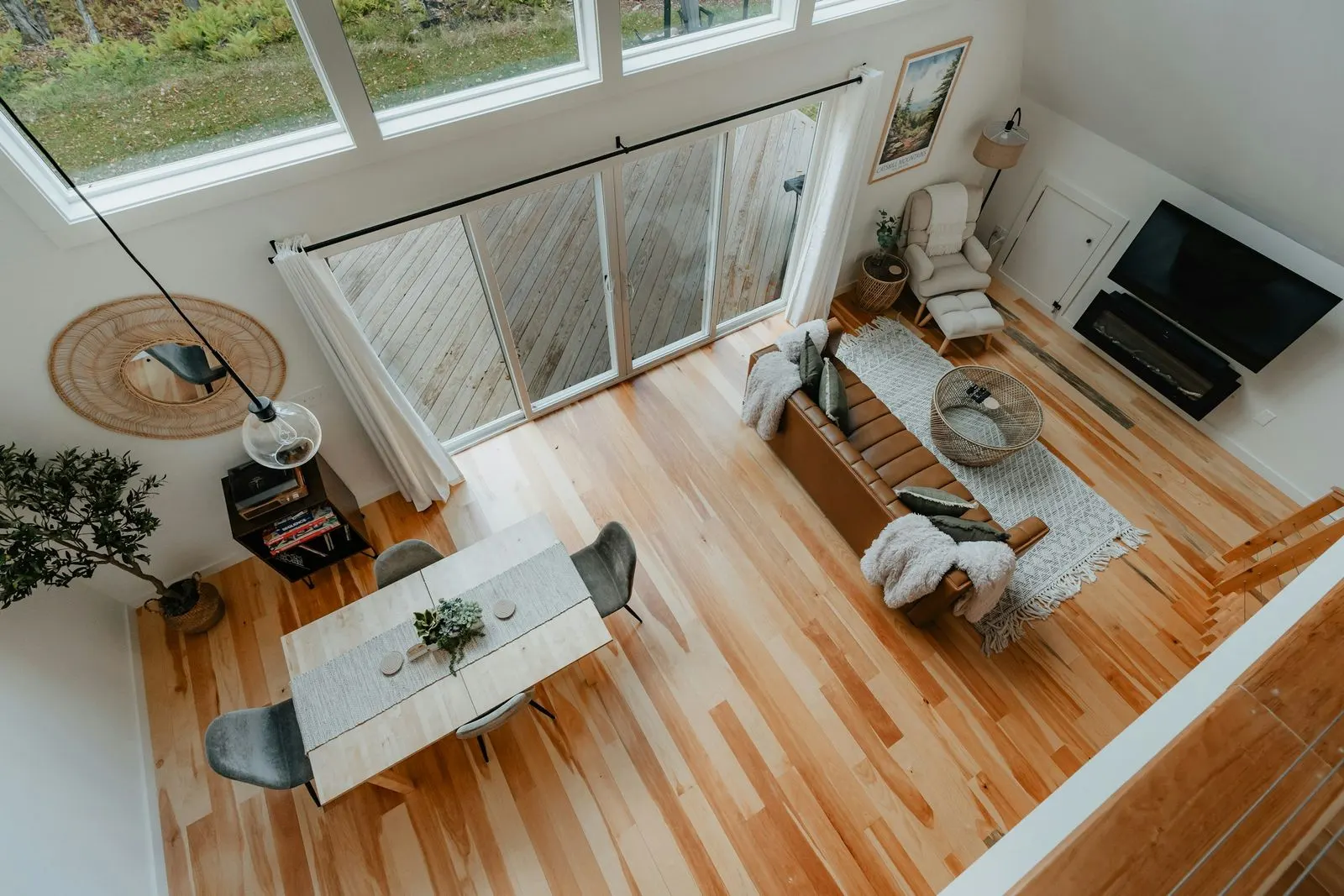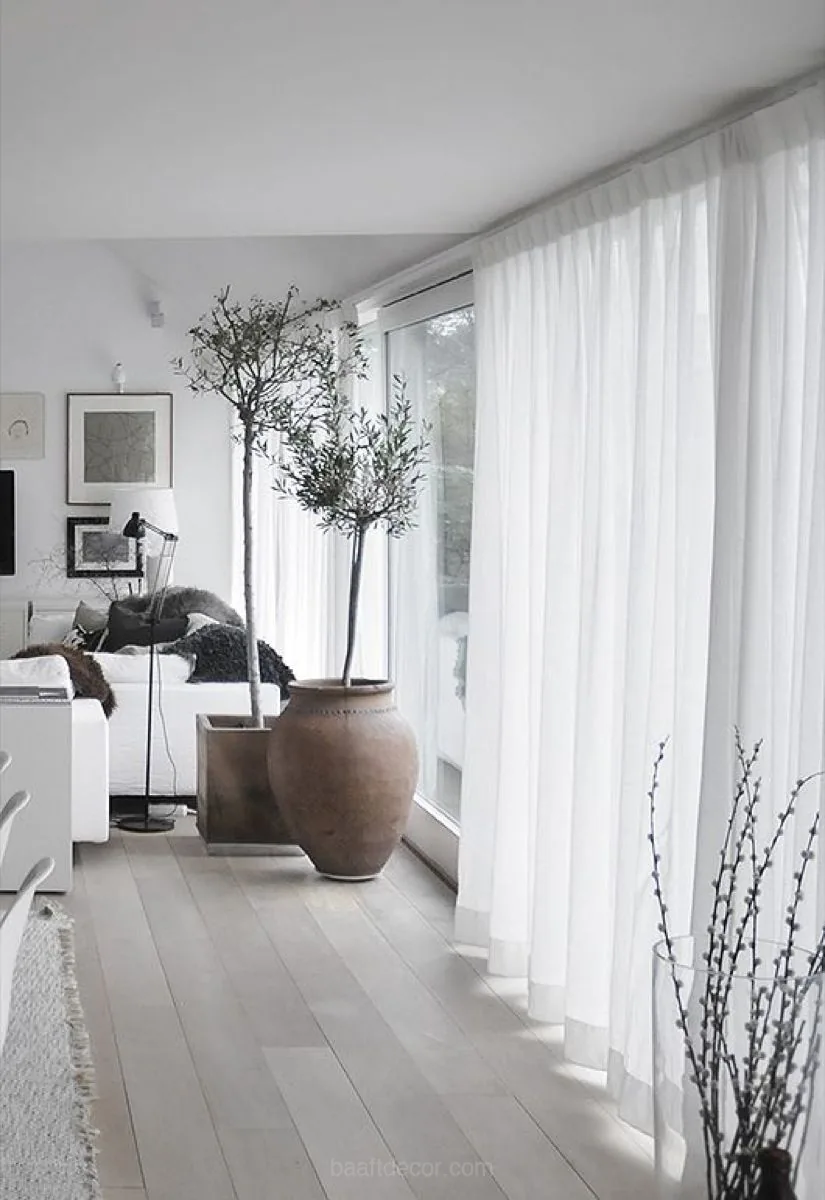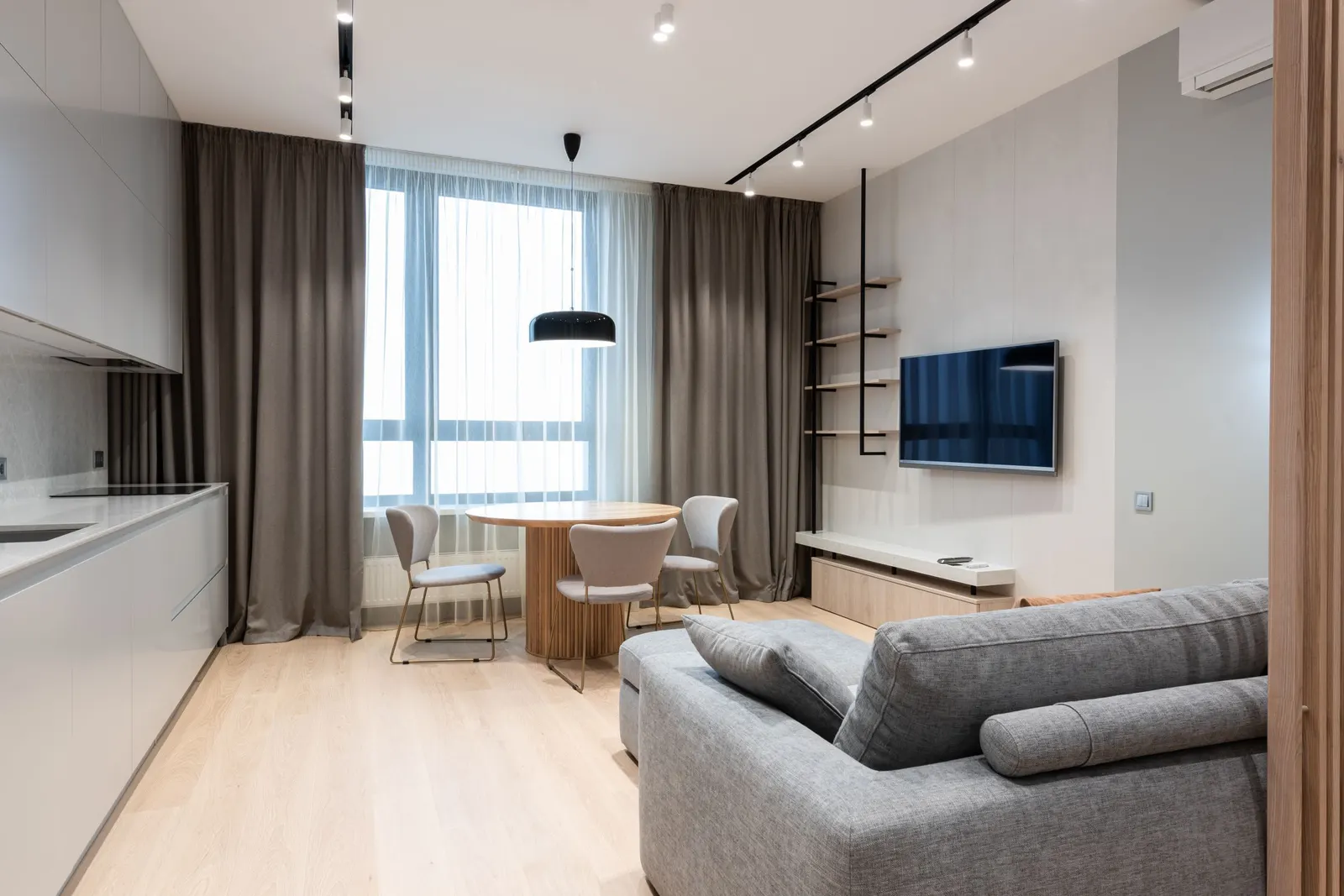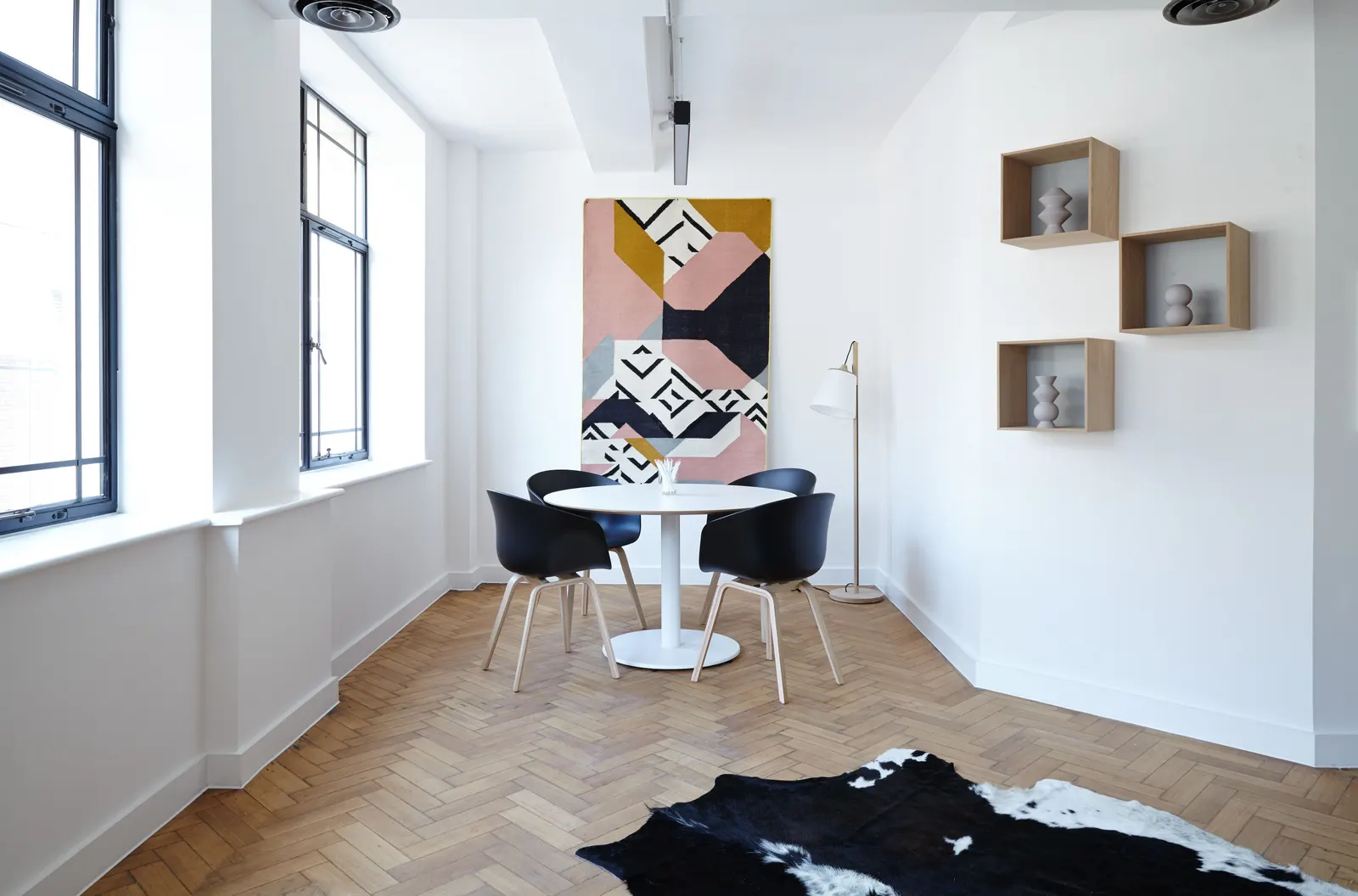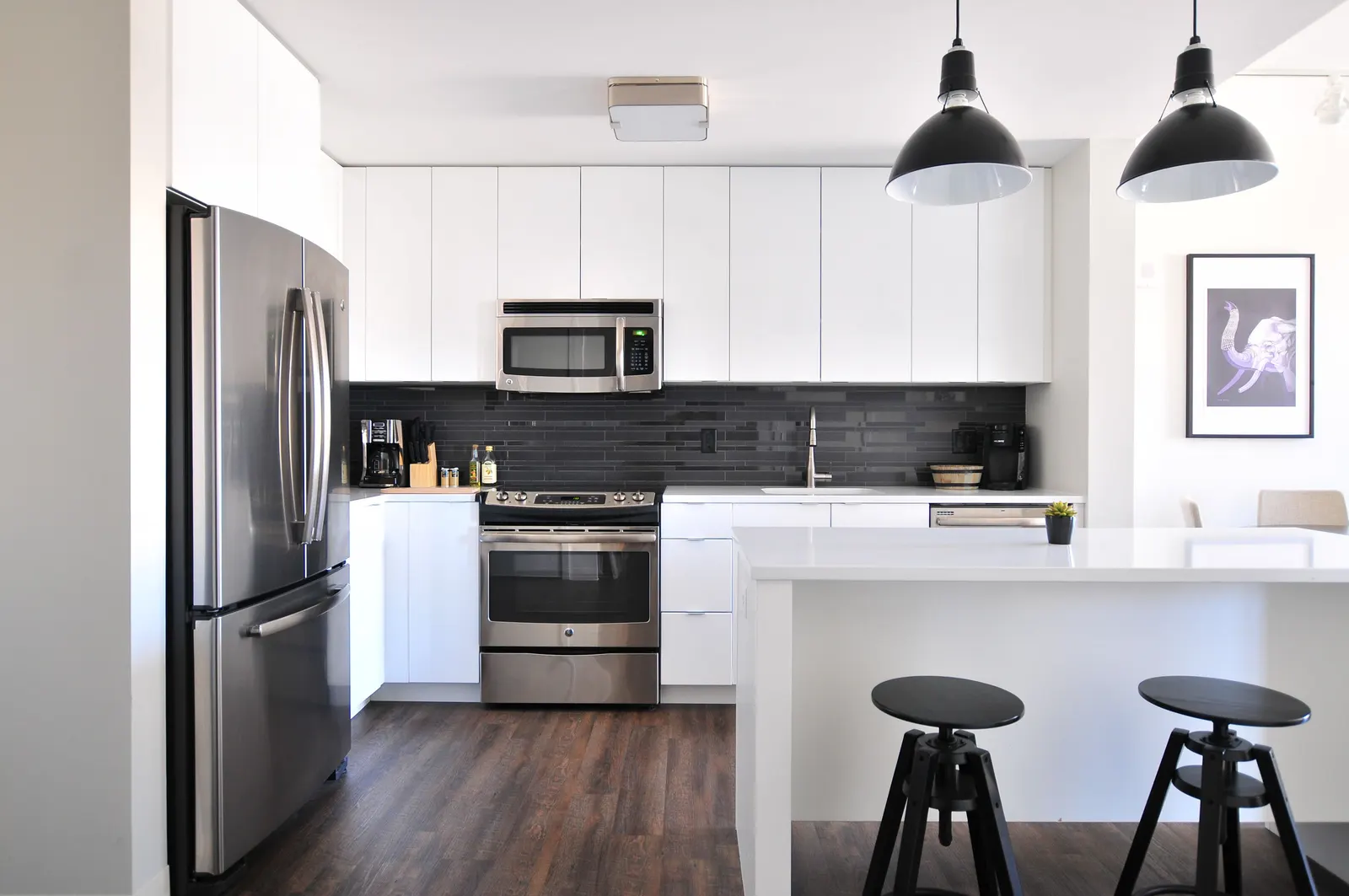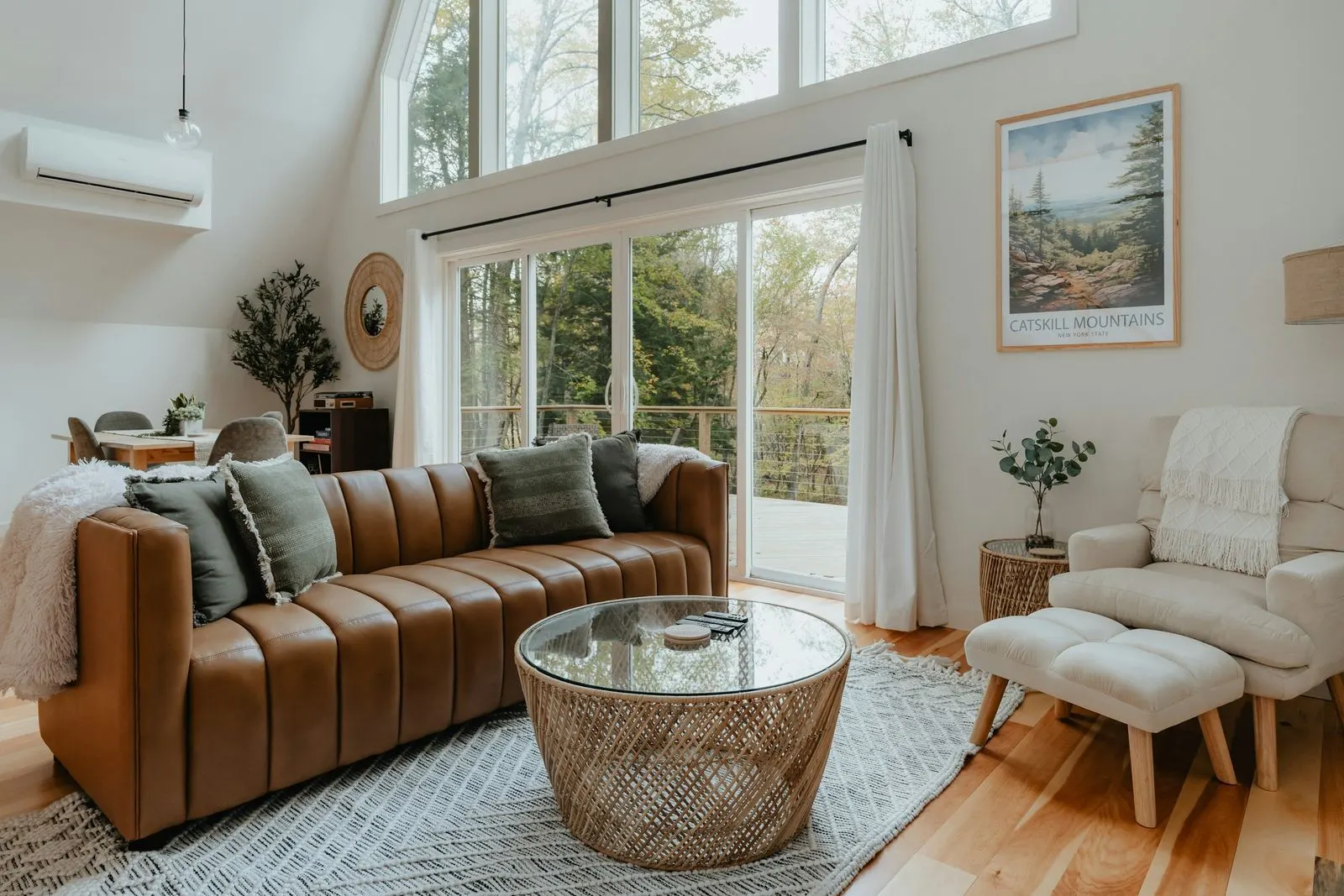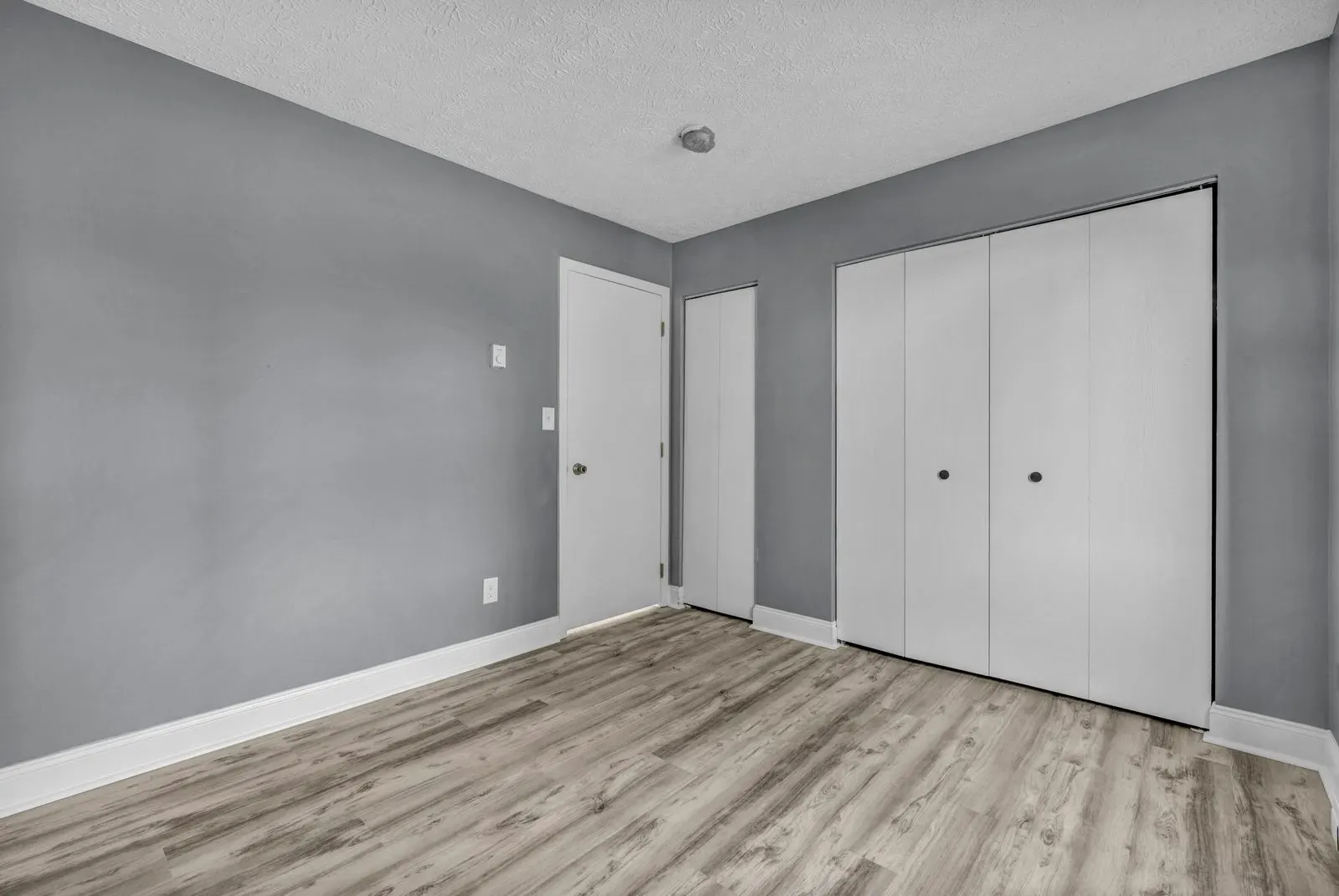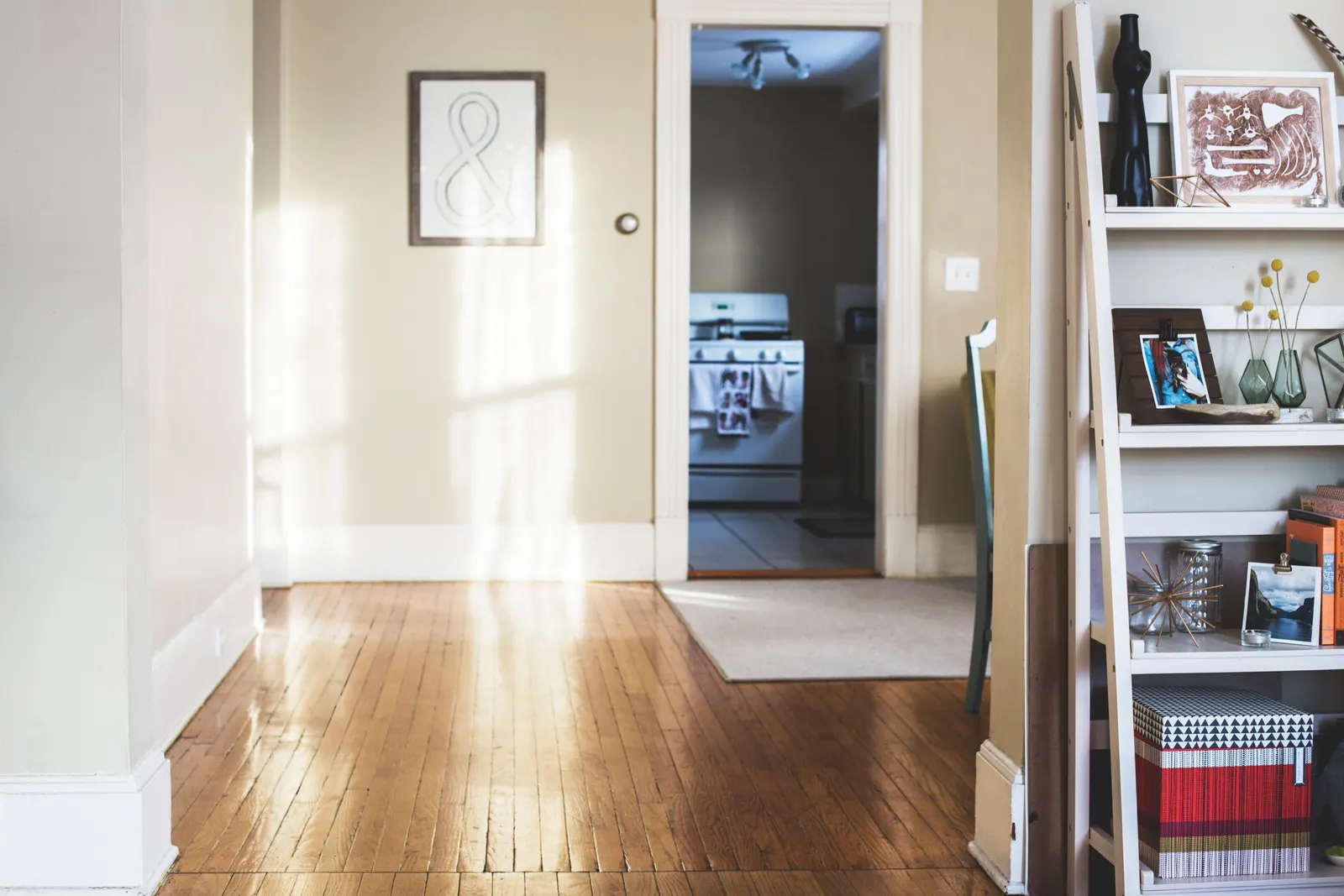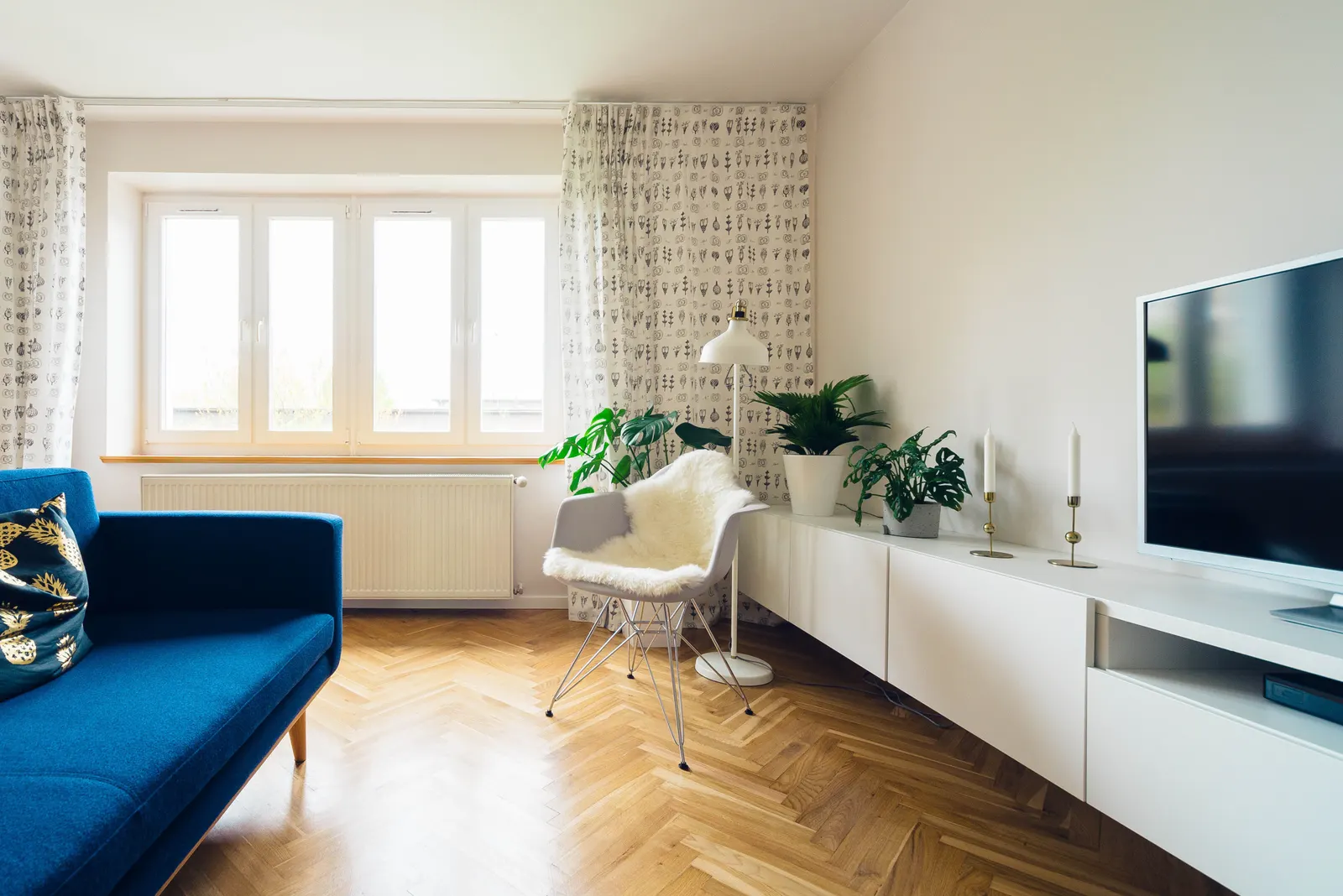
Four options, all of them sold as “wooden flooring” somewhere in Hyderabad. Only one of them is actually wood all the way through. The rest look like wood and behave very differently once water, sun and daily mopping get involved. Here’s how they compare, and which one we’d put in which room. For installation, see our flooring services in Hyderabad.
This page is the head-to-head. Carpets, rugs, room-by-room planning, installation and care are in our complete flooring guide for Hyderabad homes.
The quick verdict
- Choose SPC for living rooms, bedrooms, kids’ rooms and kitchens in apartments where floors get mopped daily. It’s the safest all-rounder for Hyderabad.
- Choose laminate for dry bedrooms and studies when budget matters most, and you can keep water off it.
- Choose engineered wood when you want the feel, sound and look of real wood in living rooms and bedrooms, and the budget allows.
- Choose solid hardwood only for villas and independent houses with a dry, well-prepared base, where you plan to stay for decades.
- Choose sheet or glue-down vinyl for rentals, offices and clinics on a very flat floor, or where budget is the main constraint.
What each one is actually made of
| Type | Construction | Typical thickness | How it’s laid |
|---|---|---|---|
| Solid hardwood | One piece of real timber (oak, teak, walnut and others) | Thick boards, often around 18 to 20 mm | Nailed or glued to a prepared base |
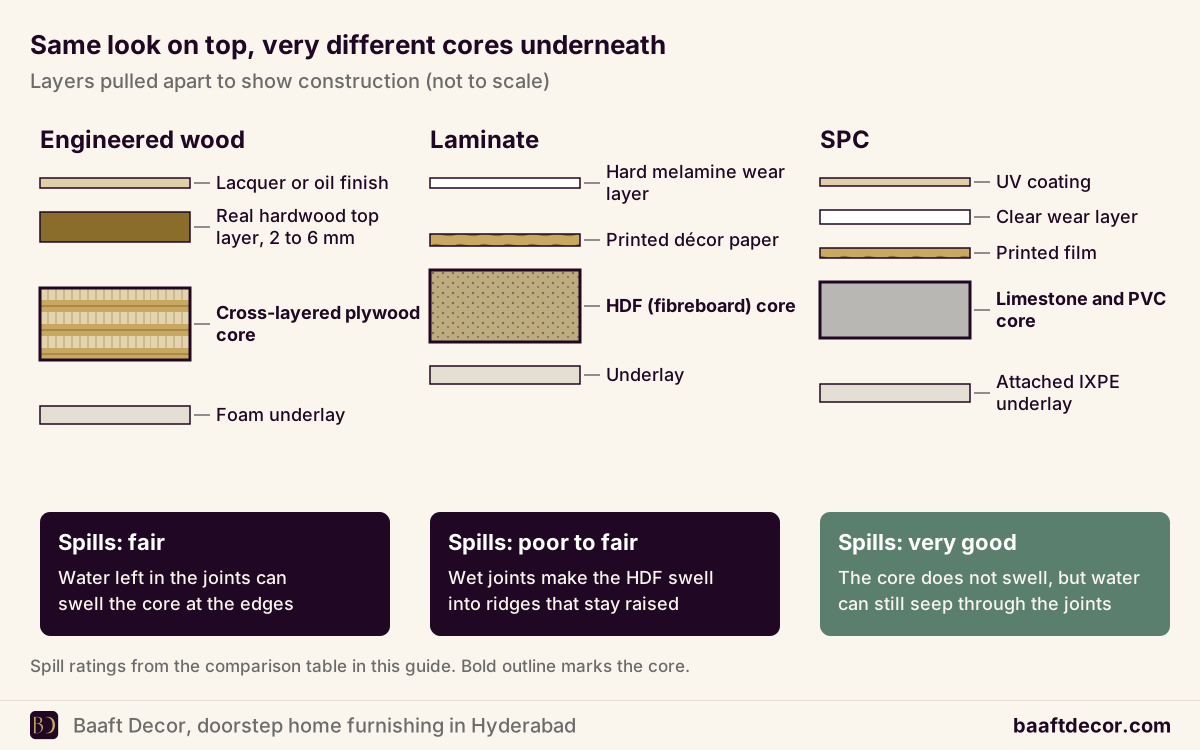
| Engineered wood | Real hardwood top layer (about 2 to 6 mm) bonded to cross-layered plywood or HDF | Typically 10 to 15 mm (some products up to 20 mm) | Floating click or glued |
| Laminate | Printed décor paper and a hard melamine wear layer on an HDF (fibreboard) core | 8 to 12 mm | Floating click on underlay |
| Sheet / glue-down vinyl (LVT) | Flexible PVC with a printed film and clear wear layer | Thin, a few mm | Glued to a smooth, flat base |
| SPC (rigid-core vinyl) | Rigid core of limestone powder and PVC, printed film, clear wear layer, often an attached underlay | About 4 to 6 mm plus underlay | Floating click |
What is the difference between SPC and laminate?
People mix these two up constantly, because both are click-lock planks that look like wood. The difference is the core.
Laminate’s core is HDF, compressed wood fibre. It’s dense and stable when dry, but if water sits in a joint long enough, the fibre absorbs it and the edges swell into a raised ridge. That damage doesn’t go back down. Laminate’s surface, on the other hand, is very hard. Its abrasion resistance is graded from AC1 to AC5 or higher under the European standard EN 13329, and AC3 to AC4 is the usual range for homes. Our laminate flooring guide explains the AC classes, thickness and underlays in more detail.
SPC’s core is limestone powder bound with PVC. Water doesn’t make it swell. It’s a little thinner than laminate, feels firmer, and can sound slightly different underfoot depending on the underlay. Its durability comes from the clear wear layer on top, so a thicker wear layer means a longer life.
If your home mops daily, has kids spilling water, or has a balcony door where rain blows in, SPC is the safer pick. Our SPC flooring guide goes deeper.
Vinyl vs laminate: where does vinyl fit?
“Vinyl” covers three quite different products:
- Sheet vinyl, sold in rolls. Budget-friendly, waterproof surface, but it looks and feels like what it is.
- Glue-down LVT (luxury vinyl tile/plank). Thin, realistic, waterproof, but it needs a very smooth, flat base, because every bump and grout line underneath shows through.
- Rigid-core click vinyl, of which SPC is the most common type. Stiff enough to bridge small imperfections and click together like laminate.
So, vinyl vs laminate: rigid-core vinyl beats laminate on water, laminate usually beats thin vinyl on surface hardness, and glue-down vinyl only works on a near-perfect floor.
Side-by-side comparison
| Factor | Solid wood | Engineered wood | Laminate | Glue-down vinyl | SPC |
|---|---|---|---|---|---|
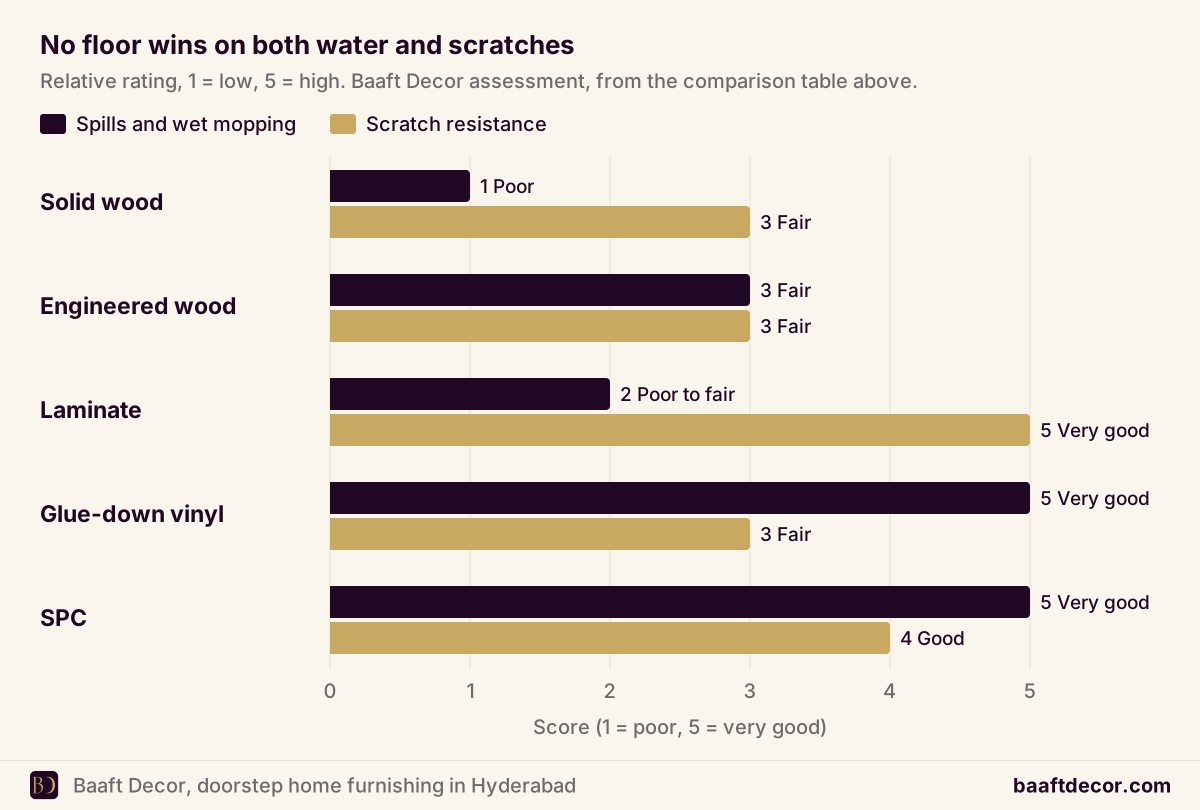
| Spills and wet mopping | Poor | Fair | Poor to fair | Very good | Very good |
| Monsoon humidity stability | Fair | Good | Fair | Good | Very good |
| Scratch resistance | Fair (can be sanded) | Fair (can be sanded) | Very good | Fair | Good |
| Dents from heavy furniture | Fair | Fair | Good | Fair | Good |
| Feel and sound | Warmest, most natural | Natural | Firm, can sound hollow | Soft, quiet | Firm |
| Can be refinished | Many times | A few times, depends on top layer | No | No | No |
| Over existing tiles | No | Yes (floating) | Yes | Only after levelling | Yes |
| Relative cost | Highest | High | Lower | Lowest | Mid |
Which flooring for which room?
- Living room: SPC or engineered wood. Engineered if you want real wood and the room doesn’t open onto a rain-exposed balcony.
- Bedrooms: any of them. Laminate is a good value choice here because bedrooms see the least water.
- Kids’ room: SPC. Spills, toys and drawings on the floor.
- Kitchen: SPC with a thicker wear layer, or stay with tiles. Avoid laminate.
- Bathroom wet areas and open balconies: none of these. Tiles.
- Home office: SPC or laminate, with a chair mat under castor wheels.
Hyderabad-specific things that change the answer
Daily wet mopping. Most homes here mop with water every day. A well-wrung mop is fine on any of these floors, but a dripping one slowly kills laminate and engineered wood at the joints.
Monsoon humidity. Real wood and HDF absorb and release moisture across the year. Floors laid without a proper expansion gap can push up at the edges by August.
Ground-floor damp. Older independent houses often have rising damp. Wood and laminate there need a moisture barrier under them, and sometimes damp-proofing first.
West sun through glass. Large sliding doors on west-facing balconies push strong afternoon sun onto the floor. Over time it can fade any surface, and heat can make planks expand. Blinds or curtains that close in the afternoon protect the floor too.
Construction dust and grit. In new gated communities, fine sand gets tracked in for months. Grit under shoes scratches every floor, so use doormats and sweep before mopping.
Termites. For wood-based floors on ground floors, check for termite activity and treat before laying.
What ends each floor’s life?
Lifespan claims on brochures vary wildly, so it helps to know what actually retires each floor in a real home.
- Solid wood wears down slowly and can be sanded back to fresh timber many times. What ends it is usually water damage or termites, not wear.
- Engineered wood lasts as long as its top layer. Once sanding has used up the veneer, the board is done. Standing water at the joints is the other common killer.
- Laminate rarely wears through in a home. It’s usually replaced because of swollen joints after a leak, a mopping habit or an RO purifier overflow.
- Glue-down vinyl gets replaced when the wear layer scuffs through in walkways or when the adhesive lets go on a damp base.
- SPC ends when its wear layer is worn through in high-traffic paths, which is why the wear layer matters more than plank thickness. We cover what to look for on our vinyl and SPC flooring service page.
In Hyderabad homes, water decides more floor lifespans than footsteps do.
Thickness numbers that actually matter
- Laminate: look at the AC rating, not just the thickness. AC4 is a sensible choice for living areas.
- SPC: look at the wear layer (often 0.3 mm or 0.5 mm), not the overall plank thickness. A thicker wear layer lasts longer in busy rooms.
- Engineered wood: look at the top-layer thickness. A 2 mm veneer can be sanded once at best; 4 to 6 mm allows more refinishes over the floor’s life.
Budgeting for real wood? Our wooden flooring cost guide explains what drives the price, and the engineered and wooden flooring service page covers how we install it. And if you’d rather not break your existing tiles, you usually don’t have to: SPC, laminate and click engineered wood can all float over a sound, flat tiled floor.
See the samples in your own light
We bring laminate, SPC, vinyl and engineered wood samples to your home, check your existing floor, and recommend what suits each room before quoting. Call or WhatsApp +91 98499 17494 (8 AM to 10 PM, all 7 days) for a free home visit.
Frequently asked questions
What is the difference between SPC and laminate flooring?
The main difference between SPC and laminate flooring is the core. Laminate has a high-density fibreboard (HDF) core made from compressed wood fibre, topped with a printed décor layer and a hard melamine wear layer. SPC has a rigid core of limestone powder and PVC with a printed vinyl film and a clear wear layer. Water that seeps into laminate joints makes the HDF swell, while SPC planks do not swell. Laminate often has a harder scratch-resistant surface and feels more like wood underfoot.
Which is better, vinyl or laminate flooring?
Vinyl is better than laminate where water is a concern, such as kitchens, kids' rooms and homes that mop daily, because the PVC-based plank does not swell. Laminate is better where scratch resistance and a wood-like feel matter in dry rooms, and it is usually more forgiving of small subfloor bumps than thin glue-down vinyl. Rigid-core vinyl such as SPC combines vinyl's water resistance with a stiff click plank, which is why it has become the popular middle ground in Indian apartments.
Is engineered wood better than solid wood flooring in India?
For most Indian homes, engineered wood is the more practical choice than solid wood. Engineered boards have a real hardwood top layer bonded to cross-layered plywood or HDF, which makes them far more stable through humidity swings like Hyderabad's monsoon. They can be laid as a floating floor over existing tiles. Solid wood moves more with moisture, needs a well-prepared, dry base, and costs more. Solid wood's advantage is that it can be sanded and refinished many more times over its life.
Which flooring is best for Indian homes that mop with water daily?
For Indian homes that wet-mop daily, SPC or other rigid-core vinyl flooring is the safest choice, because water left on the surface or in the joints does not make the planks swell. Laminate and engineered wood can tolerate a well-wrung damp mop, but repeated wet mopping lets water reach the joints and slowly damages the core or veneer edges. Whatever you choose, use a well-squeezed mop rather than a dripping one, and wipe up standing water quickly, especially near sliding balcony doors.
Can laminate or SPC flooring be used in a kitchen?
SPC flooring can be used in most kitchens because its core is waterproof and handles spills, provided big spills are wiped up and water is not left in the joints. Choose a thicker wear layer for a busy kitchen. Laminate is riskier, because water from the sink, dishwasher or a leaking RO purifier can swell the fibreboard core at the joints. Neither should be used under a washing machine area that floods, or in a combined kitchen and utility space that is washed down.
Which wooden-look flooring lasts the longest?
Solid hardwood lasts the longest because it can be sanded and refinished many times, followed by engineered wood with a thick top layer of 4 to 6 mm, which can be refinished a few times. SPC and laminate cannot be refinished, so their lifespan depends on the wear layer and how well water is kept out of the joints. In Hyderabad conditions, a good SPC with an adequate wear layer often outlasts a laminate that sees frequent mopping or spills.
Are wooden floors a problem with termites in Hyderabad?
Termites can be a concern for solid and engineered wood flooring in Hyderabad, especially on ground floors of independent houses and older buildings where termites already exist in door frames or wardrobes. Pre-installation anti-termite treatment and checking for existing activity are sensible precautions. SPC and vinyl are not a food source for termites. Laminate's HDF core is wood-based, so ask the supplier about termite treatment. If you have had termites before, mention it at the home visit so we plan accordingly.