SPC has quietly become the default answer when Hyderabad homeowners ask for “wooden flooring that won’t get spoilt by water”. It earns that reputation in most rooms. It isn’t magic, though, and the places where it fails are predictable. For installation, see our SPC and vinyl flooring service in Hyderabad.
Below: what SPC is, what “waterproof” really means, how it compares with tiles, and how to pick a good one. If you haven’t settled on SPC yet, our flooring guide for Hyderabad homes covers every floor type room by room, from engineered wood to carpet tiles.
What is SPC flooring?
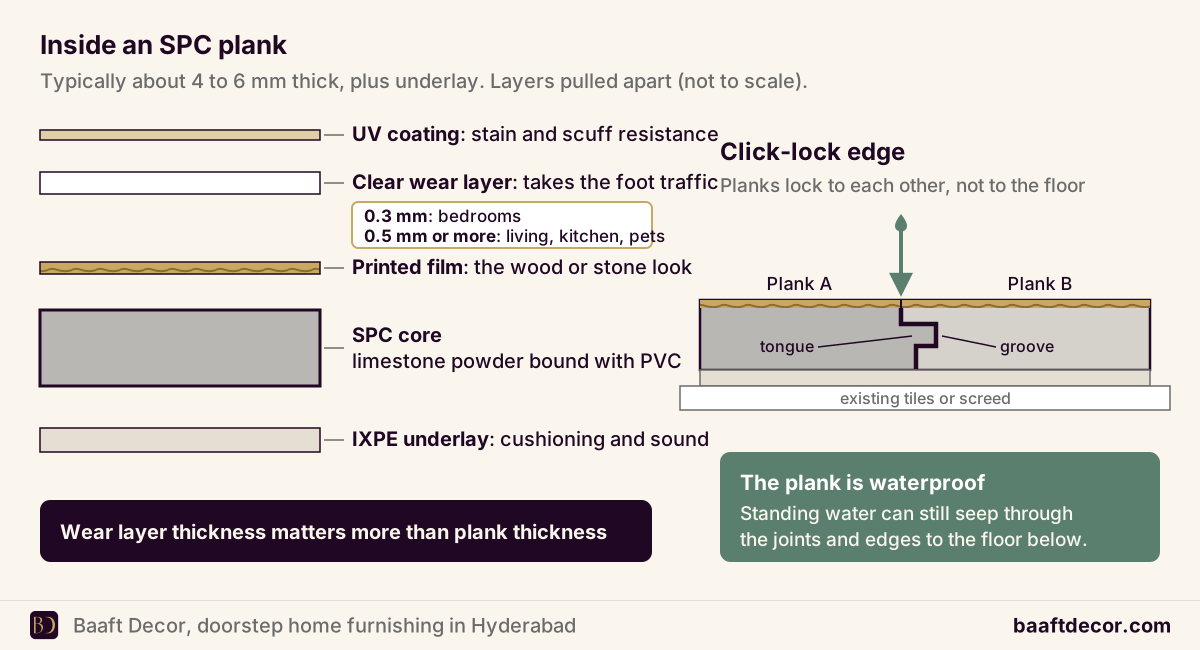
SPC stands for stone plastic composite (some brands say stone polymer composite). It’s a type of rigid-core vinyl flooring. Each plank is built in layers:
- UV coating on top, for stain and scuff resistance
- Clear wear layer, the part that takes foot traffic
- Printed décor film, the wood or stone pattern you see
- SPC core, made mostly of limestone powder bound with PVC and stabilisers
- Attached underlay on many products, usually IXPE foam, for cushioning and sound
Planks are typically around 4 to 6 mm thick plus the underlay, and they click together edge to edge. The floor “floats”: it isn’t glued or nailed down, which is why it can go over existing tiles.
Is SPC flooring waterproof?
The plank is. The floor isn’t a sealed membrane.
The limestone-PVC core doesn’t absorb water, so it won’t swell the way laminate’s fibreboard core does after a spill. That’s the big win in homes where floors are mopped every day, kids spill water, or an RO purifier occasionally overflows.
But water still finds gaps. Left standing, it can seep through the click joints and around the perimeter to the tiles or screed underneath, where it sits trapped under the floor. So:
- Fine: bedrooms, living rooms, kids’ rooms, study, most kitchens, passages.
- Careful: kitchens with a lot of washing down, the area in front of a balcony door where rain blows in.
- Avoid: shower areas, bathroom wet zones, open balconies and terraces, and utility areas that get washed with buckets.
The rule we give at home visits: spills are fine, floods are not.
SPC vs tiles: which is cheaper and which is better?
| Factor | SPC flooring | Vitrified / ceramic tiles |
|---|---|---|
| Install over existing floor | Usually yes, no demolition | Old tiles normally broken out, or new tiles laid over with adhesive and height gain |
| Time and mess | Quick, dry install; walk on it immediately | Cement or adhesive, curing time, more dust |
| Feel underfoot | Warmer, softer, quieter | Hard and cold; echoes in empty rooms |
| Wet zones | Not suitable | Suitable (with anti-skid finish) |
| Heat and heavy point loads | Can dent; avoid hot pans on it | Excellent |
| Repairs | Replace individual planks (easier near edges) | Replace tiles; matching old batches is hard |
| Cost picture | Often cheaper in renovations | Often cheaper in new construction |
Which is cheaper depends on where you’re starting. On a bare slab in a new house, basic vitrified tiles usually win on cost. In an existing flat where you’d otherwise break out tiles, SPC often wins once you count demolition, debris removal, new bedding and the days lost to curing. Always compare full quotes, not material rates.
SPC vs WPC vs LVT: how they differ
You’ll hear all three names when shopping for floors. They’re related but not the same.
- LVT (luxury vinyl tile or plank) is the flexible, thin version. It’s usually glued down and copies every bump and grout line beneath it, so it needs a near-perfect base.
- WPC (wood plastic composite) flooring has a rigid core of PVC foamed with wood flour or similar fillers. It’s thicker, lighter and softer underfoot, and a little quieter, but the foamed core dents more easily under heavy furniture legs.
- SPC has the dense limestone-PVC core. It’s thinner than WPC, heavier per plank, more resistant to dents, and more stable when the temperature changes.
(Don’t confuse WPC flooring with WPC wall panels or WPC boards used for doors and cabinets. Same letters, different products.)
For most Hyderabad apartments, SPC is the practical pick among the three: it handles spills, bridges minor floor imperfections and stays flat through the summer heat.
Is SPC flooring safe for kids and pets?
SPC is a common choice for homes with toddlers and pets, mainly because it shrugs off spills, accidents and water bowls, and is warmer to crawl on than tiles. Two things to check. First, ask the supplier for the product’s emission and safety certificates rather than relying on “eco-friendly” labels on the box. Second, for dogs, choose a 0.5 mm or thicker wear layer and keep nails trimmed; claws scratch every floor surface, SPC included. A matte, textured finish also gives paws and small feet more grip than a glossy one.
How to choose a good SPC floor
Wear layer first, thickness second
The wear layer, not the plank thickness, decides how long the surface lasts. Around 0.3 mm suits bedrooms. Around 0.5 mm or more is better for living rooms, kitchens, passages and homes with pets. A thick plank with a thin wear layer is the classic false economy.
Check the click system and core density
Good click profiles lock firmly without gaps and survive a few re-installations. Flex a sample: a quality rigid core feels stiff and doesn’t bend easily.
Underlay
An attached IXPE underlay is convenient and helps with footfall noise, which matters in apartment buildings where the neighbours below hear everything. If the product has no attached underlay, ask what goes under it.
Finish and texture
Matte and lightly embossed finishes hide dust and footprints better than glossy ones, and are less slippery with wet feet.
Where SPC works and where it struggles in Hyderabad
Works well: bedrooms and living rooms in apartments from Gachibowli to Kompally, kids’ rooms, home offices (with a chair mat), and rented flats where the owner allows a floating floor.
Struggles with:
- Strong west sun through glass. Large sliding doors push afternoon sun onto the floor most of the year. That fades surfaces and makes planks expand. Close blinds or curtains in the afternoon on west-facing rooms.
- Heavy fixed furniture on top. A floating floor needs to move. Wardrobes, kitchen base units and islands should be installed first, with the SPC laid around them, not under them.
- Uneven bases. SPC bridges small dips, but hollow tiles, big lippage between tiles and wide grout lines need fixing first. Our guide on laying flooring over existing tiles covers the checks.
- Dragging heavy appliances. A fridge or washing machine pulled across SPC can gouge the wear layer or catch a plank edge. Lift, or slide it on a sheet of hardboard, and put protective cups under the feet.
- Grit. Fine construction sand tracked in from new gated-community sites scratches any wear layer. Doormats at every entrance help more than any coating.
What a proper SPC installation includes
- Checking the existing floor for hollow tiles, flatness and moisture
- Removing old skirting where needed
- Laying planks with the maker’s perimeter expansion gap (commonly a few mm to around 10 mm, depending on the product and room size)
- Staggering joints so end seams don’t line up
- Trimming door bottoms for clearance
- Fitting new skirting and threshold profiles at doorways and level changes
- Cleaning up and explaining care
If you’re still comparing materials, our wooden vs laminate vs vinyl vs SPC comparison sets them side by side, our laminate flooring guide covers the main budget alternative for dry bedrooms, and the main flooring services page lists everything we lay.
See SPC samples at home
We bring SPC samples with different wear layers and finishes to your home, check your existing tiles, and give a fixed quote that includes skirting, profiles and door trimming. Call or WhatsApp +91 98499 17494 (8 AM to 10 PM, all 7 days) for a free home visit.
Frequently asked questions
Is SPC flooring waterproof?
SPC flooring planks are waterproof: the limestone and PVC core does not absorb water or swell the way laminate's fibreboard core does. The floor as a whole is not a waterproof membrane, though. Water left standing for long can seep through the click joints and around the edges to the subfloor below. That is why SPC suits kitchens, kids' rooms and homes that mop daily, but not shower areas, open balconies or rooms that get washed down with buckets of water.
Which is cheaper, tiles or SPC flooring?
Whether tiles or SPC flooring is cheaper depends on the situation. In new construction on a bare slab, basic vitrified tiles often cost less overall. In a renovation, SPC frequently works out cheaper because it is usually laid directly over existing tiles, avoiding demolition, debris removal, new cement bedding and curing time. Premium large-format tiles can cost more than mid-range SPC. Compare full quotes that include removal, levelling, skirting and labour, not just the material rate per sq ft.
Is SPC flooring better than vitrified tiles?
SPC flooring is better than vitrified tiles for comfort and quick renovation: it feels warmer and softer underfoot, is quieter with an underlay, and can go over existing tiles in a day or two. Vitrified tiles are better for wet zones, heat tolerance, resistance to heavy point loads and very long life. In a Hyderabad apartment, many homeowners keep tiles in bathrooms, balconies and utility areas and use SPC in bedrooms, living rooms and sometimes the kitchen.
What wear layer thickness should I choose for SPC flooring?
For SPC flooring, the wear layer thickness matters more than the total plank thickness. A 0.3 mm wear layer suits bedrooms and other low-traffic rooms. A 0.5 mm wear layer or more is a better choice for living rooms, kitchens, homes with pets and passages that see constant footfall. A thicker plank with a thin wear layer is not more durable than a slightly thinner plank with a thicker wear layer, so always ask for the wear layer figure on the specification sheet.
Can SPC flooring be installed over existing tiles?
Yes, SPC flooring is usually installed directly over existing ceramic or vitrified tiles as a floating floor. The tiles must be firmly bonded with no hollow or cracked pieces, and the surface must be flat within the manufacturer's tolerance. Deep or wide grout lines and uneven tile edges may need filling or levelling first. Expect the floor to rise by a few millimetres, so doors may need trimming, and new skirting usually covers the expansion gap at the walls.
Does SPC flooring get damaged by sunlight?
SPC flooring can fade over time under strong direct sunlight, like most floor finishes, and planks warm up and expand slightly when sun beats on them through large glass doors. Quality SPC is more dimensionally stable than flexible vinyl, but it still needs its perimeter expansion gap. In Hyderabad homes with west-facing sliding doors, drawing blinds or curtains in the afternoon protects the floor, and checking the product's temperature limits before buying is sensible.
How do you clean and maintain SPC flooring?
Clean SPC flooring by sweeping or vacuuming grit first, then mopping with a well-wrung mop and a mild, pH-neutral cleaner. Avoid harsh acids, bleach in strong concentrations, and abrasive scrubbers, which dull the wear layer. Many SPC makers advise against steam mops, so check your product's care sheet. Put felt pads under furniture legs, use a chair mat under office chairs with castor wheels, and keep doormats at entrances to stop construction dust and sand from scratching the surface.
How long does SPC flooring installation take?
SPC flooring installation is quick compared with tiling because there is no cement bedding or curing. A typical bedroom laid over sound, flat tiles can often be finished within a day, and a full 2BHK usually takes two to three days depending on the area, how much levelling is needed, door trimming and skirting work. Rooms can be walked on as soon as the planks are laid. Fixed furniture such as wardrobes is ideally installed before the SPC goes down around it.