Tiles or the full roll? Both put something soft underfoot, but they behave very differently once spills, dust and furniture moves start. This guide compares them on the points that matter in Hyderabad homes and offices, and explains what sets the price, so a quote for carpets and rugs in Hyderabad makes sense before you commit.
If you’re still deciding between carpet and a hard floor such as SPC, laminate or engineered wood, start with our flooring guide for Hyderabad homes, which compares every option room by room.
The quick answer: carpet tiles or wall-to-wall?
Choose wall-to-wall (broadloom) carpet for bedrooms, home theatres and living spaces where softness and a continuous look matter most.
Choose carpet tiles for offices, kids’ rooms, study rooms and anywhere spills or heavy traffic are likely, because a damaged tile lifts out and gets replaced on its own.
What each one actually is
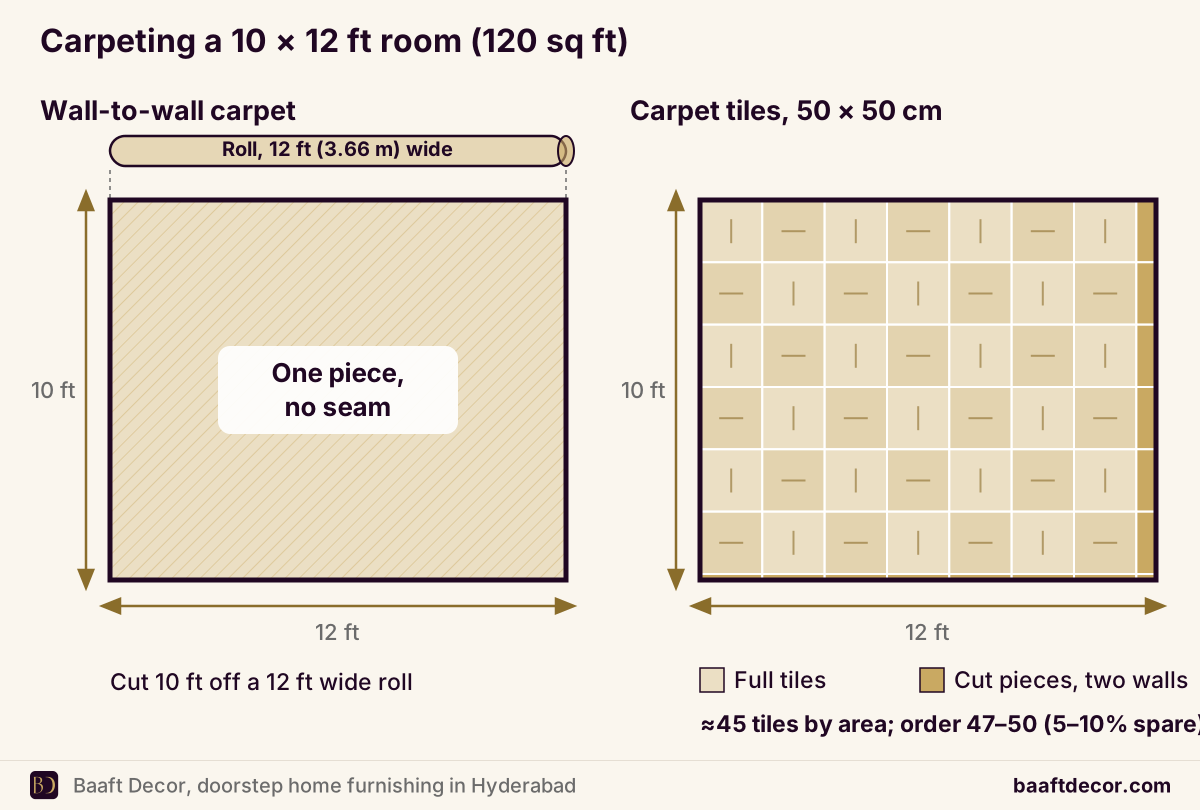
Wall-to-wall carpet (broadloom) comes off wide rolls, typically 12 ft (3.66 m) or 4 m wide. It is cut to the room and either stretched over an underlay and held at the edges by gripper strips, or glued directly to the floor. Rooms narrower than the roll need no joins at all.
Carpet tiles are squares, most commonly 50 × 50 cm, with plank shapes like 25 × 100 cm also available. Each has its own heavy backing (bitumen, PVC or felt), so there’s no separate underlay. They’re laid with a releasable “tackifier” adhesive that holds them in place but lets you lift them later. Tiles can be laid all in one direction for a near-continuous look, or turned 90° alternately (quarter-turn) for a checkerboard texture that hides joins.
Carpet tiles vs wall-to-wall carpet compared
| Factor | Carpet tiles | Wall-to-wall carpet |
|---|---|---|
| Feel underfoot | Firmer | Softer, especially over underlay |
| Look | Joins visible in some designs | Continuous; seams only in wide rooms |
| Repairs | Lift and replace one tile | Patch or relay a section |
| Spills and stains | Lift, wash or swap the tile | Clean in place |
| Waste in irregular rooms | Low | Higher; cut from rectangular roll |
| Installation | Room by room, around furniture | Room usually cleared |
| Moving through a high-rise | Boxes fit any lift | Long, heavy rolls |
| Moisture | Can be lifted to dry | Traps damp underneath |
| Cost per sq ft | Usually higher | Usually lower |
| Best for | Offices, kids’ rooms, studies | Bedrooms, home theatres, lounges |
Where each one works in a Hyderabad home
Wall-to-wall carpet
The obvious place is a home theatre: broadloom over underlay absorbs sound and looks finished edge to edge. Master bedrooms in air-conditioned villas are the other common use, where barefoot comfort is the point. Large living rooms in independent houses in Jubilee Hills or Banjara Hills sometimes carpet the formal seating area.
Carpet tiles
Children’s rooms are where tiles earn their keep: crayon, juice and play dough mean a tile or two gets swapped, not the whole floor. Study rooms, home gyms and the spare bedroom turned home office also suit tiles, as does any carpeted area in a rented flat, since tiles lift out when you leave.
In offices
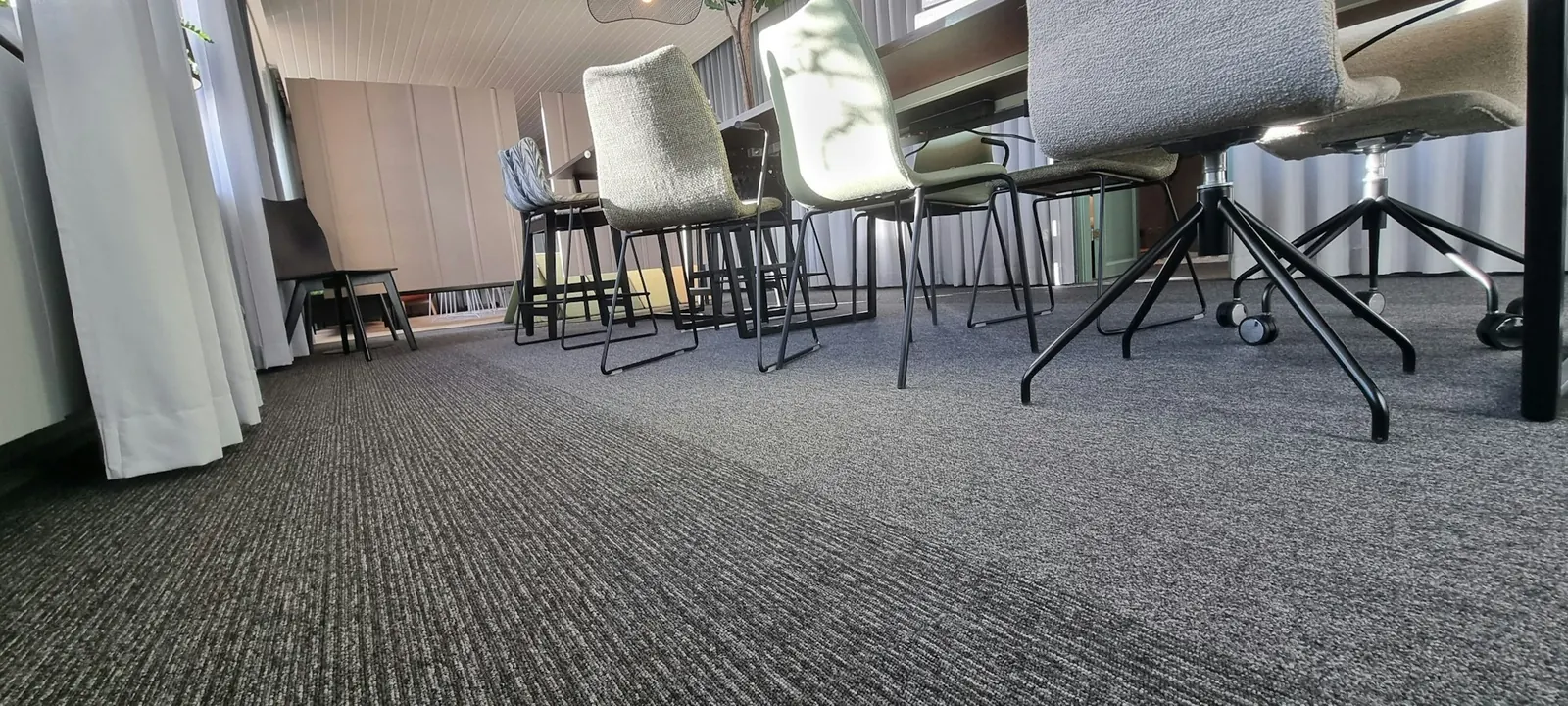
Tiles are the standard. Desks get rearranged, cables run under the floor, and chairs on castors wear specific patches. Tiles let facility teams swap worn ones and lift sections for access. Our office furnishing service covers carpet tiles alongside blinds and other fit-out furnishings.
What decides the price of a 10x12 carpet?
A 10 × 12 ft room is 120 sq ft. Whether that ends up costly or reasonable depends on:
- Rug or wall-to-wall. A 10 × 12 rug is a finished piece you place on the floor; our rug buying guide covers sizes and materials if that’s what you’re after. Wall-to-wall is cut and fitted, and includes underlay and fitting work.
- Fibre. Polypropylene is the budget option; polyester sits in the middle; nylon costs more and lasts longest; wool is premium.
- Pile weight and density. Denser, heavier pile wears better and costs more.
- Room width vs roll width. A 10 × 12 room fits within a 12 ft roll, so it can be done from one piece. A 13 ft wide room needs a seam and a strip of extra carpet.
- Underlay or adhesive. Underlay quality changes comfort and life of broadloom.
- Floor preparation. Levelling, fixing hollow tiles, removing old flooring.
- Edges and trims. Door threshold strips, skirting finishes, any stairs.
For carpet tiles, the count is simple. 120 sq ft is about 11.15 m². Each 50 × 50 cm tile is 0.25 m² (about 2.69 sq ft), so you need roughly 45 tiles, plus 5 to 10% for cuts and spares: about 47 to 50.
How each one is installed
Wall-to-wall carpet, stretched in. Gripper strips (thin timber strips with angled pins) are fixed around the room’s edge, a short gap from the wall. Underlay is laid inside them. The carpet is rolled out, rough-cut, then hooked onto the pins at one wall and stretched across the room with a knee kicker or power stretcher before being hooked at the far side. Edges are trimmed and tucked under the skirting line. Stretched carpet can be re-tensioned later if it ripples.
Wall-to-wall carpet, glued down. Adhesive bonds the carpet straight to the floor with no underlay. Firmer and more stable under rolling office chairs, but harder to remove later.
Carpet tiles. The floor is cleaned and checked for level, a centre line is marked, and tiles are laid outward from the middle so the cut tiles at the walls come out even on both sides. A releasable adhesive holds them; any tile can be lifted later. Furniture can be moved section by section, so a room rarely needs emptying completely.
Both need a clean, dry, level floor. Hollow or cracked tiles underneath should be fixed first, because they show through over time.
Which carpet fibre suits Hyderabad?
- Nylon: the most durable and resilient; the usual choice for offices and busy rooms.
- Polypropylene: budget-friendly, absorbs little water and resists many stains, but crushes in heavy traffic. Fine for low-traffic rooms.
- Polyester: soft with vivid colour and good resistance to water-based stains; flattens sooner than nylon.
- Wool: premium feel and natural resilience, but costlier and needs protection from moths.
Loop pile wears well but can snag on pet claws. Cut pile feels softer and shows footprints.
Moisture, dust and the monsoon
Two local issues decide whether carpet works well. Damp: on ground-floor flats and villas, check for seepage before laying anything, because carpet over a damp floor grows mould during the June to September monsoon. Tiles can at least be lifted and dried; broadloom can’t, not easily. Dust: fine construction dust settles deep into pile. Plan on vacuuming high-traffic areas several times a week, and keep outdoor footwear out of carpeted rooms.
Our guide to laying flooring over existing tiles explains the tap test and flatness checks that apply to carpet too. For balconies and terraces, carpet is the wrong choice; see artificial grass for balconies instead.
What a carpet quote should include
- Carpet type, fibre, pile and colour code
- Area measured, roll width or tile count, and wastage allowance
- Underlay or adhesive specification
- Floor preparation and removal of old flooring
- Edge trims and threshold strips
- Spare tiles left on site (for carpet tiles)
For a measured quote, book a free home visit. We bring carpet and carpet tile samples, measure the room, check the floor for damp and level, and recommend tiles or broadloom for how you’ll use it. Call or WhatsApp +91 98499 17494, 8 AM to 10 PM, all seven days.
Frequently asked questions
What is the difference between carpet tiles and wall-to-wall carpet?
Wall-to-wall carpet, also called broadloom, is cut from wide rolls, typically 12 feet or 4 metres wide, and fitted to the whole room, usually stretched over an underlay or glued down. Carpet tiles are smaller squares, most often 50 by 50 cm, with their own firm backing, laid individually with a releasable adhesive. Broadloom feels softer and has few joins. Carpet tiles are firmer underfoot but can be lifted and replaced one at a time, which makes them easier to repair.
Are carpet tiles cheaper than wall-to-wall carpet?
Carpet tiles are usually not cheaper per square foot than wall-to-wall carpet of a similar fibre and grade, because each tile carries its own heavy backing. The overall cost can still come out close, since tiles waste less in L-shaped or irregular rooms and need no separate underlay, while broadloom may need extra length when a room is wider than the roll. Over time, tiles can work out cheaper because a stained or worn patch is fixed by swapping a few tiles rather than relaying the room.
What decides the price of a 10x12 carpet?
The price of a 10x12 foot carpet, an area of 120 square feet, depends on whether it is a loose rug or wall-to-wall carpet, the fibre (polypropylene, polyester, nylon or wool), the pile density and weight, the backing and underlay, and the fitting work. For wall-to-wall carpet, the room's width compared with the roll width also matters, because a room wider than the roll needs a seam and extra material. Floor preparation, edge trims and removal of old flooring add to the total.
How many carpet tiles do I need for a 10x12 room?
A 10 by 12 foot room is 120 square feet, or about 11.15 square metres. Standard 50 by 50 cm carpet tiles cover 0.25 square metres each, which is about 2.69 square feet, so the room needs roughly 45 tiles. Add 5 to 10 percent for cuts at the walls and for spares, which brings it to about 47 to 50 tiles. Keep the spare tiles from the same batch, because later batches can differ slightly in shade.
Are carpet tiles good for homes?
Carpet tiles are good for homes in rooms where practicality matters more than plush softness, such as children's playrooms, study rooms, home gyms and rooms where spills happen. A stained tile can be lifted, washed or replaced without touching the rest of the floor, and tiles are easy to carry up in a lift and lay around built-in furniture. They feel firmer than wall-to-wall carpet over underlay, so for bedrooms and home theatres where comfort comes first, broadloom is usually the better choice.
Which carpet fibre is best for Hyderabad homes?
Nylon is the most durable carpet fibre and recovers well from foot traffic, which suits busy rooms and offices. Polypropylene is the budget option and resists moisture and many stains well because it absorbs little water, but it crushes faster in heavy traffic. Polyester is soft with rich colour and resists water-based stains, though it flattens sooner than nylon. Wool is premium and naturally resilient but costlier and more prone to moth damage. For most Hyderabad homes, nylon or polypropylene is the practical choice.
Can carpet be laid over vitrified tiles?
Yes, carpet can be laid over vitrified or ceramic tiles, which is how most carpet goes into Hyderabad apartments. The tile floor must be clean, dry and level, with no loose or hollow tiles, because both carpet tiles and broadloom show unevenness beneath them over time. Carpet tiles are usually fixed with a releasable adhesive that can be removed later. Wall-to-wall carpet is stretched over underlay or glued down. Check for moisture first on ground floors, where damp can cause mould under carpet.
How do you keep carpet clean in a dusty city?
To keep carpet clean in a dusty city like Hyderabad, vacuum high-traffic areas two or three times a week and the whole carpet weekly, using a vacuum with a beater brush for cut pile and suction-only for loop pile. Place doormats at entrances and keep outdoor footwear off carpeted rooms. Blot spills immediately rather than rubbing them. Book a professional deep clean once or twice a year. With carpet tiles, a badly stained tile can simply be lifted and replaced.