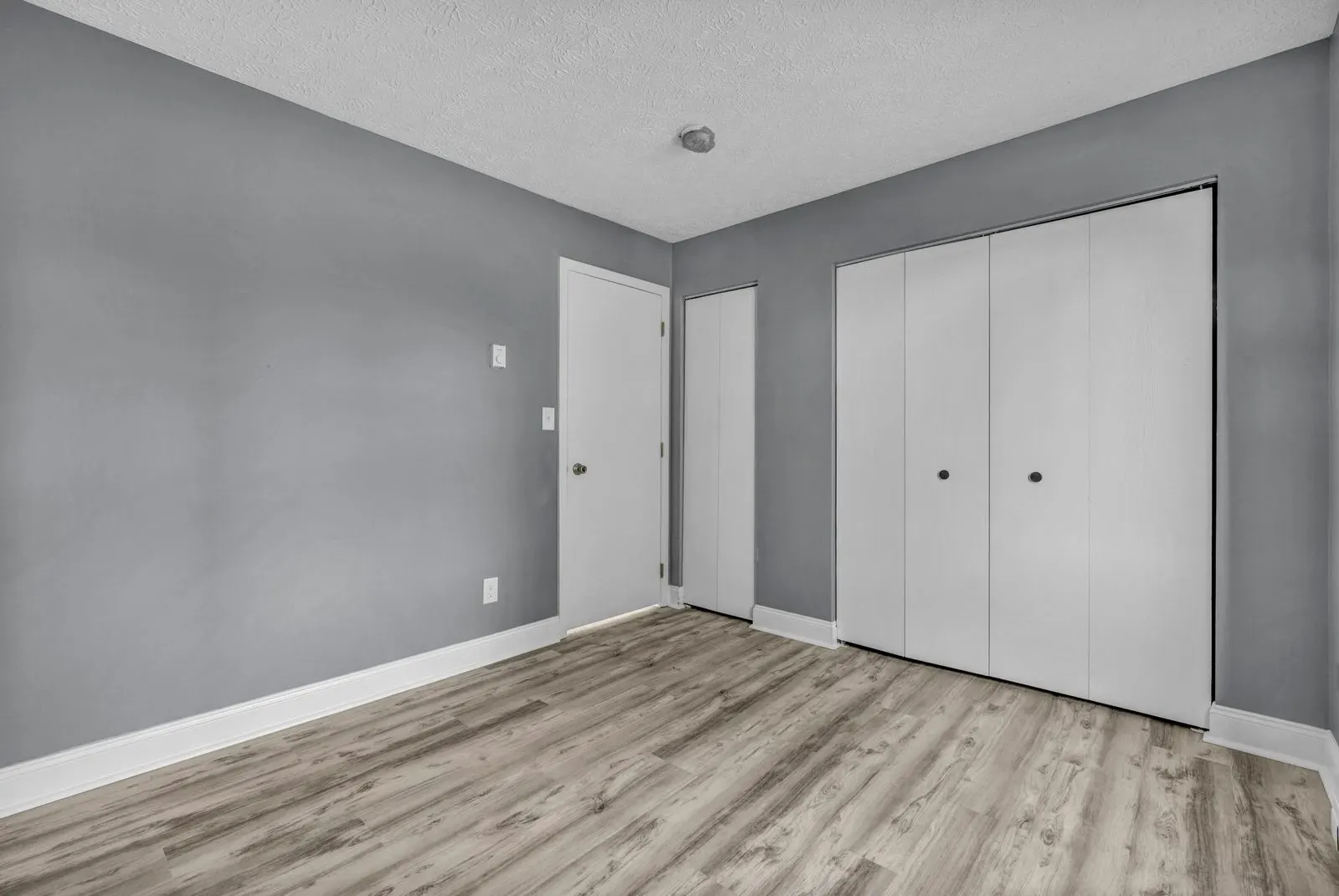
Laminate flooring is, in plain terms, a photograph of wood on a very hard board. It looks like timber, clicks together without glue, and goes down over existing tiles in a day or two. When we lay flooring in Hyderabad homes, laminate is the option people misunderstand most: it is tougher on the surface than they expect, and weaker against water than they hope.
One quick clarification. In India, “laminate” also means the thin decorative sheets on wardrobes and kitchen shutters; our guide to wardrobe finishes covers those. This guide is about the floor. For how laminate fits among every other floor type, start with our flooring guide for Hyderabad homes.
What is laminate flooring made of?
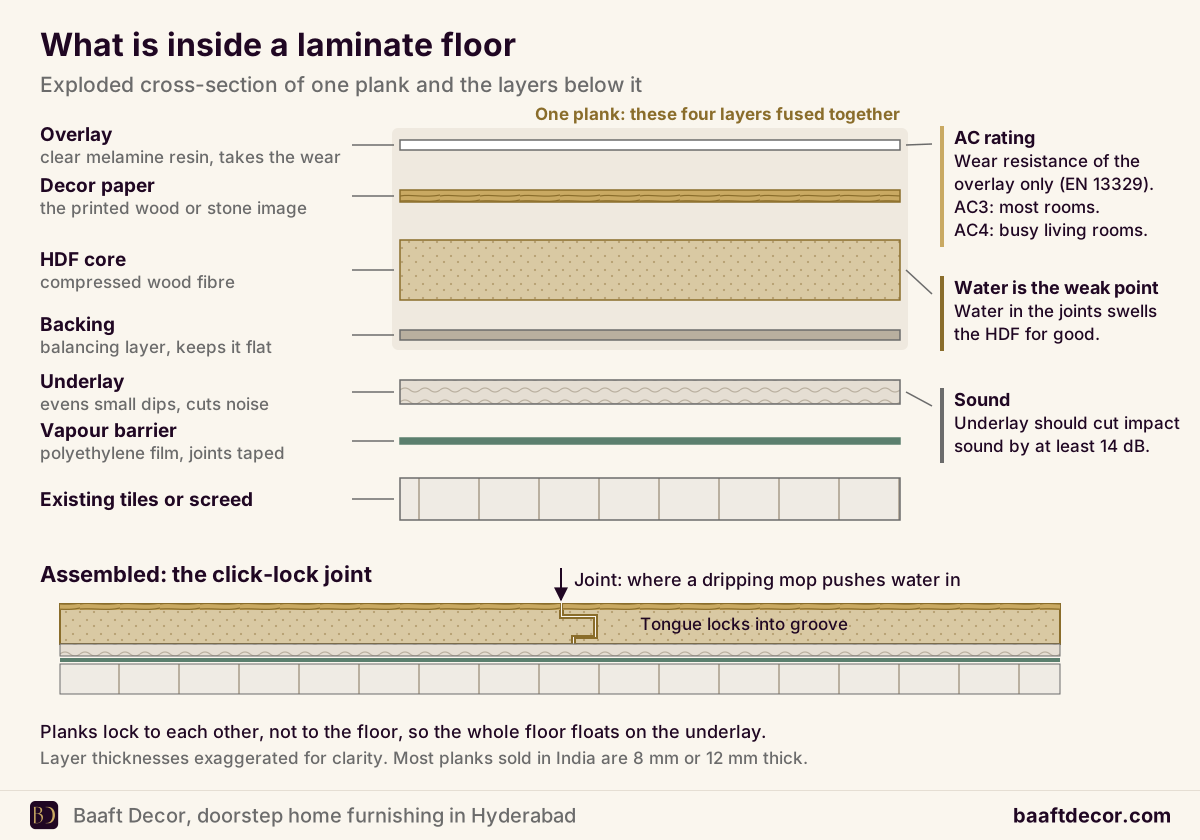
A laminate plank has four layers, fused under heat and pressure:
- Overlay. A clear, hard melamine-resin layer that takes the wear.
- Decor paper. The printed wood (or stone) image.
- Core. High-density fibreboard (HDF), made from compressed wood fibre. This is what gives the plank its strength and also its weakness with water.
- Backing. A balancing layer underneath that keeps the plank flat.
The edges are machined into a click-lock profile. Planks lock to each other, not to the floor, so the whole floor “floats” on an underlay. The industry body EPLF notes that laminate contains at least 65% wood, which is why it behaves like wood when wet.
What do AC ratings mean?
The AC (abrasion class) rating comes from a standard abrasion test under EN 13329. It tells you how well the surface resists wear from footsteps and grit, and nothing else.
| AC rating | Use class | What it suits |
|---|---|---|
| AC1 | 21 (moderate domestic) | Rarely used rooms; avoid |
| AC2 | 22 (normal domestic) | Bedrooms with light use |
| AC3 | 23 (heavy domestic), 31 (light commercial) | Most rooms in most homes |
| AC4 | 32 (general commercial) | Busy living rooms, pets, home offices |
| AC5 | 33 (heavy commercial) | Shops, offices; more than a home needs |
The use classes come from EPLF, which describes 21 to 23 as domestic and 31 to 34 as commercial. For a Hyderabad flat, AC3 is fine for bedrooms. AC4 is worth it for the living room, especially with a dog’s claws or a study chair rolling across it every day.
8 mm or 12 mm: which thickness?
Most laminate sold in India is 8 mm or 12 mm. Thickness doesn’t change how the surface wears (that’s the AC rating). What it changes:
- Feel and sound. 12 mm feels more solid and less hollow underfoot.
- Old floors. 12 mm bridges small dips and tile lippage more easily.
- Height. Laminate plus underlay adds roughly 10 to 15 mm over tiles, so thicker boards mean more door trimming.
Our usual suggestion: 8 mm is fine in bedrooms, and 12 mm earns its cost in living rooms and over older tiled floors.
How water-resistant is laminate?
This is the question that decides whether laminate suits your home. The HDF core is wood fibre. EPLF puts it bluntly: water will cause unsightly swelling of the joints. Once an edge swells into a ridge, it stays that way.
A spill wiped up in a minute does no harm. The real danger in Indian homes is the daily pocha. A dripping mop pushes a little water into every joint, every day, and after a monsoon or two the edges start to lift. Other repeat offenders: RO purifier overflows, pet water bowls, potted plants without trays, and rain blowing in through an open balcony door.
Some newer laminates have treated cores and sealed edges, sold as water-resistant for a stated number of hours. They’re a real improvement, but read the warranty wording carefully. For kitchens, bathrooms, utility areas and homes that wet-mop daily, look at SPC instead; our SPC flooring guide explains why its core doesn’t swell, and our vinyl and SPC flooring service covers the products we lay.
Underlay and moisture barrier
The underlay sits between the laminate and the floor. It smooths minor unevenness, protects the click joints, and cuts footfall noise. That last one matters in apartments, where the flat below hears every step. EPLF’s laminate A to Z says an underlay should reduce impact sound by at least 14 dB, with 18 dB or better as the higher standard.
Over concrete screed, a polyethylene vapour barrier is required, and it’s wise over tiles too, especially on ground floors of independent houses and along walls shared with bathrooms. Some underlays have the film built in. Joints in the film should overlap and be taped.
Can you lay laminate over existing tiles?
Usually, yes. EPLF confirms it’s possible if the tile surface is suitably even and meets the subfloor requirements. Before we lay, we check:
- Hollow or cracked tiles (tap them; a dull sound means a loose tile)
- Flatness, with a long straightedge across the room
- Wide grout lines and chipped corners, which get filled
- Damp, especially on ground floors
- Door clearance, since doors usually need trimming
Our guide to laying flooring over existing tiles goes through every check and the skirting options.
Expansion gaps: why the floor needs room to move
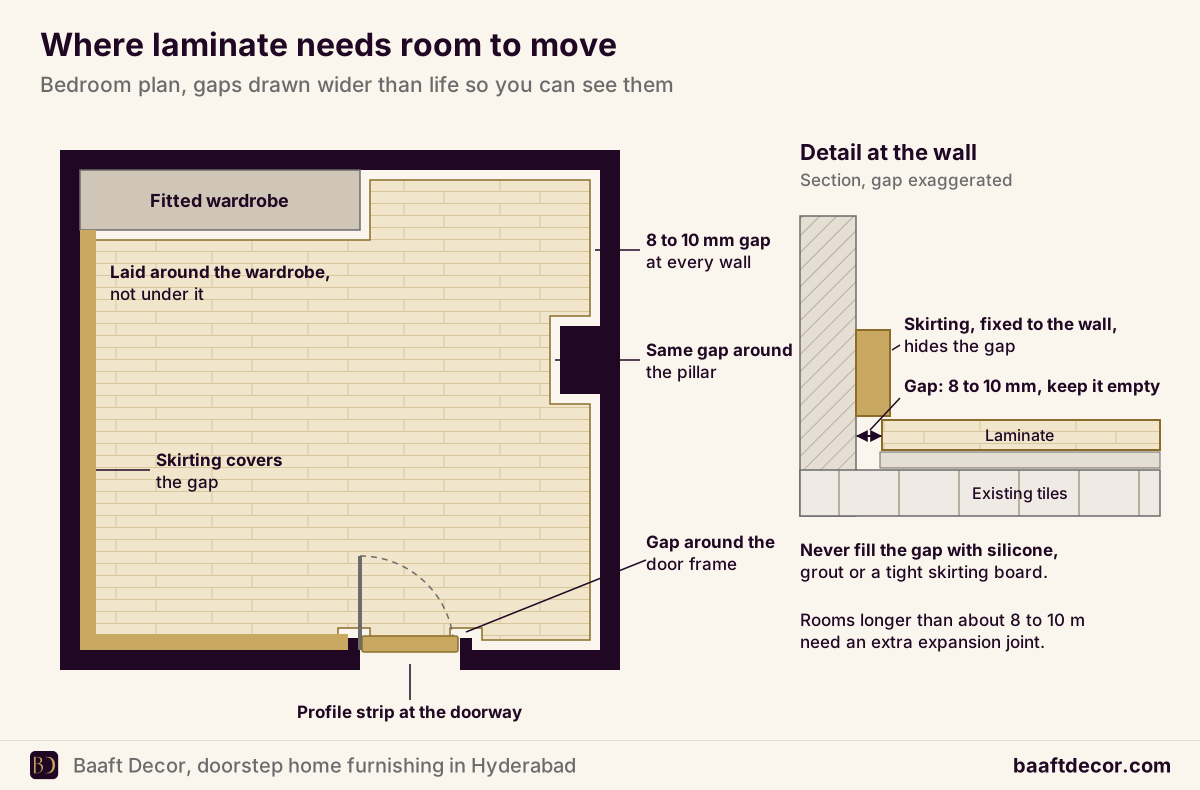
Laminate expands in humid weather and shrinks in dry weather. Hyderabad gives it both: dry April heat, then June to September humidity. So the floor needs space at every edge.
- Leave 8 to 10 mm at every wall, as the maker specifies, plus the same gap around pillars, door frames and pipes.
- Rooms longer than about 8 to 10 metres in either direction need an extra expansion joint, according to EPLF.
- Many makers also ask for a profile strip at doorways, so each room moves on its own.
- Lay laminate around fitted wardrobes and kitchen units, not under them. Anything fixed on top pins the floating floor.
- Let the boxes rest in the room before laying (often around 48 hours, as the maker specifies).
Skirting hides the gap. It must never be filled with silicone, grout or a tight skirting board, or the floor will buckle in the first monsoon.
How do you look after laminate?
- Grit is the enemy. Sweep or vacuum often; Hyderabad dust acts like fine sandpaper. Put a mat at the main door.
- Mop with a well-wrung, barely damp mop. No soaking, no steam mop, no wax or polish.
- Wipe spills at once, especially near joints.
- Felt pads under sofa and table legs; a chair mat under castor chairs.
- Keep a few spare planks from the same batch. A damaged plank can be replaced, and matching the shade later is hard.
Where does laminate make sense in a Hyderabad home?
Laminate is at its best in dry rooms that get a lot of foot traffic but little water:
- Bedrooms and studies in upper-floor flats, where it makes a cold vitrified floor feel warmer underfoot, quickly and without breaking a single tile.
- Living rooms that aren’t open to the kitchen, ideally in AC4.
- Rented flats being refreshed, since it goes over existing tiles and the floor underneath stays intact.
It’s the wrong choice for bathrooms, kitchens, utility areas and balconies, for ground-floor rooms where the slab feels damp in the monsoon, and for homes where the floors are wet-mopped every morning and nobody is going to change that habit. Be honest with yourself about the last one.
Laminate, SPC or engineered wood?
| Laminate | SPC | Engineered wood | |
|---|---|---|---|
| Core | HDF (wood fibre) | Limestone and PVC | Plywood or HDF with real wood top |
| Water | Swells if water sits | Doesn’t swell | Sensitive |
| Surface | Very scratch-resistant | Depends on wear layer | Real wood, can be refinished |
| Feel | Solid, warm | Firmer, thinner | Warmest, most natural |
Choose laminate for dry bedrooms, studies and upper-floor living rooms where scratch resistance matters. Choose SPC where water is likely. If you want real timber, see our engineered wooden flooring service, and our wooden vs laminate vs vinyl vs SPC comparison sets all four side by side.
See the planks on your own floor
Book a free home visit and we’ll bring laminate, SPC and wooden flooring samples, check your tiles for hollows and flatness, measure every room, and give you a written quote with the underlay, profiles and skirting listed. We work across Hyderabad from 8 AM to 10 PM, all seven days. WhatsApp or call +91 98499 17494.
Frequently asked questions
What AC rating do I need for laminate flooring at home?
For most homes, AC3 laminate flooring is enough, and AC4 is the safer choice for busy living rooms, homes with pets, and study areas with castor chairs. The AC rating comes from an abrasion test under the European standard EN 13329 and only measures how well the surface resists wear. It says nothing about water resistance or how well the board handles dropped objects. AC1 and AC2 boards are meant for light domestic use and are best avoided in Indian homes with heavy foot traffic.
Is 8 mm or 12 mm laminate flooring better?
Neither is better in every case. 12 mm laminate feels more solid underfoot, sounds less hollow, and bridges small unevenness in an old tiled floor more easily, so it suits living rooms and floors laid over tiles. 8 mm laminate is lighter, adds less height at doors, and is perfectly adequate for bedrooms. Thickness does not decide how well the surface resists wear; that is the AC rating. Compare AC rating, core quality and the click joint before comparing thickness.
Is laminate flooring waterproof?
Standard laminate flooring is not waterproof. Its core is high-density fibreboard made from wood fibre, and if water sits in the joints long enough, the edges swell into ridges that do not go back down. Spills wiped up quickly do no harm. Some newer laminates have treated cores and sealed edges and are sold as water-resistant for a stated number of hours; check the warranty wording. For bathrooms, kitchens and homes that wet-mop daily, SPC or rigid-core vinyl is the safer choice.
Can laminate flooring be installed over existing tiles?
Yes, laminate flooring can usually be laid over existing ceramic or vitrified tiles as a floating floor, as long as the tile surface is even. Before installation, check for hollow-sounding or cracked tiles, test flatness with a long straightedge, fill wide grout lines and chipped corners, and lay a moisture barrier and underlay. Laminate with underlay adds roughly 10 to 15 mm of height, so doors often need trimming. New skirting is usually fixed in front of the old tile skirting to hide the expansion gap.
What expansion gap does laminate flooring need?
Laminate flooring needs an expansion gap of about 8 to 10 mm at every wall, and the same gap around pillars, door frames and pipes, so the boards can expand and shrink with humidity. The European Producers of Laminate Flooring also say floors longer than about 8 to 10 metres in either direction need an extra expansion joint. Skirting and profiles cover the gap but must not pin the floor down. In Hyderabad, where monsoon humidity follows dry summer heat, a filled gap often leads to buckling.
How do you clean laminate flooring?
Clean laminate flooring by sweeping or vacuuming regularly to remove grit, which scratches the surface like sandpaper, and by mopping with a well-wrung, barely damp mop. Never leave water standing on the floor or let it seep into the joints, and avoid steam mops, soaking wet pochas, wax and polish. Wipe spills immediately. Put felt pads under furniture legs, a mat at the main door, and a chair mat under office chairs with castors, which wear even good laminate over time.
Laminate or SPC flooring: which is better for Indian homes?
SPC flooring is better for most Indian homes where floors are wet-mopped daily, children spill water, or rooms are near kitchens and bathrooms, because its limestone and PVC core does not swell. Laminate is better where you want a harder, more scratch-resistant surface and a warmer wood-like feel in dry rooms, such as bedrooms and studies on upper floors. Laminate is also thicker and can feel more solid. If water exposure is uncertain, SPC is the lower-risk choice in Hyderabad apartments.
Is laminate flooring the same as the laminate on wardrobes?
No. In India, the word laminate is used for two different products. Laminate flooring is a thick click-together plank with a fibreboard core, laid on the floor over an underlay. Decorative laminate sheets, often around 1 mm thick, are pressed onto plywood or board to finish wardrobes, kitchen shutters and furniture. Both use printed decor paper and resin, which is why they share the name, but they are made, sold and installed differently. This guide is about laminate flooring.