Two wardrobes with identical shutters can work completely differently once you open them. One has every shirt visible and every drawer in reach. The other has clothes piled on shelves because the only hanging rail is too short for half of them. The difference is internal design, and it’s the part most people rush.
When we plan made-to-measure wardrobes in Hyderabad, the inside gets settled before the colour does. This guide is part of our wardrobe guide for Hyderabad homes; here we go bay by bay through hanging space, shelves, drawers, lofts and fittings, with the dimensions we actually work from.
Start with an inventory, not a design
Before anyone draws a wardrobe, count what goes in it. Roughly is fine.
- Shirts, tops and folded-over trousers on hangers (short hang).
- Kurtas, dresses, gowns, lehengas and sherwanis (long hang).
- Sarees: how many, and which are silk or zari that you’d rather fold than hang.
- Folded clothes: T-shirts, jeans, nightwear, innerwear.
- Accessories: jewellery, bangles, watches, belts, ties, dupattas, scarves.
- Bags, suitcases, quilts and festival boxes.
Then note who shares the wardrobe. Two people sharing one run of shutters is easier when each person gets their own bays, not alternate shelves.
Standard wardrobe internal dimensions
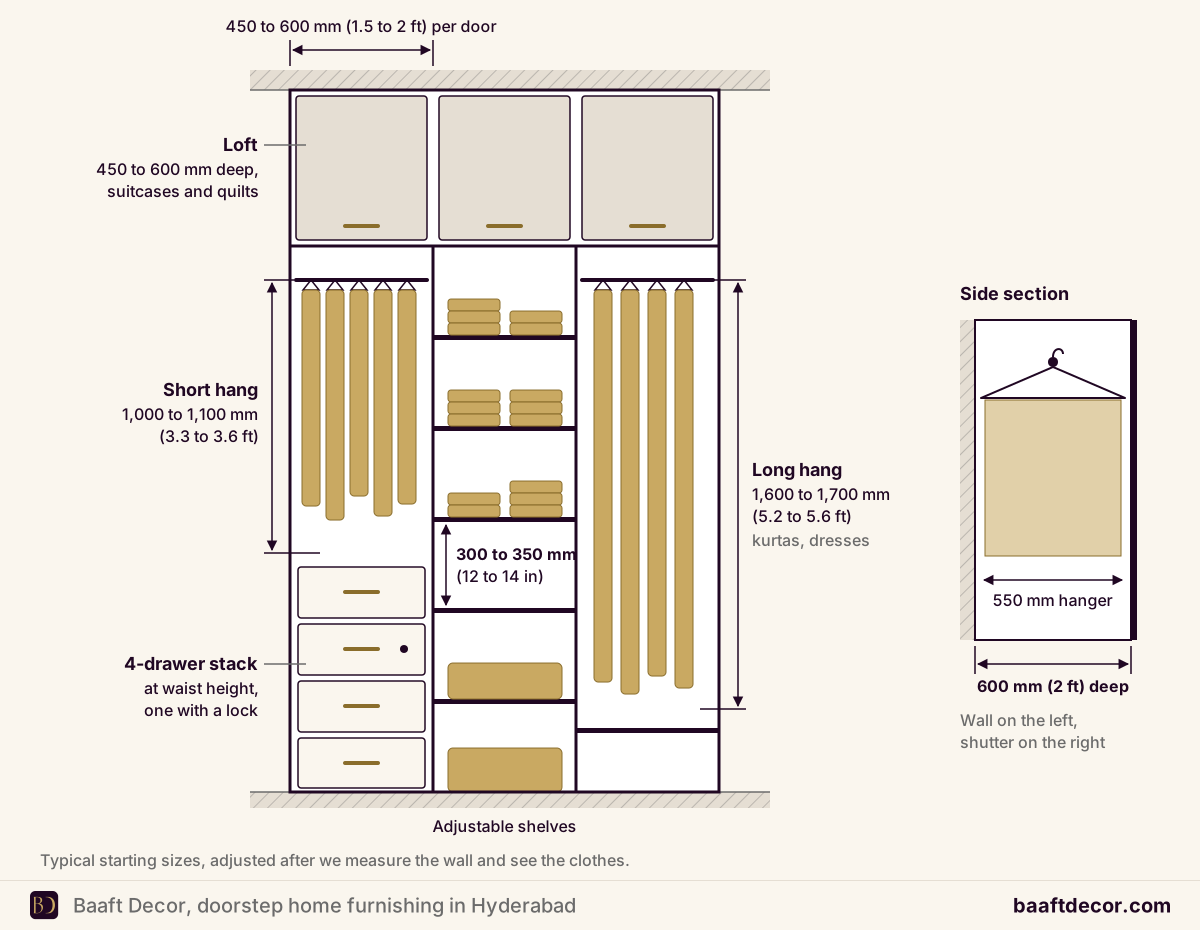
These are the sizes we start from, then adjust once we’ve measured the wall and seen the clothes.
| Element | Typical size | Notes |
|---|---|---|
| Carcass depth | About 600 mm (2 ft); 600 to 650 mm for sliding | A hanger needs about 550 mm to hang straight |
| Short-hang drop | About 1,000 to 1,100 mm | Shirts, tops, trousers over a hanger |
| Long-hang drop | About 1,600 to 1,700 mm | Kurtas, dresses, gowns, coats |
| Double hang (two rails stacked) | About 2,000 to 2,200 mm of height | Two short-hang rails, one above the other |
| Shelf spacing | About 300 to 350 mm | Folded stacks; taller for bags and bedding |
| Shelf thickness | 18 mm | Wide shelves need a centre support |
| Shutter and bay width | 450 to 600 mm per door | Wider doors sag; plan bays to match doors |
| Loft depth | About 450 to 600 mm | Suitcases, quilts, seasonal storage |
For a sense of scale, IKEA’s PAX wardrobe frames are 58 cm deep and 201 or 236 cm tall, which lines up with the depth most carpenters here work to. If someone offers you a 450 mm deep “wardrobe” to save floor space, the hangers will sit at an angle and the doors may not close over them.
How much hanging space do you need?
Most families need more short hang than long. But almost every Indian wardrobe needs at least one long-hang bay, because a kurta or anarkali folded at the hem over a drawer top ends up creased.
Measure it rather than guessing. Hang your longest garment, measure from the top of the hanger hook to the hem, and add a few centimetres. That’s your long-hang drop.
Double hanging is the most space-efficient trick for shirts. Two short-hang rails, one above the other, fit in roughly the height of a standard wardrobe below the loft, doubling the hanging length of that bay. The top rail does end up high, so it suits the taller person in the house or clothes worn less often.
Sarees don’t all belong on a rail. Cotton and everyday sarees hang well on padded hangers in the long-hang bay. Heavy silk and zari sarees are better folded flat in shallow pull-out trays or open shelves, in breathable cotton covers, and refolded along different lines every few months so the creases don’t set.
Shelves: depth, spacing and why adjustable matters
A full-depth shelf in a 600 mm wardrobe is deep. Things pushed to the back get forgotten. Two fixes help: keep the most-used stacks at the front edge, or fit one or two pull-out shelves (trays on channels) in the bay you use daily.
Spacing of 300 to 350 mm suits folded clothes. Larger gaps suit handbags and bedsheets. Ask for shelves on system holes so you can move them later; fixed shelves are cheaper to make but you’ll live with the spacing for years.
Long shelves sag. Keep bays to the width of one or two shutters, and use 18 mm board with a centre support on anything wider.
Drawers: where they go and what makes them work
Waist height is the sweet spot. A stack of three or four drawers under a short-hang rail is a common layout, and it works because you can see into the top drawer without bending.
In a sliding wardrobe, drawers must sit behind a single panel. Behind the overlap, the other door blocks them. Our guide to sliding vs hinged wardrobes shows how to plan bays to match panel widths.
The hardware decides how a drawer feels for the next decade. Full-extension channels let you see the back of the drawer, soft-close channels stop slamming, and a locker drawer with a concealed lock can sit in the same stack. Shallow drawers with velvet-lined dividers suit jewellery and bangles; deeper ones suit T-shirts and nightwear.
Lofts: the cheapest storage in the wardrobe
Running the wardrobe to the ceiling adds a loft and removes the dust shelf on top. In flats with high ceilings, the loft can be generous. In older buildings, check the beam depth first.
Lofts hold what you need once or twice a year: suitcases, quilts, winter blankets for December, Diwali and Sankranti decorations. Hinged or lift-up shutters both work. Keep a sturdy step stool nearby, because a loft you can’t reach safely turns into a loft nobody opens.
Accessories: worth it, or skip?
| Fitting | Worth it when | Skip if |
|---|---|---|
| Pull-out trouser rack | You hang a lot of trousers | You fold trousers on shelves |
| Jewellery tray or velvet drawer | You keep everyday jewellery at home | It all goes in a locker or bank |
| Tie, belt and dupatta rail | Several people share the wardrobe | Hooks on the shutter do the job |
| Pull-down wardrobe lift | The top rail is out of easy reach | Rails are already at a comfortable height |
| Mirror inside a shutter or on a pull-out | No separate dressing mirror | There’s a full-length mirror elsewhere |
| Sensor LED strip | The wardrobe is deep or the room is dark | No power point nearby |
| Shoe rack inside | Space is tight elsewhere | Shoes come in dusty from outside |
A small note on shoes. In Hyderabad, outdoor shoes carry construction dust and monsoon mud. A ventilated shoe cabinet near the door usually works better than a rack inside the bedroom wardrobe.
If you want a dressing area built into the wardrobe run, with a mirror, drawers and a lit niche, see idea 6 in our bedroom wardrobe design ideas.
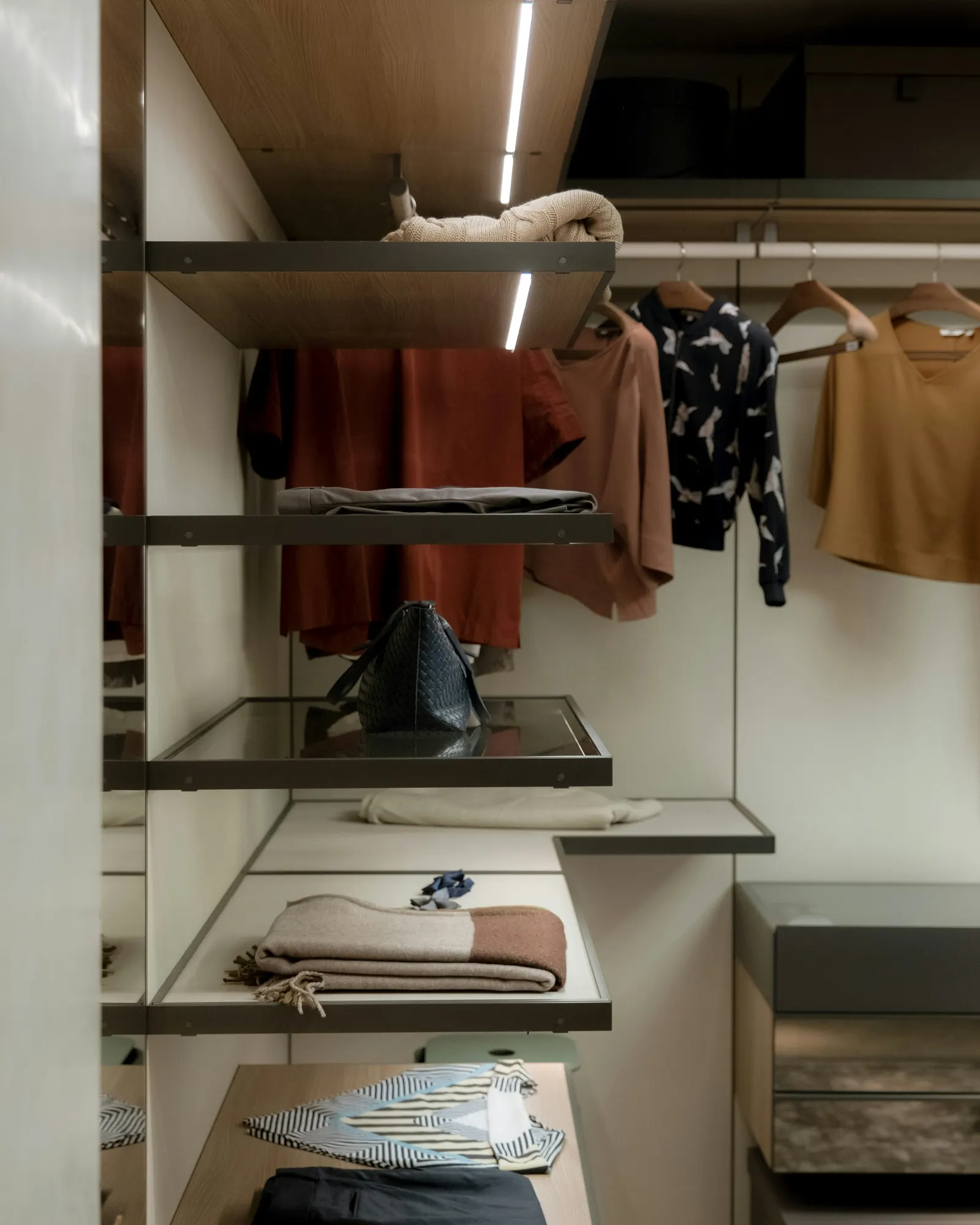
A 2-door wardrobe inside design that works
A two-door wardrobe is usually 900 to 1,200 mm wide. Give each door a job:
- Left bay: short-hang rail with a four-drawer stack below, the top drawer split for accessories and one drawer with a lock.
- Right bay: adjustable shelves for folded clothes, or a long-hang section above two shelves if you need one.
- Loft: one or two shutters across the full width for suitcases.
- Inside the doors: hooks for belts and dupattas, or a slim mirror.
Light-coloured liner laminate inside makes dark clothes easier to find, and it’s how we finish most interiors.
Planning the inside for Hyderabad’s climate
The monsoon is the real test. From June to September, a wardrobe on a wall shared with a bathroom can turn musty, and clothes packed tight dry slowly. Leave a little breathing space in each bay, air the wardrobe on dry days, and never put damp clothes away. For those walls we also use moisture-resistant board with an air gap at the back. Our monsoon home care guide covers airing and storage in more detail.
If you’re still deciding on the material itself, compare aluminium vs wooden wardrobes first, then come back to the layout.
Want the inside planned around your clothes? Book a free home visit. We’ll measure the wall, go through your inventory with you, sketch the bays and give a fixed quote that lists every drawer and fitting. Call or WhatsApp +91 98499 17494, 8 AM to 10 PM, all 7 days.
Frequently asked questions
What is the standard depth of a wardrobe?
The standard depth of a hinged wardrobe is about 600 mm (2 ft), measured from the back wall to the front of the shutter. Sliding wardrobes are usually 600 to 650 mm because the track takes extra space. A clothes hanger needs about 550 mm of clear depth to hang straight, so going much shallower forces hangers to sit at an angle. For comparison, IKEA's PAX wardrobe frames are 58 cm deep. Shallower 300 to 450 mm units work only for shelves, shoes or folded clothes.
What is the ideal hanging height inside a wardrobe?
The ideal hanging height depends on the clothes. A short-hang section for shirts, tops and trousers folded over hangers needs about 1,000 to 1,100 mm of clear drop below the rail. A long-hang section for kurtas, dresses, gowns and coats needs about 1,600 to 1,700 mm. The easiest check is to hang your longest garment, measure from the top of the hanger hook to the hem, and add a few centimetres so it doesn't touch the drawer or shelf below.
How far apart should shelves be in a wardrobe?
Shelves for folded clothes in a wardrobe usually work best about 300 to 350 mm apart. That spacing holds a neat stack of shirts, T-shirts or folded trousers without the pile toppling when you pull one out. Taller gaps suit handbags, bedsheets and blankets. Ask for adjustable shelves on system holes rather than fixed ones, so the spacing can change as your needs do. Shelves should be 18 mm board, and wide shelves need support in the middle so they don't bow.
What should a wardrobe inside design for ladies include?
A wardrobe inside design for ladies in an Indian home usually needs at least one full-height long-hang bay for kurtas, dresses and lehengas, a place for sarees (padded hangers, or shallow pull-out trays for folded silks), a velvet-lined jewellery and bangle drawer, a rail or hooks for dupattas and scarves, shelves sized for handbags, and a mirror on the inside of a shutter or on a pull-out fitting. A concealed locker drawer is worth planning at the design stage.
Where should drawers go in a wardrobe?
Drawers in a wardrobe work best at roughly waist height, usually as a stack of three or four under a short-hang rail, so you can see into them without bending. In a sliding wardrobe, place drawers behind a single panel, never behind the overlap, or they won't open past the other door. Full-extension channels let you reach the back of the drawer, and soft-close channels stop slamming. Keep the locker drawer in the same stack where it is less obvious.
Is a loft worth adding above a wardrobe?
Yes, a loft is usually worth adding above a wardrobe, especially in flats with high ceilings. It gives storage for suitcases, quilts, festival decorations and out-of-season clothes, and it closes the dusty gap between the wardrobe top and the ceiling. Lofts are typically 450 to 600 mm deep, with hinged or lift-up shutters. Keep things you need once or twice a year up there, and remember you'll need a sturdy step stool to reach it safely.
What is the best inside design for a 2-door wardrobe?
The best inside design for a 2-door wardrobe, usually about 900 to 1,200 mm wide, gives each door its own job. Behind one door, put a short-hang rail with a three- or four-drawer stack below it, including a locker drawer. Behind the other, fit adjustable shelves for folded clothes, with a long-hang section if you need one for kurtas or dresses. Add a loft above for suitcases. Keep the shelves and drawers in light liner laminate so dark clothes are easy to find.
Which wardrobe accessories are worth paying for?
The wardrobe accessories most worth paying for are the ones you use daily: soft-close hinges, full-extension drawer channels, a pull-out trouser rack if you hang many trousers, and a jewellery tray or velvet-lined drawer. Sensor lights help in deep or dark wardrobes, and a pull-down wardrobe lift makes a high rail usable for shorter family members. Corner carousels, motorised fittings and fancy organisers are nice extras, but add them only once the basic layout is right.