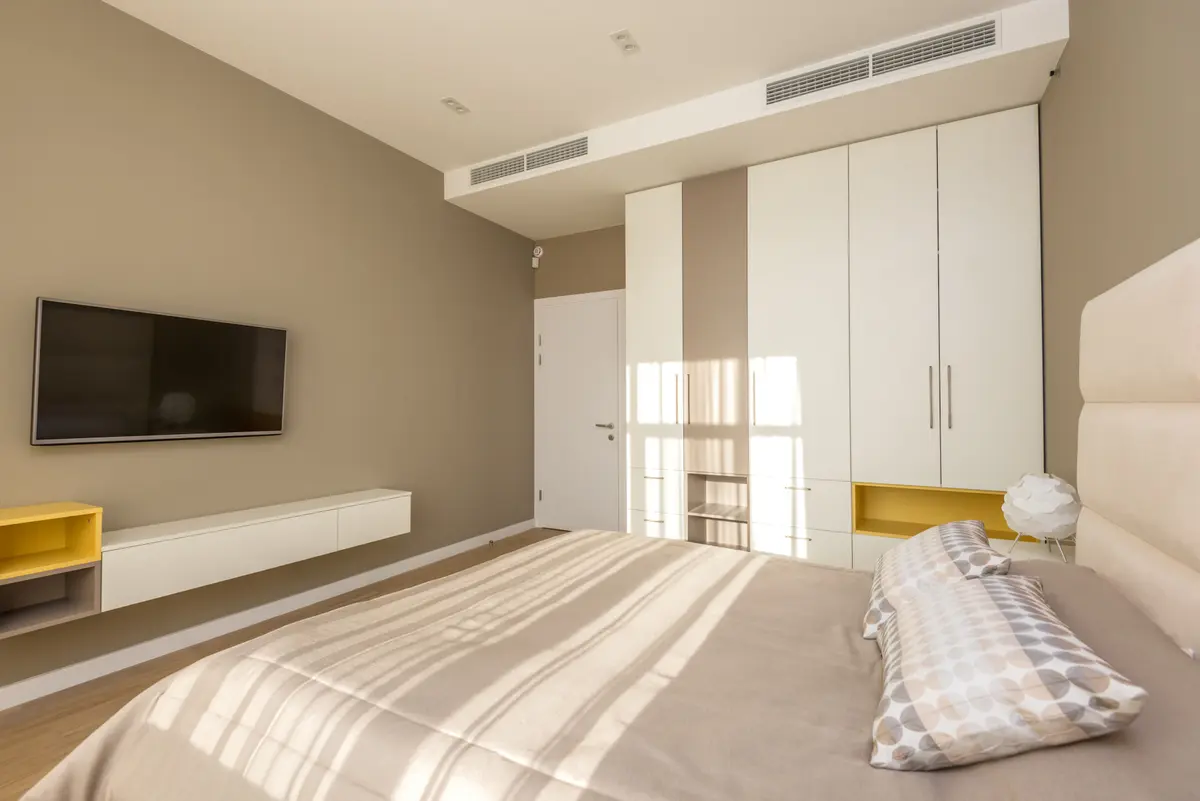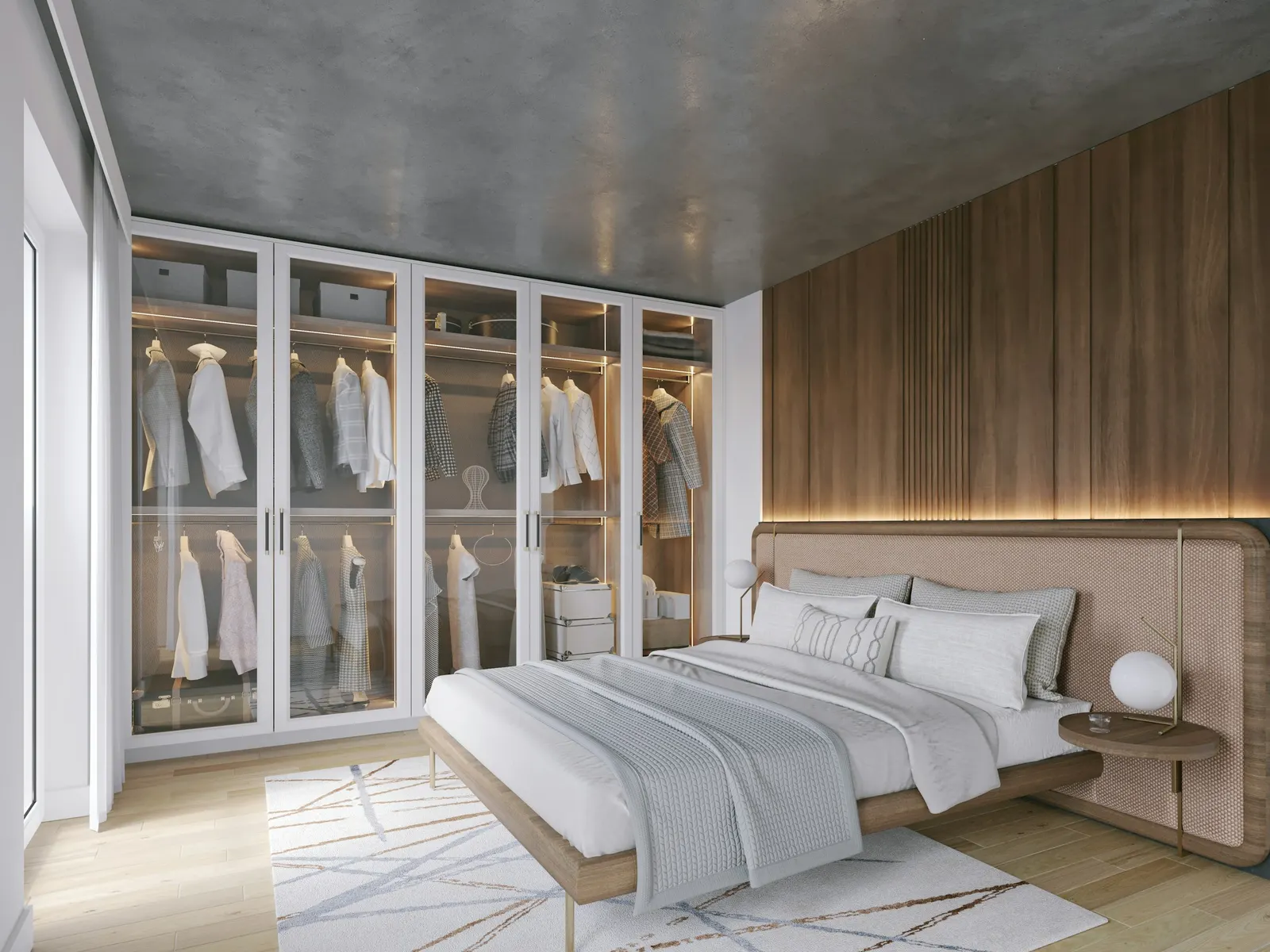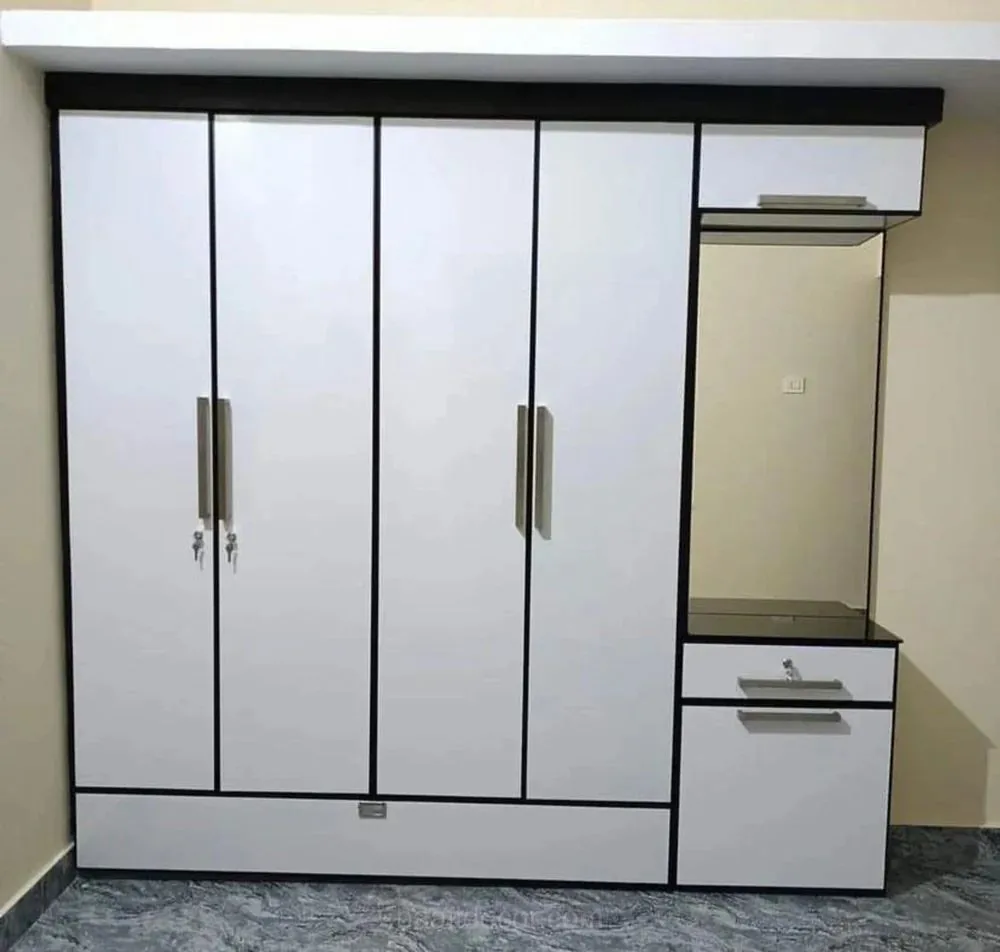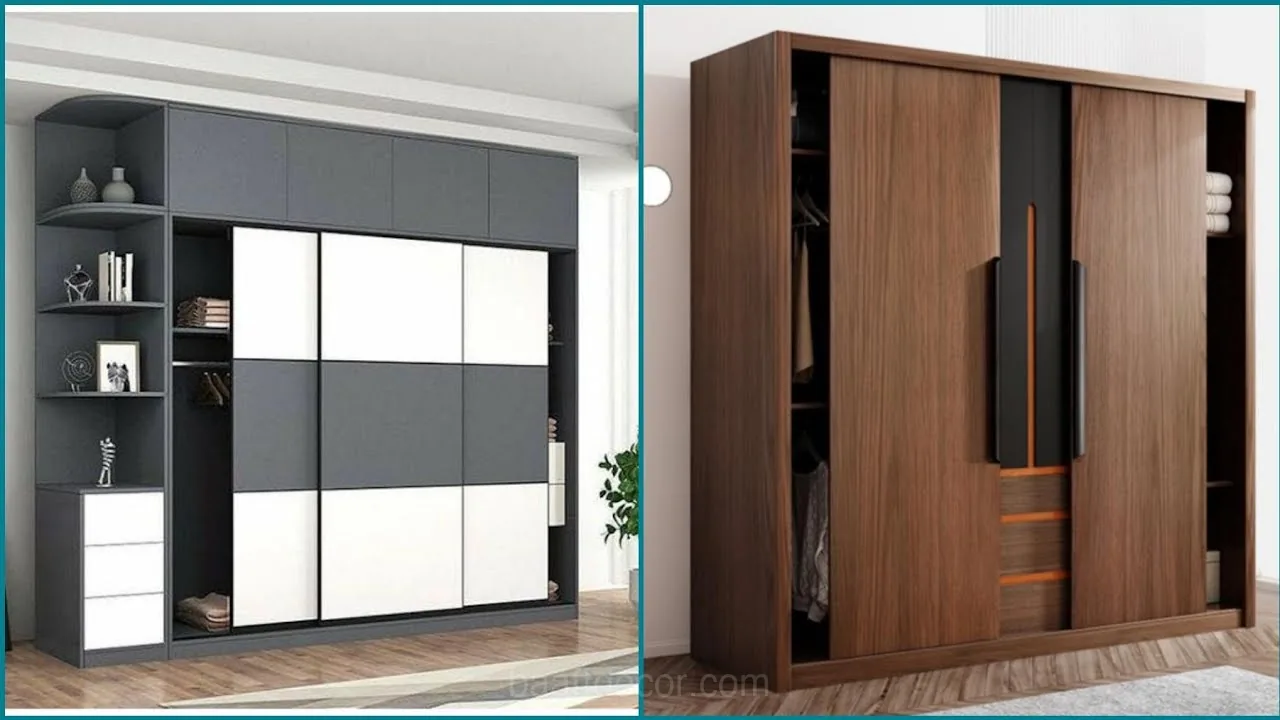
The sliding-or-hinged question is best settled with a tape measure, once you know where the bed will go. The floor in front of the wardrobe decides most of it. Looks and budget come second.
Here’s how we help homeowners decide when planning made-to-measure wardrobes in Hyderabad, with the trade-offs laid out plainly. Door type is one chapter of our complete wardrobe guide for Hyderabad homes, which also covers boards, finishes, interiors and cost.
Sliding or hinged wardrobe: the quick verdict
Choose sliding if:
- The bed, a dresser or the room door sits less than about 2 ft from the wardrobe.
- You want full-length mirror or glass panels.
- The wardrobe runs along a narrow passage or walk-through.
Choose hinged if:
- You have at least 2 ft (ideally 3 ft) of clear floor in front.
- You want to see and reach the entire interior at once.
- Budget matters, or you want internal drawers in every bay.
- The room gets a lot of dust and you don’t want to clean tracks.
Sliding vs hinged wardrobe: side-by-side comparison
| Factor | Sliding wardrobe | Hinged wardrobe |
|---|---|---|
| Floor space needed | Almost none beyond standing room | Door width (450 to 600 mm) plus standing room |
| Access | Half (2 panels) or two thirds (3 panels) at a time | Full access to every bay |
| Depth | About 600 to 650 mm | About 600 mm |
| Cost | Higher (track, profiles, fittings) | Lower for the same size and finish |
| Mirror / glass panels | Excellent, very common | Possible, but heavy doors strain hinges |
| Internal drawers | Must avoid the panel overlap zone | Can go in any bay |
| Upkeep | Track cleaning; roller adjustment | Hinge adjustment; handles |
| Look | Flat, continuous front | More panel and handle options |
How much space does a hinged wardrobe need?
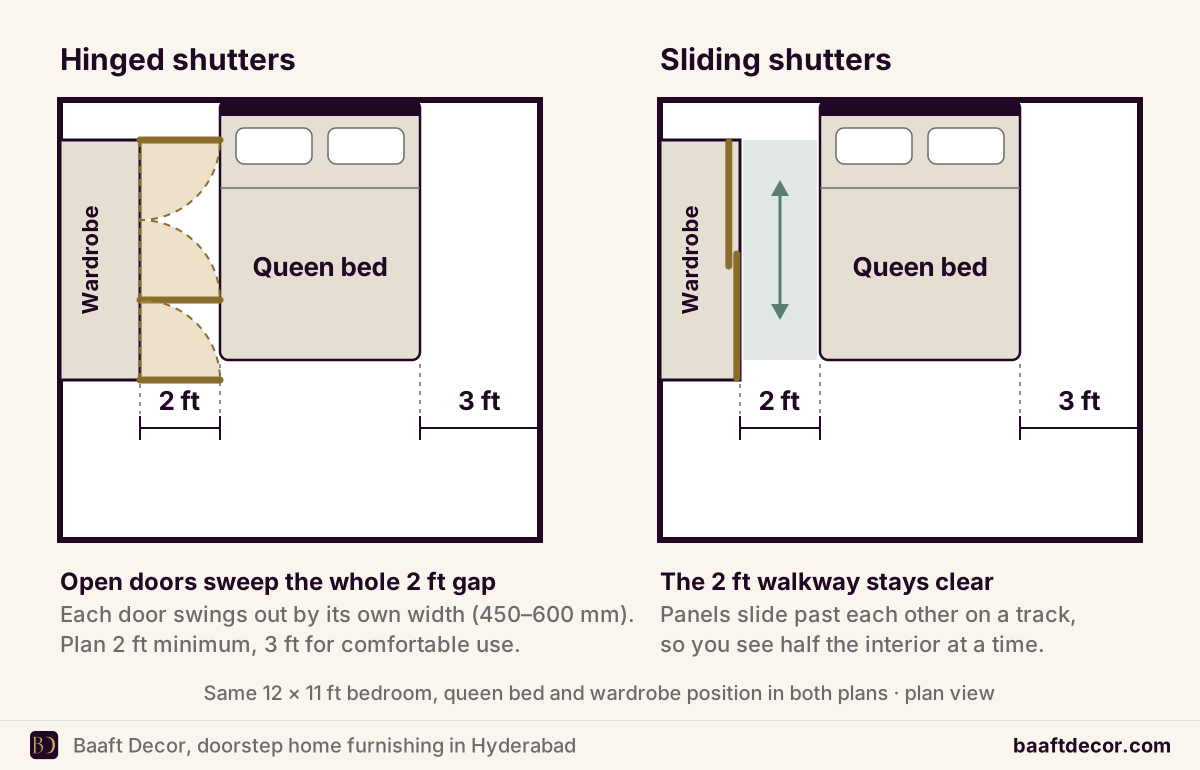
A hinged door sweeps a quarter circle equal to its own width. So a 500 mm door needs 500 mm of free floor just to open, and you need somewhere to stand on top of that. In practice we plan for at least 2 ft, preferably 3 ft.
That’s tighter than it sounds. A common 2BHK secondary bedroom in Hyderabad is around 10 × 11 ft. Put a queen bed in it (about 5 × 6.5 ft) and the gap between the bed and the wardrobe wall often comes down to 2 ft or less. That room usually ends up with sliding doors.
There’s a middle path: narrower hinged doors, around 400 to 450 mm, reduce the swing. They look busier but cost less than sliding.
How do sliding wardrobe tracks work?
A sliding door is only as good as the track it runs on, so this is the part to get right.
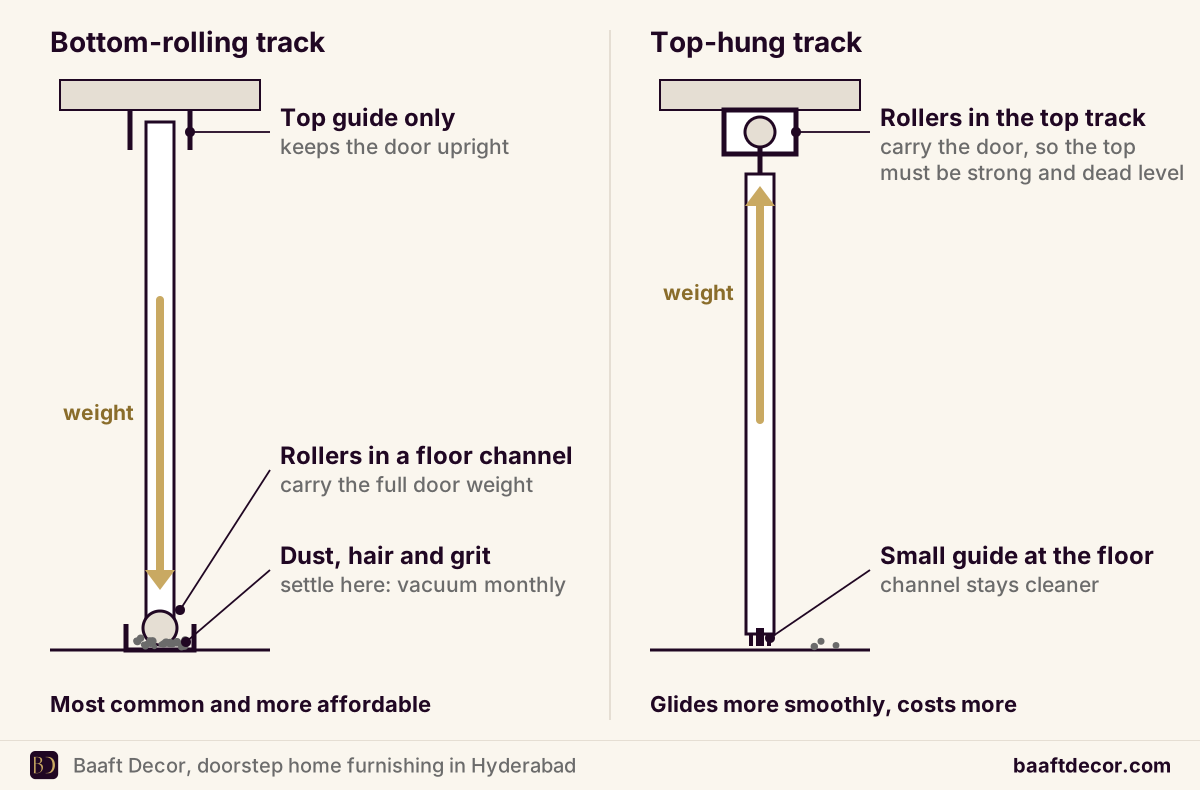
Bottom-rolling tracks carry the door’s weight on rollers running in a floor-level channel, with a top guide to keep it upright. This is the most common system in Indian homes and the more affordable one. The downside is that the bottom channel collects dust, hair and grit.
Top-hung tracks carry the weight from the top of the wardrobe, with only a small guide at the bottom. Doors glide more smoothly and the floor channel stays cleaner, but the wardrobe top must be strong and dead level. They cost more.
Two features are worth insisting on:
- Soft-close dampers, which slow the door in the last few centimetres so it doesn’t slam. Essential on mirror and glass panels.
- Anti-jump clips, which stop a door lifting off the track when someone tugs it hard. Cheaper kits often skip these, and a child pulling on a heavy mirror door is exactly when you need them.
Two panels or three?
With two panels, one always covers half the wardrobe. With three, you see two thirds at a time. For a 6 to 8 ft wardrobe, three panels usually give better access. Plan internal drawers so they sit behind a single panel, never behind the overlap, or they won’t open.
Which costs more, and why?
Sliding wardrobes almost always cost more than hinged ones of the same size and finish. The difference comes from:
- The track and roller system, which varies a lot between basic and branded soft-close kits.
- Aluminium profiles that frame many sliding doors, especially glass and mirror panels.
- Panel weight: mirror, lacquered glass and thick acrylic panels need heavier hardware.
- Installation time, since sliding doors must run level along the full width.
Hinged wardrobes have their own cost levers: soft-close hinges, handles or profile grips, and the finish. We break all of this down in our wardrobe cost guide for Hyderabad.
Sliding door wardrobe designs that work well
- Two-door sliding wardrobe with one mirror panel: the classic small-bedroom solution.
- Three-door sliding wardrobe for 7 to 9 ft walls, with the middle panel in a contrast finish.
- Tinted glass in black aluminium frames for a modern look; best with interior lighting.
- Sliding wardrobe with loft: the loft above usually gets hinged or lift-up shutters, since a separate track up there is hard to reach.
The shutter finish matters as much as the mechanism. A sliding panel is the part everyone pushes with a flat palm, so gloss shows handprints there first. Our guide to laminate vs acrylic vs PU wardrobe finishes covers how each one looks and ages on a big sliding panel.
Plan the inside differently for each type
The interior layout should follow the door type, not the other way round. This is the step most ready-made catalogues skip.
For a sliding wardrobe, divide the interior into bays that match the panel widths exactly. A three-panel, 7.5 ft wardrobe works best as three bays of about 2.5 ft each, so whichever panel you move, you see one complete bay. Put drawers and the locker in the bay that sits behind a single panel. Long-hang sarees and kurtas can go behind an overlap because you slide in and pull from the side anyway.
For a hinged wardrobe, you have more freedom. Drawers can go in any bay, and the inside of each door can carry a tie rack, a narrow mirror or hooks for belts and dupattas. Pull-out trouser racks and a full-extension jewellery tray work well here because nothing blocks them.
In both cases, keep the most-used clothes between waist and eye height, and use the loft for suitcases and seasonal bedding. Our guide to wardrobe internal design has the hanging heights, where drawers go and accessory choices for each bay.
Living with each type in Hyderabad
Dust is the sliding wardrobe’s biggest enemy. In fast-growing areas like Kondapur, Kokapet and Tellapur, many gated communities have construction next door for years. If that’s your situation, either budget for a top-hung system or commit to vacuuming the bottom track monthly.
Humidity tests tall shutters. Shutters made from ordinary MDF can bow slightly during the June to September monsoon. On a hinged wardrobe, the door stops sitting flush; on a slider, panels start to rub. HDHMR or good plywood shutters stay flatter. A hinged door that drifts can be brought back with a screwdriver in five minutes.
Children and older parents. Hinged doors can catch little fingers; soft-close hinges reduce that risk. Sliding doors are easier for someone with limited mobility because there’s nothing to step around.
Can you mix sliding and hinged doors?
Yes, and we often do. The most common pattern is sliding doors on the main wardrobe with hinged shutters on the loft. In larger master bedrooms, a hinged section for daily clothes beside a sliding glass section for display gives you both.
Compact secondary bedrooms, common in IT-corridor flats such as those we fit out for wardrobes in Kondapur, are where pricing both options side by side helps most.
Not sure which suits your room? Book a free home visit. We’ll measure the clearance, show you track and hinge samples in your bedroom, and give a fixed quote for both options so you can compare. Call or WhatsApp +91 98499 17494, 8 AM to 10 PM, all 7 days.
Frequently asked questions
Is a sliding or hinged wardrobe better?
Neither is better everywhere. A sliding wardrobe is better when floor space in front of the wardrobe is tight, because the doors move along a track instead of swinging out. A hinged wardrobe is better when you have about 2 ft of clear floor, because every door opens fully, interiors are easier to reach, and it usually costs less for the same size and finish. In most Hyderabad 2BHK bedrooms the deciding factor is simply the distance between the bed and the wardrobe.
Do sliding wardrobes cost more than hinged wardrobes?
Sliding wardrobes usually cost more than hinged wardrobes of the same size and finish. The extra cost comes from the sliding track and roller system, aluminium frame profiles on many designs, soft-close and anti-jump fittings, slightly greater depth, and more careful installation so the doors run level. Hinged wardrobes use standard hinges, which are cheaper even in soft-close versions. Exact quotes depend on width, height, finish and hardware brand, and are fixed after measuring the room.
What are the disadvantages of sliding wardrobes?
Sliding wardrobes have four main disadvantages. You can only open half the wardrobe at a time with two panels, or two thirds with three panels. Bottom tracks collect dust and grit, which makes doors stiff unless you vacuum them regularly. Cheap rollers can jump off the track or wear out. And the overlapping panels make internal drawers harder to plan, because a drawer behind the overlap cannot open. A good track system and careful interior planning solve most of these issues.
How much space is needed in front of a hinged wardrobe?
A hinged wardrobe needs clear floor space at least equal to the width of one door, which is usually 450 to 600 mm, plus room to stand while the door is open. In practice, plan for about 2 ft of clearance as a minimum and 3 ft for comfortable use. If your bed, a study table or the room door sits closer than that, either choose sliding shutters or use narrower hinged doors.
How deep should a sliding wardrobe be?
A sliding wardrobe should be about 600 to 650 mm deep overall. Clothes on hangers need roughly 550 mm of clear internal depth, and the double sliding track with two door planes takes up extra depth at the front. If the wardrobe is made only 550 mm deep to save space, hangers rub against the back door panel and the doors can scrape clothes as they slide. Hinged wardrobes work well at about 600 mm.
Can a sliding wardrobe have a mirror?
Yes, a sliding wardrobe can have a full-length mirror panel, and it is one of the best uses of sliding doors in a small bedroom, because the mirror replaces a separate dressing mirror. Mirror and glass panels are heavier than laminate panels, so they need a stronger track, soft-close dampers and anti-jump clips. The mirror should have a safety backing film, so that if it is ever cracked the pieces stay stuck to the film, and it is usually set in an aluminium frame.
How do you maintain sliding wardrobe tracks?
To maintain sliding wardrobe tracks, vacuum the bottom track once a month and wipe it with a dry cloth, more often if there is construction nearby. Use a dry silicone spray on rollers if they feel stiff; avoid oil, which traps dust. If a door rubs or leans, adjust the roller screws a quarter turn at a time until it runs level. Check soft-close dampers and anti-jump clips twice a year.