“Aluminium cupboard” is one of the most searched furniture terms in Hyderabad, and it usually comes up after a plywood wardrobe has swollen, sagged or been eaten by termites. That worry is fair. But aluminium fixes those problems by giving up other things, and in most bedrooms the better fix is the right board, not a different material. We build custom wooden wardrobes in Hyderabad, not aluminium cupboards, so read this as a comparison from people who work with board every day and know exactly where it fails.
This guide sits under our complete wardrobe guide for Hyderabad homes, which covers layouts, doors, finishes and costs. Here we stick to one question: aluminium or wood, and for which room?
Aluminium or wooden wardrobe: the short verdict
Choose an aluminium cupboard if:
- It’s going in a wash area, utility balcony, store room or under a staircase, where water and damp are a given.
- You live on a ground floor or in an older independent house with a termite history.
- You rent, and want something light enough to take with you.
Choose a wooden wardrobe (plywood or HDHMR) if:
- It’s a bedroom wardrobe you’ll open many times a day.
- You want internal drawers, a locker, soft-close hinges and pull-outs.
- You want a finish that matches the rest of the room, from matte laminate to PU.
- It needs to fit floor to ceiling around beams, windows and AC pipes.
What is an aluminium cupboard actually made of?
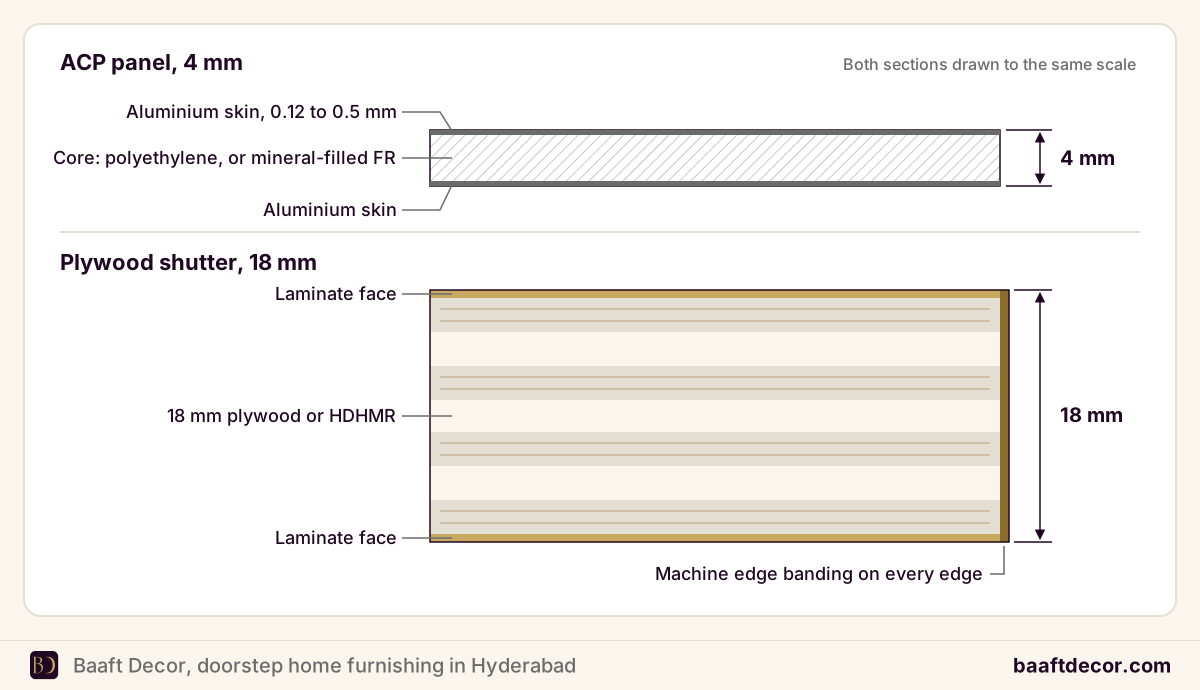
Most aluminium cupboards sold in Hyderabad have two parts: a frame of extruded aluminium sections (fabricators call it the profile) and panels fitted into that frame. The panels are usually aluminium composite panel (ACP), sometimes plain aluminium sheet, glass or mirror.
ACP is two thin aluminium skins bonded to a plastic or mineral core. Aludecor, one of the larger Indian makers, lists panels in 3 mm, 4 mm and 6 mm, with skins anywhere from 0.12 mm to 0.5 mm, and its thinnest-skinned grades are meant for interiors only. That spread matters. Two cupboards both sold as “ACP” can have skins four times apart in thickness, and you feel the difference every time you press a shutter.
The core matters too. Standard ACP has a polyethylene core, which is highly combustible; fire-retardant (FR) grades replace much of it with mineral filler. Inside a bedroom that isn’t a reason to panic, but if you do go with aluminium, ask which core you’re getting.
A wooden wardrobe, as we build it, is a carcass (the box) of 18 mm plywood or HDHMR, with shutters in laminate, acrylic, PU or glass. Plywood is graded under IS 303: MR for dry rooms, BWR for humid ones and, since a 2024 revision of the standard, a BWP grade as well. Our kitchen cabinet materials guide explains each board in detail, and the same logic carries over to wardrobes.
Aluminium vs wooden wardrobe: side by side
| Factor | Aluminium cupboard (profile + ACP) | Wooden wardrobe (plywood or HDHMR) |
|---|---|---|
| Water and damp | Doesn’t swell or rot | MR ply swells if damp; BWR/BWP ply and HDHMR cope when edges are sealed |
| Termites and borers | Not affected | Needs treated board, especially on ground floors |
| Strength | Frame is stiff; thin panels flex | 18 mm board holds hinges, channels and loaded shelves |
| Sound | Panels can rattle and sound tinny | Quiet, solid close |
| Weight | Light; easy to carry and move | Heavy; built in place and fixed to the wall |
| Finishes | Powder-coated or anodised profiles, printed ACP, glass | Laminate, acrylic, PU, veneer, glass, mirror |
| Drawers and fittings | Possible, but thin panels limit what holds well | Full range: drawers, lockers, pull-outs, lifts |
| Repairs | Dents are hard to hide; panels get replaced | Hinges adjust; shutters and edges can be redone |
| Best for | Wash areas, store rooms, rentals | Bedrooms, dressing areas, kids’ rooms |
How each one behaves in the Hyderabad monsoon
From June to September, a wall shared with a bathroom or facing the rain can stay damp for weeks. This is where aluminium earns its reputation. The panels don’t absorb water, so nothing swells or peels.
A damp wall still makes the clothes inside smell musty, though, whatever the cupboard is made of. And the screws, hinges and locks in a cheap aluminium cupboard are often plain steel, which rusts long before the aluminium shows any sign of trouble. If the cupboard is going near a washing machine or a wet floor, ask for stainless or coated hardware.
Wooden wardrobes usually fail at the edges and the back. MR plywood or particle board with hand-glued edge strips takes in moisture, and the edges lift. The cure is in the specification: BWR or BWP plywood or HDHMR on any wall that gets damp, machine-pressed edge banding on every edge, hidden ones included, and a small air gap between the carcass back and the wall. That’s why we check walls for damp on the home visit before suggesting a board.
Termites: the real reason many people ask
Termites can’t eat aluminium. For a ground-floor flat in an older building, an independent house with a termite history, or a store room that stays dark and shut, that alone can settle the question.
Plywood isn’t defenceless. Treated plywood, and HDHMR (made termite-resistant during manufacture), hold up well once the source in the wall or floor has been treated. A new wardrobe of any material against an untreated wall is only a temporary fix, and the termites will move on to whatever is stored inside.
Strength, noise and weight
This is where wood pulls ahead in a bedroom.
An aluminium frame is stiff, but the panels between the profiles are thin. Press the middle of an ACP shutter and it gives. Shut it a little hard and you’ll hear it. Over the years, hinges fixed into thin panels or narrow profiles can loosen on tall doors that get opened all day. Shelves are the other weak spot, so ask what they’re made of and how far apart the supports are. A thin shelf stacked with folded jeans will bow.
An 18 mm plywood or HDHMR carcass takes soft-close hinges, full-extension drawer channels and a locker without fuss, and the doors shut with a dull, solid sound. The trade-off is weight. A wooden wardrobe is heavy, built on site and fixed to the wall. If you move house every couple of years, an aluminium cupboard you can unbolt and carry down the stairs has a real advantage.
Finishes and looks
Aluminium profiles come powder-coated or anodised, in black, white and wood-effect colours among others, and the panels can be printed ACP, glass or mirror. The look is lighter and a little more commercial, and the profile lines show on every shutter.
Wood gives you the full range: matte or suede laminate, high-gloss acrylic, PU paint, veneer, fluted panels, handleless grips. Our guide to wardrobe finishes: laminate vs acrylic vs PU compares how each one ages.
There’s also a middle path. A plywood or HDHMR carcass can carry a few aluminium-framed glass shutters for display and slim aluminium profile handles. You get the aluminium look where people see it and a solid box where the weight sits.
What drives the cost of each?
Prices swing too much with specification to be useful in an article, and a fixed quote follows the home visit. The cost drivers, though, are easy to compare.
Aluminium cupboard:
- Profile section and wall thickness. Heavier sections cost more and flex less.
- ACP grade: skin thickness and core (polyethylene or FR).
- Panel type: ACP, plain sheet, glass or mirror.
- Hardware: hinges, locks and handles, and whether they resist rust.
Wooden wardrobe:
- Board grade and thickness (MR, BWR or BWP plywood, or HDHMR).
- Shutter finish, from laminate up to PU and glass.
- Hinged or sliding doors, and the hardware brand.
- Internal fittings: drawers, locker, pull-outs and the loft.
Our wardrobe cost guide explains how wooden wardrobes are priced per square foot. For either type, compare quotes on the written specification, not the per sq ft figure alone. A cheap aluminium quote with thin skins and steel screws is no bargain in a wash area.
Which material suits which room?
| Room or situation | Our suggestion | Why |
|---|---|---|
| Master or kids’ bedroom | Wood: MR ply or HDHMR is enough in a dry room (BWR on an external or damp-prone wall), laminate shutters | Quiet, strong, full range of fittings |
| Wall shared with a bathroom | BWP ply or HDHMR, or aluminium | Both handle damp if specified properly |
| Wash area or utility balcony | Aluminium | Splashes and humidity every day |
| Store room or under-stair storage | Aluminium or BWP ply | Damp, dark, rarely aired |
| Ground floor with a termite history | Aluminium, or treated ply once the wall is treated | Takes termites out of the equation |
| Rented flat | Aluminium or a freestanding unit | Light, and it moves with you |
| Dressing area or walk-in | Wood with glass sections | Finish and fittings matter most |
If aluminium is right for your wash area, a specialist aluminium fabricator is the right person for that cupboard. The bedrooms can still be planned in wood.
Questions to ask before you order either type
- What exactly are the panels: ACP (which grade and skin thickness), aluminium sheet, plywood or HDHMR?
- For plywood, which IS 303 grade, and is it termite-treated?
- Are the hinges, screws and locks stainless or coated?
- What are the shelves made of, and where are they supported?
- Is the back closed, and is there an air gap to the wall?
- Does the quote include the loft, drawers and installation?
If you’re leaning towards wood, plan the inside before the finish. Our wardrobe internal design guide covers hanging heights, shelf spacing and drawers.
Not sure your bedroom wall is dry enough for a wooden wardrobe? Book a free home visit. We’ll check the wall for damp, bring board, laminate and hardware samples, and give you a fixed quote with the board grade written on it. Call or WhatsApp +91 98499 17494, any day from 8 AM to 10 PM.
Frequently asked questions
Which is better, an aluminium cupboard or a wooden wardrobe?
Neither is better everywhere. An aluminium cupboard, made of aluminium profiles with ACP or sheet panels, is the better choice for wet utility areas, store rooms, ground-floor rooms with a termite history and rented flats, because it doesn't swell, rot or attract termites and is light enough to move. A wooden wardrobe in BWR or BWP plywood or HDHMR is the better choice for bedrooms, because it is stronger and quieter, holds drawers and soft-close hinges well, and comes in far more finishes.
Do aluminium cupboards get termites?
No, termites cannot eat aluminium, so the frame and the ACP or sheet panels of an aluminium cupboard are not damaged by them. Termites can still live in the wall or floor behind the cupboard, and they will happily attack clothes, papers and cardboard boxes stored inside. If a room has a termite problem, get the wall and floor treated first. A wooden wardrobe in treated plywood or HDHMR also holds up well once the source of the termites has been dealt with.
Are aluminium cupboards waterproof?
Aluminium cupboards are water-resistant rather than fully waterproof. The aluminium profiles and ACP panels don't absorb water, so they won't swell or delaminate in a damp wash area or during the June to September monsoon. Water can still get in through the gaps between panels, though, and cheaper cupboards often use plain steel screws, hinges and locks that rust. If the cupboard will stand near water, ask for stainless or coated hardware and keep the base slightly raised off a wet floor.
Is ACP good for wardrobes?
ACP can work for wardrobes in damp or utility areas, but the grade matters. Aluminium composite panel is two thin aluminium skins bonded to a core, and Indian makers sell it with skins from about 0.12 mm to 0.5 mm thick; the thin interior grades dent and flex more easily. Standard polyethylene cores are combustible, while fire-retardant (FR) grades are safer. For a bedroom wardrobe opened many times a day, 18 mm plywood or HDHMR with laminate gives a stronger, quieter shutter.
Which plywood is best for a wardrobe in Hyderabad?
For a dry bedroom wall, MR-grade plywood to IS 303 or HDHMR is enough for a wardrobe carcass. For a wall shared with a bathroom, an outside wall that turns damp in the monsoon, or a ground-floor room, step up to BWR or BWP plywood or HDHMR, with machine-pressed edge banding on every edge and a small air gap at the back. Carcass sides and shelves are usually 18 mm thick. Check the ISI mark, grade and brand printed on each sheet before fabrication starts.
Are aluminium wardrobes noisy?
Aluminium wardrobes are usually noisier than wooden ones. The thin ACP or sheet panels between the profiles flex when pressed and can rattle or sound tinny when a door is shut firmly, especially on tall shutters. Rubber buffers and soft-close hinges reduce the noise but don't remove it. A wooden wardrobe with 18 mm plywood or HDHMR shutters closes with a dull, solid sound, which is one reason most families still choose wood for bedroom wardrobes they open many times a day.
Does Baaft Decor make aluminium cupboards?
No. Baaft Decor builds custom wardrobes with plywood or HDHMR carcasses and laminate, acrylic, PU or glass shutters, and those wardrobes can include aluminium-framed glass shutters and slim aluminium profile handles. We don't fabricate full aluminium cupboards. If aluminium suits your utility area or store room, a specialist aluminium fabricator is the right choice for that one. For bedrooms, we visit free of charge, check the walls for damp, bring board and finish samples and give a fixed quote.