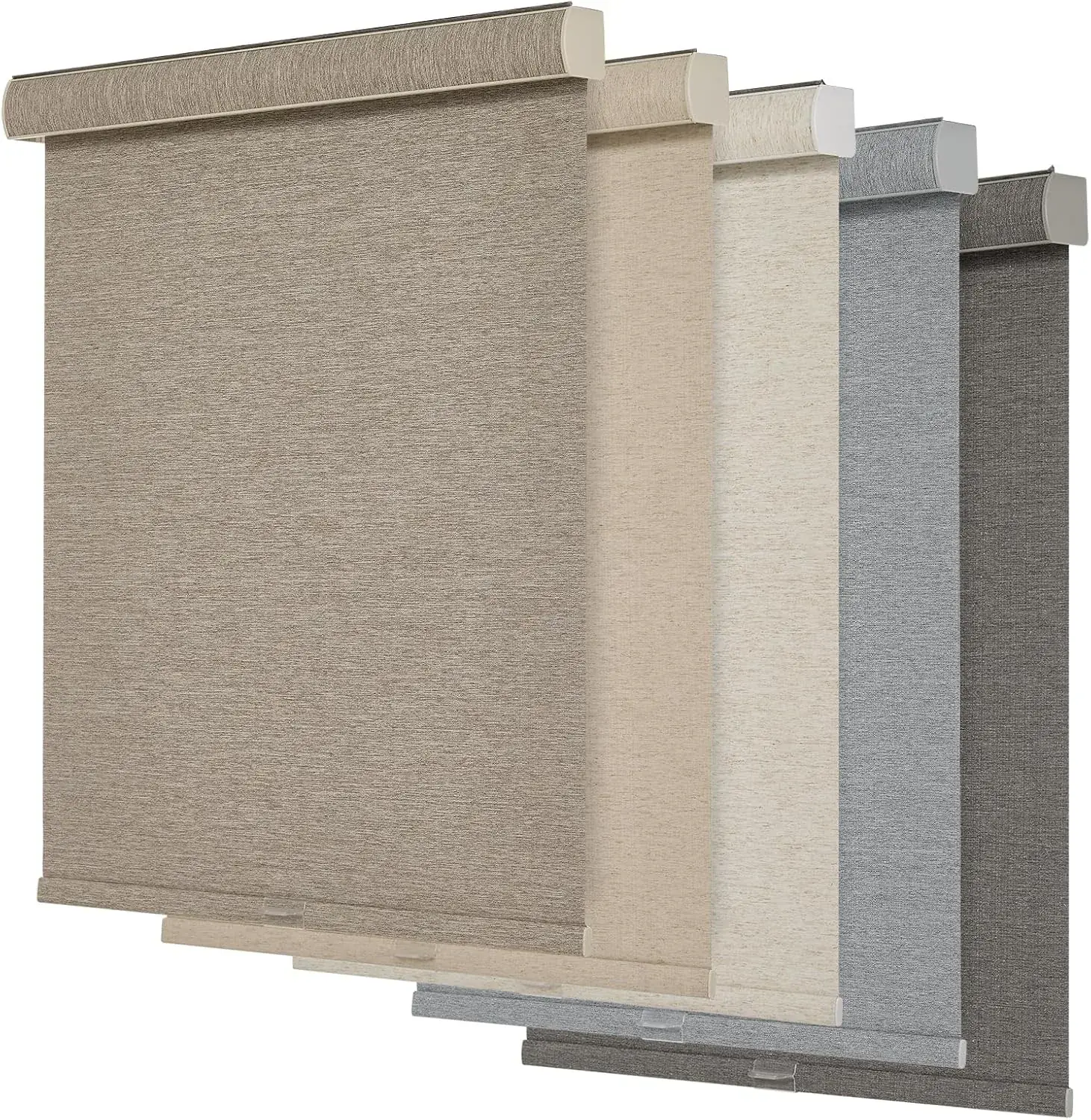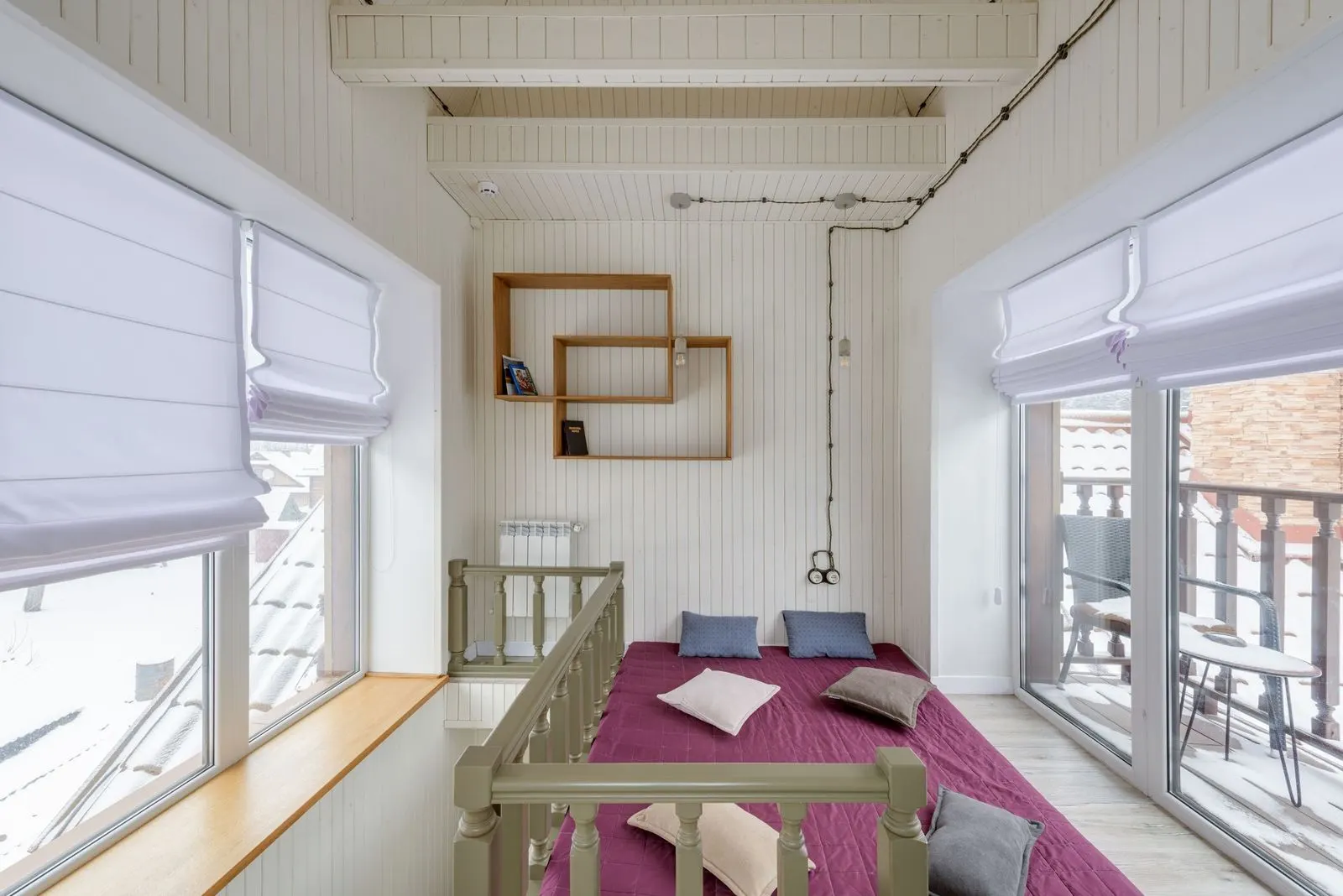
A roman blind is a single panel of curtain fabric that pulls up into neat horizontal folds. You get the softness of curtains with the footprint of a blind, which is why people ask for them in bedrooms and dining rooms where long drapes would crowd the furniture. When we fit made-to-measure blinds in Hyderabad, romans are the type where fabric, lining and fold style matter most, because a wrong combination shows the day it goes up.
This guide covers the fold styles, linings, cord safety, and the rooms where romans earn their place (and the ones where they don’t). If you’re still deciding between blind types, our window blinds buying guide for Hyderabad compares them all.
How does a roman blind work?
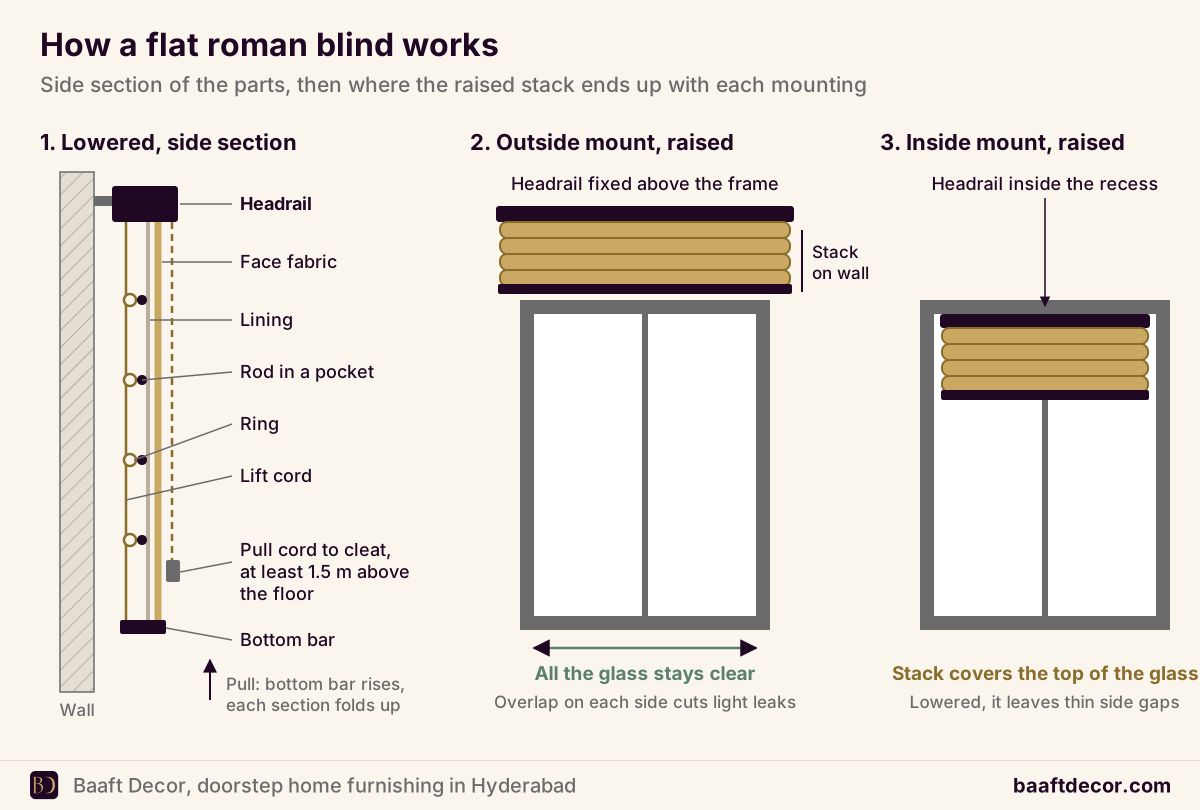
The fabric hangs from a headrail fixed above or inside the window. On most flat romans, thin rods sit in pockets across the back at even intervals. Lift cords or tapes run up through rings to the headrail, and when you pull the cord or chain, the bottom bar rises and each section folds onto the one above it.
Raise it fully and all that fabric ends up as a stack at the top of the window. That stack is the one thing people don’t expect. On an inside mount it covers the top part of the glass, so if you want every bit of daylight, we fix the blind above the frame and let the stack sit on the wall.
There are four ways to lift one:
- Cord and cleat. The traditional system. Cheapest, but the cords are a child-safety issue (more on that below).
- Chain operated. A continuous bead chain turns a shaft that winds up the lift tapes. Smoother on bigger blinds.
- Cordless. You lift the bottom bar by hand and a spring mechanism holds it. Good for small windows and kids’ rooms.
- Motorised. Remote, app or wall switch. Worth it on tall windows or blinds behind a bed. See our motorised curtains and blinds service.
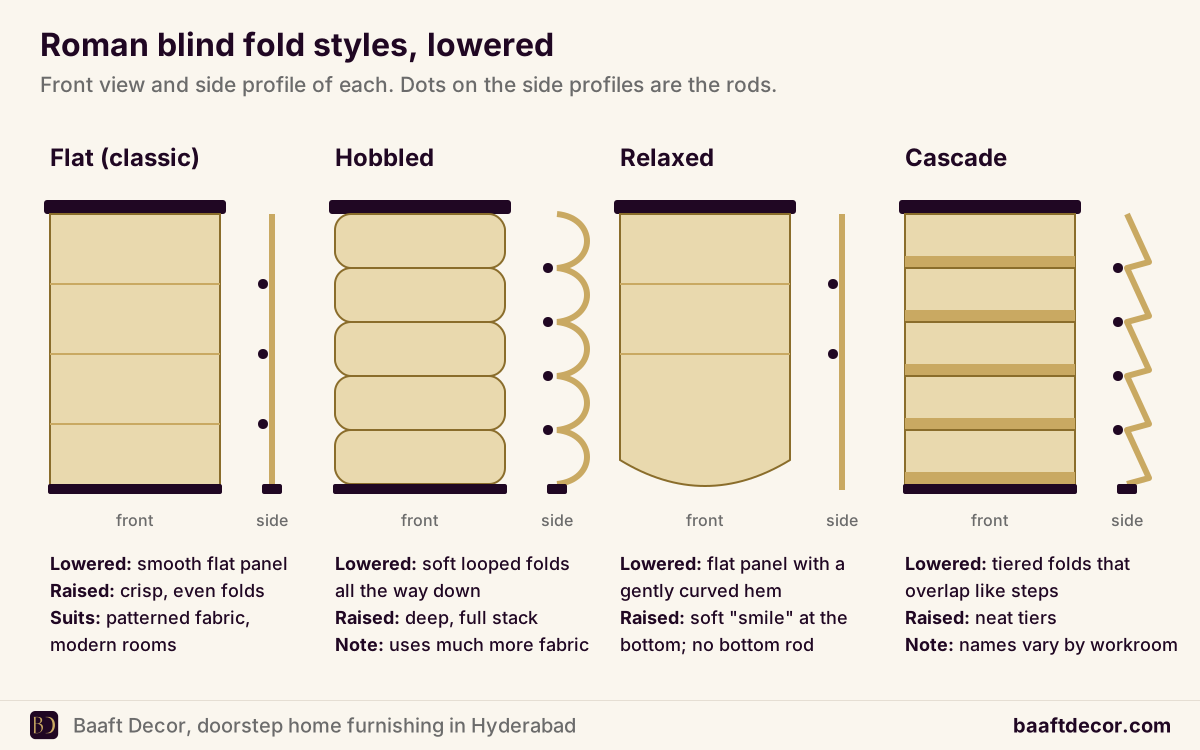
Roman blind fold styles: flat, hobbled, relaxed and cascade
Fold style changes the look more than anything else, and it changes how much fabric you buy.
| Style | Lowered | Raised | Suits | Watch out for |
|---|---|---|---|---|
| Flat (classic) | Smooth flat panel | Crisp, even folds | Patterned fabric, modern rooms, small windows | Thin fabric shows rod lines and creases |
| Hobbled (waterfall, soft fold) | Soft looped folds all the way down | Deep, full stack | Plain or textured fabric, traditional rooms | Uses much more fabric; folds hold dust |
| Relaxed | Flat panel with a gently curved hem | Soft “smile” at the bottom | Casual rooms, blinds left half-down | Hem never sits dead straight |
| Cascade | Tiered folds that overlap like steps | Neat tiers | Dining rooms, feature windows | Names vary between workrooms |
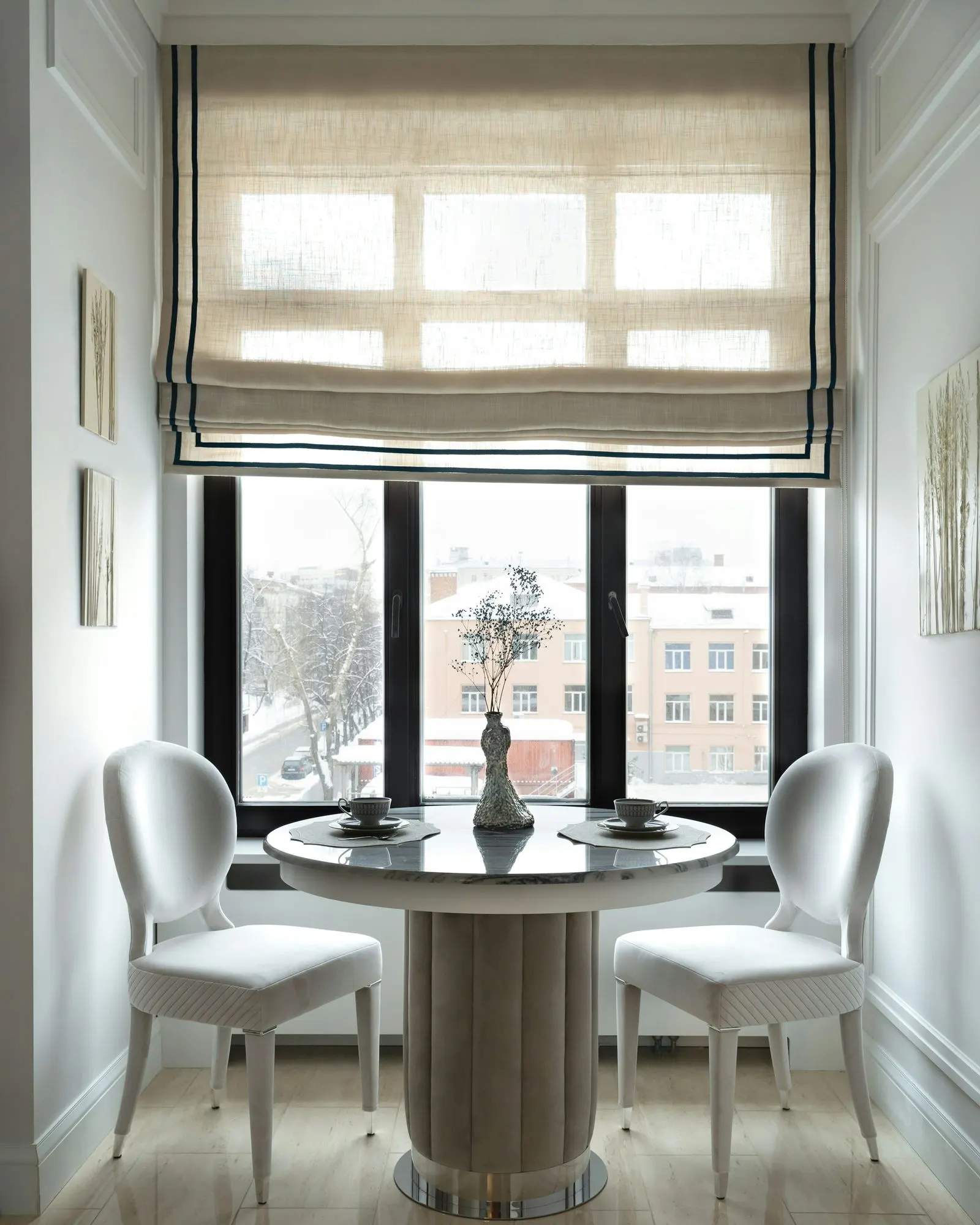
Flat is what most Hyderabad apartments end up with. It keeps a print unbroken, which matters if you’ve chosen a bold geometric or a block-print fabric, and it looks tidy on standard bedroom windows.
Hobbled blinds keep their loops even when lowered, so the blind always looks full. They’re lovely in a traditional living room. But you’re paying for a lot more fabric, and every loop is a little shelf for dust.
Relaxed romans have no rod at the very bottom, so the hem curves. People who like a soft, slightly undone look love them. People who like everything lined up don’t, and the curve looks odd on wide windows.
Cascade usually means tiered folds with a rod in each tier, so they overlap crisply when lowered. Some workrooms use “cascade” and “waterfall” as other names for hobbled, so ask to see a made-up sample before you approve anything.
Lined, unlined or blackout: which lining do you need?
The lining does more work than the face fabric. It decides how much light gets through, how long the fabric lasts in the sun, and how the folds hang.
- Unlined. Light filters through the fabric. Nice in a study or a dining room with a pleasant view, but the fabric takes the full sun and fades faster, and the rod pockets show as lines when light comes through.
- Standard lining. A cotton or poly-cotton sateen behind the fabric. It gives privacy at night, protects the face fabric, and makes folds look fuller. This is our default for most rooms.
- Blackout lining. For bedrooms, kids’ rooms and TV rooms. Light can still sneak in at the edges, and on some designs stitching through the lining for the rods lets pinpoints of light through. Ask how the rods are attached.
- Interlining. A soft layer between fabric and lining. Plumper folds, a little more insulation and sound damping, but heavier.
West-facing bedrooms in April and May are where lining earns its cost. Unlined fabric facing the afternoon sun can fade in a couple of summers; lined, it holds its colour far longer. Our guide to blackout, sheer and dim-out fabrics explains the light levels in more detail.
Are roman blinds safe for children?
They can be, if no cord or chain can form a loop a child can reach. Corded romans have lift cords running up the back of the blind, and a small child can pull one out into a loop. The pull cord and any bead chain are the other hazards.
RoSPA, the UK accident prevention charity, reports that nine children died from blind cord strangulation between April 2019 and March 2022 in the UK alone. Its advice, and the US Consumer Product Safety Commission’s, comes down to this:
- In children’s rooms, go cordless or motorised. No exceptions.
- Elsewhere, fix cleats at least 1.5 metres above the floor and wrap the cord in a figure of eight.
- Anchor bead chains to the wall with a tensioner.
- Don’t cut cords to shorten them; it doesn’t remove the risk.
- Keep beds, cots and sofas away from windows so children can’t climb up to the cords.
When we fit corded romans, we fix the cleat or tensioner during installation, not as an extra.
Where do roman blinds work best?
Bedrooms. Blackout-lined, mounted outside the recess with overlap on both sides. If you wake with the sun, pair it with a curtain.
Dining rooms. One of the best rooms for romans. You raise and lower them less often, and a flat or cascade fold in a patterned fabric gives the room a focal point without the bulk of drapes.
Children’s rooms. Cordless or motorised, blackout-lined, and in a fabric that can come off the headrail for washing. Kids touch everything.
Studies and home offices. Light-filtering lining cuts screen glare while keeping the room bright.
Smaller living-room windows. Romans suit the windows beside a sofa or a reading chair. For full-height sliding doors to the balcony, they’re the wrong tool: you walk through those openings daily, and a huge roman is heavy to lift. Curtains or vertical blinds do that job better, as our comparison of blinds vs curtains explains.
Where roman blinds don’t belong
- Bathrooms. Steam and fabric don’t mix. Folds stay damp, and in the monsoon that means mildew.
- Above the sink or hob. Splashes, oil and tadka fumes soak into fabric, and most romans can’t go in a washing machine. Aluminium venetians or PVC-coated rollers wipe clean instead.
- Balconies and utility areas. Sun, rain and wind will ruin indoor fabric. Look at outdoor blinds.
- Very wide windows. One wide roman gets heavy, and its folds can sag in the middle. We split wide windows into two or three blinds on a shared headrail line.
For a side-by-side look at the alternatives, see our guide to types of window blinds.
Which fabrics last in Hyderabad sun and dust?
Polyester and poly-blend fabrics hold a crisp fold and resist fading better than pure cotton or linen on sunny windows. Linen-look polyesters give the texture without the creasing. Velvet looks rich in an air-conditioned bedroom but is heavy, so keep velvet romans to modest widths.
Thin, loosely woven fabrics are a poor match for flat romans. They show every rod line and wrinkle. And if you live near a construction site (much of the IT corridor does), choose a mid-tone over white or cream, because folds trap dust and pale fabric shows it within weeks.
Vacuum romans with a soft brush along each fold every week or two. If washability matters, ask for fabric attached to the headrail with hook-and-loop tape and removable rods, so it can come down for dry cleaning.
What decides the cost of a roman blind?
Fabric grade and the amount used drive most of it, and hobbled or cascade styles use noticeably more fabric than flat. Then come lining (blackout and interlining cost more), size, the lift system (motorised is the biggest jump), and fitting conditions such as high windows. Our window blinds cost guide explains every price driver. You get a fixed quote after we’ve measured.
Pick your fabric at home
Book a free home visit and we’ll bring roman blind fabrics and lining samples, check each window’s recess depth, handles and sun direction, and suggest the right fold style and lift system for every room before giving a written quote. We work across Hyderabad from 8 AM to 10 PM, all seven days. WhatsApp or call +91 98499 17494.
Frequently asked questions
Are roman blinds good for bedrooms?
Roman blinds are a good choice for bedrooms when they have a blackout lining and are mounted outside the window recess. The lining stops most of the light coming through the fabric, and an outside mount with a few centimetres of overlap on each side cuts the light leaking around the edges. A little light can still escape at the sides, so light sleepers in east-facing rooms often pair a blackout roman with a sheer or blackout curtain. In children's bedrooms, choose a cordless or motorised lift.
What is the difference between flat and hobbled roman blinds?
A flat roman blind hangs as a smooth, flat panel when it is lowered and only forms folds as you raise it. A hobbled roman blind, also called a waterfall or soft-fold roman, has soft looped folds down its whole length even when fully lowered. Flat romans suit patterned fabrics and modern rooms because the pattern stays unbroken. Hobbled romans look fuller and more traditional, use noticeably more fabric, and have more ledges that collect dust, which matters in Hyderabad homes near construction.
Do roman blinds block light completely?
Roman blinds block nearly all light through the fabric only when they have a blackout lining, and even then some light usually gets in around the edges. Inside-mounted romans leave thin gaps at the sides, and stitching that runs through the lining for the rod pockets can let tiny points of light through on some designs. For the darkest result, mount the blind outside the recess with generous overlap, ask for a design where the rods sit in the lining rather than stitched through it, or add a blackout curtain.
Can roman blinds be used in a kitchen or bathroom?
Roman blinds are a poor choice for bathrooms and for windows directly above a kitchen sink or hob. Fabric soaks up steam, splashes and cooking fumes, and in Hyderabad's monsoon humidity a damp roman can grow mildew in its folds. Because the rods make most romans hard to wash, a stained one often has to be replaced. For wet areas, aluminium venetian blinds, faux-wood blinds or wipeable PVC-coated roller blinds are more practical. A roman can work in a dry dining area or a kitchen window well away from the cooking zone.
Are roman blinds safe for children?
Roman blinds are safe for homes with children only if the cords and chains cannot form a reachable loop. Corded romans have lift cords running up the back, and a child can pull these out into a loop, which is a strangulation risk. In children's rooms, choose cordless or motorised roman blinds. If a corded blind is unavoidable elsewhere, fix the cleat at least 1.5 metres above the floor, keep the cord wrapped, use a chain tensioner on chain-operated blinds, and keep beds and cots away from windows.
How do you clean roman blinds?
Clean roman blinds by vacuuming them with a soft brush attachment every week or two, working along each fold, and more often when there is construction dust nearby. Spot-clean marks with a barely damp cloth and mild detergent, testing on a hidden area first. Most roman blinds should not go in a washing machine, because the rods and cords are sewn in. If you want to wash or dry-clean the fabric, ask for a design where the fabric attaches to the headrail with hook-and-loop tape and the rods slide out.
Should roman blinds be mounted inside or outside the window recess?
Mount roman blinds outside the window recess when you want maximum darkness or when the recess is shallow, and inside the recess when you want a neat built-in look and the recess is deep enough. Inside mounts leave light gaps at the sides and need enough depth to clear window handles and the folded stack. Outside mounts, fixed above the frame, let the raised stack sit on the wall instead of covering the glass, which keeps more daylight in the room. Many Hyderabad flats have shallow recesses, so outside mounting is common.
Roman blinds or roller blinds: which is better?
Roller blinds are better for wet or dusty rooms, very wide windows, and anyone who wants the lowest upkeep, because the flat fabric wipes clean and rolls into a slim tube. Roman blinds are better where you want the warmth of curtain fabric without long drapes, such as bedrooms, dining rooms and studies with average-sized windows. Romans take more fabric, collect dust in their folds and stack at the top of the window. Rollers give a cleaner, more modern look but less softness.