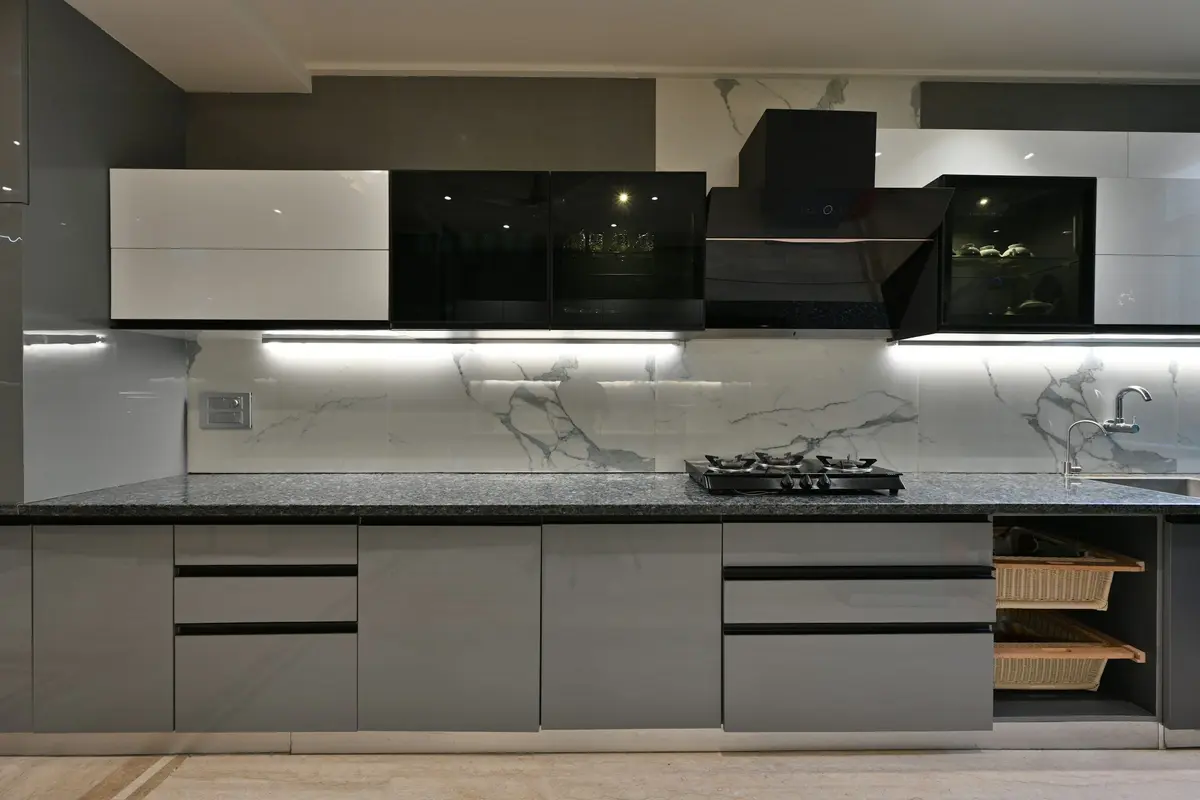
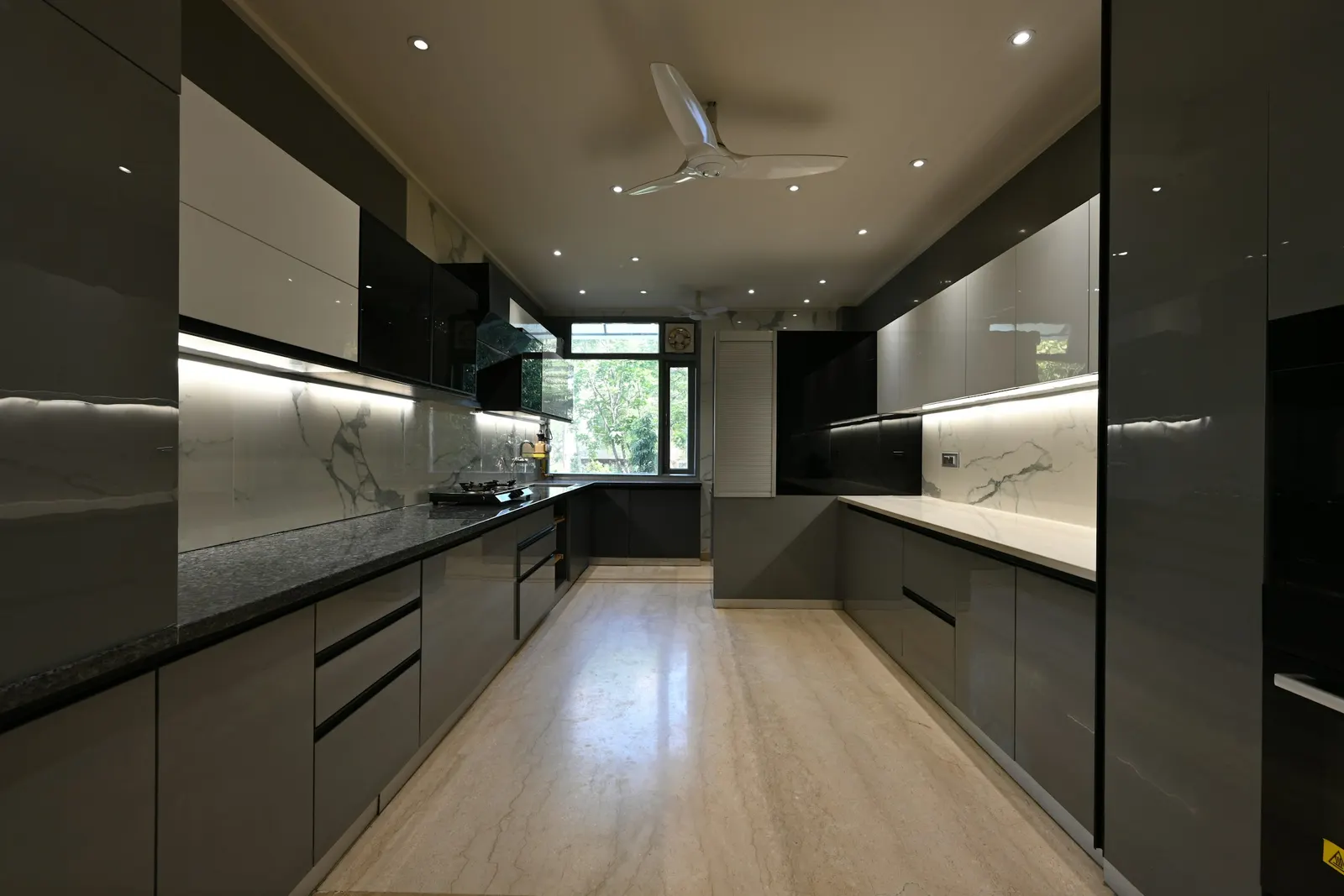
A kitchen countertop in an Indian home takes more punishment than any other surface in the house. Pressure cookers come straight off the flame, tadka splashes hot oil, fingers carry haldi everywhere, and the mixer-grinder rattles on it twice a day. When we plan modular kitchens in Hyderabad, the countertop is one of the first things we talk through, because the wrong stone shows its faults within months.
This guide compares granite, quartz, marble, solid surface, stainless steel and sintered stone for real Indian cooking. For the rest of the kitchen (layout, cabinets, shutters and hardware), see our modular kitchen guide for Hyderabad.
Kitchen countertop materials at a glance
| Material | What it is | Hot vessels | Haldi and oil | Upkeep | Best for |
|---|---|---|---|---|---|
| Granite | Natural igneous stone | Very good | Dark polished hides marks; light can absorb | Seal lighter stones | Everyday Indian cooking |
| Quartz | Crushed quartz bound with resin | Use trivets | Non-porous; wipe quickly on light colours | No sealing | Clean, uniform looks |
| Marble | Natural calcareous stone | Fair | Stains and etches | Seal; accept wear | Dining or breakfast counters |
| Solid surface | Acrylic resin with mineral filler | Poor; trivets always | Non-porous; marks buff out | Repairable | Islands, light cooking |
| Stainless steel | Steel sheet over a board | Excellent | Stain-proof | Scratches, water spots | Heavy-duty cooking |
| Sintered stone | Minerals fused under heat | Very good | Almost no absorption | Low | Open kitchens, outdoor counters |
Granite: still the default for Indian kitchens
Granite is hard, dense and happy with heat, which is why many Hyderabad flats are handed over with a granite platform already in place. Dark polished granite also forgives a lot: oil splashes and turmeric fingerprints barely show.
Common choices in Indian kitchens include Black Galaxy (the “galaxy” granite quarried around Chimakurthi in Prakasam district, Andhra Pradesh), Absolute Black, Jet Black, Steel Grey, Kashmir White and Tan Brown, which is quarried in Telangana’s Karimnagar district. Slabs vary, so always see the actual slab, not just a sample chip.
Sealing depends on the stone. The industry site Use Natural Stone notes that some granites like Absolute Black may need little or no sealing, while others need several coats. The test is simple: leave hot water on the surface for 10 to 20 minutes and wipe it off. If the stone darkens, it’s absorbing and needs sealing. The same source warns that dish soap leaves a dulling film, so a neutral stone cleaner is better for daily wiping.
Two downsides. Joins show, especially on light granite. And granite is heavy, which matters if it sits directly on cabinets instead of a masonry platform; our kitchen cabinet materials guide explains the load question.
Quartz: clean looks, careful with heat
Quartz (engineered stone) is roughly 90% crushed quartz bound with polyester resin. It’s non-porous, never needs sealing, and comes in even colours, including whites that natural stone can’t match.
The resin is the weak point. Engineered stone is generally unaffected below about 150 °C, but a kadai or pressure cooker straight off a gas flame can be hotter than that, and the result is a scorch or a pale ring that doesn’t come out. The resin isn’t fully UV-stable either, so quartz isn’t meant for open balconies or outdoor counters.
There’s also a fabrication issue worth knowing. Cutting quartz releases fine crystalline silica dust, and the US workplace safety agency OSHA lists stone countertop manufacturing among silica-exposure activities. Australia went further and banned engineered stone from 1 July 2024. For your home, the practical step is to ask that cut-outs are done at the fabricator’s workshop with wet cutting, and to keep dry cutting out of your flat.
Marble: beautiful, but not for the cooking counter
Marble is a calcareous stone. Acids react with it, so lemon juice, tamarind, tomato, curd and vinegar etch dull patches into the polish, and sealing doesn’t stop that. Turmeric and oil can also soak in. In a kitchen where nimbu and imli are daily ingredients, marble will look worn within a year.
If you love it, use marble on a dining table, a breakfast counter or a baking slab, and accept the patina.
Solid surface: repairable and joint-free
Solid surface (Corian is the best-known brand) is acrylic resin with a mineral filler; Corian is roughly 55 to 60% alumina trihydrate with acrylic. Joins can be made nearly invisible, sinks can be moulded in, and scratches can be sanded and buffed out.
Heat is its limit. It’s generally rated for heat up to only about 100 °C, and DuPont recommends trivets. That rules it out next to the hob in most Indian kitchens, but it works on islands and serving counters.
Stainless steel: the professional’s choice
Steel doesn’t stain, doesn’t mind heat and is easy to sanitise, which is why commercial kitchens use it. In a home it scratches into a soft patina, shows water spots and fingerprints, and can dent if something heavy drops on it. Fixed over a solid board, it’s quieter and dents less. It suits families who cook in volume and care more about function than looks, often just on the hob run.
Sintered stone: heat-proof but needs careful edges
Sintered stone (brands include Neolith and Dekton) is made from natural minerals fused at high temperature. Neolith describes it as resistant to scratches, high temperatures and UV, with absorption close to zero. Slabs are thin, so they suit sleek modern kitchens and even outdoor counters.
The edges are where it’s vulnerable. A heavy vessel knocked against a thin square edge can chip it, and repairs aren’t easy. It also needs a fabricator with experience in the material.
How do haldi, oil and heat affect each countertop?
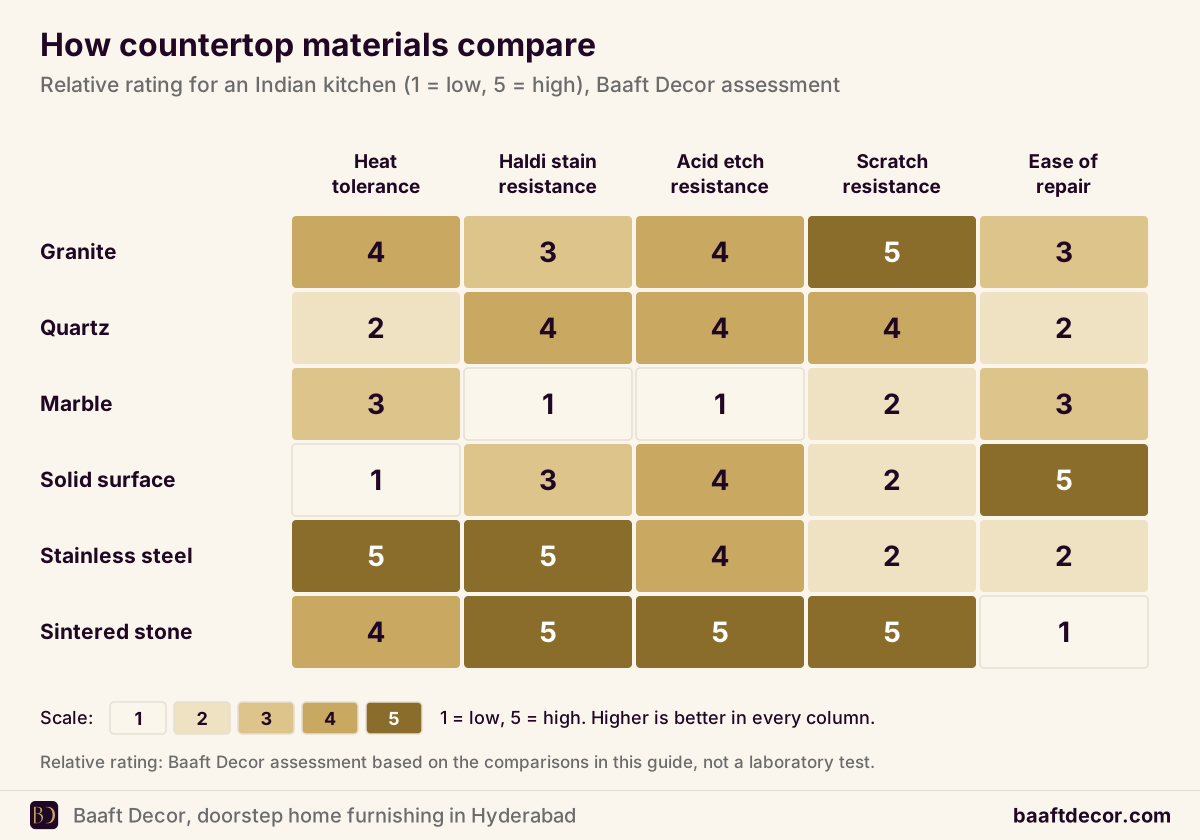
Haldi. Wipe it within minutes on any light surface. If you scrub with soap and the yellow turns reddish-brown, don’t panic: turmeric is a natural pH indicator that turns red-brown in alkaline solutions. Rinse with plain water. On granite, quartz and sintered stone, a non-abrasive cream cleaner handles stubborn marks; never use acids on marble.
Oil. On sealed dark granite, quartz, steel and sintered stone, oil wipes off. On unsealed light granite and marble, it darkens the stone and needs a poultice to draw it out.
Heat. Granite, steel and sintered stone cope with hot vessels. Quartz and solid surface need trivets every time. Even on granite, avoid putting very hot vessels right at a sink cut-out or a join.
Acid. Only marble really suffers, but it suffers badly.
Which edge profile should you choose?
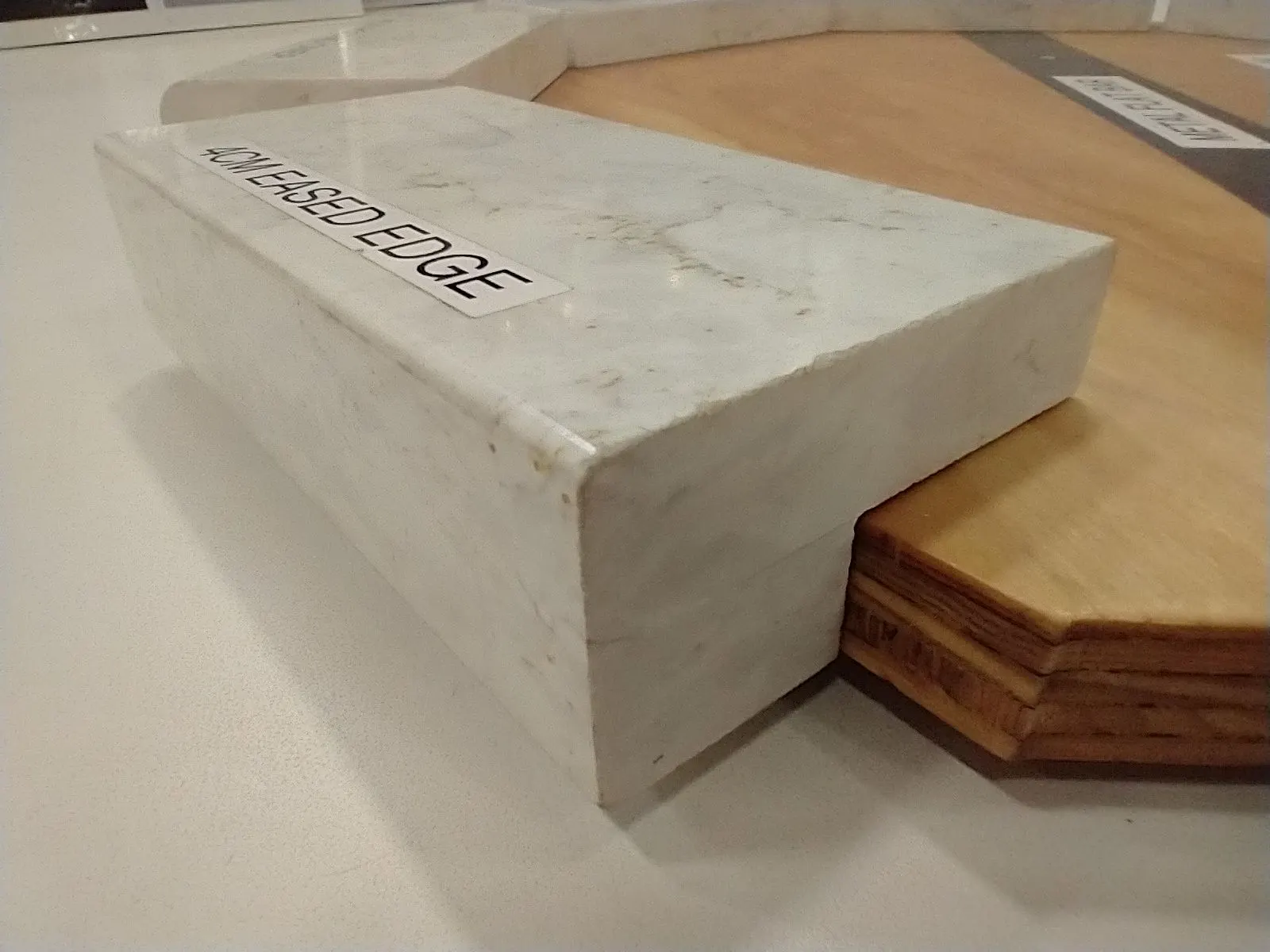
- Eased: a square edge with slightly softened corners. Clean, modern, chips less than a razor-sharp edge.
- Half bullnose: rounded on top, flat underneath. Kind to hips and toddlers.
- Full bullnose: fully rounded. Soft look, slightly less usable counter at the front.
- Bevel: a 45-degree cut along the top edge.
- Ogee: a decorative S-curve. Traditional, but grime collects in the curve.
- Mitred: a strip joined to the front edge so a thin slab looks thick. Common with quartz and sintered stone.
For a hard-working kitchen, we usually suggest eased or half bullnose.
Which countertop suits your kitchen?
- Heavy daily cooking, practical budget: dark polished granite.
- Light, uniform look and you’ll use trivets: quartz.
- Open-plan island or breakfast counter: quartz, solid surface or sintered stone.
- Marble lovers: keep it to the dining or breakfast counter.
- Builder’s granite in good shape: keep it and spend on cabinets instead, as our modular kitchen cost guide explains.
Layout changes the decision too. An L-shaped or parallel kitchen has more joins and corner cut-outs, which favours materials with neat seams; see our modular kitchen layouts guide.
Plan the countertop with the cabinets
Book a free home visit and we’ll measure your kitchen, check the existing platform, talk through how you cook, and include the right countertop in a written modular kitchen quote. We work across Hyderabad from 8 AM to 10 PM, all seven days. WhatsApp or call +91 98499 17494.
Frequently asked questions
Which is better for an Indian kitchen, granite or quartz?
For heavy daily Indian cooking, granite is usually the better choice, because it tolerates hot vessels, hides oil and turmeric marks well in darker colours, and is widely available in India. Quartz is better if you want a uniform light colour, a surface that never needs sealing, and you are disciplined about using trivets, since its resin binder can mark under direct heat. Many Hyderabad families choose granite for the cooking counter and quartz for an island or breakfast counter that sees lighter use.
Does a quartz countertop stain with haldi?
Quartz is non-porous, so haldi (turmeric) usually wipes off if you clean it within minutes. On white and very light quartz, turmeric left to sit, especially with oil, can leave a yellow mark that takes effort to remove. Wipe spills straight away, use a soft cloth with a mild cleaner or a non-abrasive cream cleaner, and avoid scouring pads that dull the surface. If soap turns the mark reddish-brown, rinse with plain water; turmeric changes colour with alkaline cleaners.
Can you put a hot pan or pressure cooker on a quartz or granite countertop?
Granite handles hot vessels far better than quartz, though using a trivet is still wise near sink cut-outs and joints, where sudden temperature changes put stress on the stone. Quartz contains resin, which is generally unaffected below about 150 °C but can scorch or discolour when a pan or pressure cooker comes straight off a gas flame. Solid surface is even more heat-sensitive. Make trivets a habit on any engineered or acrylic countertop, and keep a heat-proof stand beside the hob.
Is marble good for a kitchen countertop?
Marble is a poor choice for the main cooking counter in an Indian kitchen. It is a calcareous stone, so acids such as lemon juice, tamarind, tomato and vinegar etch dull marks into the polish, and oil and turmeric can soak in and stain it. Sealing slows staining but does not prevent etching. Marble works better on a dining table, a breakfast counter or a pastry slab where it sees less acid and heat, and where you are comfortable with it developing a worn, lived-in look.
Does granite need sealing?
It depends on the granite. Dense dark granites such as Absolute Black may need little or no sealing, while lighter, more porous granites can need several coats of a penetrating sealer. To check, pour a little hot water on the surface and wipe it off after 10 to 20 minutes. If the stone has darkened, it is absorbing moisture and should be sealed. Kitchen counters are worth testing every year or so, and resealed whenever water starts to darken the stone.
What is sintered stone and is it worth it for a kitchen?
Sintered stone is a slab made from natural minerals that are compacted and fused at high temperature, sold under brand names such as Neolith and Dekton. It absorbs almost no liquid, resists heat, stains and UV light, and comes in thin slabs with marble, stone or concrete looks. It is worth considering for open kitchens and outdoor counters. The trade-offs are cost, the need for an experienced fabricator, and edges that can chip if a heavy vessel knocks them, so choose an eased or mitred edge.
Which edge profile is best for a kitchen countertop?
For a working Indian kitchen, an eased edge (a square edge with slightly rounded corners) or a half bullnose is the most practical choice. Both are easy to wipe, less likely to chip than a sharp square edge, and gentler on hips and children's heads. Ogee and other decorative profiles look traditional but trap grime in their curves. A mitred edge, where a strip is joined to the front to make the slab look thicker, suits quartz and sintered stone in modern kitchens.
Which granite colour is best for a kitchen?
Darker polished granites are the most forgiving for Indian cooking, because they hide oil splashes, turmeric marks and minor scratches, and dense dark stones often need little sealing. Black Galaxy, Absolute Black, Steel Grey and Tan Brown are common choices in Hyderabad kitchens. Light granites such as Kashmir White look fresh but are usually more porous, show stains faster and need regular sealing. Always see a full slab before you buy, because natural granite varies from one slab to the next.