“Will wallpaper survive the monsoon?” is one of the first questions we hear at home visits across Hyderabad. It’s a fair worry. But the short answer surprises most people: wallpaper rarely fails because of humid air. It fails because of water inside the wall. Get the wall right and the paper stays put. Our wallpaper installation service in Hyderabad starts with exactly that check.
This page goes deep on damp, because it decides everything else. For choosing the wallpaper type, design and whether panels suit a wall better, see our wallpaper and wall panels guide for Hyderabad homes.
Why does wallpaper peel?
Peeling, bubbling and black spots each point to a different cause. Read the symptom before blaming the paper.
| What you see | Most likely cause | What fixes it |
|---|---|---|
| Seams lifting within days | Too little adhesive at the joints, or adhesive dried before smoothing | Re-stick seams with seam adhesive |
| Bubbles in the first day or two | Air trapped during hanging | Installer pricks, re-pastes and rolls flat |
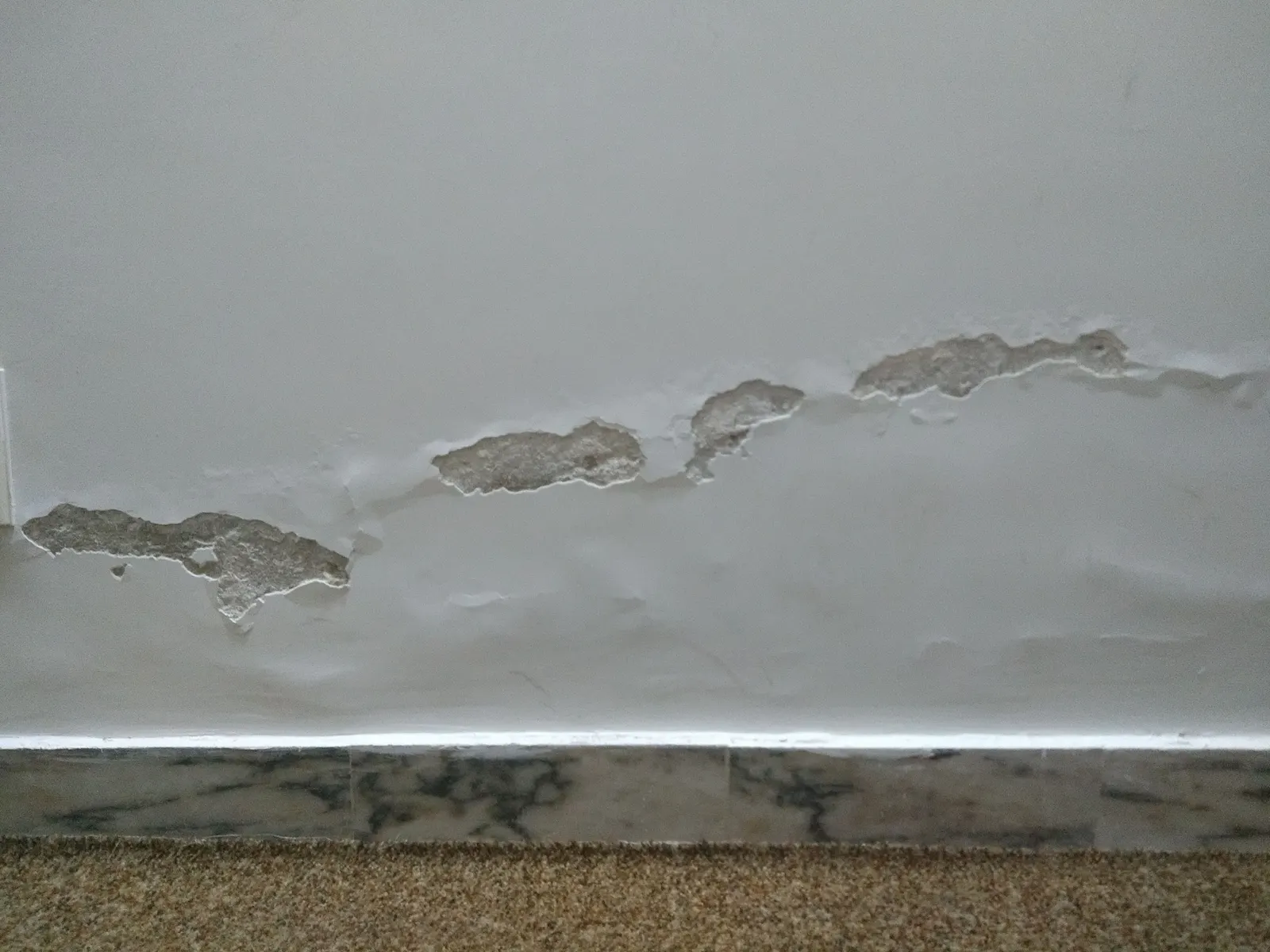
| Bubbles appearing weeks or months later | Moisture pushing out from the wall | Find and fix the moisture source, then re-paper |
| Peeling from the bottom, tide marks near skirting | Rising damp or water seeping from the floor | Damp-proofing, plumbing repair, then dry the wall |
| Patches near the ceiling | Leakage from the terrace, a balcony or the flat above | Waterproofing above, then re-paper |
| Black or grey spots at seams, musty smell | Mould from a persistently damp wall | Strip, treat, dry, fix the source |
| Whole strips falling off with paint stuck to the back | Weak base: old distemper, chalky emulsion, loose putty | Scrape back to a sound surface, prime, re-hang |
Notice how few of these are about the wallpaper itself.
What Hyderabad’s monsoon does to your walls
From roughly June to September, the city gets most of its annual rain, and humidity stays high for weeks. The air alone mostly slows things down: adhesive takes longer to dry, and a wall that was borderline in March shows its problem by August.
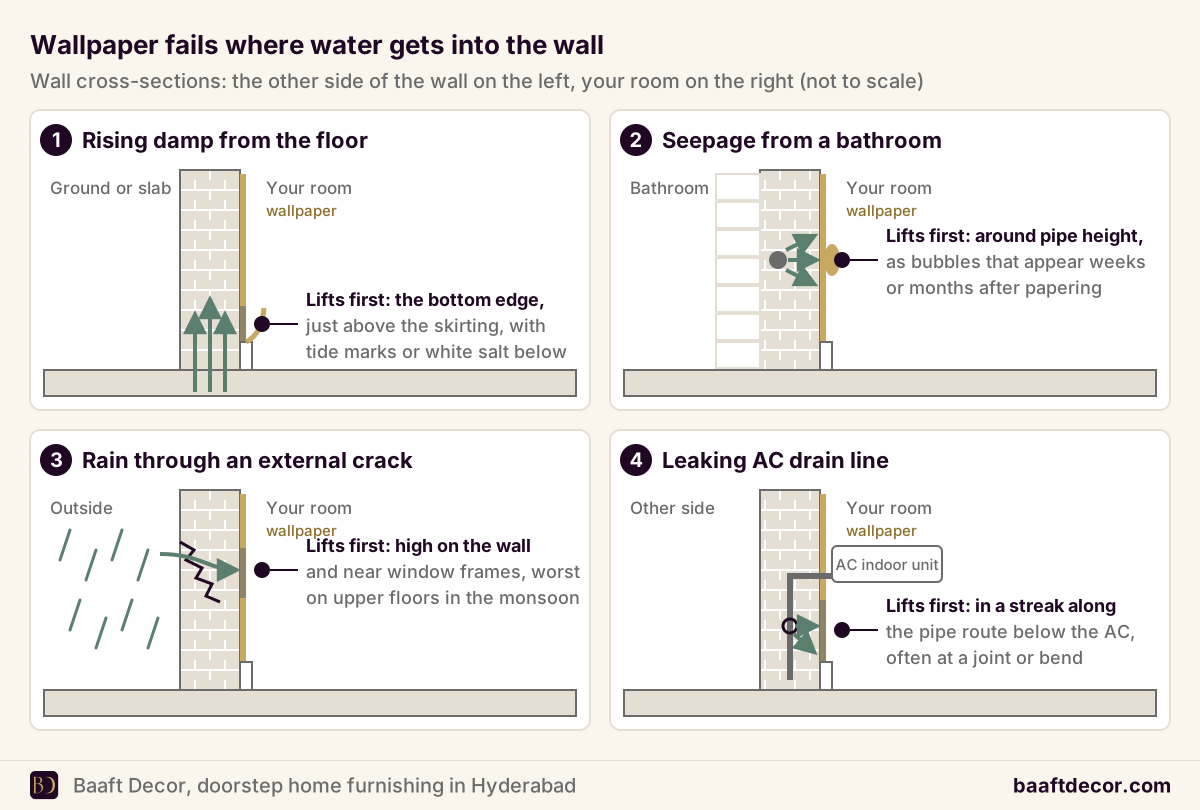
The real sources of water, in the homes we visit, tend to be:
- Bathroom-backed walls. A failed tile joint or a leaking concealed pipe soaks the wall on the bedroom side.
- External walls facing driving rain. Hairline cracks in exterior plaster let water in, especially on upper floors of high-rises.
- AC drain lines. A split AC’s drain pipe that runs inside or along a wall and leaks slowly.
- Kitchen sink walls. The wall behind the sink often shares plumbing with the living room or a bedroom.
- Fresh plaster in new flats. Thick cement plaster finished during or just before the monsoon can take months to dry.
- Ground-floor walls in older independent houses. Rising damp from the foundation shows as tide marks and white salt (efflorescence) near the skirting, a common sight in older parts of the city such as Secunderabad.
New high-rise flats need extra patience
The towers going up around Kokapet, the Financial District and Tellapur add two risks of their own. Upper floors take wind-driven rain hard against external walls, so any gap around window frames or in the exterior plaster shows up inside as a damp patch, often only during the first heavy monsoon after handover. And these flats are frequently handed over months after plastering, sometimes with the walls still drying under a fresh coat of builder’s emulsion.
If you’ve just taken possession, our advice is simple. Paper interior walls that don’t back onto bathrooms or the outside, and wait one monsoon before papering external walls. Note any damp patches that appear and get them fixed while the builder is still responsible. It costs you a few months of patience, not a second set of rolls. If you can choose the timing, the dry months from November to February are the easiest for papering; our Hyderabad home furnishing calendar lays out the year month by month.
How to check a wall before wallpapering
You don’t need a lab. You need to look, touch and, ideally, measure.
- Look along the skirting. Tide marks, bubbling paint or white powder mean moisture coming up or through.
- Check what’s on the other side. A bathroom, kitchen sink or external face makes this a higher-risk wall.
- Tap it. A hollow, papery sound means loose putty or plaster that will let paper fall away.
- Tape a plastic sheet. Tape a 1 ft square of clear plastic to the wall on all four sides and leave it 24 hours. Droplets on the inside of the plastic mean the wall is giving off moisture.
- Use a moisture meter. This is what we rely on. Wallcovering makers set strict limits. Schumacher’s hanging instructions, for example, say plaster and masonry walls shouldn’t read above 5.5% moisture on a meter, and that unpainted new walls should be at least 90 to 120 days old before papering.
If a wall fails these checks, wallpaper is the wrong next step. Fix the water first.
Which wallpaper handles humidity best?
| Wallpaper type | Behaviour in humid conditions | Our view for Hyderabad |
|---|---|---|
| Washable vinyl | Surface resists splashes and wipes clean; slows moisture escaping from the wall | Best for kids’ rooms, passages, powder rooms, on a dry wall |
| Non-woven | Breathable, dimensionally stable, strips off dry | Good for bedrooms and living rooms; forgiving if the wall breathes a little |
| Paper | Absorbs moisture, stains, tears when wet | Avoid in humid rooms |
| Fabric, grasscloth, jute | Absorb moisture and can stain or grow mould | Dry feature walls only, away from windows and AC units |
| Self-adhesive / 3D foam sheets | Glue softens in heat and humidity; edges lift | Short-term use only |
Here’s the trade-off with vinyl. Its face keeps splashes out, but it also keeps moisture in. On a damp wall, that’s exactly where mould starts. So vinyl is the right choice for humid rooms only when the wall itself is dry.
Can you wallpaper a bathroom?
Sometimes. It depends on the zone.
- Powder room or guest toilet (no shower): yes, with washable vinyl, a sealed wall, and a working exhaust fan.
- Full bathroom, dry side, well away from the shower: possible, but we usually advise against it in Hyderabad. Steam from daily hot showers through the monsoon is tough on adhesive.
- Shower zone and splashback behind the basin: no. Use tiles, or waterproof PVC wall panels if you want a quick finish without retiling.
The same logic applies to kitchens: never behind the hob or sink. A dining-side wall in an open kitchen, away from steam, is fine.
Prep that keeps wallpaper on through the monsoon
- Fix every leak first. Bathroom grouting, terrace waterproofing, AC drain lines and external cracks.
- Let the wall dry fully after repairs. Running fans or the AC in dehumidify mode helps; time and a meter reading decide.
- Scrape back to a sound surface. Old distemper and chalky paint go.
- Prime with a wallcovering primer or sealer. It evens out absorption, helps adhesion and makes future removal cleaner.
- Use the right adhesive for the paper type, and roll seams firmly.
- Leave a small gap at the skirting on walls with any history of damp, so moisture doesn’t wick up into the paper.
Monsoon care for wallpapered rooms
- Keep rooms ventilated on dry days; don’t leave them sealed for weeks.
- Keep wardrobes and sofas 3 to 4 inches off external walls so air moves behind them.
- Wipe washable vinyl with a barely damp cloth. Never soak it.
- Check corners and seams after heavy rain spells. Early lifting is easy to fix; late lifting usually isn’t.
For a whole-house checklist covering sofas, curtains and wooden floors too, see our monsoon home care guide. Still deciding between finishes? Our wallpaper vs paint comparison covers which walls should simply stay painted.
Get your walls checked first
We test walls for damp, tell you honestly which ones will hold wallpaper, and only then measure and quote. Call or WhatsApp +91 98499 17494 (8 AM to 10 PM, all 7 days) to book a free home visit anywhere in Hyderabad.
Frequently asked questions
Does wallpaper peel in humid weather?
Wallpaper does not usually peel just because the air is humid. In Hyderabad homes, peeling almost always traces back to moisture inside the wall, such as seepage from a bathroom on the other side, rain driving into an external wall, a leaking AC drain line, or fresh plaster that has not dried out. Humid monsoon air slows adhesive drying and makes an existing damp problem show faster. On a dry, sealed, primed wall, quality vinyl or non-woven wallpaper stays put through the monsoon.
Can you wallpaper a bathroom?
You can wallpaper a bathroom only in the right zone. A ventilated powder room or guest toilet, where nobody showers, can take washable vinyl wallpaper hung on a sealed wall with the edges finished neatly. A full bathroom is risky outside the wet area and unsuitable inside it: the shower zone and the wall behind a wash basin splashback should be tiled or covered with waterproof panels. An exhaust fan that actually runs is essential for any wallpapered bathroom wall.
Why is my wallpaper bubbling?
Wallpaper bubbles for three common reasons. Air trapped during installation shows as bubbles within a day or two and is an installation issue. Bubbles that appear weeks or months later usually mean moisture is pushing out from the wall, often from seepage or condensation. Bubbles over a hollow-sounding patch can mean loose putty or plaster underneath. Small early air bubbles can often be fixed by the installer, but late bubbles need the moisture source found and fixed before re-papering.
Which wallpaper is best for humid areas?
For humid areas, washable vinyl wallpaper is the most practical because its surface resists splashes and wipes clean, while non-woven wallpaper is breathable and lets small amounts of moisture escape. Neither will survive a wall that is actively damp. Avoid paper, fabric, grasscloth and natural-fibre wallpapers in humid rooms, because they absorb moisture and stain. Self-adhesive sheets also struggle, as heat and humidity weaken their glue. Fix any damp first, then choose vinyl or non-woven with a suitable primer.
How long should new plaster dry before wallpapering?
New plaster should be fully dry before wallpaper goes on, and that takes longer than most people expect. Wallcovering makers such as Schumacher ask for unpainted plaster walls to be at least 90 to 120 days old and for moisture to be checked with a meter before installation. Thick cement plaster in a new flat, especially one finished during the monsoon, can hold moisture for months. A moisture meter reading is a more reliable guide than counting days on the calendar.
Can wallpaper be fixed after it starts peeling?
Peeling wallpaper can often be re-stuck if the cause was poor adhesion at the seams and the paper itself is undamaged. The installer lifts the edge, cleans out old adhesive, applies a seam adhesive and rolls it flat. If the peeling comes from damp in the wall, re-gluing only buys time. The leak or seepage must be fixed, the wall allowed to dry and sealed, and the affected strips replaced, ideally from a spare roll of the same batch.
Does mould grow behind wallpaper?
Mould can grow behind wallpaper when a wall stays damp, especially behind vinyl wallpaper, which slows moisture from escaping. Signs include black or grey spots at seams, a musty smell, and discolouration spreading from the skirting or a corner. Mould behind wallpaper is not a surface problem: the paper must come off, the wall must be treated and dried, and the moisture source must be fixed. On a dry wall with ventilation, mould behind wallpaper is uncommon.