Every guide in this series
Paper or panels? Most people start with that question and a few photos saved on their phone. In Hyderabad homes the better first question is about the wall itself: is it dry, is it sound, and what will happen to it in August? Wallpaper and panels both look great on a good wall and both fail on a damp one. When we plan wallpaper in Hyderabad or PVC, WPC and fluted wall panels, we check the wall before we open a catalogue.
This guide follows that order: the wall, then the finish, then design, measuring, cost, fitting and care. Each chapter gives you enough to decide, and links to a deeper guide where there’s more to say.
Wallpaper, wall panels or paint: which suits your wall?
Choose by what the wall has to do:
| Finish | Best at | Avoid on | Typical walls |
|---|---|---|---|
| Wallpaper | Patterns, textures, murals; thin and quick on a ready wall | Damp walls, wet zones, behind hobs | Bedroom headboard, living feature wall, pooja niche |
| Wall panels | Depth, hiding cables and uneven walls, taking knocks | Unfixed seepage (it hides it), heat sources | TV wall, passage, foyer, kids’ room lower wall |
| Paint | Whole rooms, ceilings, kitchens, bathrooms, damp-prone walls | Nothing, really; it just can’t do pattern | Everything else |
The pattern most Hyderabad homes settle on: paint the room, then paper or panel one wall.
Chapter 1: Is your wall ready? Check for damp first
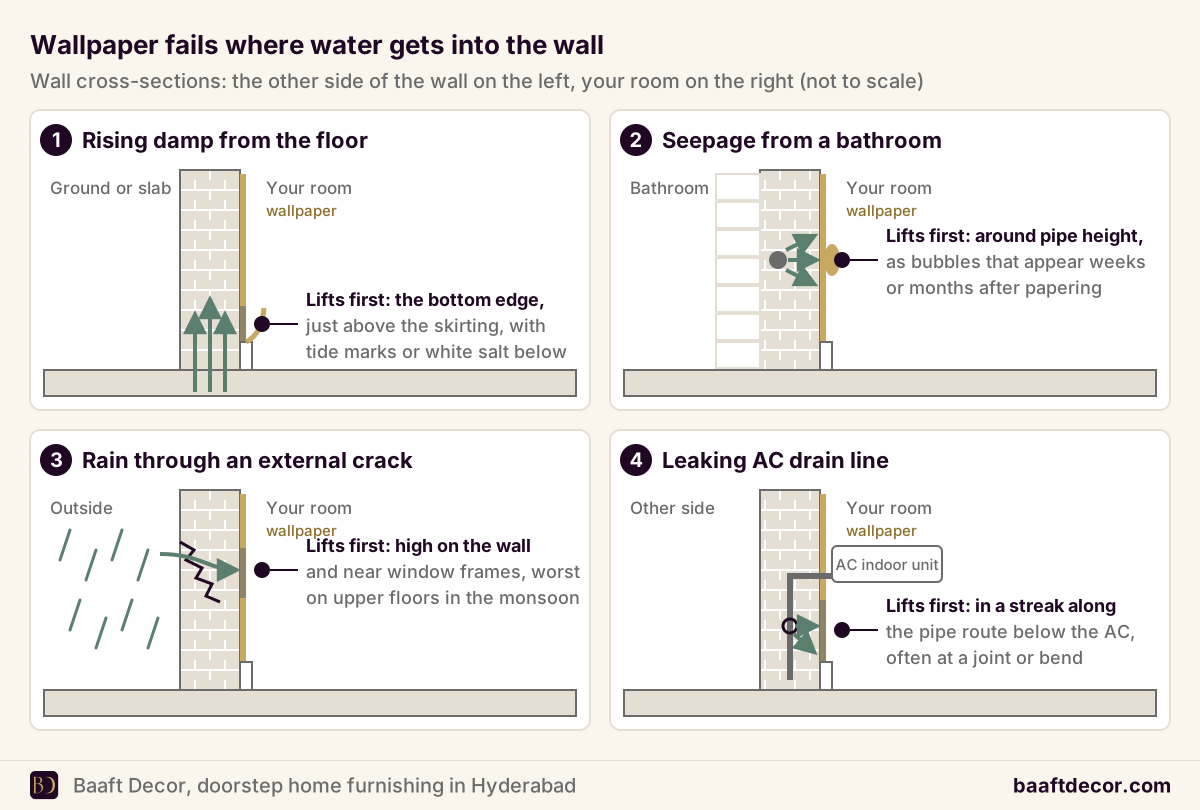
Wallpaper rarely fails because of humid air. It fails because of water inside the wall. Panels are no different, except they hide the problem: mould grows behind them unseen.
From roughly June to September, Hyderabad gets most of its rain. The water sources we find in homes are usually the same few:
- Bathroom-backed walls, where a failed tile joint or concealed pipe soaks the bedroom side.
- External walls facing driving rain, especially on upper floors of high-rises.
- AC drain lines running inside or along a wall.
- Kitchen sink walls that share plumbing with a living room or bedroom.
- Fresh plaster in new flats, which can take months to dry.
- Rising damp on ground floors of older independent houses, showing as tide marks and white salt near the skirting.
Five checks before anything goes up: look along the skirting for tide marks or white powder; check what’s on the other side of the wall; tap it for a hollow sound that means loose putty; tape a 1 ft square of clear plastic to it on all four sides for 24 hours and look for droplets inside; and, best of all, take a moisture meter reading, which is what we rely on. Wallcovering makers set tight limits: Schumacher’s hanging instructions, for example, say plaster and masonry shouldn’t read above 5.5% moisture on a meter. Then rub the paint: chalky emulsion or old distemper has to be scraped back to a sound surface.
New flats need patience. In towers around Kokapet and Tellapur, flats are often handed over with walls still drying under builder’s emulsion, and wind-driven rain on upper floors shows up inside only during the first heavy monsoon. Paper or panel interior walls first, wait one monsoon for external walls, and get the builder to fix any damp patches during the defect liability period. The same instructions want unpainted new walls to be at least 90 to 120 days old, and even then the meter decides, not the calendar. If you can pick the timing, the dry months from November to February are the easiest for papering.
Our guide to wallpaper in Hyderabad’s humidity has a symptom-by-symptom table for peeling, bubbling and black spots, walks through these wall tests, compares how each wallpaper type copes with damp, and explains when a bathroom can take wallpaper.
Chapter 2: Which type of wallpaper should you choose?
The type matters more than the pattern, because it decides how the paper behaves in your room and how hard it is to remove later.
| Type | What it is | Our view for Hyderabad |
|---|---|---|
| Non-woven | Fibre-based fleece, breathable | Bedrooms and living rooms; strips off dry when you want a change |
| Vinyl | PVC face on paper or non-woven backing, washable | Kids’ rooms, passages, pooja spaces, powder rooms, on a dry wall |
| Paper | Printed paper | Rare now; absorbs moisture and stains |
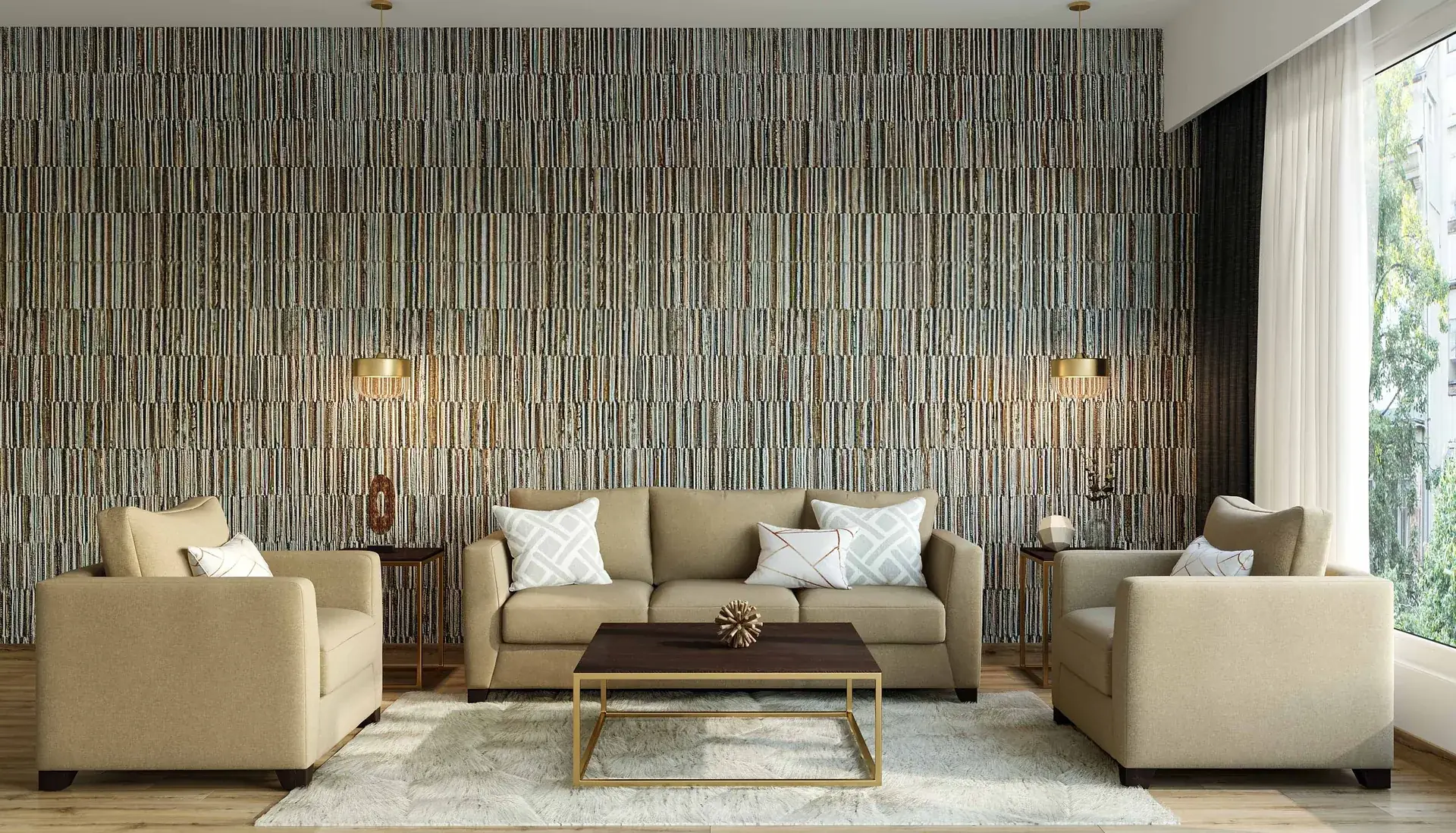
| Fabric-look, grasscloth, jute | Textured vinyl, real textile or woven plant fibres | One dry statement wall, away from windows and AC units |
| Self-adhesive, 3D foam sheets | Peel-and-stick PVC or foam | Short-term only; edges lift in summer heat |
| Custom mural | Printed to your exact wall | TV walls, kids’ rooms, pooja unit backs |
Vinyl is the most common choice here because it wipes clean, and construction dust in new gated communities settles on everything. But its face also keeps moisture in, so vinyl belongs only on a wall you know is dry. Non-woven is the sensible pick if you think you’ll want a different look in a few years: lift a corner and the whole strip usually comes away. Vinyl often leaves its paper backing behind, and peel-and-stick sheets can pull paint and putty off with them.
Roll formats differ too. A standard roll is about 0.53 m wide and 10 m long, roughly 57 sq ft. Wide-width rolls, about 1.06 m wide and often 15 m or more long, cover roughly 170 to 180 sq ft each and are common in Korean-style plain and textured papers. They mean fewer seams on big walls but are heavier and need two people to hang. Murals arrive as numbered panels sized to your wall.
Chapter 3: Wallpaper or paint?
Choose paint for kitchens, bathrooms, ceilings, damp-prone walls and whole-house refreshes on a budget. Choose wallpaper for a wall that should carry the room (behind the TV, sofa, bed or dining table), for textures paint can’t copy, and for kids’ rooms that need a scrubbable surface.
On lifespan, paint makers generally suggest refreshing interior walls every five to seven years; Berger’s paint vs wallpaper guide uses a similar range. Good wallpaper on a dry, primed wall holds its look longer and is usually replaced because you want a change, not because it’s worn. The exception is a wall that seeps: paper lifts within a monsoon or two, while paint can just be redone after the leak is fixed.
Two practical rules. Finish all drilling for ACs, TV mounts and curtain tracks before papering. And on a west-facing wall beside big sliding glass, choose lighter, sun-tolerant designs, because some colours fade in that afternoon light. Our full comparison of wallpaper vs paint covers removal, cost over time and the new-flat sequence.
Chapter 4: Wallpaper design ideas, room by room
Stand at the main door and look in. The wall that faces you is usually your feature wall. In most apartments that’s the TV wall, the sofa wall, the dining wall in an open living-dining room, or a small foyer wall where you can afford a premium paper because so little is needed.
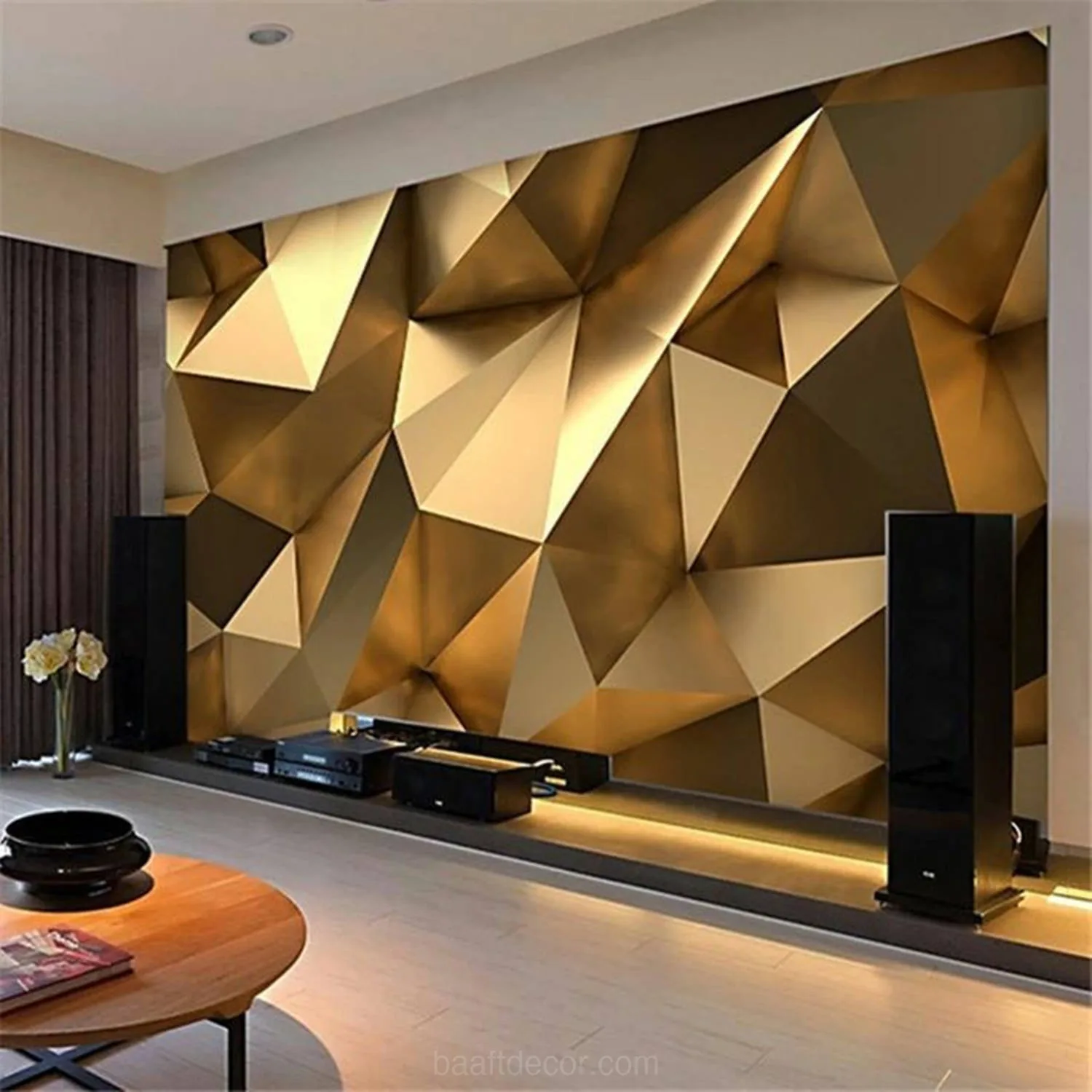
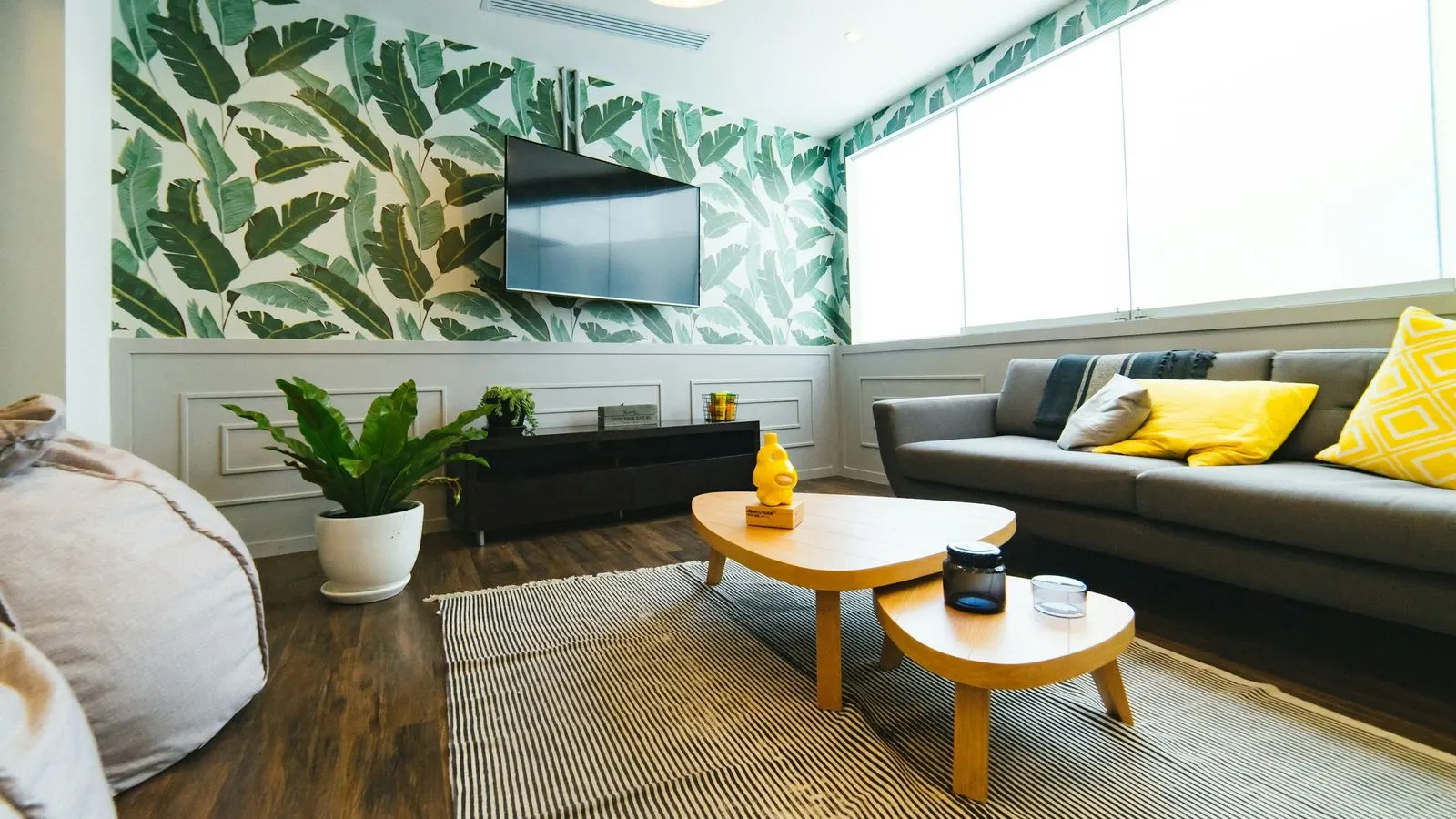
Living rooms suit textures (linen weave, plaster or concrete effects) if you change cushions and curtains often, large botanicals on big walls, geometrics with a plainer room around them, and murals on TV walls as long as the main subject isn’t hidden behind the screen. Indian art such as Pichwai-style lotus motifs or Kalamkari-inspired florals works on one wall in a muted palette.
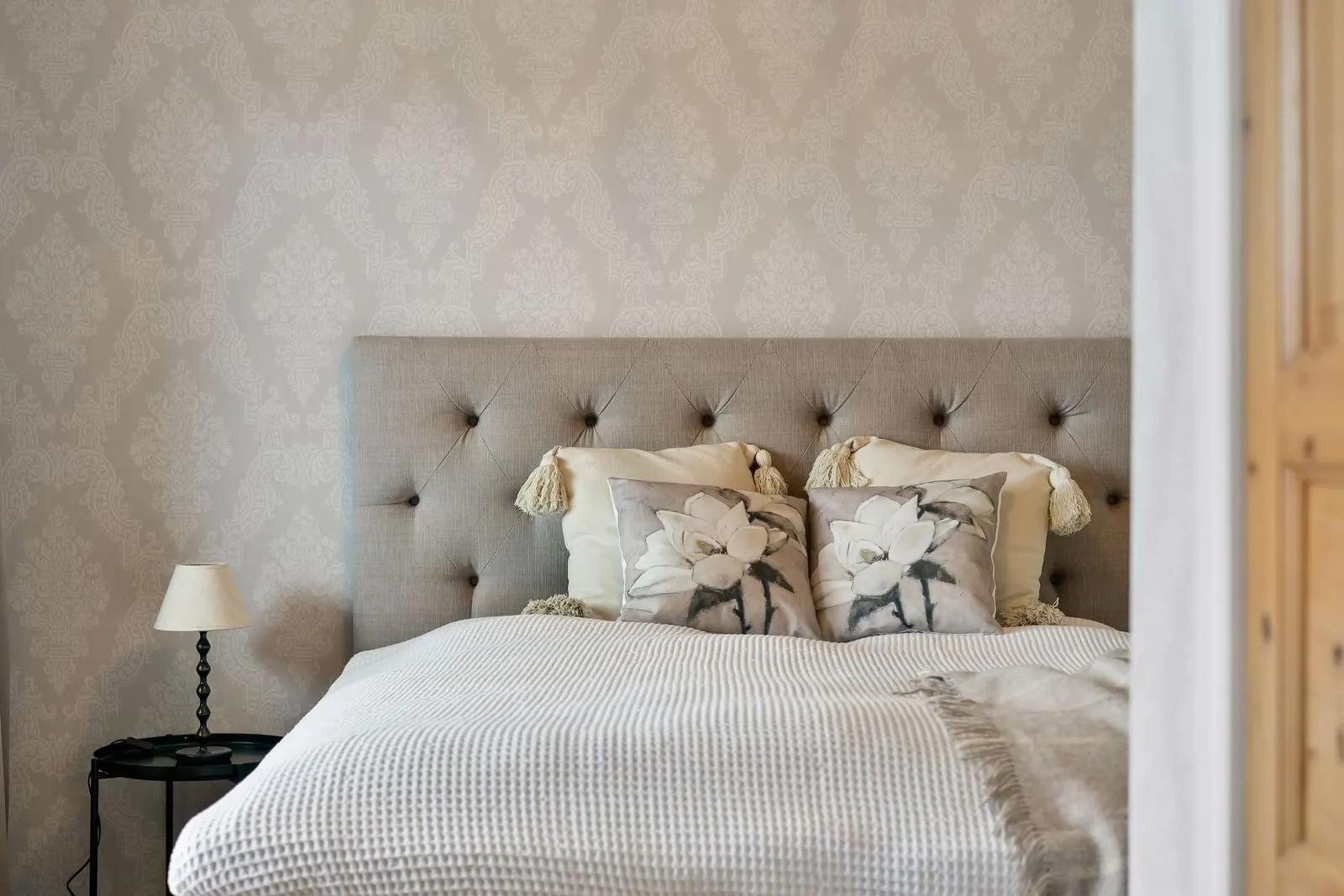
Bedrooms call for restraint. Paper the headboard wall only, in soft textures or tone-on-tone patterns. Kids’ rooms get washable vinyl, in designs they won’t disown in two years.
Pooja spaces suit small repeating motifs, soft gold on matte, and washable vinyl so incense residue wipes off. Keep paper well away from diyas and camphor. Our pooja room design ideas cover the rest of the space: wall-mounted, corner and cabinet mandirs for flats, separate rooms in villas, jaali and marble-look backdrops, and diya safety, with at least a foot of clear space around the flame and stone, tile or metal directly behind it.
Pattern scale has to match the wall:
| Your wall | Pattern scale that works |
|---|---|
| Under 8 ft wide, niches, pooja units | Small to medium motifs, textures |
| Standard TV or bed wall, 10 to 14 ft | Medium to large patterns, murals |
| Large or double-height villa walls | Large botanicals, panoramas, wide-roll textures |
Always tape an A4 sample to the actual wall and look at it in the morning and at night. Warm-white LED lighting turns cool greys muddy, and a phone screen lies about colour. Our guide to wallpaper design ideas for living rooms and bedrooms goes room by room, adds the spots people forget (passages, the bedroom ceiling, the study wall behind your video calls), and shows how to pair paper with curtains, panels and rugs.
Chapter 5: Wall panel materials: PVC, WPC, MDF and fluted
Here’s the mix-up we hear most: “Should I use PVC, WPC or fluted?” PVC and WPC are materials. Fluted is a shape, the vertical ribbed profile, and it comes in PVC, WPC, MDF or solid wood.
| PVC | WPC | MDF fluted | Solid wood fluted | |
|---|---|---|---|---|
| Water resistance | Excellent | Very good | Poor | Fair, if sealed |
| Termites | Not affected | Highly resistant | Vulnerable | Vulnerable |
| Dent resistance | Low if hollow | Good | Good | Good |
| Screw holding | Poor | Good | Fair | Good |
| Relative cost | Lowest | Mid | Mid to high | Highest |
| Best for | Bathrooms, utility, rentals | TV walls, bedrooms, passages | Dry feature walls | Statement walls |
PVC is light, water-resistant and affordable, but hollow panels dent when a chair or toy hits them, and rigid PVC is heat-sensitive (standard PVC starts to distort at around 60 °C), so it never goes behind a cooktop. WPC (wood fibre blended with plastic, usually PVC in the interior panels sold in India) is denser, cuts and drills like wood, holds screws, and resists termites and humidity far better than MDF or plywood. It isn’t fully waterproof, though: cut edges can soak up moisture over time, so seal them in wet zones, where solid PVC is the safer pick. For most living rooms, WPC fluted balances looks and durability.
Acoustic panels look similar but do a different job: wood or veneer slats on a PET felt backing absorb echo in new flats with tiled floors, home theatres and work-from-home rooms. They reduce echo inside the room. They don’t soundproof it.
A few local rules: panels hide seepage, they don’t cure it; use aluminium or WPC battens rather than wood on ground floors with termite activity; leave small expansion gaps on walls that bake in west sun; and keep plastic-based panels away from the hob and from diya flames. Our PVC vs WPC vs fluted wall panels guide explains each material and acoustic panels, how west sun, monsoon seepage and termites change the choice, fire and wiring precautions, and which panel goes in which room. For samples and a fitted quote, see our wall panels service in Hyderabad.
Chapter 6: Wall panelling designs that work
A panelled wall can make a plain flat look finished, or look like a catalogue page glued onto the wrong wall. The difference is proportion, lighting and planning.
The designs we see work again and again:
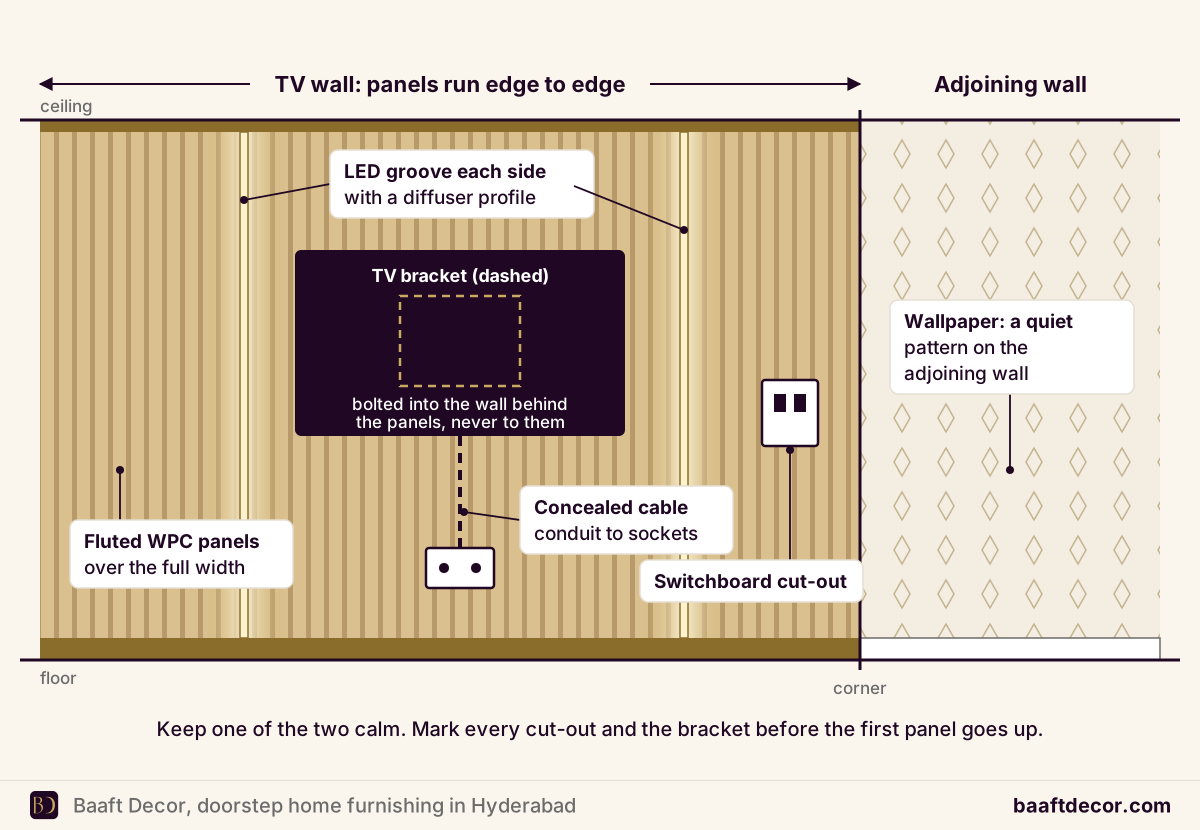
- Fluted TV wall with hidden LED. Run the panels across the full wall width, not a narrow strip behind the TV, and use an LED profile with a diffuser so you see a line of light, not dots.
- Marble-look centre with fluted sides. The stone look without the weight. Check where the sheet joints fall first.
- Full-height headboard wall. Plan bedside switches and charging points so cut-outs line up with panel joints.
- Half-height wainscoting with moulding frames in dining areas, passages and kids’ rooms, where the lower wall takes knocks.
- Vertical slats to make a room with a lowered false ceiling feel taller.
- CNC jaali panels, softly backlit, for pooja rooms and living-dining partitions.
- Panels with wallpaper: fluted panels below or beside, a quiet paper on the rest. Keep one of the two calm.
Before any of these, mark every switchboard, socket, AC line and TV cable route, and decide how the TV is mounted: the bracket goes onto a plywood backing fixed before the panels, or is bolted through them into the masonry behind, never hung from a panel itself. Our wall panelling design ideas walk through thirteen layouts, from fluted TV walls to washable low panels in kids’ rooms, with colour and finish advice and the mistakes we see most. If the panelled wall is also your TV wall, our TV unit design ideas start from the sofa: screen size for your seating distance, the screen centre at about 3.5 to 4 ft off the floor, what a concrete, brick or board wall can carry, and, on concrete walls that can’t be grooved, cables run behind a backdrop panel fixed about an inch off the wall.
Chapter 7: Measuring a wall and estimating rolls
The single biggest budget shock with wallpaper comes from measuring the floor instead of the walls.
Measure each wall’s length, multiply by the ceiling height (to the underside of any false ceiling), and subtract large openings. A 12x12 ft room with 10 ft walls is 480 sq ft of wall; take off a 3x7 ft door and a 5x4 ft window and you’re papering about 440 sq ft, not the 144 sq ft on the floor plan.
Rolls don’t divide neatly into that. Wallpaper goes up in full-height strips, and a 10 m roll (about 33 ft) gives three strips on a 9 or 10 ft wall, with the leftover too short to use. So that room needs 9 to 10 standard rolls, not 8. A large half-drop pattern, where every strip must start at the same point in the design, can push it to 13 or 14. That’s why one quote shows more rolls than another for “the same room”.
Two more rules: make sure all rolls come from one print batch, and keep a spare roll for future patch repairs. Panels are simpler: wall area, plus trims for edges, corners, the ceiling line and the skirting, plus any batten framework if the wall isn’t flat.
Chapter 8: What drives the cost of wallpaper and wall panels?
There’s no honest per-wall figure before seeing the wall. These are the lines that move it.
Wallpaper:
- Wall area and roll count, including strip waste and pattern repeat.
- Type and format. Self-adhesive sits at the bottom, non-woven and vinyl in the middle, fabric-look and textile-backed papers above them, and natural grasscloth, jute or cork at the top. Murals vary with print size.
- Wall preparation. Scraping distemper, filling cracks, removing old paper, and above all fixing damp.
- Labour. A clear 10x10 wall is quick; a TV wall with a switchboard, set-top box niche, AC pipe and pelmet takes far longer. Ceilings cost more per sq ft than walls, and double-height walls need scaffolding.
Wall panels:
- Material and finish: PVC, WPC, MDF or wood; plain, wood-grain, marble-look or veneer.
- Framework: direct fixing on a flat dry wall, or a batten frame on an uneven one.
- Extras: LED profiles and wiring, mouldings, inlays, trims, and the number of cut-outs.
A fair quote lists design code, roll size and number of rolls (or panel material and area), each preparation step, primer and adhesive, labour, removal of old finishes and cleanup. Our wallpaper cost guide explains each driver in detail, with ways to save that don’t look cheap, such as choosing a smaller pattern repeat. When you want a fixed figure, we quote for wallpaper installation and panels after measuring and testing the wall.
Chapter 9: How wallpaper and panels are installed
Here’s how a job runs with us.
- Free home visit. We test the walls for damp, tap for loose putty, bring wallpaper catalogues and PVC, WPC and fluted samples, and mark switch and TV positions with you.
- Quote. Written and itemised, listing the preparation each wall needs.
- Preparation. If a wall has a leak, it has to be fixed and the wall dried before we start; a meter reading decides when it’s ready, not the calendar. Then we scrape back to a sound surface and fill.
- For wallpaper: a wallcovering primer or sealer to even out absorption and make future removal cleaner, the right adhesive for the paper type, strips hung and matched, seams rolled firmly, and a small gap left at the skirting on walls with any history of damp.
- For panels: direct fixing with adhesive and concealed clips on a flat, dry wall, or aluminium or WPC battens first where the wall is uneven or wiring and LED strips run behind. Then trims at every edge.
On a ready wall, a single wallpaper feature wall goes up in a few hours with very little dust. A panelled TV or headboard wall usually takes a day, and a full room two to four days. Papering an empty flat before move-in is faster than working around furniture.
Chapter 10: Caring for papered and panelled walls
- Wipe washable vinyl with a barely damp cloth. Never soak it.
- Dust panels and grooves with a soft brush; wipe PVC and WPC with a damp cloth.
- Ventilate wallpapered rooms on dry monsoon days rather than leaving them sealed for weeks. Our monsoon home care guide covers sofas, curtains, wooden floors and wardrobes through the same months, with the US EPA’s advice to keep indoor humidity below 60 percent and a before, during and after checklist.
- Keep wardrobes and sofas a couple of inches off papered walls so air moves behind them.
- Check seams and corners after heavy rain spells. Early lifting is easy to re-stick; late lifting usually means re-papering.
- Keep heat away: no diyas, camphor or hot lamps close to paper or plastic-based panels.
When should you call a professional?
Peel-and-stick sheets on a small patch are a reasonable DIY job. Call a professional for any wall with a damp history, full rooms with pattern matching, wide-width rolls and murals, ceilings, double-height walls, and all panelling with LED wiring, cut-outs or a TV mount, where a wrong cut wastes a whole panel.
Which finish suits each wall?
| Wall | Our usual suggestion |
|---|---|
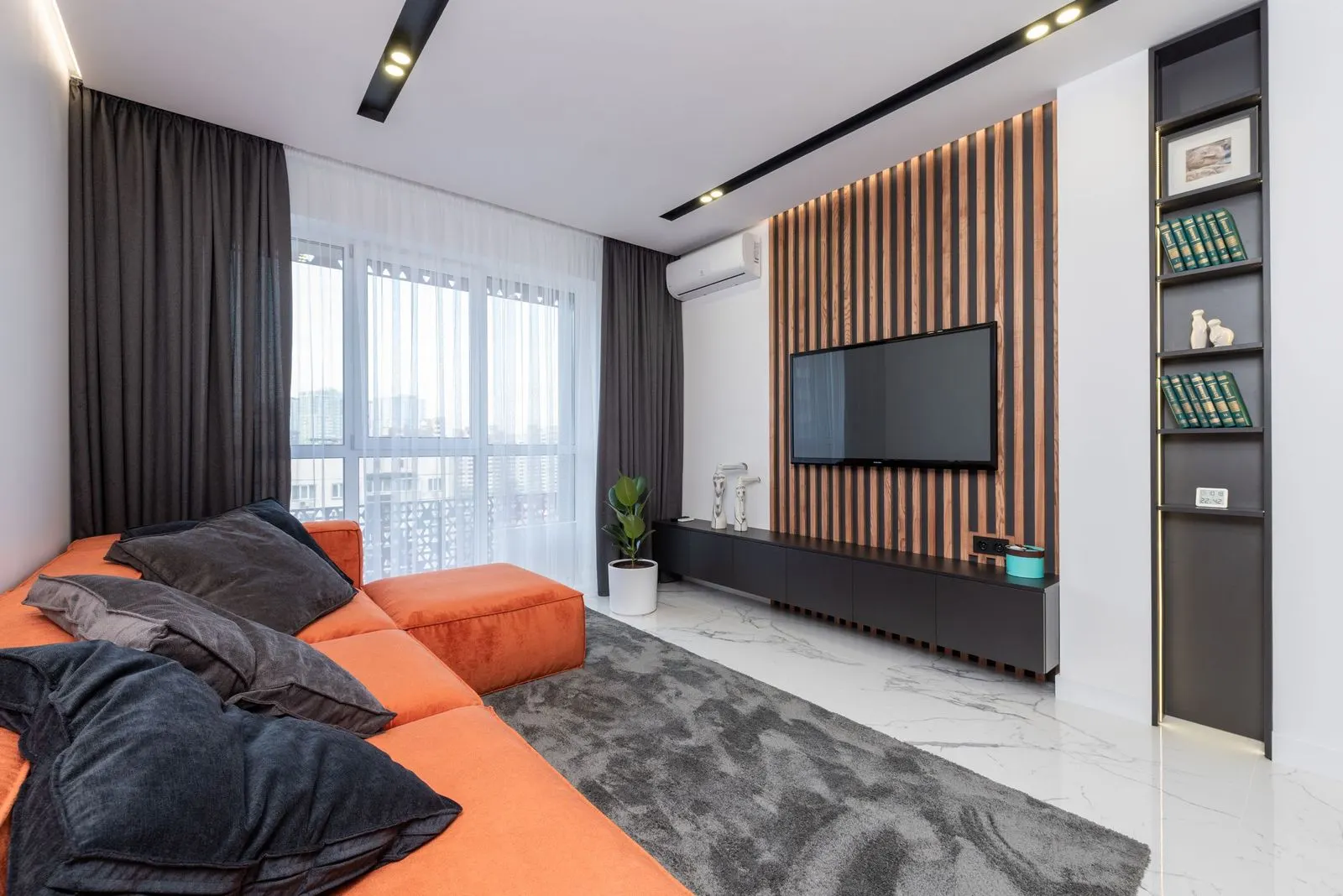
| Living room TV wall | WPC fluted panels with LED, or a mural |
| Bedroom headboard wall | Non-woven or textured wallpaper, or fluted WPC |
| Kids’ room | Washable vinyl, or half-height panels below |
| Passage, foyer | WPC panels or washable vinyl |
| Pooja niche | Washable vinyl motif or a WPC or MDF jaali panel, with stone or metal right behind the diya |
| Bathroom dry wall | PVC panels; wallpaper only in a ventilated powder room |
| Kitchen, away from hob | WPC panels or paint |
| Wall with seepage | Fix and dry it first; paint until then |
Get your walls checked
Book a free home visit and we’ll test your walls for damp, bring wallpaper catalogues and panel samples, measure, and give a written quote for wallpaper or wall panels before any work starts. We work across Hyderabad from 8 AM to 10 PM, all seven days. WhatsApp or call +91 98499 17494.
Frequently asked questions
Is wallpaper a good idea in Hyderabad's climate?
Wallpaper works well in Hyderabad as long as the wall behind it is dry. Wallpaper rarely fails because of humid monsoon air; it peels or grows mould when water comes from inside the wall, such as seepage from a bathroom, an external wall crack, a leaking AC drain pipe or fresh plaster that has not dried. On a dry, sound, primed wall, good vinyl or non-woven wallpaper holds through the June to September monsoon. Fix every leak first, then paper.
Which is better, wallpaper or wall panels?
Wallpaper and wall panels suit different walls. Wallpaper is thinner, costs less per wall and offers far more patterns, textures and murals, so it suits bedroom headboard walls, living room feature walls and pooja niches. Wall panels add depth, hide uneven walls and cables, take knocks and wipe clean, so they suit TV walls, passages, entrance foyers and kids' rooms. Many Hyderabad homes combine both: fluted panels on the TV wall and wallpaper on a bedroom wall.
How many rolls of wallpaper does a 12x12 room need?
A 12x12 ft room with 10 ft walls has roughly 440 sq ft of wall after subtracting a door and a window, which is about three times its floor area. A standard roll of about 0.53 m by 10 m covers roughly 57 sq ft, but because wallpaper goes up in full-height strips, each roll gives only about three usable strips on a 10 ft wall. That room usually needs 9 to 10 rolls in a plain design, and 13 or 14 with a large pattern repeat.
Is vinyl or non-woven wallpaper better?
Vinyl wallpaper is better where the surface needs to be wiped often, such as kids' rooms, passages, pooja spaces and powder rooms, because its PVC face is washable. Non-woven wallpaper is better for bedrooms and living rooms where you may want a change in a few years, because it is breathable and usually strips off dry in full sheets. Both need a dry wall. Vinyl keeps splashes out but also traps moisture in, so on a damp wall it is where mould starts.
Can you put wallpaper in a bathroom or kitchen?
Wallpaper can go in a powder room or guest toilet without a shower, using washable vinyl on a sealed wall with a working exhaust fan. In a full bathroom it is generally not advisable in Hyderabad, because daily steam through the monsoon weakens the adhesive, and it should never go in the shower zone or behind the basin. In kitchens, keep wallpaper away from the hob and sink; a dining-side wall away from steam is fine. PVC wall panels suit wet areas better.
Are PVC wall panels strong enough, or should I choose WPC?
PVC wall panels are strong enough for decoration in bedrooms, bathrooms, ceilings and rented flats, and they are fully water-resistant and the lowest-cost panel. Hollow PVC panels dent when chairs, bags or toys hit them, and rigid PVC is heat-sensitive, starting to distort at around 60 °C. WPC panels, a wood-plastic composite, are denser, hold screws properly and resist knocks, termites and humidity, so they suit TV walls, passages, entrance foyers and kitchens away from the hob. Fluted is a grooved design available in PVC, WPC, MDF and wood.
How long does wallpaper last compared with paint?
Interior paint is usually refreshed every five to seven years, and walls near doors, passages and kids' rooms often need it sooner. Good vinyl or non-woven wallpaper on a dry, primed wall holds its look longer, because it does not chalk and washable grades take a damp cloth, so it is usually replaced when you want a new look rather than because it has worn out. On a wall with seepage, though, wallpaper can lift within a monsoon or two, while paint can simply be redone once the leak is fixed.
Can I put wallpaper or wall panels on a new flat's walls right away?
In a new Hyderabad flat it is safer to wait. Builders often hand over walls with fresh cement plaster under a coat of basic emulsion, and that plaster can keep giving off moisture for months, especially if it was finished during the monsoon. Paper or panel interior walls that do not back onto bathrooms or the outside first, live through one monsoon before treating external walls, and get any damp patches fixed while the builder is still responsible. Finish all AC, TV and curtain drilling beforehand.
What decides the cost of wallpaper and wall panels in Hyderabad?
Wallpaper cost in Hyderabad depends on the wall area (not the floor area), the wallpaper type and roll format, the number of rolls after allowing for strips and pattern repeat, how much the wall needs scraping, filling or damp repair, and labour for cut-outs around switchboards and windows. Wall panel cost depends on the wall area, panel material and finish, batten framework for uneven walls, LED profiles and wiring, trims and cut-outs. A fixed, itemised quote is given after measuring and checking the wall.