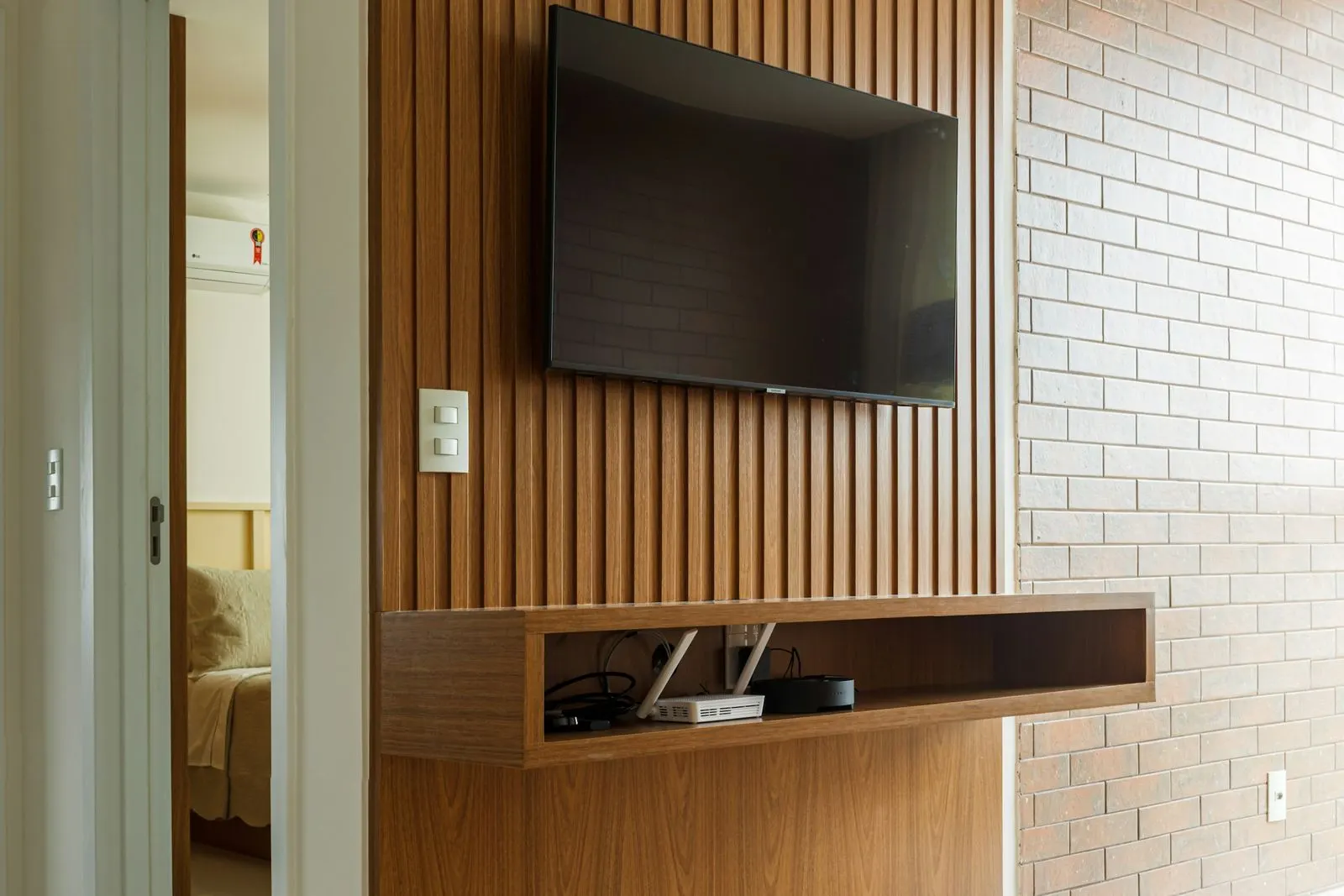
“Should I use PVC, WPC or fluted panels?” We hear it more than any other question about wall panels, and it hides a mix-up. PVC and WPC are materials. Fluted is a shape. You can have fluted PVC, fluted WPC, fluted MDF or fluted wood. When we plan wall panels in Hyderabad homes, we pick the material for the room’s conditions first, and the design after that.
This guide sticks to materials. If you’re still deciding between panels, wallpaper or plain paint for a wall, our wallpaper and wall panels guide for Hyderabad homes starts with the damp checks every wall needs, then covers both finishes end to end.
The short answer
- PVC panels: lightest, lowest cost and fully water-resistant. Best for bathrooms, utility areas, rentals and ceilings. They dent and can distort with heat.
- WPC panels: denser and stronger, hold screws well, resist termites and humidity. Best for living room feature walls, TV walls, bedrooms and kitchens (away from the hob).
- Fluted panels: a grooved design available in all these materials. Choose the material by room, then choose fluted if you like the look.
- MDF or solid wood fluted: premium finish for dry rooms, but keep them away from moisture and termites.
What are PVC wall panels?
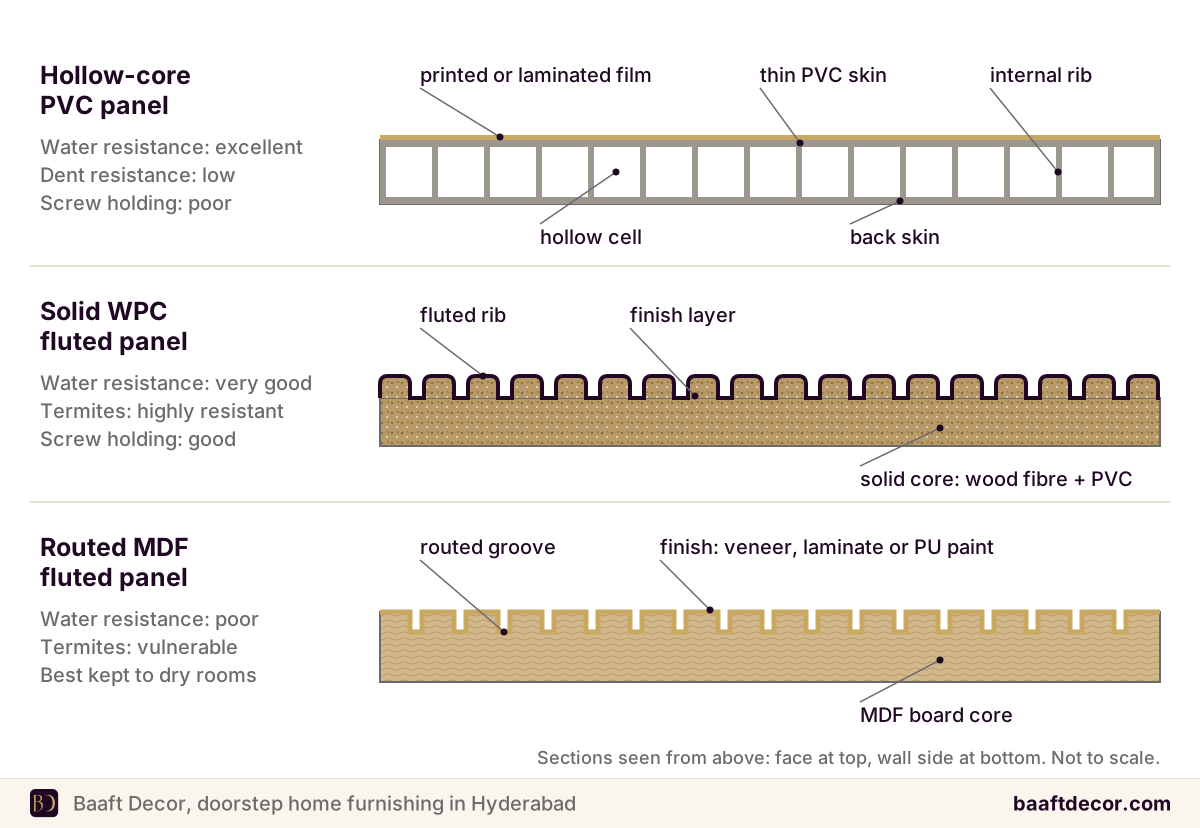
PVC panels are rigid polyvinyl chloride. Most sold in India are either hollow-core (two thin skins joined by internal ribs) or thin solid sheets, with a printed or laminated face that imitates wood, marble, stone or fabric.
Where PVC is strong: it doesn’t absorb water, termites don’t eat it, it’s light enough to fix with adhesive, and it wipes clean. It’s also the most affordable panel.
Where PVC is weak: hollow panels dent when a chair or a child’s toy hits them. PVC is heat-sensitive; standard PVC starts to distort at around 60 °C, so it doesn’t belong behind a cooktop or next to a hot lamp. White PVC can yellow after years of direct sun. And the cheap printed finishes look like plastic once you’re close.
What are WPC wall panels?
WPC stands for wood-plastic composite: wood fibre or wood flour blended with a thermoplastic. Internationally that plastic can be polyethylene, polypropylene or PVC (the composite is described here); in the interior wall panels sold in India, it’s usually PVC.
The wood content makes WPC denser and more rigid than plain PVC. It holds screws and nails properly, cuts and drills like wood, and sounds solid when you knock on it. Because the plastic encapsulates the wood fibres, WPC resists termites and humidity far better than MDF or plywood.
What you give up: it’s heavier, it costs more than PVC, and cut edges can absorb some moisture over long exposure. In wet zones, trim or seal the edges.
Fluted panels: a design, not a material
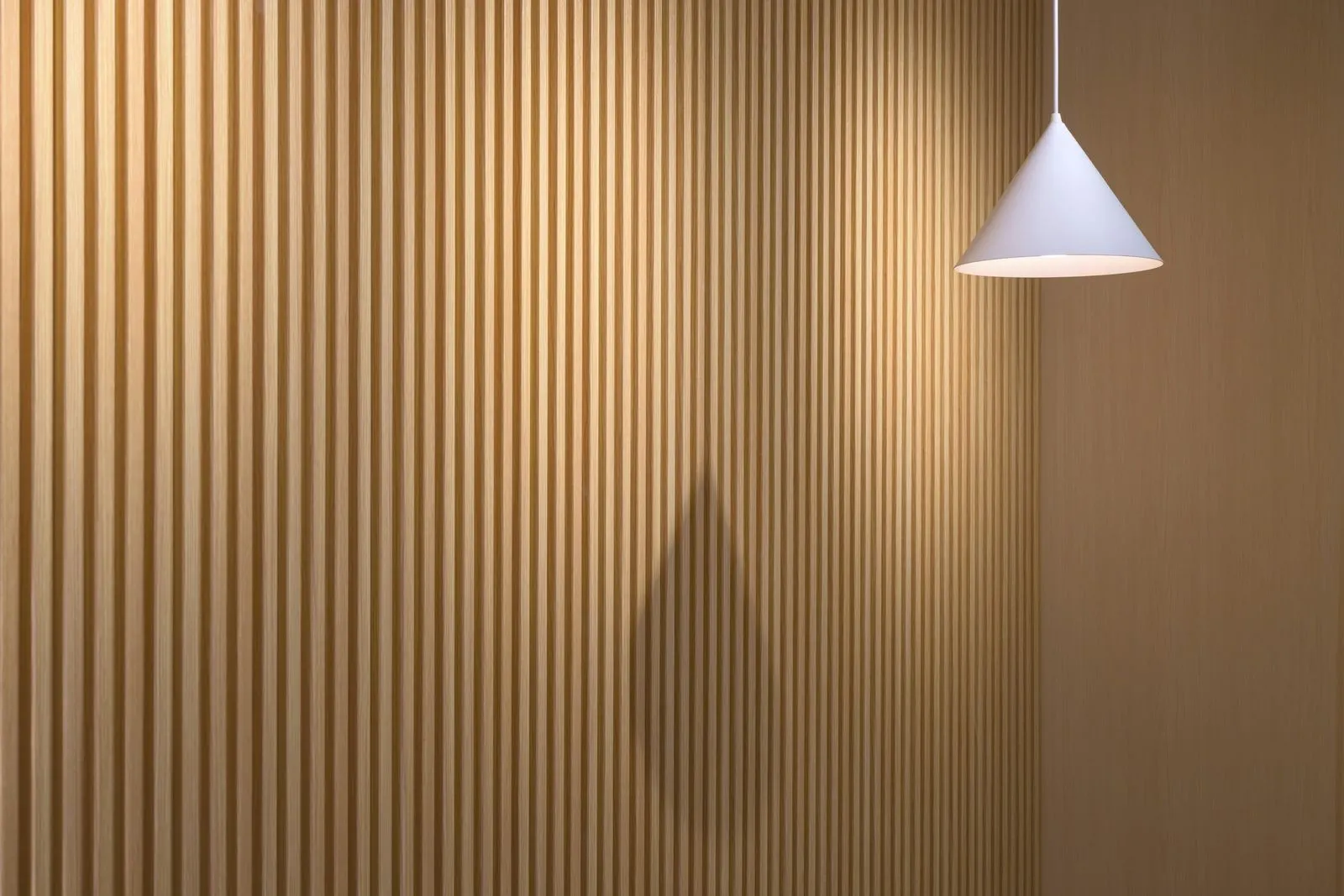
A fluted panel has vertical grooves (rounded or square ribs) that create the ribbed look you see on TV walls, headboards and kitchen islands. The same profile is sold in several materials:
- WPC fluted: the most popular choice for homes. Rigid, termite-resistant, pre-finished in wood tones, solid colours or charcoal.
- PVC fluted: cheaper and lighter, but the ribs dent more easily.
- MDF fluted: routed from MDF board and finished with veneer, laminate or PU paint. Premium look, but MDF swells with moisture and is vulnerable to termites.
- Solid wood fluted: the richest finish and the highest cost. Needs seasoned timber and protection from damp.
- Polystyrene (PS) fluted: light decorative profiles, best for trims and accents rather than full walls.
Panels sold as “charcoal louvers” are usually polymer composites, whatever the name suggests. Ask for the spec sheet; don’t go by the label.
What about acoustic wall panels?
Acoustic panels look similar to fluted panels but do a different job. The common type is a row of wood or veneer slats mounted on a felt backing, usually PET felt made from polyester fibre. The felt absorbs sound bouncing around the room, so voices and TV audio echo less.
They help most in rooms full of hard surfaces. Think of a new flat with vitrified tiles, bare walls and hardly any furniture yet, a home theatre, or a work-from-home room where video calls sound hollow. They don’t soundproof, though. Echo inside the room drops; noise from the neighbour’s flat or the road doesn’t.
PVC vs WPC vs MDF vs wood: comparison
| PVC | WPC | MDF fluted | Solid wood fluted | |
|---|---|---|---|---|
| Core | Rigid PVC, often hollow | Wood fibre + plastic | Wood-fibre board | Timber |
| Water resistance | Excellent | Very good | Poor | Fair, if sealed |
| Termites | Not affected | Highly resistant | Vulnerable | Vulnerable |
| Dent resistance | Low (hollow) | Good | Good | Good |
| Heat tolerance | Low | Moderate | Moderate | Good |
| Screw holding | Poor | Good | Fair | Good |
| Weight | Lightest | Medium | Heavy | Heavy |
| Relative cost | Lowest | Mid | Mid to high | Highest |
| Best for | Bathrooms, utility, rentals | Living, TV wall, bedrooms | Dry feature walls | Statement walls |
Are PVC wall panels strong?
Strong enough for decoration. Not for abuse. A hollow PVC panel fixed flat to a wall can look fine for years in a bedroom or bathroom. Put it on a passage wall where suitcases, cycles and toys knock against it and the dents show fast. Thicker solid or foam-core PVC sheets hold up better, but if the wall takes knocks, go with WPC.
Heat, sun and Hyderabad conditions
In Hyderabad homes, these decide the panel more than any catalogue photo:
- West-facing walls. Panels on a wall that bakes in afternoon sun, or that catches direct sun through a big window, get hot. Dark PVC is the most affected. Choose WPC, lighter colours, and leave small expansion gaps at the ends.
- Monsoon seepage. Plenty of Hyderabad flats get damp patches on exterior walls once the monsoon sets in. Panels hide seepage; they don’t cure it. Fix the leak, let the wall dry, then panel, or mould grows unseen behind them.
- Termites. Ground floors and older independent houses often have termite activity. PVC and WPC are safe, but wooden battens behind them aren’t. Use aluminium or WPC battens.
- Cooking heat. No plastic-based panel near the hob. Use tiles, glass or steel there.
Fire and wiring
PVC contains a lot of chlorine, which makes it relatively fire-retardant. When it does burn, though, it gives off hydrogen chloride fumes. WPC contains plastic too. So keep panels away from flames (diyas included), run all wiring behind them in proper conduit, and never seal an electrical distribution board behind panelling.
How are wall panels installed?
Two methods:
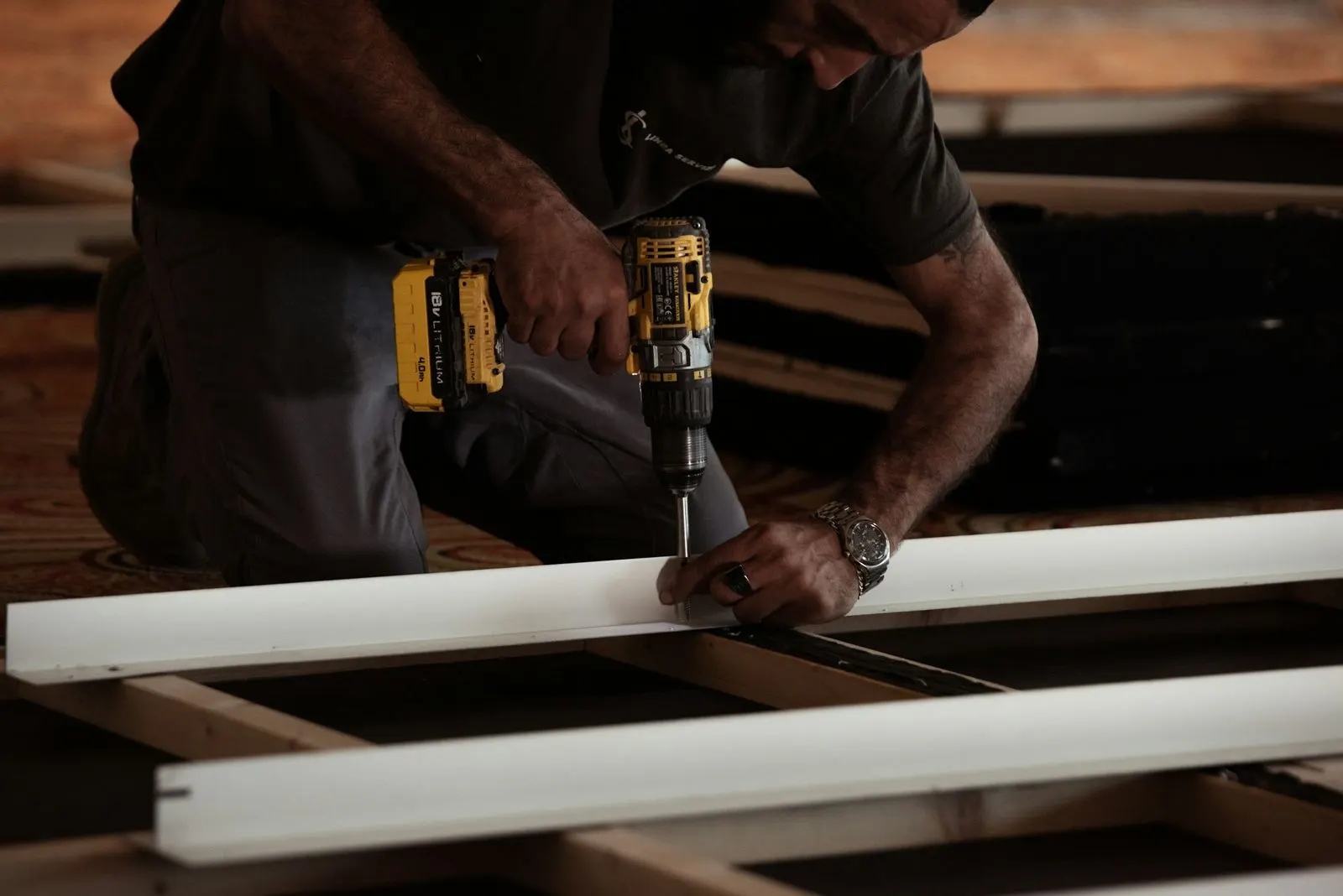
- Direct fixing. On a flat, dry, sound wall, panels are fixed with construction adhesive plus concealed clips or pins. Quick and slim.
- Batten framework. On uneven walls, or where wiring and LED strips need to run behind, aluminium or WPC battens are fixed first and panels are screwed or clipped to them. This adds a little depth but gives a straighter result.
Either way, the job finishes with trims at edges, corners, the ceiling line and the skirting. Plan switchboard and socket cut-outs, TV brackets and LED profiles before the first panel goes up. A TV must be bolted through the panels into the wall behind, never hung from the panel itself.
Which panel for which room?
- Living room TV wall: WPC fluted, with an LED profile in the groove.
- Bedroom headboard wall: WPC or MDF fluted (dry room), or upholstered panels.
- Bathroom dry wall: PVC.
- Kitchen, away from the hob: WPC.
- Passage and entrance: WPC, for knock resistance.
- Rented flat: PVC, the lowest commitment.
- Pooja room: WPC or MDF with a CNC jaali pattern.
For layouts, colours and lighting ideas, see our wall panelling design ideas. If you’re weighing MDF and HDHMR boards for a panelled wall, the same material logic applies as in our kitchen cabinet materials guide.
Wall panels or wallpaper?
Panels add depth, hide uneven walls and resist knocks; wallpaper is thinner, cheaper per wall and offers far more patterns. On walls prone to damp, both need the seepage fixed first; our guide to wallpaper in Hyderabad’s humidity explains why. Many homes combine them: panels on the TV wall, wallpaper on a bedroom wall. For a whole-home plan, our interior design service covers panels, ceilings and furniture together.
See the panels on your wall
Book a free home visit. We’ll check the wall for damp and level, bring PVC, WPC and fluted samples, and give you a written quote that lists the material, finish, trims and installation. We work across Hyderabad from 8 AM to 10 PM, all seven days. WhatsApp or call +91 98499 17494.
Frequently asked questions
Are PVC wall panels strong?
PVC wall panels are strong enough for decorative wall cladding, but they are not tough. Thin hollow-core PVC panels can dent or crack if hit by furniture, a vacuum cleaner or a child's toy, and they flex if pressed between supports. Thicker solid or foam-core PVC sheets are noticeably sturdier. PVC is also sensitive to heat and can start to distort at around 60 °C, so keep it away from cooktops and hot lamps. For high-traffic walls, WPC panels are the stronger choice.
What is the difference between PVC and WPC wall panels?
The difference between PVC and WPC wall panels is the material. PVC panels are made entirely of rigid polyvinyl chloride, often with a hollow ribbed core, which makes them light, waterproof and inexpensive. WPC panels are a wood-plastic composite: wood fibre or wood flour blended with a thermoplastic, which in Indian interior panels is usually PVC. That makes WPC denser, more rigid and better at holding screws and nails, but heavier and costlier. Both resist termites far better than wood or MDF.
Are fluted panels made of PVC or WPC?
Fluted panels can be made of PVC, WPC, MDF, solid wood or polystyrene, because fluted describes the shape, not the material. A fluted panel has rounded or square vertical grooves that create the ribbed look popular on TV walls and headboards. WPC fluted panels are the most common choice for homes because they are rigid, highly termite-resistant and come pre-finished. PVC fluted panels cost less but are lighter and dent more easily. MDF or wood fluted panels give a premium painted or veneered finish but need protection from moisture.
Are WPC wall panels waterproof?
WPC wall panels are highly water-resistant but not completely waterproof in the way solid PVC is. The plastic in WPC protects the wood fibres inside, so splashes, humidity and mopping do not swell the panel the way they swell MDF or plywood. However, the wood fibres can absorb some water over long exposure, especially at cut edges. In bathrooms and wet zones, solid PVC is the safer choice. In kitchens and living rooms, WPC panels handle normal humidity well.
Can PVC or WPC panels be used in bathrooms and kitchens?
PVC panels can be used in bathrooms because PVC does not absorb water, although they should not sit inside the shower area where water runs constantly. WPC panels suit kitchens and dry areas of bathrooms, as long as edges are sealed. In kitchens, keep any plastic-based panel away from the cooktop, since heat and flame can distort PVC and WPC. Behind the hob, tiles, glass or stainless steel are better. Fix any leaking pipes or seepage before covering a wall with panels.
Are PVC and WPC wall panels termite-proof?
PVC wall panels are effectively termite-proof because termites do not feed on PVC. WPC panels are highly termite-resistant because the wood fibres are encapsulated in plastic, which is one of their main advantages over MDF, particle board and solid wood in Indian homes. However, termites can still damage wooden battens or plywood framing behind the panels, or travel through gaps in the wall. If your home has a termite history, treat the wall before installation and use aluminium or WPC battens instead of wood.
Can you mount a TV on wall panels?
You should not hang a TV directly from PVC or WPC wall panels, because the panels are cladding, not a structural surface. The TV bracket must be bolted through the panels into the brick, block or concrete wall behind, using spacers or a backing block so tightening the bolts does not crush the panel. Plan the TV position and the cable route before the panels go up, so a conduit can be hidden behind them and the panel joints line up neatly around the bracket.
How are PVC and WPC wall panels installed?
PVC and WPC wall panels are installed either directly on the wall with construction adhesive and concealed clips or nails, or on a framework of battens (aluminium or WPC) when the wall is uneven or needs space for wiring. The wall must be dry, and any dampness fixed first. Panels are cut to size, fixed one by one with their joints interlocking, and finished with matching trims at the edges, corners, ceiling and skirting. Switchboards and sockets need neat cut-outs planned in advance.
Do PVC wall panels catch fire easily?
PVC wall panels do not catch fire as easily as many plastics because PVC contains a large amount of chlorine, which makes it relatively fire-retardant. However, if PVC does burn, it releases hydrogen chloride fumes, which are harmful to breathe. WPC panels also contain plastic, which adds fuel in a fire. For safety, keep plastic-based panels away from cooktops and open flames, run all wiring behind the panels inside proper conduit, and avoid covering electrical distribution boards with panels.