Invisible grills are now a common choice on high-rise balconies, and it’s easy to see why. They stop a child or a pet slipping through without turning the view into a cage. But “invisible” also hides a lot of variation in quality. When we fit invisible grills in Hyderabad, we spend more time on the specification than on the look, because the spec is what decides whether they work.
What follows is the honest version: what they do well, what they don’t, and what to get in writing. Grills are one layer of balcony safety; our balcony and window safety guide for Hyderabad shows how they fit with mesh, bird nets and blinds.
What are invisible grills?
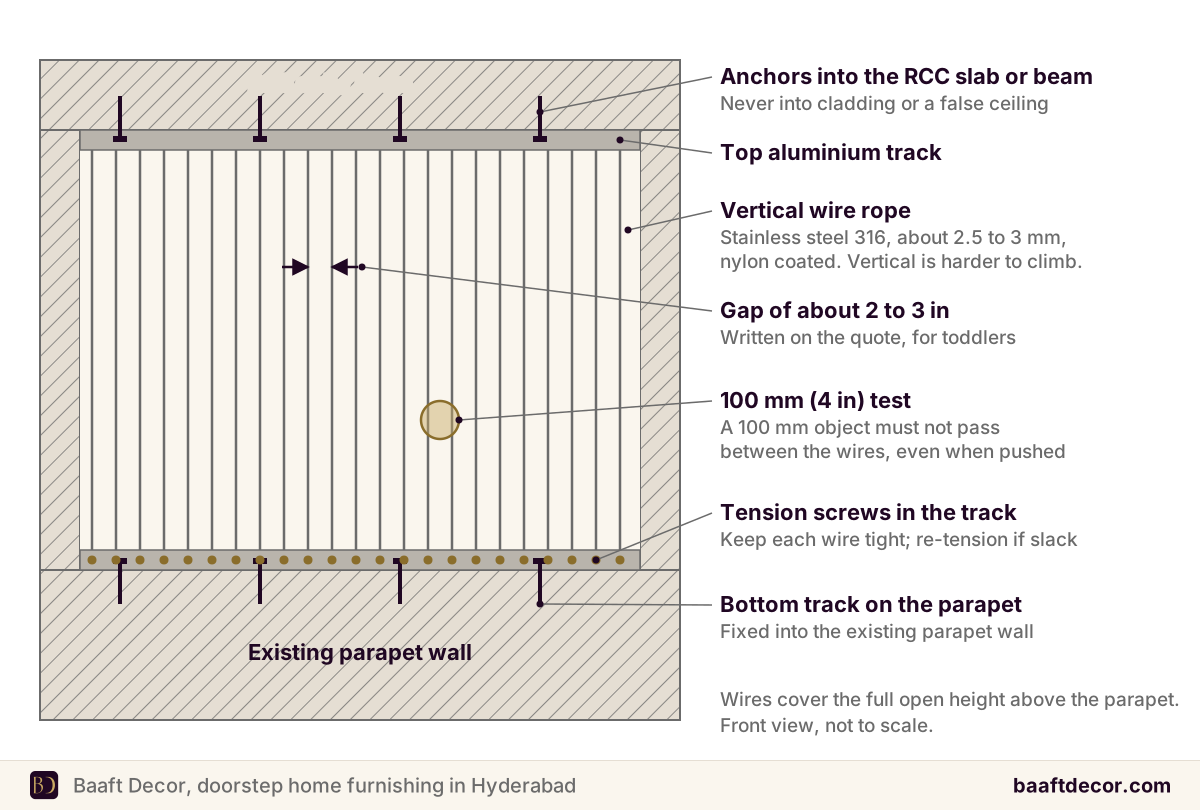
An invisible grill is a set of thin stainless steel wire ropes stretched tight across an opening. The main parts are:
- Wire rope. Multi-strand stainless steel cable, usually sold as grade 316, in diameters of roughly 2 to 3 mm, with a nylon or other polymer coating that makes it easier to wipe and gentler on hands.
- Tracks. Aluminium channels fixed to the structure at the top and bottom (or the sides) that hold the ends of each wire.
- Tensioners. Screws or bolts in the track that pull each wire tight.
- Anchors. Fasteners that tie the tracks into the RCC slab, beam or wall.
The wires sit at a set gap. Suppliers offer several, and with children at home we suggest about 2 inches; smaller is safer. From a few metres away the wires mostly disappear. Up close, or when the sun catches them, you’ll see them. “Invisible” is relative.
Are invisible grills safe? The honest answer
As a fall-prevention barrier, yes, if they’re specified and installed properly. Tight spacing, firm tension and anchors in concrete stop children and pets slipping through.
The limits are real, though:
- They are not burglar-proof. Heavy wire cutters cut them. They’re designed to stop falls, not intruders.
- Horizontal wires can be climbed. Tensioned horizontal wires can work like the rungs of a ladder for a determined child. Building inspectors raise the same concern with horizontal cable railings (InspectAPedia’s guide to cable railings discusses it), and Kerala’s building rules, for example, say that where metal grills are used as guard rails on balconies with a drop of 2 m or more, they shall not be made of continuous horizontal members (KMBR Rule 113).
- Quality varies a lot. Wire grade, coating, tracks and anchors differ widely between suppliers, and we’re not aware of a BIS standard written for invisible grills, so there’s no mark to rely on. The written specification is your protection.
- Wires can lose tension. A slack wire lets the gap widen when someone pushes on it.
Strength figures you’ll see in advertisements, such as breaking loads per wire, are manufacturer claims. Ask for the test report behind any number you’re quoted, and treat a number without one as marketing.
What makes an installation safe?
| Item | What to ask for | Why it matters |
|---|---|---|
| Wire grade | Stainless steel 316, stated on the quote | Better corrosion resistance outdoors |
| Wire diameter | Written on the quote | Thin wire stretches and deflects more |
| Maximum gap | Written, about 2 inches with toddlers | A child’s head must not pass through |
| Tension | Wires shouldn’t spread when pressed by hand | Slack wires widen the gap |
| Orientation | Discuss vertical wires for balconies with small children | Horizontal wires can be climbed |
| Anchoring | Into RCC slab or beam, not cladding | Tracks must hold under load |
| Coverage | Full open height above the parapet | Gaps at the top defeat the purpose |
| Emergency access | Ask whether a section can open | Escape and rescue access |
A useful reference point: building codes in the US and UK require that a 100 mm (about 4-inch) sphere can’t pass through any opening in a guard. After installation, try pushing a 100 mm object between the wires with firm hand pressure. If it goes through, the gap or the tension is wrong.
Horizontal or vertical wires?
Horizontal wires are common on windows, and they’re what most people picture. On a balcony used by toddlers, vertical wires are harder to climb because there are no footholds. They can need different tracks, so settle it before the quote.
Whichever way the wires run, climbing usually starts from furniture. Keep chairs, planters, storage boxes and the AC outdoor unit away from the parapet. A perfectly built grill doesn’t help if a child can stand on a stool and lean over the top.
Pigeons, approvals and afternoon glare in Hyderabad towers
Three things come up on almost every Hyderabad tower balcony. Pigeons, first: sheltered ledges and the space behind AC units make high-rises easy nesting ground, and city dealers told Siasat in July 2026 that most of their bird-net work is now in high-rise residential complexes. A grill won’t fix that; a net from a netting specialist will (we don’t fit nets). See our guide to pigeon-proofing a balcony. Second, approval. Most associations want cable colour, spacing and fixing details before they agree, so get their sign-off before anything is ordered. Third, glare. Coated cables have a slight sheen, and on a west-facing balcony the low afternoon sun can turn them into bright lines across the view. Look at a sample cable in direct sun before you settle on a finish.
Invisible grills for windows
Invisible grills also work on windows, particularly in high-rise flats where children can climb onto a low sill or a bed placed next to the window. On sliding uPVC or aluminium windows, the tracks are usually fixed on the outer side of the frame opening or inside the recess, so the shutters still slide and the mesh track stays usable. On casement windows that open outward, the grill must sit on the room side so the shutters can still swing.
Two cautions. On low floors, a wire grill is not a security barrier. And if a window is a bedroom’s only possible escape route, ask for an openable section. Our guide to high-rise apartment window solutions covers sills, wind and heat on upper floors.
Fire safety and emergency exit
People rarely ask about this, and they should. Any fixed grill slows escape or rescue in a fire. Invisible grills can be cut with the right tools, one reason families prefer them to welded MS grills, but cutting takes time. Ask for an openable section on any window or balcony that could be an escape route, and check your building’s fire rules before covering every opening.
What invisible grills won’t do
- Stop pigeons reliably. Birds get through or perch on the cables. A bird net is the usual fix.
- Stop mosquitoes. Pair grills with mosquito mesh on the balcony door; our guide to the types of mosquito mesh explains the options.
- Block sun or rain. For that, add balcony blinds; see our guide to the best blinds for balconies.
- Replace supervision. No barrier does.
Invisible grills vs traditional MS grills
| Invisible grills | MS or SS box grills | |
|---|---|---|
| View | Nearly unobstructed | Blocked by bars |
| Facade | Barely visible | Changes the building’s look |
| Fall prevention | Good when specified properly | Good |
| Security against intruders | Low | Higher |
| Climbability | Horizontal wires can be climbed | Depends on design |
| Rust | Stainless, low | MS rusts once paint chips |
| Emergency access | Can be cut; openable sections possible | Hard to cut; needs a door |
In high-rise flats, where falls are the main risk and facade rules are strict, invisible grills usually make sense. On ground floors and in villas, conventional grills still win on security. Our guide to gated community interior rules covers what associations typically allow.

What affects the cost of invisible grills?
Invisible grills are usually priced by area. These move the rate:
- Area. Width × height of every opening covered, in square feet.
- Spacing. Tighter spacing means more wire and more tensioning work per square foot.
- Wire grade and diameter. Grade 316 and thicker wire cost more.
- Track type and finish. Heavier aluminium sections and colour-matched finishes cost more.
- Access. On high floors, installers may need to work from the outside with safety harnesses, which takes longer.
- Shape. Curved, L-shaped or very tall balconies need more tracks and cuts.
- Openable sections and removal of old grills add to the job.
A fair quote lists the area, the gap, the wire grade and diameter, the track type and the installation, separately.
Maintenance
Wipe the wires with a damp cloth when they get dusty. Every few months, press each one to check it hasn’t gone slack, and get them re-tensioned if they spread easily. Don’t hang clothes or pots from them, or let children swing on them; constant load loosens tension.
Get your balcony assessed
Book a free home visit. We’ll measure every opening, check what the tracks can be anchored into, talk through spacing and wire direction for your family, and give you a written specification and quote. We work across Hyderabad from 8 AM to 10 PM, all seven days. WhatsApp or call +91 98499 17494.
Frequently asked questions
Are invisible grills safe?
Invisible grills are safe as a fall-prevention barrier when they are made from good-quality stainless steel wire, spaced tightly, tensioned properly and anchored into concrete. They keep children and pets from slipping through a balcony or window opening while preserving the view. They are not designed to stop intruders, since wire cutters can cut them, and horizontal wires can be climbed by a determined child. Safety depends on the installation, so ask for the wire grade, diameter, maximum gap and anchoring method in writing.
Are invisible grills safe for small children?
Invisible grills can be safe for small children if the gap between wires is tight enough (about 2 inches) that a child's head cannot pass through, the wires are tensioned so they do not spread apart when pushed, and the grills cover the full open height above the parapet. Because horizontal wires can be used like a ladder, ask about vertical wires for balconies used by toddlers, and keep chairs, planters and furniture away from the edge. No barrier replaces adult supervision near a balcony.
What is the right gap between invisible grill wires?
Installers offer different gaps between invisible grill wires, and anything close to 4 inches (100 mm) is too wide for a home with young children. Where toddlers or small pets live, ask for a clear gap of about 2 inches (50 mm), tensioned so it doesn't widen when pushed. Building codes in the US and UK use a simple test for guards: a 100 mm sphere must not pass through any opening. Get the maximum gap written on your quote, then check it yourself after installation.
Can invisible grills be cut by thieves?
Yes, invisible grills can be cut with heavy wire cutters, so they are not a security barrier against intruders. They are designed to prevent falls, not break-ins. Ordinary household scissors will not cut them, but a determined burglar with the right tool can. For ground-floor windows, villas and easily reached balconies where security is the main concern, conventional metal grills or security doors are the better choice. In high-rise flats, where falls are the bigger risk, invisible grills are a reasonable option.
Which steel grade is best for invisible grills, 304 or 316?
Grade 316 stainless steel is generally preferred for invisible grills because it contains molybdenum, which gives it better corrosion resistance than grade 304. That matters on exposed balconies that face monsoon rain, humidity and pollution year after year. Grade 304 is still stainless and is used in many products, but it is more prone to surface staining outdoors. Because grades are easy to mislabel, ask the installer to state the grade on the quote and, where possible, show a material certificate for the wire.
Do invisible grills rust or lose tension over time?
Good-quality stainless steel invisible grills resist rust, but cheaper wire or poor-quality fixings can stain, and coatings can wear with years of sun exposure. Wires can also lose some tension over time, especially if people lean on them, hang clothes or pots from them, or children swing on them. A slack wire lets the gap widen when pushed. Check the tension every few months by pressing the wires, and ask your installer to re-tension them if they spread apart easily.
Are invisible grills allowed in gated communities in Hyderabad?
Many gated communities in Hyderabad allow invisible grills because they are far less visible from outside than traditional metal grills and do not change the facade much. Some associations still require approval, set rules on track colour or placement, or restrict anything fixed to the exterior face of the building. Rules vary from one community to another, so check your association's bylaws or ask the facility manager before installation. Fixing the tracks inside the balcony opening usually meets most facade rules.
Do invisible grills stop pigeons and mosquitoes?
No. Invisible grills don't reliably keep pigeons out, and they do nothing against mosquitoes. The cable gap that keeps a child safe is still wide enough for many birds to get through or perch on, and far too wide for insects. For pigeons, the usual fix is a bird net fitted edge to edge by a netting specialist; Baaft Decor doesn't install nets. For mosquitoes, fit mosquito mesh on the balcony door and windows. Many balconies end up with grills and one or both of the others.
What affects the cost of invisible grills?
The cost of invisible grills depends mainly on the area covered in square feet, the gap between wires (tighter spacing needs more wire), the wire grade and diameter, the type of aluminium track, and how hard the installation is. High floors where installers must work from the outside with safety harnesses, openable sections, curved or odd-shaped balconies, and removal of old grills all add cost. A fixed price is only possible after measuring, so ask for a written quote showing area, spacing and materials.