The mosquitoes that spread dengue bite during the day, and the WHO lists window screens among the basic ways to avoid bites. Most Hyderabad homes keep windows open for cross-breeze much of the year, so mesh is one of the most useful things you can fit. When we install mosquito mesh in Hyderabad homes, the first question isn’t which mesh. It’s how each window opens, because that decides the frame.
Mesh handles insects and nothing else. If you’re also dealing with falls, pigeons or monsoon rain on the balcony, start with our balcony and window safety guide for Hyderabad, which shows which product solves which problem.
Mosquito mesh types at a glance
| Type | How it works | Best for | Main drawback |
|---|---|---|---|
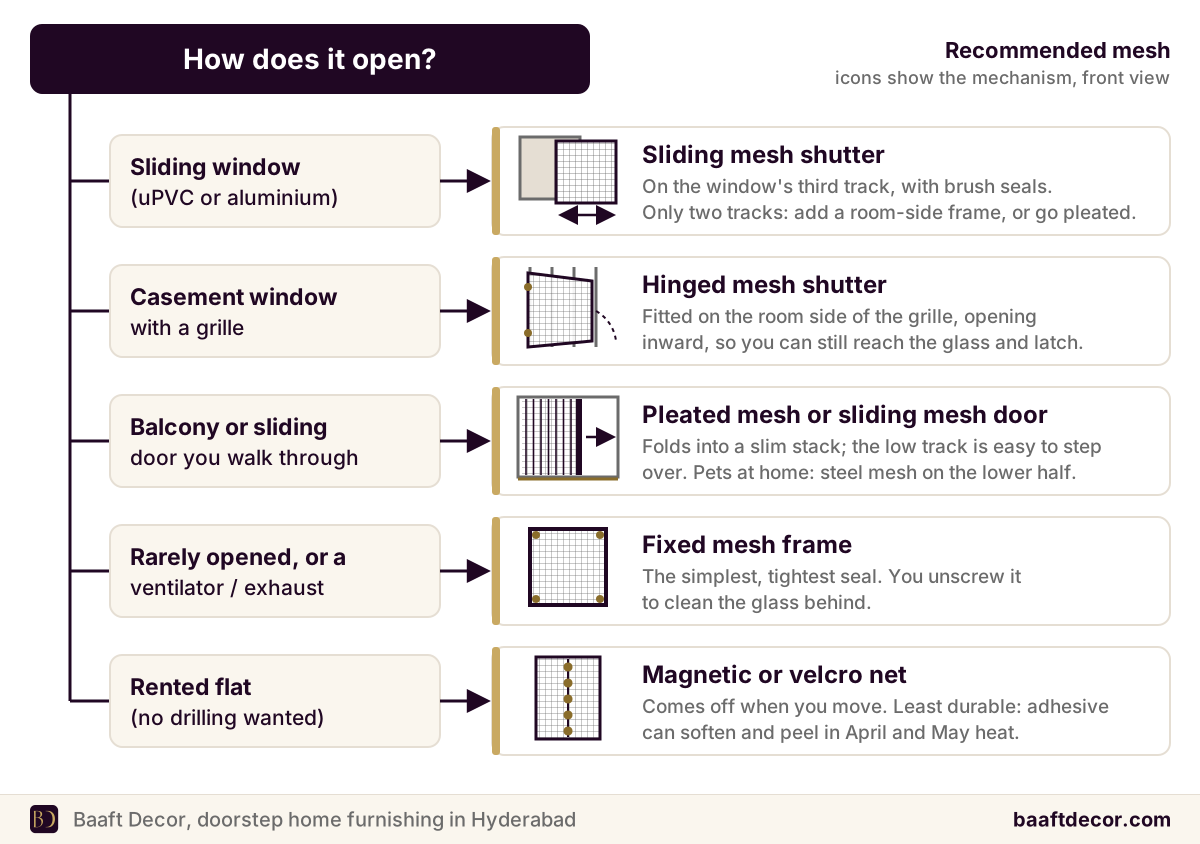
| Sliding | Mesh shutter on its own track | uPVC and aluminium sliding windows | Track collects dust |
| Pleated (plisse) | Accordion mesh folds to one side | Balcony doors, wide openings | Pleats need regular cleaning |
| Roller (retractable) | Mesh rolls into a cassette | Windows used occasionally | Springs wear with heavy use |
| Hinged (openable) | Mesh in its own frame on hinges | Casement windows with grilles, doors | Needs swing space |
| Fixed | Mesh frame screwed in place | Windows rarely opened, ventilators | Can’t reach the glass easily |
| Magnetic | Mesh held by magnets, opens and closes | Doors in rented flats | Less durable |
| Velcro | Mesh stuck with hook-and-loop tape | Temporary, very low budget | Adhesive loosens in heat |
Sliding mosquito mesh
Most new flats in Hyderabad come with uPVC or aluminium sliding windows. For these, a sliding mesh shutter is the standard answer: a framed mesh panel on its own track beside the glass. Many uPVC windows are made with a third track for exactly this.
The seal makes or breaks it. Brush seals (wool pile) on the meeting edges and the frame stop gaps where the mesh overlaps the glass shutter. A gap of a couple of millimetres is enough for a mosquito.
Only two tracks? We can add a separate sliding frame on the room side, or use pleated mesh instead.
Pleated mosquito mesh
Pleated (also called plisse) mesh is a polyester mesh folded like an accordion inside an aluminium frame. It slides sideways and folds into a slim stack at one end, clearing almost the whole opening. For balcony doors, French windows and wide openings you walk through all day, it’s usually our first suggestion.
The low bottom track is easy to step over. The pleats trap dust, though, and the mesh is softer than a flat fibreglass panel, so children and pets can damage it.
Roller (retractable) mosquito mesh
A roller mesh winds into a slim cassette at the top or side of the window, like a roller blind. Pull it across when you need it; let it go and it disappears. Good for windows you only screen some of the time, or where you want a clean look when the mesh is open. On a window used many times a day, though, the springs and guides wear out faster than a sliding or hinged frame.
Hinged (openable) mesh shutters
Many older independent houses in Hyderabad have casement windows with MS grilles and outward-opening shutters. A hinged mesh shutter, fitted on the room side of the grille, opens inward so you can still reach the glass and latch. The same idea, in a sturdier frame with a door closer, makes a good mesh door for kitchens and utility areas.
Fixed mesh frames
A fixed frame is the simplest option and seals tightest. Use it for windows you rarely open, bathroom ventilators, kitchen exhaust openings and the fixed top lights above doors. The catch: you can’t clean the glass behind it without unscrewing the frame.
Magnetic and velcro mosquito nets
Magnetic nets for doors are a split mesh curtain whose two halves snap together with magnets after you walk through. Magnetic window nets use a flexible frame that pops off when you want. Velcro nets are cut to size and stuck to the frame with hook-and-loop tape.
Both suit renters and need no drilling. Both are also the least durable. In April and May, adhesive strips on sun-facing frames can soften and peel. Treat them as a stopgap.
Which mesh material should you choose?
| Material | Strength | Rust | View | Best use |
|---|---|---|---|---|
| Fibreglass (PVC-coated) | Moderate | Never rusts | Clear | Most windows |
| Polyester | Soft, flexible | Never rusts | Clear | Pleated and roller mesh |
| Stainless steel (SS 304) | High, pet and rodent resistant | Resists rust | Slightly darker | Balcony doors, pets, ground floors |
| Aluminium | Moderate, holds a flat plane | Can oxidise and dull over time | Clear | Fixed frames |
Mesh count matters too. The standard insect screen is about 18 × 16 strands per inch, which stops mosquitoes. A finer 20 × 20 weave also stops midges and sand flies, with slightly less airflow than standard 18 × 16 mesh. For most Hyderabad homes, standard fibreglass is enough. If you have cats or dogs, use stainless steel at least on the lower half of doors where claws hit.
Which mesh for each part of the house?
In a typical Hyderabad flat or house, this is what we usually fit:
- Bedroom sliding windows: sliding fibreglass mesh on the third track, with brush seals.
- Living room sliding balcony door: a sliding mesh door or pleated mesh, so you can walk through without lifting anything. Use stainless steel on the lower half if you have pets.
- Kitchen window: a removable sliding or fixed frame, since grease means it will need washing more often than any other mesh.
- Kitchen or utility door: a hinged mesh door with a closer, so it shuts itself after every trip to the washing machine.
- Bathroom ventilator and exhaust opening: a fixed frame.
- Older casement windows with grilles: hinged mesh shutters on the room side.
- Rented flat: a magnetic net on the main balcony door and velcro or magnetic frames on windows, which come off when you move.
Mixing types is normal. One home often needs three or four different frames, and fitting them all in one visit costs less than doing it piecemeal.
Fit matters more than the mesh
A well-sealed fibreglass screen beats an expensive mesh with a gap at the corner. Whoever fits it, check for:
- Brush seals where sliding frames meet glass shutters
- Square corners with the mesh tight in its rubber beading, no sag
- Sealed gaps between the frame and an uneven wall or grille
- Overlap on sliding mesh so there’s no gap when it’s half-closed
Older grilles are rarely perfectly square, so we measure each opening rather than assuming sizes.
Hyderabad-specific things to plan for
- Construction dust. Near active sites, mesh can clog within weeks and the breeze drops noticeably. Pick frames you can remove or reach for cleaning.
- Kitchen grease. Kitchen mesh traps oily dust. Removable frames make washing practical.
- Monsoon damp. Sliding and pleated tracks turn dusty grime into sludge in the rains. A pre-monsoon clean keeps them moving.
- Pigeons in ducts. Fixed mesh on bathroom and kitchen ventilators keeps birds out of the ducts where they like to nest. Mesh won’t keep them off the balcony itself; our guide to pigeon-proofing a balcony covers nets.
- Facade rules. Some gated communities prefer mesh frames in colours that match the window. Our guide to gated community interior rules covers this.
If you’re moving into a new flat, add mesh to your new home furnishing checklist so it’s fitted before the first monsoon.
Cleaning and upkeep
Vacuum mesh with a soft brush attachment every few weeks. Once a season, wash it with mild soapy water and a soft brush, then rinse. Never use a pressure washer on fibreglass; it stretches the weave. Clean sliding and pleated tracks at the same time. Our monsoon home care guide has a pre-monsoon checklist for mesh, blinds and fabrics.
Mesh is not a safety barrier
Fibreglass and polyester tear under a child’s weight, and even steel mesh in a light frame isn’t designed to stop a fall. On balconies and high-rise windows, fit a proper barrier first. Our guide to invisible grills explains how they work, and our invisible grills service can be combined with mesh in one visit.
Get every window measured in one visit
Book a free home visit. We’ll check how each window and door opens, measure every opening, show you mesh samples and give you a written quote. We work across Hyderabad from 8 AM to 10 PM, all seven days. WhatsApp or call +91 98499 17494.
Frequently asked questions
Which type of mosquito mesh is best for windows?
The best type of mosquito mesh for a window depends on how the window opens. Sliding uPVC and aluminium windows are best fitted with a sliding mesh shutter on its own track. Casement windows with grilles suit a hinged mesh shutter or a fixed mesh frame inside the grille. Large openings and balcony doors suit pleated mesh that folds to one side. Windows that are rarely opened can take a fixed frame. Magnetic and velcro nets are temporary options best suited to rented homes.
What is the best mosquito net for sliding windows?
The best mosquito net for sliding windows is a sliding mesh shutter: an aluminium or uPVC frame fitted with fibreglass mesh that runs on its own track beside the glass shutters. Many uPVC sliding windows are made with a third track specifically for this. If your window has only two tracks, a separate sliding mesh frame can be fixed on the inside, or a pleated mesh can be used. Brush seals on the meeting edges are essential, because even a small gap lets mosquitoes through.
Is a magnetic mosquito net good for doors?
A magnetic mosquito net is good for doors you walk through often, such as balcony or kitchen doors, because the two mesh halves part as you walk through and snap back together with magnets behind you. It needs no drilling when fixed with adhesive strips, which suits rented homes. The limitations are durability and fit: adhesive strips can loosen in summer heat, and the net can sag over time. For a long-term solution, a pleated or hinged mesh door with a proper frame lasts longer.
Which is better, fibreglass or stainless steel mosquito mesh?
Fibreglass mosquito mesh is better for most windows because it is affordable, does not rust, gives a clear view, and flexes back if pushed. Stainless steel mesh is better where strength matters: homes with cats or dogs that claw at screens, ground-floor windows where rodents may chew through, and balcony doors that get knocked often. Steel mesh is stiffer, costs more and looks slightly darker. Many homes use fibreglass on most windows and stainless steel only on the balcony door or pet-accessible windows.
Does mosquito mesh reduce airflow and light?
Yes, mosquito mesh reduces airflow and light slightly, because the woven strands block part of the opening. A standard 18 by 16 mesh (strands per inch) keeps out mosquitoes with only a modest loss of breeze and a slightly dimmer view. Finer 20 by 20 mesh stops smaller insects such as midges and sand flies but cuts airflow a little more. Dust makes a bigger difference than the weave: mesh clogged with construction dust blocks far more breeze, so regular cleaning keeps airflow up.
How do you clean mosquito mesh?
To clean mosquito mesh, vacuum it gently with a soft brush attachment every few weeks to remove dust, then wash it with mild soapy water and a soft brush once a season, rinsing with plain water. For sliding and pleated mesh, also clean the tracks, because dust and monsoon damp turn into grime that makes the mesh stiff to move. Avoid pressure washers and stiff brushes, which stretch or tear fibreglass. Kitchen mesh may need more frequent cleaning because cooking grease traps dust quickly.
Can mosquito mesh be fitted on windows that have grills?
Yes, mosquito mesh can be fitted on windows with grills, which are common in older independent houses in Hyderabad. The usual options are a fixed mesh frame fitted inside the grille opening, a hinged mesh shutter that opens inward so you can still reach the glass, or a sliding mesh frame on the room side. The installer needs to measure each grille opening carefully, since older grilles are often not perfectly square, and seal any gaps between the frame and the wall or grille.
Is mosquito mesh a substitute for window grills or child safety barriers?
No, mosquito mesh is not a substitute for window grills or child safety barriers. Fibreglass and polyester mesh tear easily under a child's weight, and even stainless steel mesh in a light frame is designed to keep out insects, not to stop a fall. For balconies and windows in high-rise flats where children play, use a proper safety barrier such as invisible grills, a railing of suitable height, or fixed grills, and fit mosquito mesh on top of or behind it.